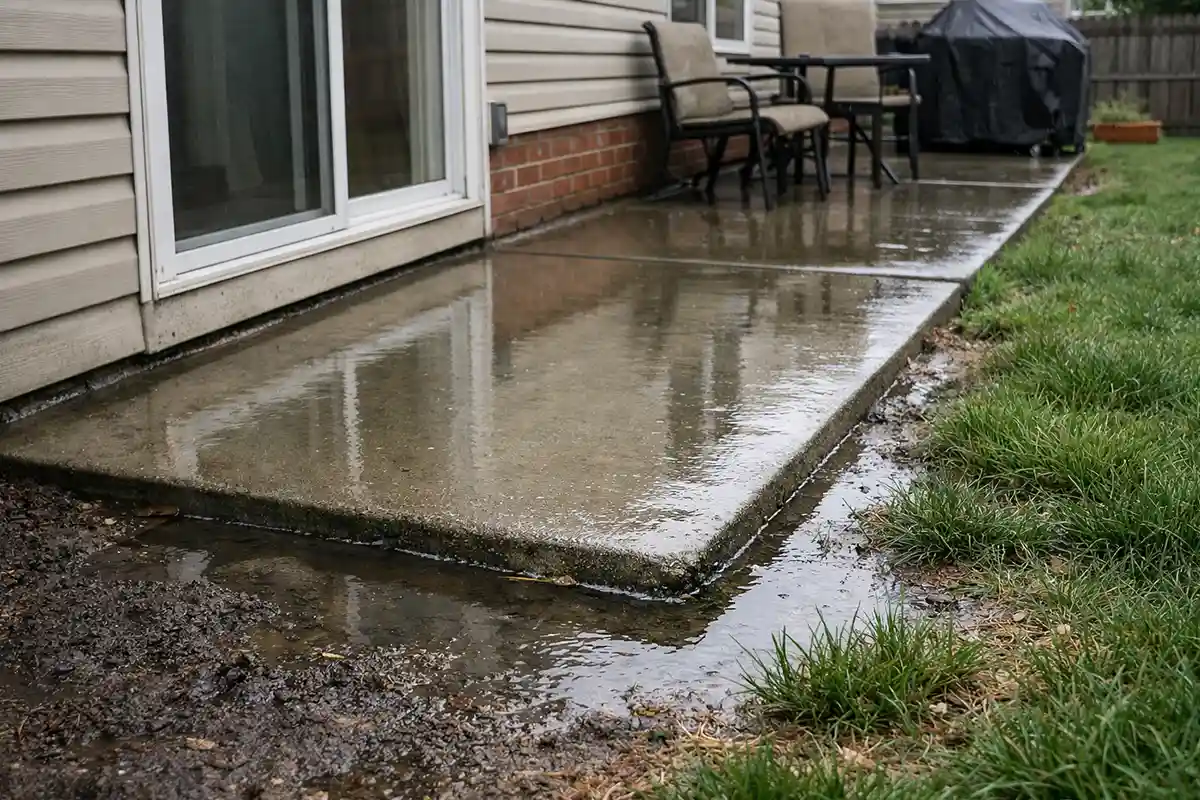
You walk outside after a storm and the patio looks totally fine. Then you spot it: a shallow strip of water sitting just beyond the concrete, right where the grass meets the slab. It’s not on the patio, so it feels easy to shrug off.
That’s the trap. The ground just outside the slab is the patio’s “support zone,” and water hanging out there changes how that support behaves. You usually feel the effects later—when a chair starts wobbling in one corner or water begins drifting toward the same edge every time it rains.
Standing water in that perimeter strip also tends to repeat in the exact same spot. That repetition matters more than the depth. It’s the steady routine of wetting and drying that slowly rewrites what the soil can handle.
Soil Saturation at the Slab Edge
The first thing most people notice isn’t a crack. It’s the ground itself. You step off the patio and the soil beside the slab feels spongier than the rest of the yard, like it’s always the last place to dry. That’s a sign the edge zone is holding onto water longer than it should.
Wet soil can’t carry weight the same way dry soil can. Even if the patio looks perfect, saturated soil makes the slab edge more likely to shift in tiny, uneven ways. Those small changes show up as everyday annoyances like:
-
A corner that feels slightly lower underfoot.
-
Water that “chooses” one edge instead of draining away.
-
Furniture that rocks only near the perimeter.
-
A hairline crack that starts at the outside and slowly creeps inward.
Clay-heavy soil makes this feel more dramatic because clay expands when it’s wet and shrinks when it dries. You might notice the soil pulling away from the patio in a dry week, then pressing tight against it again after rain. That push-pull cycle keeps stressing the edge zone.
A common mistaken belief is that “concrete is strong, so it’ll be fine.” Concrete is strong, but it still needs steady support underneath. When the support turns soft and inconsistent, the slab starts behaving differently—even before anything “breaks.”
This same perimeter weakening shows up in other hardscape areas too. Poor drainage around outdoor walkways contributes to long-term structural instability in similar ways. The surface may look normal for a long time while the base slowly loses its reliability.
Lateral Moisture Migration Toward the Foundation
Sometimes the puddle isn’t the real problem—it’s where that water goes next. You see pooling just beyond the patio, then a day later the puddle is gone, but the soil near the house still feels damp. That’s because water doesn’t just disappear; it often moves sideways through the ground.
If the yard has even a slight slope toward the house, moisture can migrate toward the foundation zone. You don’t need water pressed directly against the wall for this to matter. Saturated soil nearby can create ongoing stress because it tends to:
-
Keep the soil around footings wetter than normal.
-
Increase pressure against below-grade walls over time.
-
Encourage moisture to move under the patio edge.
-
Slow drying in the exact area that should stay firm.
People often connect foundation moisture only to obvious issues like basement leaks. But long before any interior sign appears, the soil outside can be cycling through “too wet” conditions again and again. That repeated saturation changes how the ground responds to loads—not only under the patio, but near the home.
Runoff sources make this worse when they feed the same area repeatedly. Roof drainage, splash patterns, and compacted yard paths can all funnel water toward the patio perimeter without you noticing until puddles become a habit.
Freeze-Thaw Expansion and Edge Stress
If you live where winters freeze, the edge zone becomes even more sensitive. You might notice it in a weird way: one season the patio seems fine, then in late winter a corner suddenly looks a touch higher, or a crack that was barely visible becomes easier to spot.
Freeze-thaw stress starts when wet soil freezes. Water expands as it turns to ice, and that expansion pushes upward. Along a patio edge, that pressure can create small lifts and shifts that show up as:
-
Slight corner rise after a cold snap.
-
Tiny gaps forming under the slab edge.
-
Cracks that widen a little each winter.
-
A new “low spot” where water collects when things thaw.
The frustrating part is that it can look like the patio “fixed itself” in spring. It didn’t. The ground may settle back unevenly, leaving small voids or changing the slab’s angle just enough to alter drainage next time it rains.
A common misconception is that winter damage only happens when water sits on top of the concrete. The bigger stress often begins underneath—where saturated soil is doing the lifting.
Subsurface Erosion and Void Formation
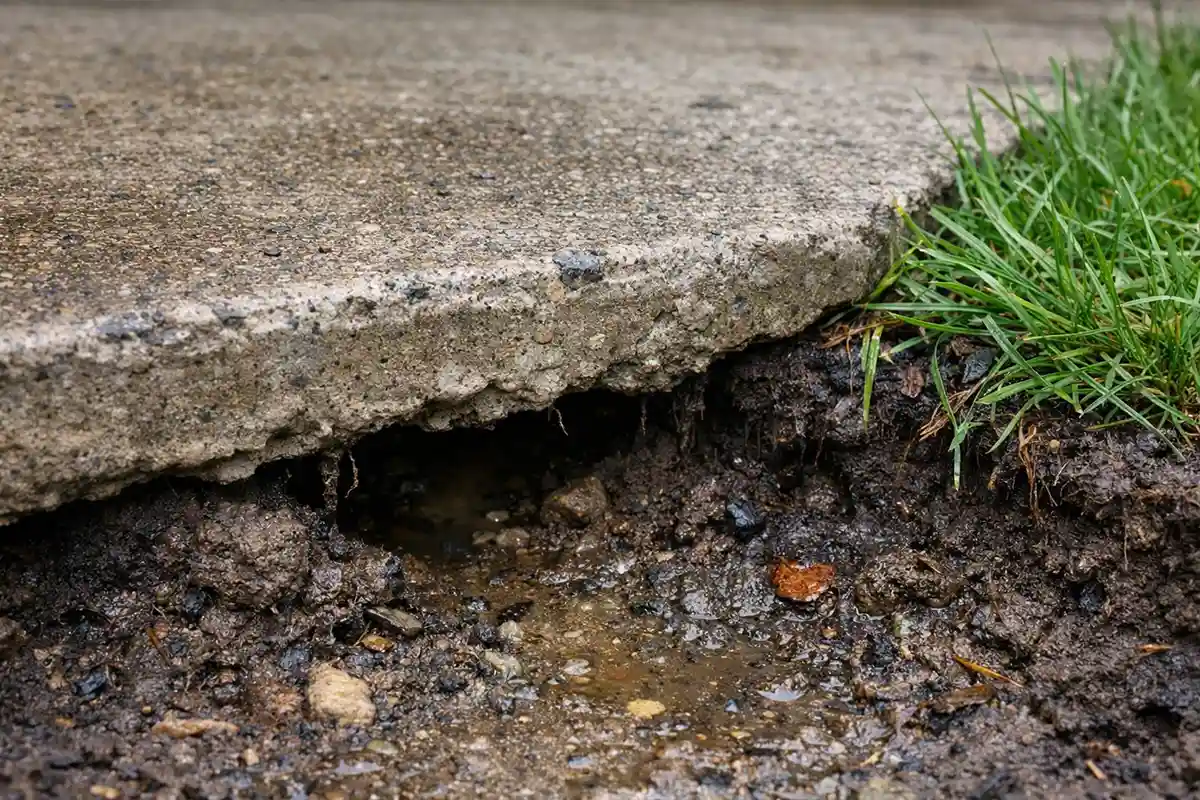
Sometimes you don’t see settling—you hear it. You tap the patio near the edge and one section sounds a little hollow, like it’s not fully supported. Or you notice ants and loose soil showing up right where water tends to pool. Those can be early hints that soil is moving out from under the slab.
Repeated water infiltration can carry fine particles downward or sideways. That slow soil migration creates pockets—small voids that stay hidden until the slab has to “bridge” them. When that happens, the concrete is forced to handle stress it wasn’t meant to handle, especially near edges and corners.
This risk goes up when runoff moves with energy—water rushing across the yard and slowing down right at the patio line. Preventing uncontrolled water runoff outdoors significantly reduces the risk of hidden subsurface washout near patios. Even when the surface looks calm, what’s happening below can be quietly changing.
People often assume erosion has to be visible to matter. In reality, the most damaging washout is the kind that stays out of sight until the patio starts reacting to missing support.
Load Redistribution and Long-Term Settlement
Months later, the “standing water beyond the patio” problem can start to feel like a “my patio is changing shape” problem. You might notice rainwater now drifts toward a corner that used to stay dry, or a straight line of furniture suddenly looks slightly off. These are daily-life signals that the slab isn’t being supported evenly anymore.
Once one edge gets weaker, the patio shifts how it carries weight. The areas still sitting on firm ground start doing more work. Over time, that uneven load sharing tends to show up as:
-
New shallow puddles forming on the patio surface.
-
Cracks that start near the perimeter and extend inward.
-
A subtle tilt that makes runoff less predictable.
-
Wider gaps where concrete meets soil or adjacent surfaces.
Settlement is rarely dramatic. That’s why it’s so easy to live with for a long time—until the change becomes obvious. The quiet pattern is what makes perimeter standing water such an important early sign.
Drainage Geometry and Progressive Slope Shift
After a few seasons, you may notice that rainwater doesn’t leave the patio the way it used to. Instead of moving cleanly outward, it hesitates near one side, then settles just beyond the slab. That small behavioral change in water flow usually reflects a change in slope—even if the patio still looks level to the eye.
Patios are poured with a slight pitch so gravity can guide runoff away from the home. When soil along the perimeter compresses unevenly, that original pitch can flatten or subtly reverse. The slab might not crack right away, but the way water travels across it begins to change.
Over time, slope shifts tend to show up through patterns like:
-
Rainwater consistently drifting toward the same edge.
-
A corner that becomes the “default” collection point.
-
One section drying much slower than the rest.
-
Thin water films forming where none existed before.
These are not cosmetic changes. They signal that load transfer beneath the slab is becoming uneven, which reinforces future pooling at the lowest point.
Subsurface Moisture Cycling and Soil Response
You might see a puddle disappear within hours and assume the issue resolved itself. What’s less visible is how long the soil below stays damp. That retained moisture affects how the ground responds to weight day after day.
Soil that repeatedly cycles between wet and dry begins to lose consistency. In practical terms, that can mean:
-
Edges that feel firmer in dry weeks but softer after rain.
-
Slight expansion in humid seasons.
-
Minor contraction during drought periods.
-
Gradual compression under patio load.
This cycling is especially noticeable in clay-based soils, which expand when saturated and shrink when dry. Sandy soils behave differently; they drain faster but are more prone to particle movement and washout.
The structural response depends heavily on soil type and climate interaction. Erosion and washout beneath outdoor surfaces often begin as subtle subsurface water migration before visible settlement occurs. By the time you notice cracking, the soil behavior has often been shifting for quite some time.
Why does the patio edge feel stable some days and soft on others?
You walk across the patio one week and everything feels solid. After heavy rain, that same edge feels slightly different—almost cushioned. The surface hasn’t changed, but your footing has.
Is it just recent rainfall affecting the feel? Yes. Saturated soil temporarily loses stiffness, which slightly reduces edge support.
Why does it seem firmer during dry spells? As moisture evaporates, soil particles compact more tightly, restoring short-term rigidity.
Why does temperature seem to matter? Cold conditions can stiffen damp soil, masking minor compression zones.
Why does barefoot walking make it more noticeable? Without shoe cushioning, your feet detect subtle elevation differences more clearly.
Why does outdoor furniture shift only after storms? Concentrated weight over softened soil can cause minimal but perceptible edge settlement.
Why does the slope look unchanged but water behaves differently? Even millimeter-level movement can alter drainage direction without obvious visual tilt.
These changing sensations usually reflect moisture variability beneath the slab rather than a sudden structural failure.
Joint Performance Under Repeated Saturation
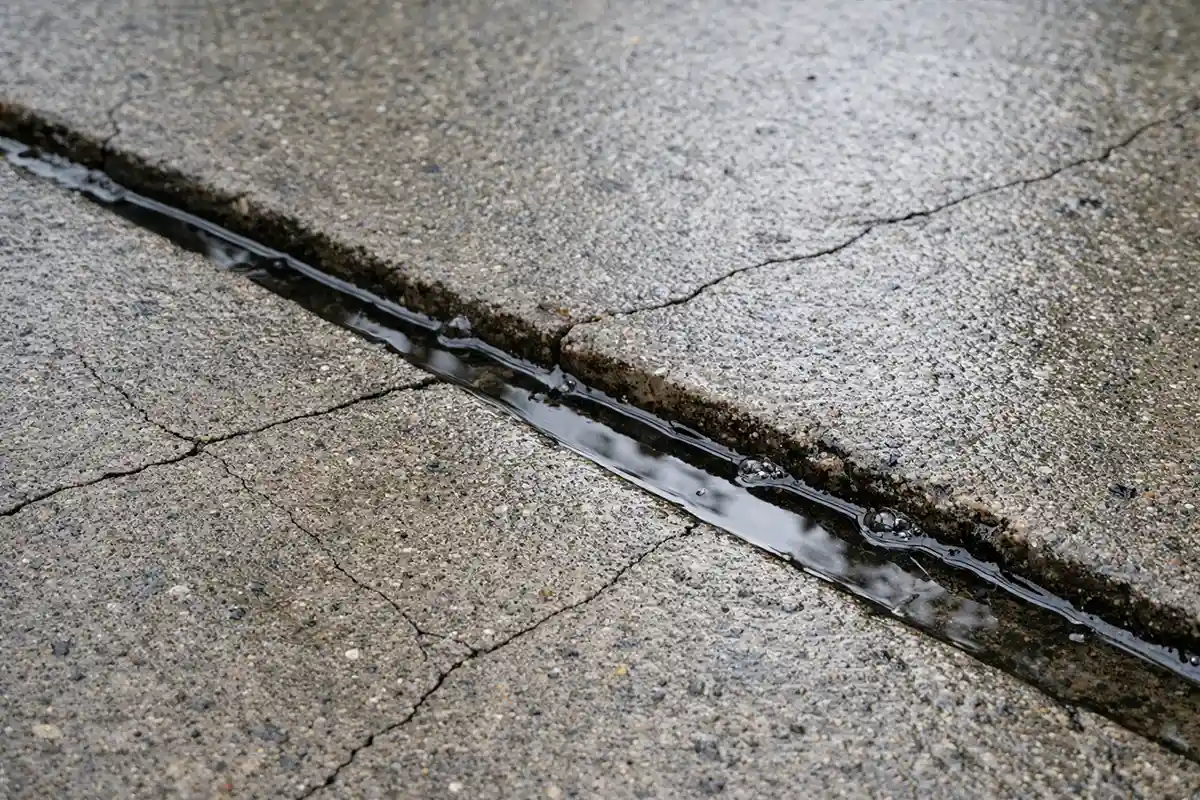
After a storm, it’s common to see water collecting directly inside expansion or control joints along the perimeter. These joints are meant to accommodate movement, but they also become entry points when exposed repeatedly to moisture.
Over time, repeated saturation can lead to:
-
Sealant softening or separating from concrete.
-
Fine cracks widening incrementally.
-
Increased water penetration below the slab.
-
Reduced load sharing between slab sections.
As joints weaken, water bypasses surface drainage and moves deeper into the base layer. That deeper infiltration increases the volume of soil exposed to wet-dry cycles, compounding edge instability.
Joint wear is often dismissed as normal aging. In reality, persistent perimeter pooling accelerates mechanical breakdown and structural interaction with moisture.
Moisture–Load Interaction Overview
Standing water does not affect every patio the same way. The interaction between soil type, moisture duration, and applied load determines how structural change progresses.
| Ground Condition | Moisture Pattern | Structural Reaction | Typical Early Sign |
|---|---|---|---|
| Clay-heavy soil | Slow drainage, high retention | Expansion and shrink cycles | Perimeter cracking |
| Sandy soil | Fast drainage, particle movement | Localized void formation | Hollow sounds near edge |
| Mixed compacted fill | Uneven density zones | Differential settlement | One-sided slope change |
| Freeze-prone region | Saturation before freezing | Frost heave at slab boundary | Seasonal corner lift |
| High roof runoff | Repeated concentration at one zone | Accelerated edge compression | Persistent puddle at same spot |
This comparison highlights why identical puddles can lead to very different structural outcomes depending on environmental context.
Surface Texture, Drainage, and Perceived Stability
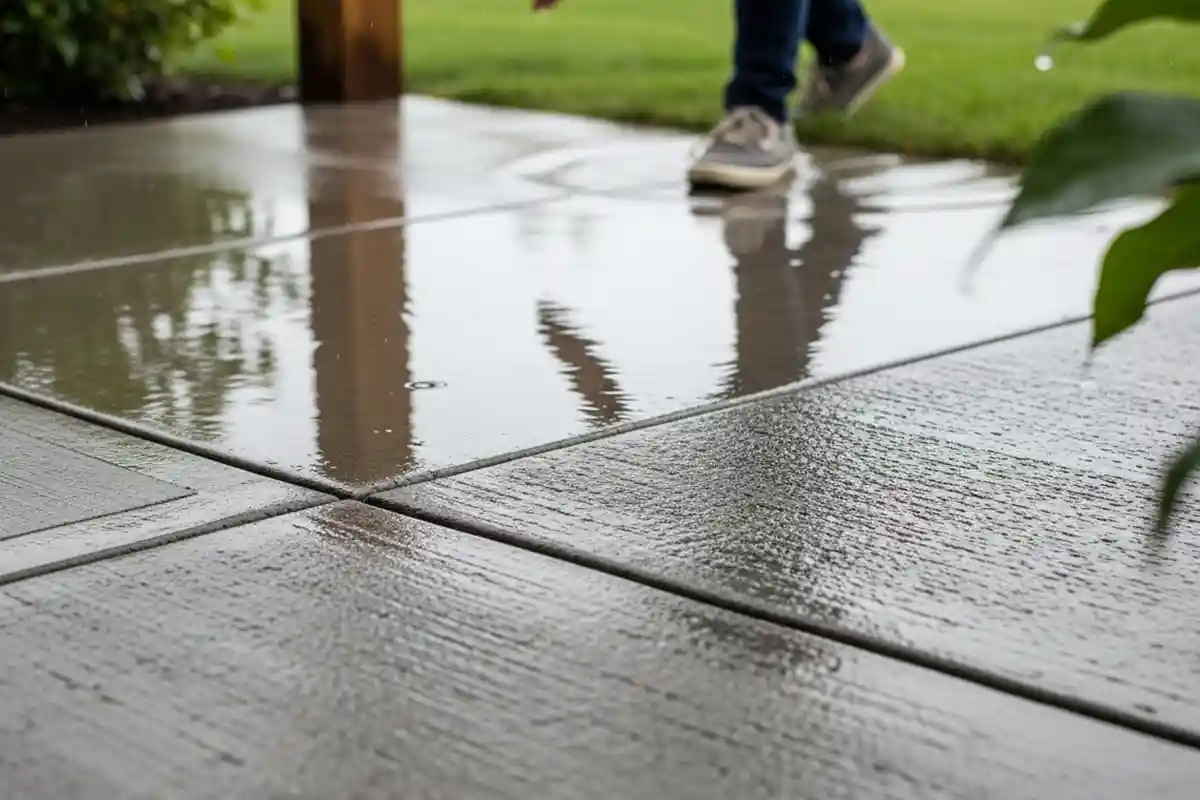
Sometimes the first noticeable change isn’t structural—it’s traction. After subtle settlement at the edge, water may spread thinly across areas that once drained quickly.
You might observe:
-
A darker sheen on one side after light rain.
-
Shoes gripping differently across sections.
-
Pets hesitating or sliding slightly.
-
Water collecting in shallow depressions that weren’t there before.
Surface texture influences how noticeable these changes become. Surface texture significantly influences underfoot stability during wet conditions. When drainage geometry shifts, even minor slope adjustments can alter how safe or stable the patio feels.
These traction changes often trace back to gradual edge settlement and moisture imbalance rather than surface wear alone.
Redirecting Water Before It Reaches the Edge
You notice the difference after a heavy rain: instead of forming a thin strip beside the slab, water now moves steadily across the yard. The patio edge dries faster, and the soil no longer feels spongy the next morning. That shift in behavior usually comes from changing how runoff approaches the perimeter.
In minor cases where no visible cracking exists, subtle grading adjustments around the slab can alter flow direction. Extending roof discharge points farther into the yard also reduces repeated saturation in the same narrow boundary zone. The visual result is simple—less pooling—but the structural benefit is steadier soil density at the edge.
Moderate scenarios involve recurring dampness and early settlement. In those cases, shallow channel drains or narrow swales positioned where water naturally converges begin to intercept flow before it lingers against the slab. The perimeter transitions from a collection point to a pass-through zone.
Severe situations, where measurable tilt or widening cracks are already present, require more than runoff redirection. Water control prevents further acceleration, but structural imbalance that has already developed must be addressed separately.
Restoring Uniform Support Beneath the Slab
When one corner sits lower or a hollow sound develops near the edge, the soil beneath has changed. Stabilization focuses on reestablishing consistent contact between concrete and subgrade rather than only improving drainage patterns.
In moderate to advanced conditions, corrective pathways typically involve:
-
Filling subsurface voids that formed through washout.
-
Recompacting perimeter soil after moisture control measures are in place.
-
Re-sealing deteriorated joints to limit further infiltration.
-
Re-leveling affected sections where differential settlement is measurable.
These actions change how the slab carries weight. Instead of bridging weakened pockets, the concrete regains uniform bearing across its footprint.
Structural correction also benefits from understanding broader ground behavior. Ground settling in outdoor areas frequently begins with subtle moisture imbalance before visible sinking occurs. When the larger soil system stabilizes, edge repairs tend to hold more reliably.
Integrated Perimeter Control as a Coordinated System
Long-term improvement often comes from aligning several small changes so they work together. When grading, runoff routing, and joint integrity support each other, the patio edge stops functioning as a moisture collection zone.
A coordinated perimeter strategy commonly includes:
-
Maintaining a consistent outward slope along the boundary.
-
Installing narrow trench drains where water naturally slows.
-
Extending downspouts beyond structural transition zones.
-
Preserving joint integrity to reduce deep infiltration.
The benefit emerges not from one element alone, but from reducing repeated concentration of water at the same structural edge.
When This Coordinated Approach Can Fail
Even well-aligned corrections may underperform in certain conditions:
-
Deep erosion has already removed substantial subgrade material.
-
Highly expansive clay continues aggressive shrink-swell cycles.
-
Roof runoff volume exceeds the capacity of installed drains.
-
Freeze-thaw cycles persist after soil remains chronically saturated.
If drainage elements are misaligned, water may be redirected toward adjacent walkways or foundation edges, shifting risk instead of resolving it.
Overcompacting perimeter soil without improving runoff direction can trap moisture beneath the surface, temporarily masking softness while increasing long-term stress.
Likewise, sealing joints without addressing external water concentration may reduce surface infiltration but leave underlying saturation patterns unchanged.
Self-Assessment: Edge Stability Evaluation
-
Water remains along the patio edge more than a day after rainfall.
-
Soil beside the slab feels noticeably softer than surrounding areas.
-
Hairline cracks at corners continue lengthening over time.
-
A straightedge reveals measurable slope change toward one side.
-
Hollow sounds appear when tapping near the perimeter.
-
Patio furniture leans slightly in a consistent direction.
-
Seasonal corner lift becomes visible after freeze periods.
-
Surface water begins pooling where it previously drained cleanly.
If several of these indicators are present simultaneously or intensify over time, deeper structural intervention may be necessary.
Corrective pathways change how water behaves around the patio and how soil responds beneath it. When moisture concentration is reduced and support is restored together, the slab regains predictable load distribution and long-term stability.
For additional technical background on site grading and moisture control principles, see the International Association of Certified Home Inspectors’ guidance on exterior drainage standards.