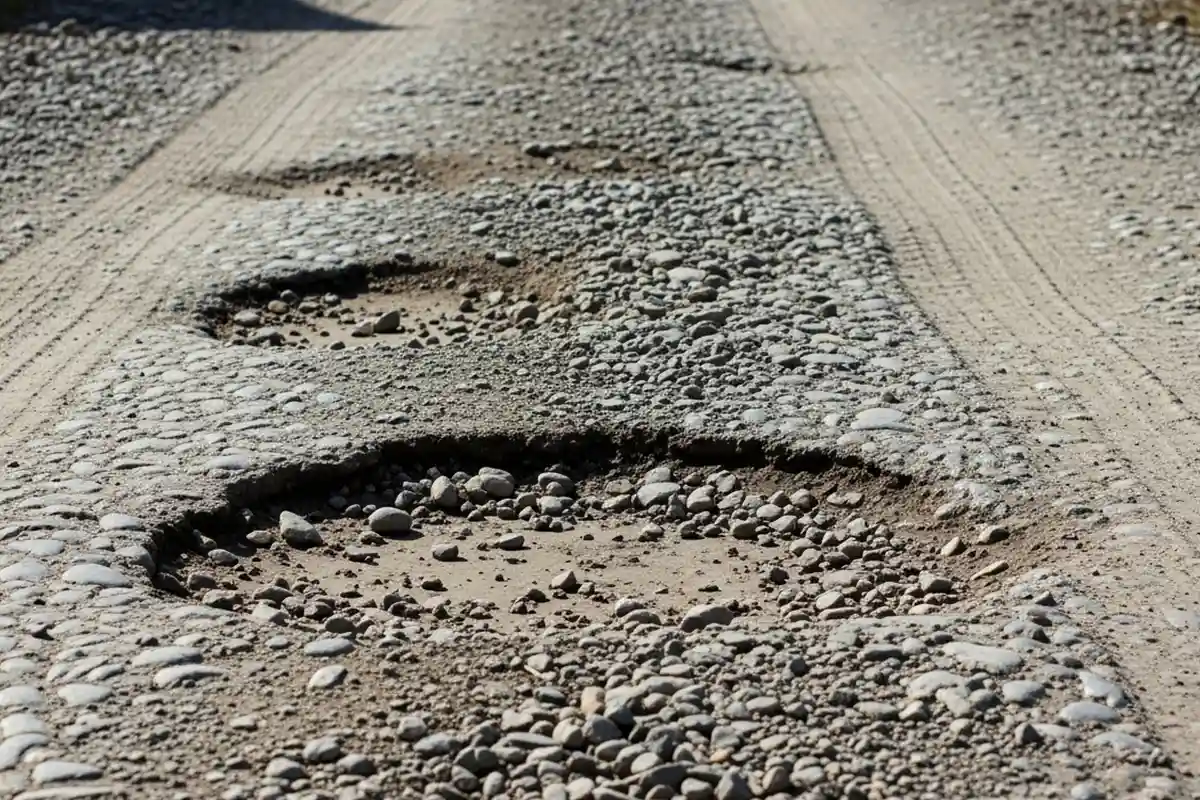
A gravel driveway can look perfectly fine from the street, especially when it’s still level from curb to garage door. Then one afternoon you notice a shallow groove about an inch deep where the tires usually track, running 10–15 feet down the center. Nothing “broke,” but the surface doesn’t feel as firm as it did last season.
The first real contact point is usually the same place every time: where the car slows, turns, or stops. You might see stones pushed toward the edge by the mailbox post, or a thin bare strip near the garage apron where the gravel looks darker and tighter. That’s the spot where pressure and movement keep repeating.
A single heavy rain can move a little gravel, but repeated rain plus repeated driving is what changes behavior. Early on, there’s no dramatic damage—just small shifts, like a slight slope forming toward one side or a soft patch that shows up after you step on it. A common belief is that gravel “can’t really fail” because you can always just add more, but topping off doesn’t fix what’s happening underneath.
Human experience shows up in tiny moments. You hear the crunch get sharper near the edge, or you feel the front wheel dip when you turn the same corner by the fence. You might even notice the dog’s paw prints sink deeper in one spot after a storm, even though the rest of the driveway feels firm.
An expert would say the surface is responding to uneven support below, not just losing stones on top.
Subgrade Movement Alters the Entire System
When the soil under gravel shifts, the gravel follows it like a blanket settling into a wrinkle. You can often spot it where the driveway meets a straight reference line, like the bottom edge of a garage door or the level line of a sidewalk. One section ends up slightly lower, and that low spot becomes the “catch point” for both tires and water. Over time, you’ll see the surface tilt a few degrees toward that dip, even if the gravel still looks evenly spread.
Water Washout and Fine Particle Loss
⚠️ Water can quietly pull the support out from under gravel without leaving a big puddle on top. After a rain, you may notice muddy water escaping at the driveway edge, or a thin fan of silt collecting along a curb line. That’s a sign fine particles are being carried down and away, leaving small voids under the stone. Later, when you walk across the area, it can feel springy or soft for a foot or two even though the gravel layer looks normal.
Traffic-Induced Lateral Displacement
Every time a tire turns, it pushes gravel sideways, not just down. You’ll often see it as a raised ridge along the driveway edge or near a walkway border, sometimes 2–3 inches higher than the center track. Those ridges mean the travel lane is thinning, so ruts deepen faster with each pass. This lateral migration contributes directly to uneven surfaces. In fact, Uneven Ground Creating Trip Hazards explains how subtle surface inconsistencies can evolve into measurable safety risks even before deep structural failure becomes obvious.
Aggregate Shape and Interlock Strength
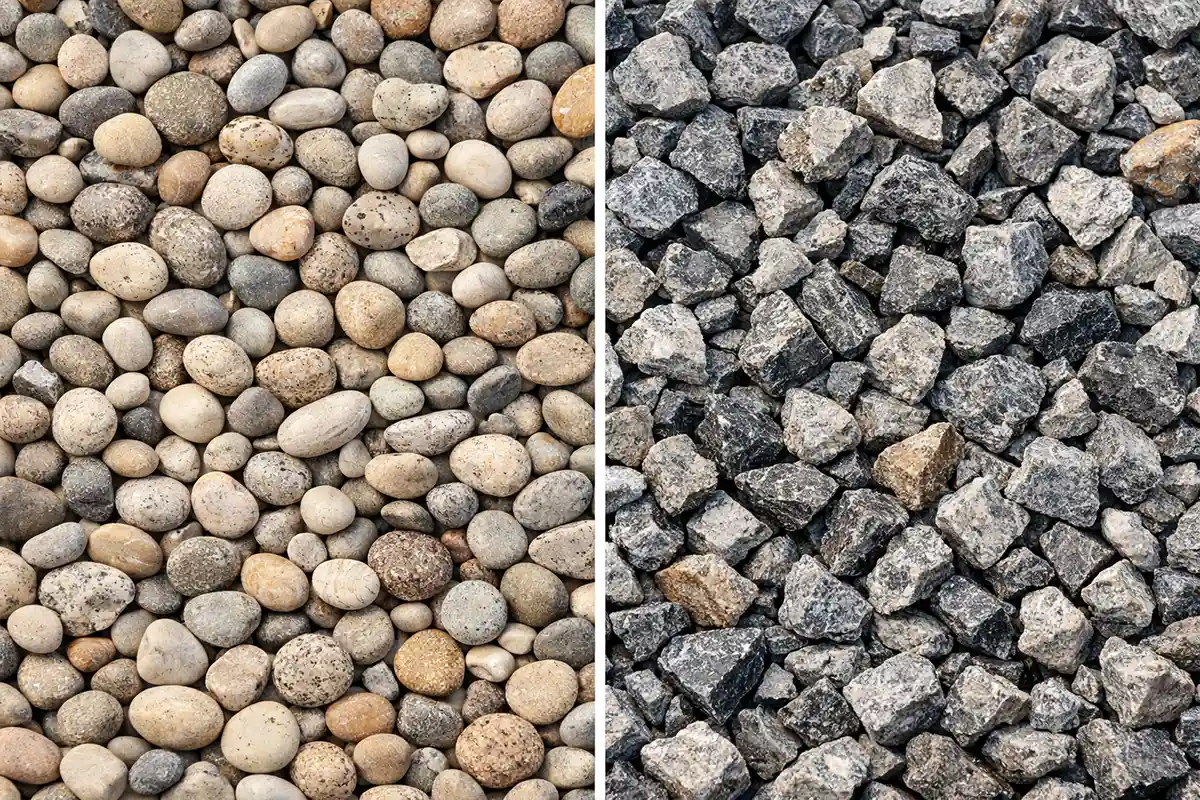
Rounded gravel rolls like ball bearings, especially on a slope you can measure with a simple level over a few feet. You’ll see it migrate downhill, leaving a thinner strip where the tires ride and a thicker pile where it collects. Angular crushed stone behaves differently because the edges bite into each other when compacted, so the surface holds its shape better under a turning wheel. If the driveway looks constantly “loose” no matter how often it’s raked, the aggregate shape is often part of the reason.
Edge Restraint Failure and Surface Spread
Gravel needs something to push against, or it will creep outward until it finds the lowest point. You can spot edge failure when the gravel line spreads past the original border, like creeping 6 inches into a lawn edge or spilling around a curb corner. As the sides loosen, the center track loses depth, and the ruts get worse even if you keep adding stone. The driveway can start to look wider, but it’s really just losing its containment.
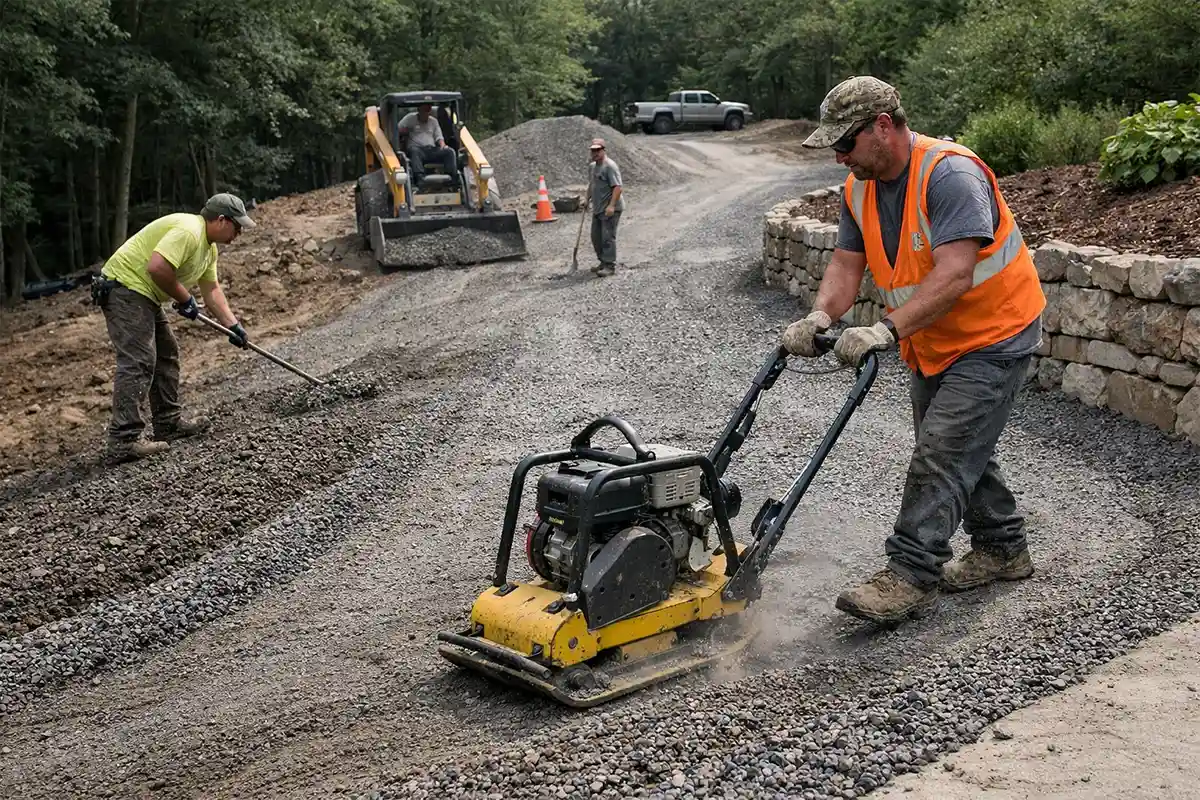
Installation Compaction Errors
💡 A gravel surface can look smooth on day one even if the base wasn’t compacted evenly. Weeks later, you may see a single low pocket reappear in the same 2–3 foot spot, usually where the subgrade was soft or too dry during compaction. Those weak pockets compress faster under the same tire path, and water starts favoring them during rain. Understanding these installation dynamics is critical because surface symptoms can resemble cracking or chipping patterns seen in harder materials. Best Solutions for Breaking and Chipping Outdoor Surfaces highlights how early structural adjustments prevent minor surface changes from escalating into costly reconstruction.
Surface Layer Thinning and Material Loss
When gravel starts thinning, the real problem is not the missing stones you can see near the driveway edge. The issue sits a few inches below the surface, where thickness and support have drifted out of balance. If one tire track is 2 inches lower than the surrounding area, the load is no longer spreading evenly across the base. That small depth difference changes how pressure moves through the soil.
The correction begins on the horizontal plane where gravel meets subgrade. You are not just adding material; you are restoring uniform thickness from edge to center. When the depth returns to a consistent level—often 4 to 6 inches for residential driveways—the load spreads out instead of punching downward into one strip.
Is adding more gravel enough?
No. If the base below is uneven, new gravel will follow the same dip and compress again.
How do I know thinning is structural, not cosmetic?
If you can measure a height difference of more than 1 inch across a 3-foot span, the issue is structural.
Why does the same tire path keep sinking?
Because the density beneath it is lower, so each pass increases compression.
Will compacting the top layer fix it?
Only if the base underneath is already level and stable.
A common belief is that gravel “levels itself” over time. It does not. It settles into the shape of whatever support it has below. The visible sign of proper rebalancing is a uniform surface where water spreads evenly instead of tracking along a narrow 8-inch-wide channel.
Freeze–Thaw Expansion and Micro-Displacement
In states like Minnesota, where winter temperatures swing above and below freezing, water trapped in the base expands and contracts repeatedly. You might see a slight hump—maybe half an inch high—running across the driveway after a cold snap. When it thaws, that hump softens and leaves a shallow depression.
The structural fix targets moisture control and compaction depth. By increasing drainage beneath the gravel and ensuring consistent slope—often a 2% grade away from structures—the freeze–thaw cycle has less trapped water to work with. Less trapped water means less vertical movement.
The behavior change is noticeable. Instead of small seasonal heaves near the garage apron or along a retaining wall, the surface remains flat relative to a siding line or foundation block course. Stability improves because expansion forces are reduced before they begin.
Drainage Channel Formation and Water Tracking
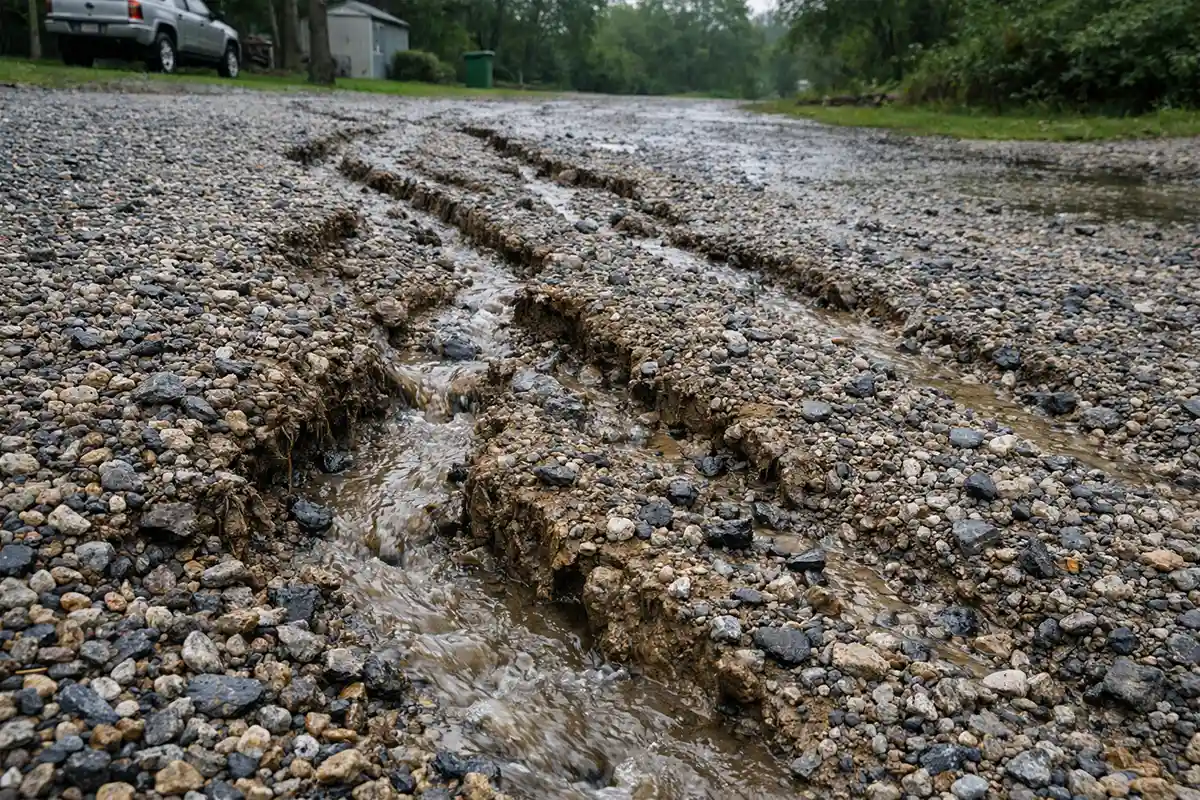
When water repeatedly flows in the same direction—often toward the street curb or downhill corner—it creates a visible groove. That groove may only be 1 inch deep at first, but it guides every future rainfall along the same line. The structural shift here involves adjusting the driveway’s crown or slope so runoff disperses instead of concentrating.
Regrading the surface changes the physical behavior immediately. Instead of water streaming in a straight path, it spreads across a broader width, reducing velocity. The observable result is the disappearance of narrow erosion trenches and the absence of muddy streaks along the lower edge.
Some homeowners think erosion only happens during heavy storms. In reality, light but repeated rainfall can slowly deepen those channels if the slope is misaligned by even a few degrees.
Transformation Progress Map
| Current Condition | Structural Shift | Physical Behavior Change | Observable Outcome |
|---|---|---|---|
| Tire rut 2 in. deep | Base re-leveled ➜ | Load spreads evenly | Rut depth reduces ▽ |
| Water groove along edge | Crown adjusted ▲ | Runoff disperses | No visible channel |
| Soft 3-ft patch | Subgrade recompacted | Compression slows | Surface feels firm |
| Gravel spilling 6 in. outward | Edge restraint reset ➜ | Lateral movement reduced | Cleaner boundary line |
| Seasonal 0.5 in. heave | Drainage improved ▽ | Less moisture expansion | Flatter winter profile |
This table shows how a physical adjustment directly changes surface behavior. Each structural shift leads to a measurable improvement you can see with a level, straight board, or simple visual alignment to a garage threshold.
Compaction Memory and Load Pattern Reinforcement
Once traffic has created defined tracks—often spaced the width of a vehicle’s wheels—those tracks become reinforced. You can see them clearly from the second-story window, running parallel like rails. The structural correction focuses on redistributing density across the full driveway width.
Scarifying the compacted lanes and recompacting the entire 10- or 12-foot span resets density balance. When the compaction is uniform, vehicles no longer sink preferentially into the same 8-inch-wide strip. The behavior shifts from concentrated pressure to distributed support.
The visual cue of success is subtle but clear: tire marks fade instead of deepening. After a week of normal use, the surface looks consistent from left edge to right edge.
Transition Zones Between Materials
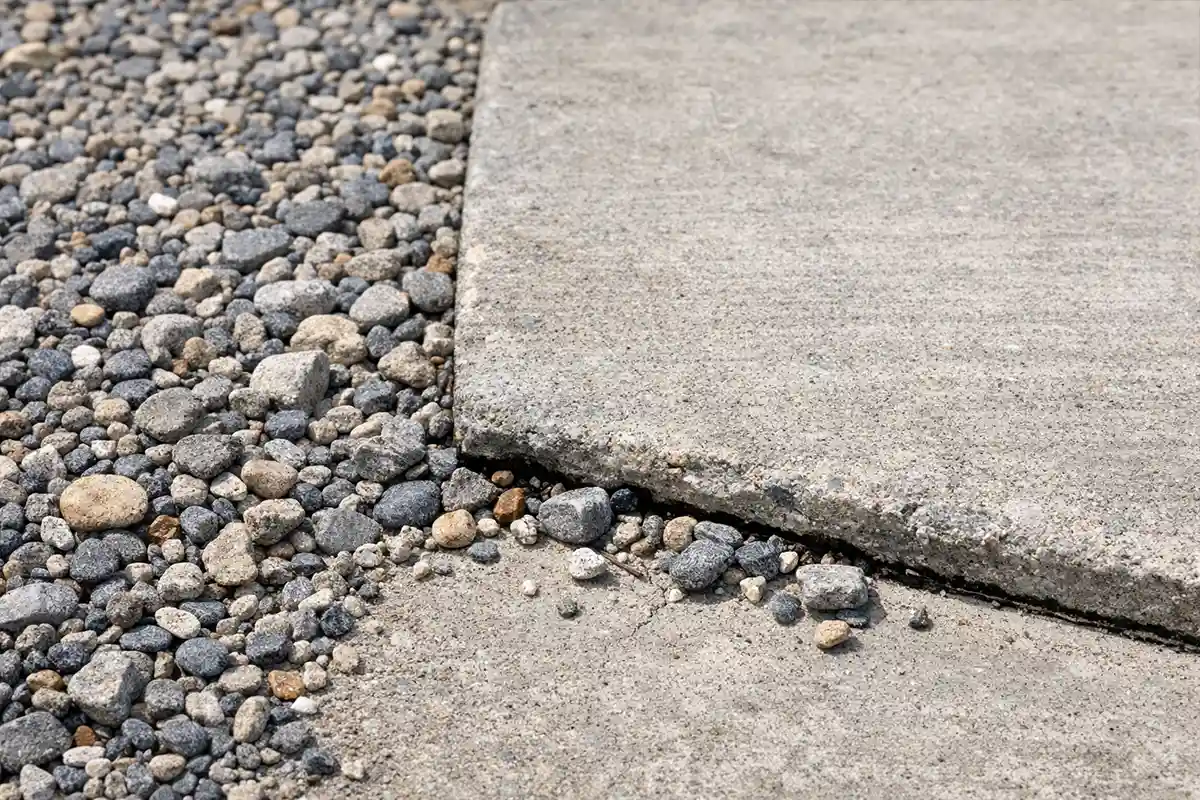
Where gravel meets concrete or stone, the difference in rigidity creates stress. You might notice a small 1-inch gap forming along the slab edge, with loose stones scattered outward. The structural adjustment here involves reinforcing that boundary with a firm edge restraint and ensuring the gravel height aligns precisely with the slab surface.
When alignment is corrected, vehicles transition smoothly without a drop or bump. The physical behavior changes from edge crumbling to stable transfer of load. The visual sign is a tight joint line where gravel meets the slab, without scattered stones or visible separation.
Gravel instability often interacts with nearby hardscape materials. Persistent surface shifts can influence adjacent stone or tile systems, a relationship examined in Cracked Outdoor Stone and Tile Isn’t Just Cosmetic. When both systems are structurally aligned, stress remains localized instead of spreading across surfaces.
Progressive Surface Instability and Adjacent Impact
As adjustments are made—regrading, recompacting, restoring slope—the progression follows a clear chain. Structural plane correction leads to load redistribution. Load redistribution reduces rut depth and water tracking. Reduced stress results in longer-term stability.
You can confirm improvement through simple observation. The driveway edge holds its line against the lawn. Water flows evenly toward the street instead of carving a narrow trench. The surface feels firm underfoot across its entire width.
Stability is not guesswork. It is visible in alignment, measurable in depth, and confirmed through repeated behavior under normal daily use.
Structural Rebalancing Instead of Surface Topping
After proper correction, the gravel surface behaves differently under the same daily use. When you drive up the 30-foot stretch toward the garage, the tires no longer settle into a defined 2-inch rut. The contact plane feels even from left edge to right edge, and water spreads in a thin sheet instead of cutting a narrow line toward the street.
You also stop seeing the same low spot reappear near the mailbox or along the siding line. If the driveway was re-leveled correctly, the slope—often around 2% away from the house—remains consistent even after heavy rain. The repeated soft patch that used to form within 24 hours of rainfall no longer returns. Stability shows up as absence: no ridge building along the edge, no loose stones piling 4 inches beyond the border.
Many homeowners believe that once fresh gravel is added, the problem is solved for good. That belief is incorrect. If the underlying plane was not reset and compacted evenly, the surface will drift back into the same pattern within weeks. True rebalancing is visible in alignment and measurable in depth, not just in appearance.
Controlled Reconstruction of the Base Layer
When reconstruction is done correctly, the system regains structural continuity. You can check this with a straight board laid across a 3-foot span; there should be no visible daylight under the center. The base feels firm underfoot across its full width, not just along the center track.
Observable changes include reduced seasonal movement. In colder climates, you no longer see a half-inch winter heave forming near the garage threshold. The driveway edge holds its line against the lawn without creeping outward 6 inches over a season.
If reconstruction was incomplete—such as skipping moisture conditioning during compaction—the surface may look smooth but still compress unevenly. A 1-inch depression reappearing in the same location within a few months signals that density was not restored evenly. Partial work delays failure but does not stop it.
Drainage Redesign to Interrupt Erosion Cycles
Once drainage is corrected, rain behavior changes immediately. Instead of flowing in a 6-inch-wide groove toward the curb, water disperses across the full driveway width and exits evenly. You can observe this during a moderate storm by watching the direction of runoff relative to the sidewalk edge.
A stable drainage profile means no muddy streaks form at the lower corner of the lot. The slope angle prevents pooling near the foundation, and the driveway crown remains centered. The repeated erosion line that once deepened after every storm stops advancing.
If drainage was only partially addressed—such as adjusting the surface without correcting lot slope—the problem can restart. Water will always follow the steepest path. If that path still concentrates along one edge, erosion resumes and gradually widens its impact area.
Reinforcing Edge Containment Systems
When edge restraint is properly rebuilt, the boundary between gravel and lawn or concrete becomes visually clean. The gravel no longer spreads beyond its intended 10- or 12-foot width. Turning vehicles do not push stones outward into a loose ridge 3 inches high along the border.
A stabilized edge keeps thickness consistent across the center travel lane. The contact direction during braking or turning remains supported instead of forcing lateral shift. You can confirm this by observing that the gravel height aligns closely with adjacent concrete slabs or walkway edges.
If containment is weak or missing, outward creep returns quickly. Within a few months, you may see stones migrating 4–6 inches into landscaping. Once that movement resumes, central thinning accelerates and rutting begins again.
Monitoring Patterns That Signal Deeper Subgrade Issues
Even after repairs, monitoring matters. If a depression deeper than 1 inch reforms in the same 2-foot area, subgrade instability may still exist. Watch for recurring softness after 48 hours of dry weather, which suggests trapped moisture below.
Without intervention, the progression follows a predictable chain: repeated compression reinforces the rut, the rut directs water flow, and the erosion widens beyond the original track. Over time, the impact area expands from a single strip to half the driveway width.
Decision thresholds become clear when observed physically:
-
Monitoring stage: surface variation under 0.5 inch, no expanding edge spread.
-
Adjustment stage: rut depth nearing 1 inch, visible directional runoff.
-
Structural intervention stage: repeated 2-inch depressions, widening erosion zone, lateral spread beyond defined edges.
Observable Stability Checklist
-
Rut depth remains under 0.5 inch across a 3-foot span.
-
Water disperses evenly, no defined 6-inch erosion channel.
-
Gravel edge stays aligned with curb or lawn border.
-
No recurring soft spot after 48 hours of dry weather.
-
Surface height aligns evenly with garage apron.
-
No seasonal heave exceeding 0.5 inch.
-
Tire tracks fade rather than deepen over time.
Long-term performance depends on maintaining balanced load distribution, controlled drainage, and firm edge restraint. Authoritative construction standards emphasize the importance of stable subgrade and proper compaction practices.
For additional guidance on soil behavior and structural ground performance, consult United States Geological Survey.