-
-
You will see why shallow tire dips often signal deeper base movement.
-
You will understand how edge spread reduces support across the center line.
-
You will learn why water direction matters more than adding extra gravel.
-
You will recognize the difference between one-time damage and repeated stress.
-
You will know when the problem is structural, not just cosmetic.
-
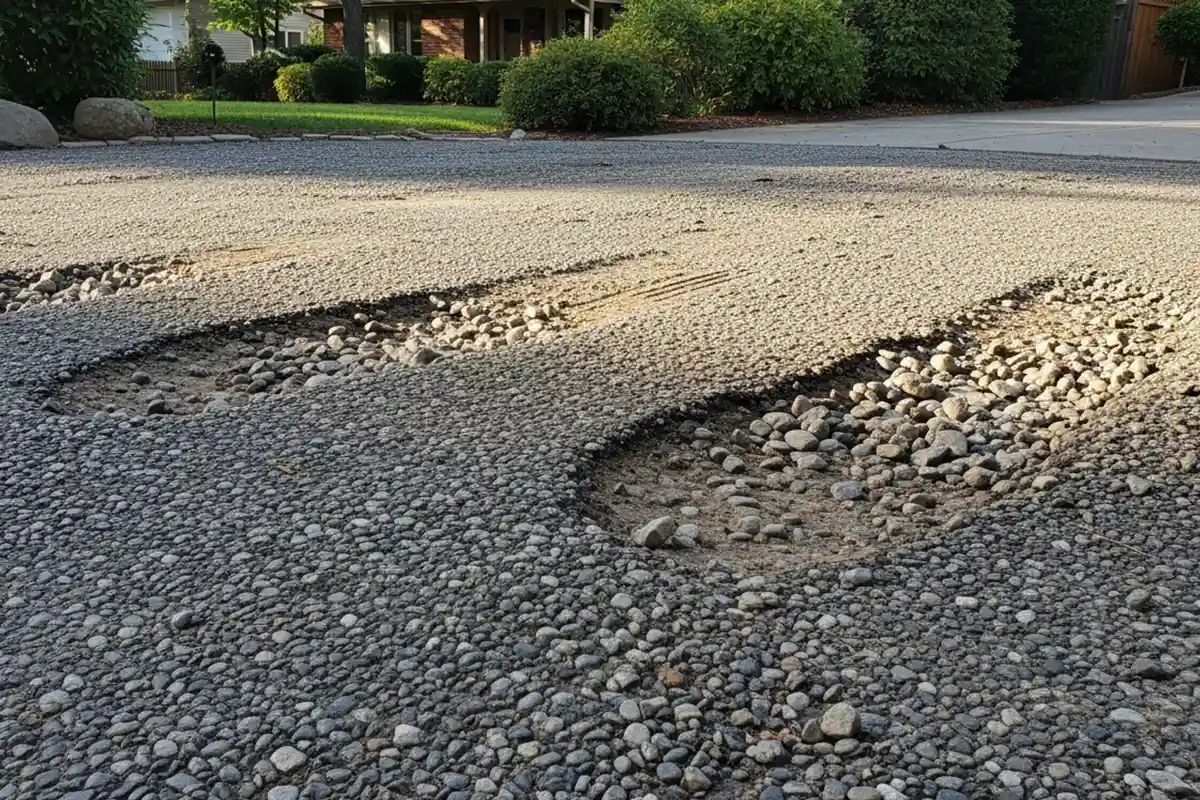
Stand at the garage and look down a 30- to 40-foot gravel driveway toward the street. From that angle, the surface may appear flat and evenly colored. But when you walk along the tire path, you may notice your shoe drops slightly—maybe half an inch—into a softer track.
That small drop is usually the first sign of structural movement below the stone layer. Gravel does not randomly fail. It reacts to pressure, moisture, and slope changes happening 4 to 8 inches beneath the surface.
The first structural interaction typically occurs where vehicles enter at a slight turn. The front tires compress a narrow band about 8 inches wide. If the compacted base below is thin or uneven, that pressure pushes downward instead of spreading outward.
A single heavy truck passing once rarely causes lasting damage. The difference shows up when the same vehicle parks in the same position every day. Repetition reshapes the load path. Over time, the center settles and the edges of the track rise slightly, creating visible channels.
Many homeowners believe gravel simply “spreads out because it’s loose.” That explanation sounds reasonable, but it is incomplete. Gravel spreads when confinement weakens or when the base beneath it shifts, not just because it lacks glue.
You may first notice shallow puddles forming after a heavy rain. The water sits in the same two parallel lines, about 6 to 10 inches apart, and lingers longer than the surrounding surface. That repeat pattern reveals a change in slope.
Living with that change can be frustrating. You rake the surface smooth on a Saturday, and within weeks the same dip returns in the exact spot near the garage slab. The driveway edge may look slightly higher compared to the center.
From a structural perspective, gravel fails gradually because compaction, confinement, and drainage fall out of balance.
Loss of Edge Restraint and Lateral Spread
Look at the boundary where gravel meets grass. If that line has shifted outward by two or three inches compared to last season, edge restraint is weakening. Without firm support, stones drift laterally under pressure.
As material moves toward the lawn, the center becomes thinner. Even a one-inch reduction in thickness changes how the driveway distributes weight. The middle ends up carrying more load with less support beneath it.
You may also notice the driveway edge sloping slightly downward into the yard. That slope encourages runoff to escape at the margins, washing small particles with it. Once confinement declines, rutting becomes easier.
Inadequate Base Depth and Subgrade Instability
Gravel depends on what lies below it. If the base layer is too shallow or poorly compacted, the soil underneath begins compressing unevenly. After heavy rain, you might see one side of the driveway sit slightly lower than the other.
Clay soils expand when wet and shrink when dry. That vertical movement may only measure fractions of an inch each season, but it repeats year after year. Gradually, uniform support disappears.
What looks like surface wear is often a mirror of subgrade movement. Drainage-related soil shifts that lead to cracking in rigid materials are explained in detail in Cracked Outdoor Stone and Tile Isn’t Just Cosmetic.
Drainage Imbalance Beneath the Aggregate
Watch how rainwater travels across the surface during a storm. If water flows from a downspout across the driveway at a slight angle, it slowly carries fine particles downward. Darker damp streaks may appear along that path.
As those fines migrate into the soil below, larger stones lose tight interlock. The surface begins to feel loose and slightly unstable underfoot. The issue follows the same rain direction every time.
A common belief is that thicker gravel solves water problems. In reality, without correcting slope and runoff direction, extra stone often settles into the same low zones.
Load Concentration and Repeated Traffic Patterns
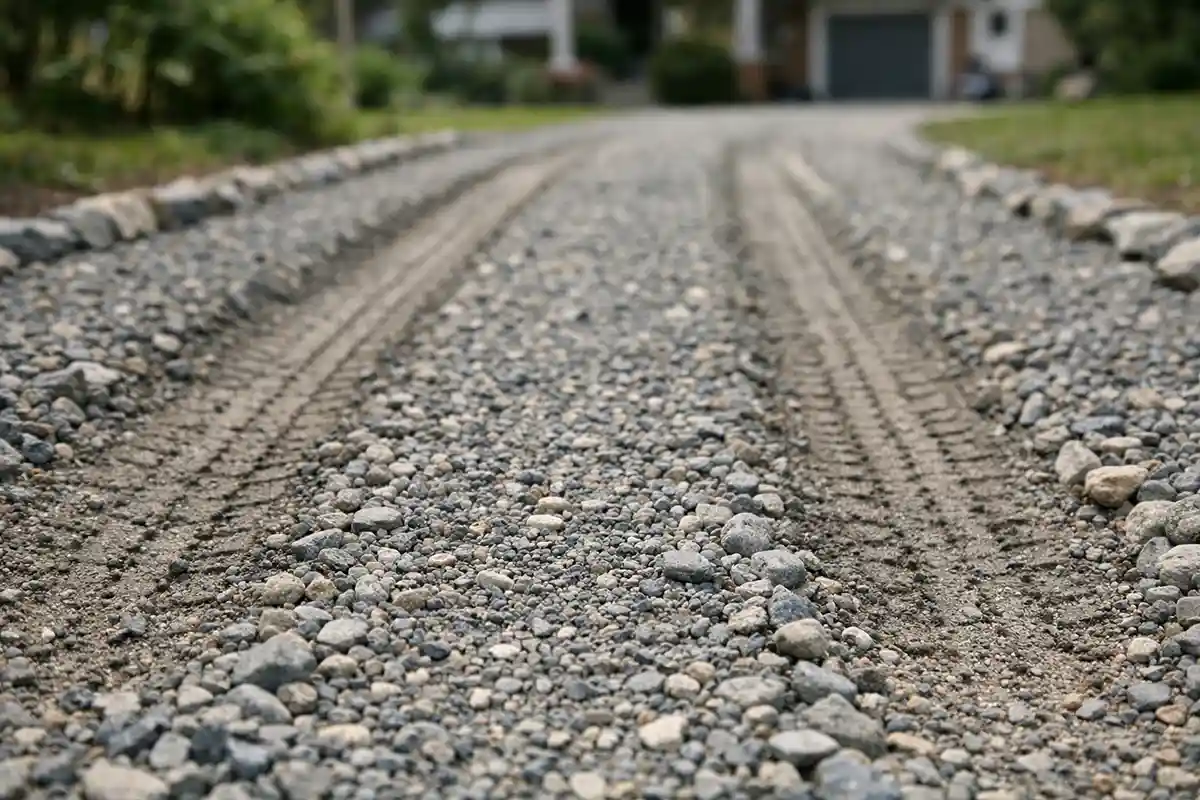
If you always park with your tires aligned to the same crack in the garage floor, pressure concentrates in those 8-inch-wide tracks. Over months, the center of each track sits slightly lower than the surrounding stone. The driveway edges may appear subtly raised by comparison.
Repeated stress locks that pattern in place. Water collects in the lower channels and softens them further. This ongoing cycle of load and moisture explains why gravel aging follows predictable stages described in Why Gravel Surfaces Break Down Over Time.
As these small shifts repeat, the surface gradually transitions from flexible to unstable, even though the changes begin at barely visible scale.
Fine Loss and Surface Loosening
Many homeowners respond to loose gravel by ordering another load and spreading it across the top. The driveway looks fuller right away, especially along the 10- to 12-inch-wide tire tracks that had sunk slightly below the surrounding surface. For a few weeks, the center feels firmer underfoot.
The problem is that surface stone is not the only layer that changed. When fine particles wash downward during heavy rain, they leave small gaps between larger stones. You might notice darker, damp streaks running at a slight angle across the driveway after a storm. Those streaks show where fines are migrating.
Without fines locking the structure together, larger stones shift more easily when a vehicle turns its front wheels at the same 20-degree entry angle every day. The surface begins to roll instead of resist. Adding more gravel on top does not restore the missing internal contact points beneath it.
A common belief is that loose gravel simply needs “more material.” In reality, material without structure behaves like a thicker cushion, not a stronger base.
Shoulder Erosion and Edge Undermining
Look closely at the driveway edge where gravel meets the lawn or landscape bed. If that line has crept outward by 2 or 3 inches over a season, edge restraint has weakened. The center may appear level from the street, but the sides are slowly dropping away.
Rainwater often runs from higher ground toward the driveway at a slight slope. You may see a narrow channel, only an inch deep, cutting along the shoulder after a heavy storm. That small channel removes supporting soil from beneath the outer edge.
As the shoulder loses support, stones spill outward. The center becomes thinner by comparison, even if you cannot measure the difference with a tape. Over time, the middle of the driveway carries more load with less confinement.
Simply raking displaced stone back toward the center changes the appearance but not the support. The soil beneath the edge remains lower than before.
Freeze–Thaw Expansion and Vertical Shift
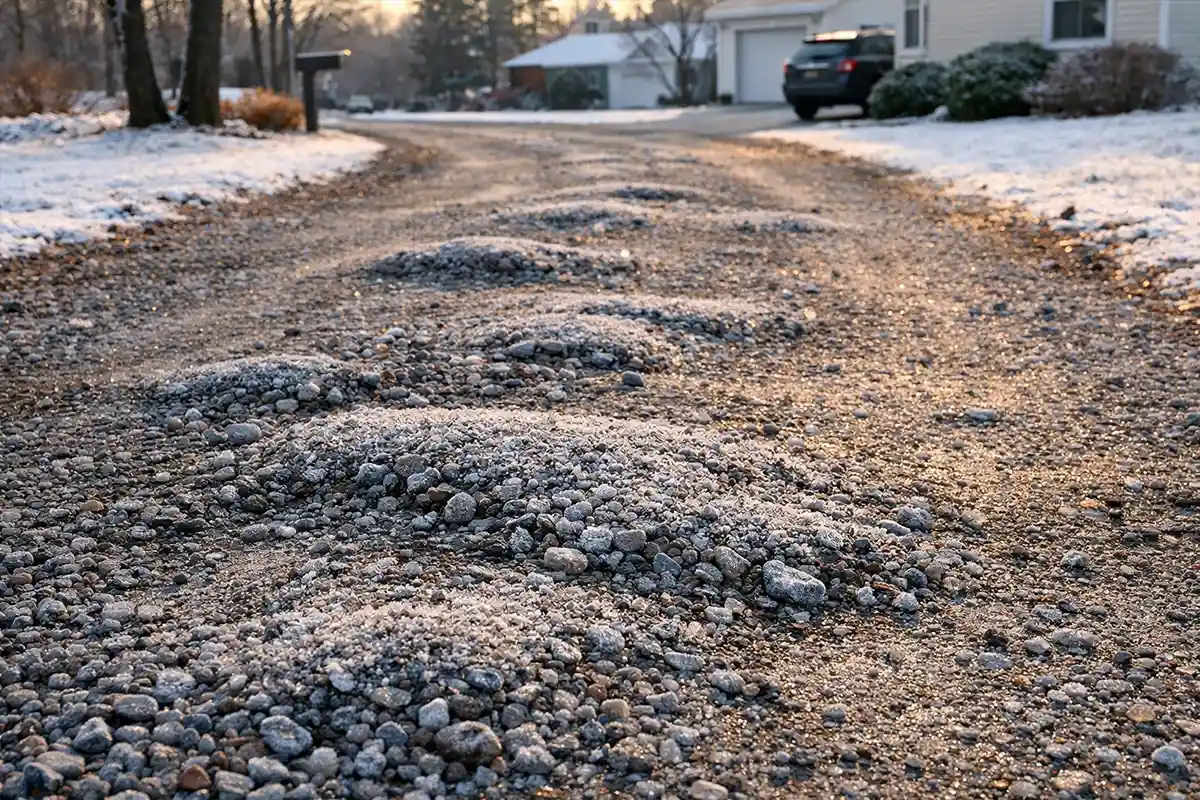
In colder regions, moisture trapped 4 to 6 inches below the surface expands as temperatures drop below freezing. You might see a section near the garage door lift slightly, creating a subtle ridge that was not there in October. When it thaws, the stone settles back unevenly.
This repeated lifting and settling weakens compaction. Even a quarter-inch vertical shift each season compounds over time. Low spots become slightly deeper, and high spots slightly firmer.
Many people assume freeze–thaw damage only affects concrete. Gravel may not crack, but it still moves. The visual cue is uneven pooling during spring melt, especially along the same tire paths that already carry most of the weight.
Load Overconcentration from Modern Vehicles
Driveways installed 15 or 20 years ago were often designed for lighter vehicles. Today’s SUVs and trucks can weigh thousands of pounds more. When those vehicles park in the same 8-inch-wide tracks near the garage threshold, pressure concentrates sharply.
You may notice the stone just inside the garage entrance sitting lower than the rest of the driveway by half an inch. That dip forms because the load is applied repeatedly at the same stopping point. Over time, the compacted base beneath compresses further.
Occasional heavy service trucks amplify the issue. Even if they visit once a month, their weight exceeds what a thin base layer can distribute. The driveway responds by pushing material outward toward the edges.
Adding fresh stone alone does not increase load capacity if the base remains unchanged. The new material simply settles into the same compression zones.
Mechanical Disturbance from Snow Removal
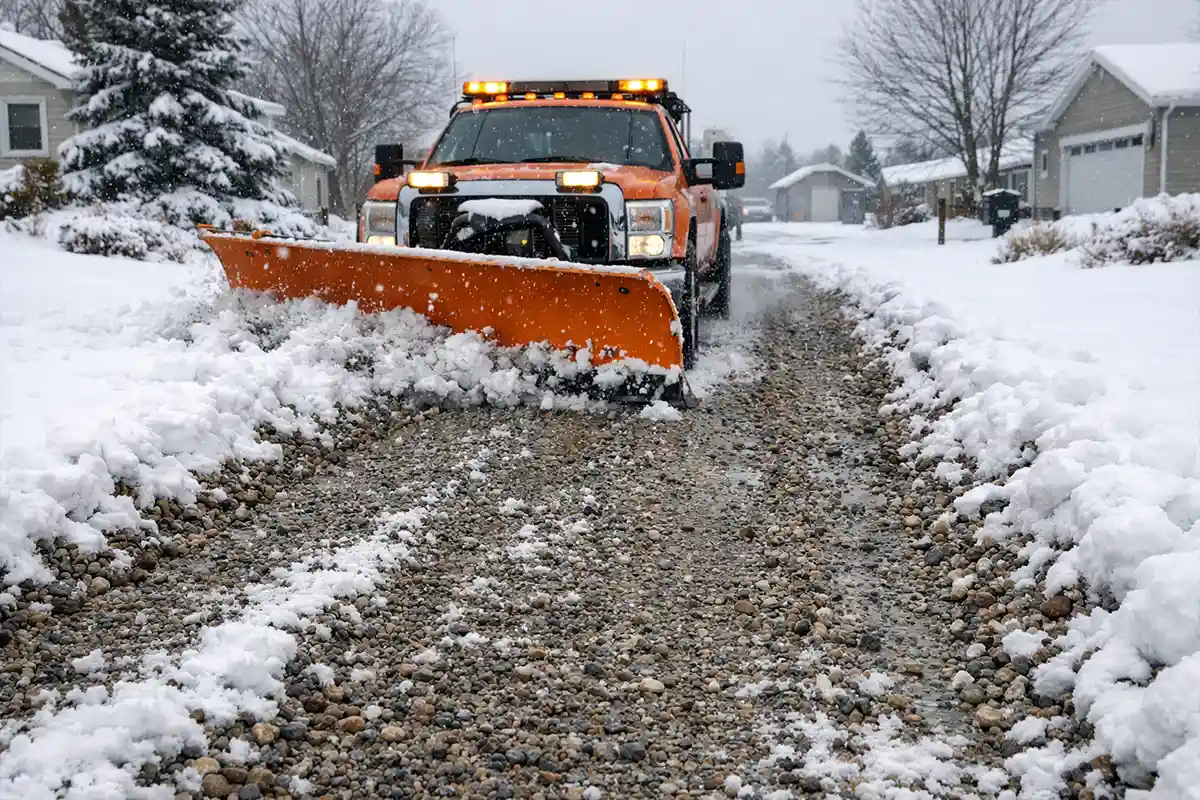
Snow removal equipment often scrapes more than snow. If the blade sits too low, it drags gravel toward the sides in long ridges 3 or 4 inches high. By late winter, the center may be visibly thinner.
Those ridges at the edge look harmless, but they represent material lost from the main load path. The driveway becomes slightly concave. Water then flows toward the center instead of away from it.
Even grading in the spring can disturb compaction. Spreading stone back into the middle without compacting it in thin lifts leaves hidden air pockets. Under vehicle weight, those pockets compress again.
Layered Solutions
1) Placement Correction
Physical change: Reinforce edges with compacted soil shoulders or metal edging to restore a straight boundary line.
Behavior change: Vehicles stay centered because the edges feel firm rather than sloped.
Symptom removed: Lateral spread slows, and the center no longer thins unevenly.
When edges are reset to a consistent height relative to the lawn—often within an inch of level difference—confinement improves. The driveway footprint stops widening season after season.
2) Flow Redirection
Physical change: Adjust grading so water runs off at a controlled 1–2 percent slope instead of pooling in tire tracks.
Behavior change: Rain follows a predictable path rather than cutting shallow channels.
Symptom removed: Persistent puddles in the same 6- to 10-inch-wide tracks disappear.
Redirecting downspouts or adding shallow swales prevents fines from washing into the subgrade. This addresses the root cause of loosening rather than masking it.
If you only add surface gravel without correcting water direction, the same low lines reappear after the next heavy rain. The pattern returns because the slope and moisture path never changed.
3) Entry Plane Rebalancing
Physical change: Rebuild the first 3 to 6 feet near the garage entrance with properly compacted base layers.
Behavior change: Vehicle load transitions smoothly from garage slab to driveway surface.
Symptom removed: The half-inch dip at the stopping point gradually stops reforming.
This zone experiences concentrated pressure at a consistent stopping distance. Strengthening it redistributes weight before it reaches thinner areas. It is not about making the surface harder; it is about making the load path even.
Understanding how repeated stress and environmental factors interact over time helps explain why surface-level fixes rarely hold, as detailed in Breaking and Chipping Outdoor Surfaces.
By addressing placement, water flow, and entry load distribution together, the driveway shifts from reactive maintenance to controlled performance.
When Surface Corrections Stop Delivering Results
A stable gravel driveway looks calm from the garage door to the street. The two tire paths sit level with the rest of the surface instead of dipping half an inch below it. When you look along the 30- or 40-foot run, you do not see darker lines marking the same old low spots.
In a balanced system, rainwater does not return to the same 8-inch-wide tracks after every storm. It moves across the surface at a steady slope and exits along the edge without leaving a shallow puddle behind. The driveway edge stays straight where it meets the lawn, not bowed outward by several inches.
Many homeowners assume that once the surface looks smooth again, the issue is resolved. That belief overlooks what is happening 4 to 8 inches below the stone. If the base and drainage path are not corrected, the surface simply resets before the same pattern reappears.
Rebuilding the Base Instead of Masking the Symptoms
A lasting fix begins below the visible gravel. The compacted base layer must be consistent in thickness from one edge to the other. When properly rebuilt, the surface above feels firm across its full width, not soft in the center and tight along the margins.
One clear physical cue is the transition at the garage threshold. Instead of a slight drop forming 2 or 3 feet out from the slab, the gravel meets the concrete at an even height. There is no visible shadow line or tire dip where vehicles stop.
Rebuilding in controlled layers changes how weight spreads. Rather than pushing straight down into a narrow band, the load distributes outward across the full driveway width. You no longer see stone drifting toward the grass after a few weeks of normal use.
Drainage must be addressed at the same time. The surface should carry a subtle slope, often around 1 to 2 percent, so water moves off rather than settling in familiar grooves. When runoff leaves the surface evenly, fine particles remain locked between larger stones instead of washing into the soil.
Drainage Redesign as Structural Protection
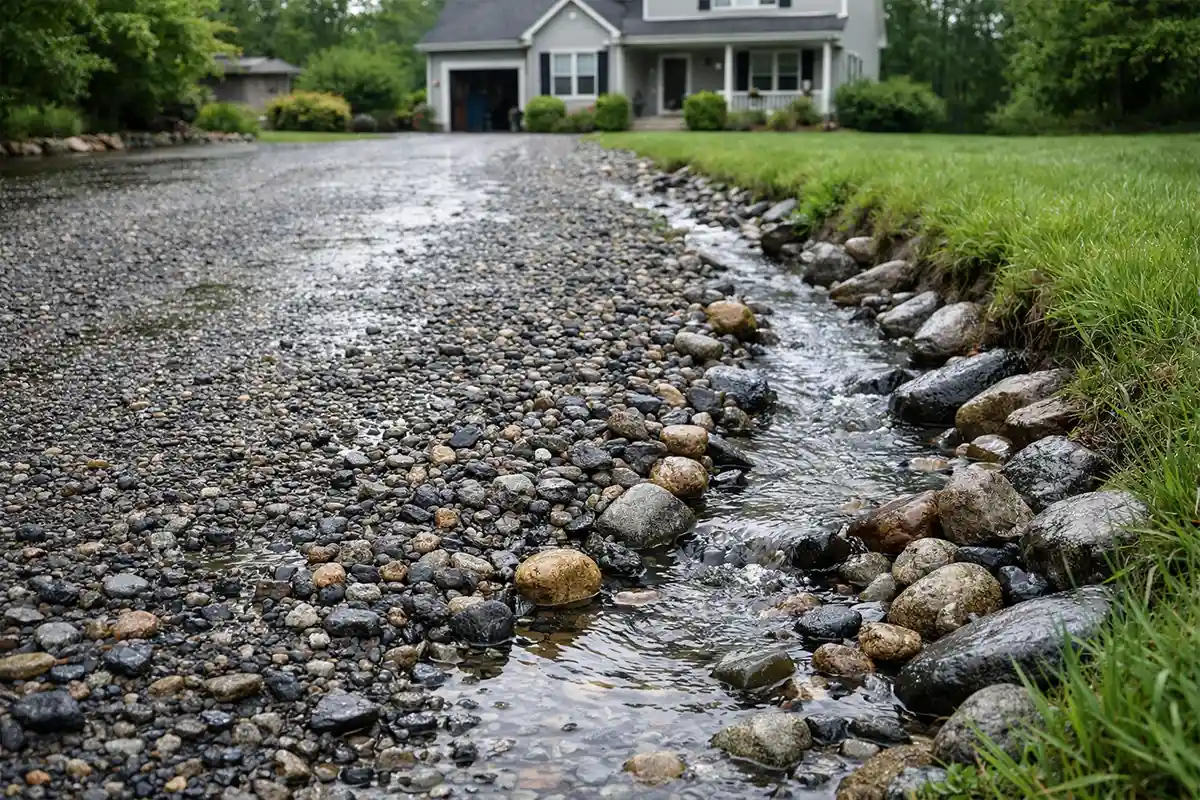
After drainage is corrected, the driveway behaves differently during a storm. Water does not collect in two parallel lines spaced several inches apart. Instead, it moves gently toward a shallow swale or lower edge that sits slightly below the main driving plane.
The change may be subtle to the eye. The difference in height might only be an inch from center to edge. Yet that small adjustment prevents the repeat pooling that once softened the base in the same location.
If drainage is ignored, the chain reaction continues. First, shallow ruts return in the same 6- to 10-inch-wide paths. Drivers naturally follow those smoother channels, reinforcing the low spots. Over time, the ruts deepen and spread, and the driveway widens as material shifts outward.
A common misconception is that gravel failure is simply part of aging. In reality, unmanaged water direction and concentrated load paths create predictable repetition. Repetition changes behavior, and behavior deepens the structural imbalance.
Long-Term Stability Requires Integrated Planning
A stable gravel system has consistent visual references. The boundary between stone and grass remains straight from one end to the other. The center does not sag compared to the garage slab. After heavy rain, the surface dries evenly rather than showing darker stripes across it.
The entry plane is balanced, meaning vehicles roll smoothly from concrete to gravel without compressing a stopping point. There is no half-inch dip forming 3 feet out from the door. The load spreads across the full width instead of carving two narrow tracks.
If these structural elements are not corrected, the failure pattern expands. What begins as a shallow depression near the garage can extend halfway down the driveway. The visible change might start at a single spot, but the structural stress gradually moves outward.
Visual Stability Snapshot
Stand at the garage door and look toward the street. The gravel surface sits level with the slab and holds a consistent slope toward the edge. The driveway line against the lawn runs straight without bowing. After rainfall, no familiar puddle marks the same location twice. The system appears steady because the base, slope, and confinement are aligned.
The Federal Highway Administration provides engineering guidance on aggregate base performance and drainage principles that inform long-term stabilization strategies.