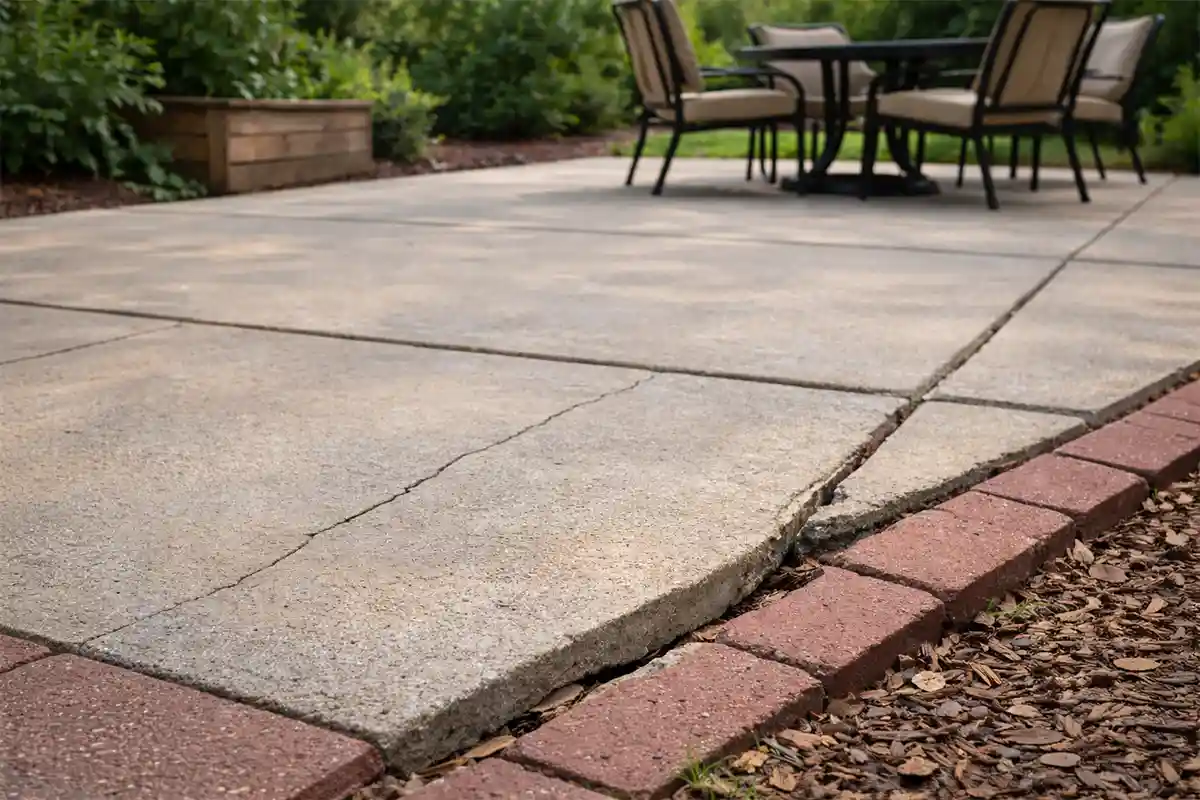
If the same crack keeps returning along your driveway edge, it rarely stays small. If one patio corner sits just 1/4 inch lower and always collects water after rain, that pattern does not correct itself. Outdoor surface fatigue begins when repeated weight, moisture, and temperature shifts keep stressing the exact same physical strip until the base beneath it loses even support.
This is not harmless aging. It becomes a structural issue when a slight height difference, hairline crack, or soft zone reappears in the same location each season. The immediate step is simple: identify where slope direction, pressure points, or runoff consistently follow a defined line along the slab edge or border.
The problem usually starts at a contact plane—where concrete meets soil, where pavers press against a rigid restraint, or where the driveway edge sits lower than the center by less than 1/2 inch. That small depression redirects load and water into a narrow band. A chipped corner from a dropped tool is random. A crack that reforms along the same joint line or fence alignment is a repeating stress path.
You might first notice a chair rocking near one patio corner or water pooling within the same 2-foot radius after every heavy storm. When you stand and look across the surface at eye level, a faint dip may follow a straight reference line that used to appear flat. The surface still feels solid overall, but one strip feels slightly softer underfoot.
Outdoor surface fatigue means the material is no longer distributing stress evenly across its base. Concrete may show a crack less than 1/16 inch wide running parallel to a garage opening. Stone may separate along a grout line that matches the installation grid. Gravel may thin along an 18-inch tire path where soil keeps compressing beneath the same band.
Many homeowners assume a narrow edge crack is cosmetic if it looks small. That belief is incorrect. When damage consistently follows the same runoff direction or pressure strip, it signals concentrated stress below the visible layer—not simple surface wear.
What Surface Fatigue Actually Means Outdoors
Surface material fatigue outdoors refers to progressive weakening caused by repeated environmental and mechanical cycles acting on a defined area, such as the outer 12-inch strip of a driveway or the low corner of a patio. Each freeze-thaw cycle or saturation event reduces the material’s rebound capacity slightly, especially where the soil condition shifts from firm to damp. You may hear a duller sound when tapping near that section compared to the center, indicating uneven contact beneath. Over time, the contact plane between surface and base loses uniform support, even if the window line or siding alignment still appears straight.
Expert insight: Surface fatigue begins when repeated load and moisture cycles create differential support beneath a specific segment, altering how force transfers across that contact plane.
The Role of Water in Accelerating Fatigue
Water accelerates fatigue when runoff consistently follows the same slope direction toward a seam or border. If one patio corner sits slightly lower, gravity channels moisture to that point, softening soil within inches of the edge. Even a 1/4-inch slope difference can change how long water remains in contact with the base.
Repeated saturation reduces soil density beneath that strip, making it more compressible under load. The pattern described in Why Ground Becomes Unstable After Major Rainfall explains how soil that appears firm at the surface can lose structural consistency after repeated heavy storms. When you observe pooling that returns to the same spot after each rainfall, you are seeing the early phase of a repeating structural pattern.
Load Concentration and Repeated Pressure Zones
Repeated pressure along a narrow band—such as vehicle tires crossing the same 18-inch path—compresses the base unevenly. You might notice gravel displacement along that strip or a shallow rut visible when viewing the driveway edge from the side. This is different from a single heavy load because the compression occurs along the exact same contact strip every time.
Over time, adjacent sections begin carrying uneven stress, even if the overall surface still aligns with the house foundation line. The early shift may only be a slight height change detectable with a straight board laid across two points. In loose systems, early behavior often includes subtle outward movement along the driveway edge, where repeated pressure and weak border support allow aggregate to migrate before any visible collapse occurs.
Early Structural Warning Signs Most Homeowners Miss
Early warning signs often appear as a 1/8-inch widening gap where pavers meet a border or a hairline crack following the exact contour of a slab corner. You may feel a minor lip forming between two stones or see soil pulling slightly away from a driveway edge. These changes usually align with a visible slope or runoff path.
Another overlooked cue is repetition. If a sealed crack along the same 2-foot section reopens after seasonal rain, the pattern signals ongoing stress rather than isolated damage. Even small separations near a pressure point show that fatigue is behaving as a recurring structural process, not a one-time cosmetic flaw.
How Material Type Changes the Fatigue Pattern
Different materials require different physical adjustments because they react differently along edges, joints, and base layers. A concrete slab that sits 3/4 inch lower along one driveway edge responds to correction differently than a loose aggregate path that has rutted 2 inches along a tire strip. The first step is identifying where the imbalance is visible—often along a straight reference like a siding line, garage opening, or fence alignment. When that reference shows even a slight tilt or gap variation, it tells you where correction must begin.
If the surface is modular, like pavers, the adjustment often happens below the contact plane rather than at the surface. Lifting and re-compacting a 12-inch-wide strip along the outer edge can restore even support if that strip has settled. In poured concrete, correction may involve stabilizing the soil beneath the lower corner that sits 1 inch below the opposite side. Once the base density becomes consistent again, visible movement along that seam slows noticeably.
Will adjusting only one edge really change overall behavior?
Yes. If the driveway edge is 1 inch lower over 6 feet, raising and compacting that strip changes how weight transfers across the slab.
Does re-leveling pavers stop joint widening?
Often. When the base under a 2-foot section is compacted properly, joint gaps along that line usually stop expanding.
If the surface looks flat, do I still need to measure slope?
Yes. A 1/4-inch drop over 3 feet can redirect runoff toward a seam you may not notice visually.
Can material thickness alone prevent fatigue?
No. A thicker slab over soft soil still shifts if the soil compresses unevenly.
Will the behavior change immediately?
You often notice reduced pooling or less edge movement within the next rain cycle.
Edge Restraint Failure and Lateral Movement
When edge restraint weakens, the surface begins drifting sideways even if the center remains level. You may see a 1/8-inch widening gap between the outer paver and the border curb, especially along the driveway edge where vehicles turn. The correction happens directly at that border: reinforcing the restraint, deepening compaction behind it, or replacing loosened edging.
Physically, tightening the boundary stops lateral spread. Once the outer 6 to 12 inches are stabilized, internal pressure redistributes more evenly across the center. You may notice that joint lines stop widening and that pavers no longer rock near the perimeter. The repeating outward migration weakens because the containment line is restored.
A common incorrect belief is that adding more sand between joints will stop shifting. If the border is still loose and the soil behind it remains soft, the sand simply redistributes again after heavy load. The visible cue—gaps reopening along the same 2-foot strip—returns because the structural boundary was never corrected.
Drainage Slope Errors and Micro-Settlement
Drainage correction starts where water visibly collects, often within a 2- to 3-foot zone along the lower patio edge. If a level shows the slab slopes 1/2 inch toward the foundation over 4 feet, that direction must change. Regrading adjacent soil or adjusting surface pitch by even 1/4 inch per foot can redirect runoff away from the siding line.
Once water no longer flows toward that seam, the soil beneath stays firmer after storms. You may notice that the dark, damp patch near the foundation dries at the same rate as the rest of the yard. Over several rain cycles, recurring micro-settlement along that edge weakens because the saturation pattern fades.
A small physical shift changes the outcome. If a driveway drops 1 inch toward the siding over 4 feet, water will keep running that way. Correct the slope, and pooling at the slab edge stops after the next heavy rain.
A 2-inch rut along an 18-inch tire strip keeps compressing because pressure hits the same band every time. Re-compact that strip, and the tires stop sinking into the same path.
When a border joint widens by 1/8 inch, reinforcing the edge restraint prevents sideways drift. The gap stays the same size instead of reopening each season.
Lift a patio corner that sits slightly low, stabilize the base beneath it, and the 2-foot wet zone disappears. The surface dries evenly again.
Stabilize the soil beneath a recurring crack, and it stops widening. The real test is repetition—if the same stress no longer produces the same symptom, the correction worked.
Compaction Variability and Sub-Base Layering
Correction for compaction variability happens below the visible surface, usually within the top 6 to 12 inches of base material. If one section compresses more than another, you may measure a 1/2-inch dip when placing a straight board across a 4-foot span. Lifting that area and re-compacting in controlled layers restores uniform density.
Physically, this evens out how load transfers downward. When density becomes consistent, the surface stops flexing at the transition line between firm and loose zones. You might notice that a previously hollow sound near one corner matches the tone at the center after adjustment. The repeating compression pattern fades because the soil condition is no longer uneven.
If layering depth was insufficient—such as a thin base over clay soil—adding additional compacted aggregate increases resistance to seasonal expansion. Even an extra 2 inches of properly compacted material can reduce vertical movement during freeze-thaw cycles. The visible cue is reduced height variation between the driveway edge and adjacent slab after winter.
Loose Aggregate Systems and Progressive Breakdown
In loose stone systems, correction often begins along the rutted 18-inch strip where tires repeatedly pass. Re-compacting that band and restoring crown height by 1 to 2 inches helps redistribute runoff toward the sides rather than straight down the center. The physical change is visible when water no longer channels through the rut after rainfall.
The early breakdown pattern described in Why Loose Stone and Aggregate Surfaces Start Failing shows how outward migration begins at weakened edges. When those edges are reinforced and fines are restored, aggregate interlock improves. You may notice that stones remain in place instead of spreading outward toward the lawn.
Gravel surfaces also improve when surface fines are replenished and slope is corrected. As explained in Why Gravel Surfaces Break Down Over Time, repeated water flow strips binding particles from the top layer. Once runoff direction is controlled and compaction restored, the visible dusting and rut deepening slow significantly.
Each of these adjustments changes a measurable physical condition—height, slope, density, or containment. When that physical condition shifts, the repeating behavior that drove fatigue begins to weaken.
When Repair Becomes Reinforcement Instead of Replacement
Stability becomes visible when the driveway edge no longer dips more than 1/2 inch compared to the slab center and the surface feels equally firm underfoot from one corner to the other. If you place a straight board across a 4-foot span and it sits flat without rocking, that is a practical sign that support has evened out. The siding line should remain visually parallel to the patio edge, with no new gap forming along the outer border. When these physical cues remain consistent through two or three rainfall cycles, the surface is behaving differently than before.
You should no longer see water collecting within the same 2- to 3-foot area after storms. The low corner that once held a shallow puddle should now dry at the same rate as the rest of the slab. Soil near the foundation should feel firm when pressed with a shoe, not soft or spongy along one strip. Stability means repetition has stopped.
If a crack once followed the driveway edge by 18 inches, it should not widen over the next season. A previously shifting paver should remain level against its neighbor, with no new 1/8-inch lip forming. When alignment stays consistent against a fixed reference like a garage door opening, you are seeing structural calm rather than temporary dryness.
Structural Cracking and the Risk of Misjudging Severity
It is easy to believe that if the surface looks dry today, the issue is fixed. That belief is misleading. A single dry day does not prove stability if the slope still tilts 1/4 inch per foot toward the foundation. When the next heavy rain follows the same runoff direction and soil near the siding darkens again, the pattern has not been broken.
Incomplete correction often shows up as delayed movement. The driveway edge may look level for a few weeks, but after six months you notice a slight 1/4-inch drop returning along the same seam. If a crack reopens in the same 2-foot section after seasonal temperature shifts, the stress path still exists. Visible repetition is the true measure, not temporary appearance.
Ignoring small returning signs usually follows a predictable path. Water collects near the outer slab edge. Soil softens over several months. The slope shifts slightly more toward that side. The impact zone widens from one narrow strip to a broader 3-foot section. What began as a minor alignment issue becomes a larger structural imbalance.
Choosing Solutions Based on Stress Source
Knowing it is fixed means the original behavior does not return under the same conditions. After heavy rain, runoff should consistently move away from the siding line and not trace the same 2-foot strip along the slab edge. The previously soft soil near that border should remain firm when pressed, even after multiple storms.
If fatigue once appeared as widening cracks in stone or tile, those lines should remain stable without growing longer or deeper. The warning signs discussed in Cracked Outdoor Stone and Tile Isn’t Just Cosmetic emphasize that movement matters more than appearance. When edges stay level and joints do not separate further, stability is holding.
For surfaces that previously chipped or flaked near a pressure point, you should not see new fragments forming along the same 12-inch zone. The broader repair approaches described in Best Solutions for Breaking and Chipping Outdoor Surfaces only prove effective when the physical trigger—slope, load, or soil softness—no longer repeats. Stability shows itself in consistency.
Monitoring Stage
Driveway edge remains level within 1/2 inch across 4 feet.
Runoff consistently flows away from the foundation after two storms.
No soft soil develops within 3 feet of the siding line.
Adjustment Stage
The same 2- to 3-foot area shows minor pooling again.
A crack widens slightly over one season.
A paver edge begins lifting more than 1/8 inch.
Structural Intervention Stage
Visible slope shift greater than 1/2 inch toward one side.
Impact zone expands beyond the original strip.
Multiple joints along the same line begin separating.
According to the U.S. Environmental Protection Agency, consistent runoff control and soil stability are key factors in protecting hard surfaces from recurring moisture damage.