Field Observation
Routine yard maintenance often reveals subtle patterns that develop gradually around a home’s exterior. While clearing leaves, trimming plants, or washing outdoor surfaces, certain sections of pavement may start to feel slightly different underfoot. What once felt firm and level may begin to show small height changes or areas that feel softer than surrounding ground.
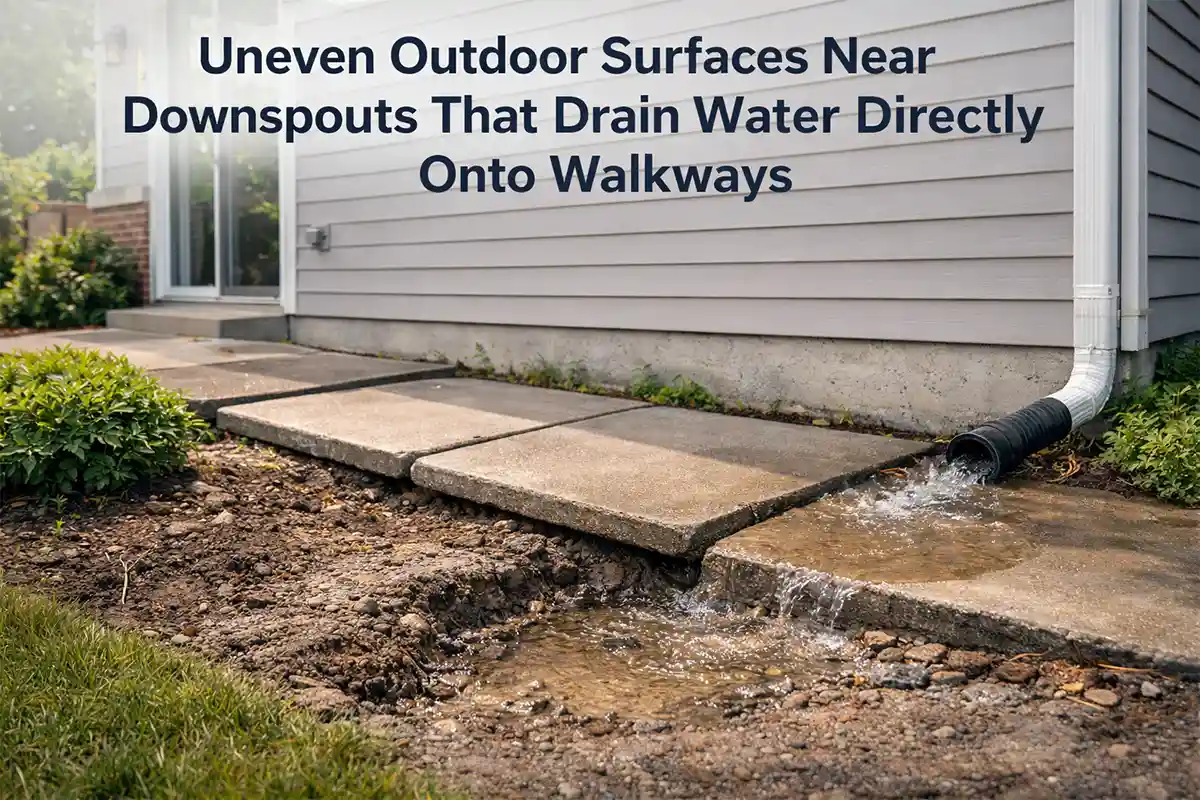
These shifts are often most noticeable near roof drainage outlets. At the base of a gutter downspout, rainwater typically exits the roof system at a concentrated point before spreading across nearby ground or hard surfaces. A walkway located within a few feet of this outlet may show darker patches after rainfall, especially where water repeatedly lands before flowing away.
Moisture tends to linger longer in this area. After storms, the surface may remain damp while nearby sections of pavement have already dried. Fine sediment often gathers along the edges of the path, and narrow water tracks sometimes appear where runoff repeatedly travels across the same route.
Over time, the paving closest to the downspout may begin to shift. Individual stones or concrete sections might tilt slightly or settle lower than the surrounding surface. Even a height difference of ¼ inch can become noticeable when walking across the path or pushing garden equipment.
Seasonal weather changes can amplify these early signs. During freeze–thaw cycles, saturated soil expands when frozen and contracts as it thaws. Areas exposed to concentrated roof runoff absorb more moisture than the rest of the walkway base, which can exaggerate small irregularities.
Landscape contractors frequently observe this pattern in homes where gutter discharge is directed onto paved paths instead of soil beds or dedicated drainage lines. What appears to be a small surface irregularity often signals gradual soil movement occurring beneath the walkway structure.
What These Observations Usually Mean
Roof drainage systems collect large amounts of water and release it rapidly through downspouts. A typical 1,200-square-foot roof can shed more than 700 gallons of water during a one-inch rainfall event, meaning the discharge point receives a concentrated surge of runoff.
When this water repeatedly strikes the same portion of a walkway, the soil beneath the surface gradually changes behavior. Moisture fills the air pockets within the soil structure, reducing the friction that normally keeps soil particles locked together. Studies referenced by several U.S. land-grant university extension programs show that soil strength may decline by 20–40 percent once saturation levels rise significantly.
Walkways are normally built on a compacted base made of crushed stone or gravel. This layer distributes weight evenly and prevents the paving surface from shifting. However, when runoff flows across or beneath the walkway, small particles within the base layer can slowly migrate.
Each storm may carry away only a small amount of material, but the cumulative effect becomes visible over time. As support beneath the walkway weakens, surface sections begin to settle unevenly.
Another contributing factor involves water direction. Runoff leaving a downspout often follows slight surface slopes or gaps between paving joints. When water repeatedly travels along the same path, it gradually removes fine particles from the base material.
This slow destabilization is one of the mechanisms described in Why Outdoor Walkways Become Uneven, where small shifts begin long before major cracks or structural damage appear.
Properties built on sloped ground can experience an additional influence. Roof runoff moving across an inclined surface may accelerate downhill soil displacement. Similar conditions appear in Uneven Outdoor Surfaces on Sloped Yards Where Soil Slowly Washes Downhill, where gravity and water movement gradually relocate supporting soil.
Over longer periods, this interaction between concentrated water flow and soil instability becomes part of the broader ground behavior described in Soil Movement Causing Surface Problems. Minor surface irregularities often represent the earliest visible sign of deeper subsurface movement.
Quick Diagnostic Checklist
Several environmental indicators commonly appear when roof drainage begins affecting the stability of a nearby walkway.
• A damp or darker patch forms within 1–3 feet of a downspout outlet after rainfall.
• Sediment or sand accumulates along the edges of the walkway following storms.
• Individual paving stones show slight tilting near the gutter discharge point.
• Moss or algae develops more heavily in areas that remain consistently moist.
• Small depressions appear where runoff repeatedly lands before spreading outward.
• Narrow water channels form beside or across the walkway surface.
• Surface irregularities become more noticeable after winter freeze–thaw cycles.
When multiple signals appear together near a roof drainage outlet, the underlying cause often relates to repeated runoff concentration rather than normal surface aging.
Indicators and Conditions
| Indicator | Condition | Likely Cause | Recommended Fix |
|---|---|---|---|
| Depressed paving directly under downspout outlet | Concentrated runoff hitting same point | Soil beneath base slowly eroding | Install downspout extension to redirect water |
| Pavers tilting toward house wall | Water trapped along foundation edge | Poor drainage slope | Regrade soil and adjust walkway slope |
| Moss or algae growing near outlet area | Surface stays damp longer than surrounding pavement | Excess moisture from roof runoff | Improve drainage and increase sunlight exposure |
| Fine sand washing out of paver joints | Water flowing across surface repeatedly | Base material migration | Refill joints and stabilize base layer |
| Small channels forming beside walkway | Runoff carving shallow erosion paths | Water leaving outlet at high velocity | Add splash block or underground drain pipe |
Practical Steps That Usually Solve the Problem
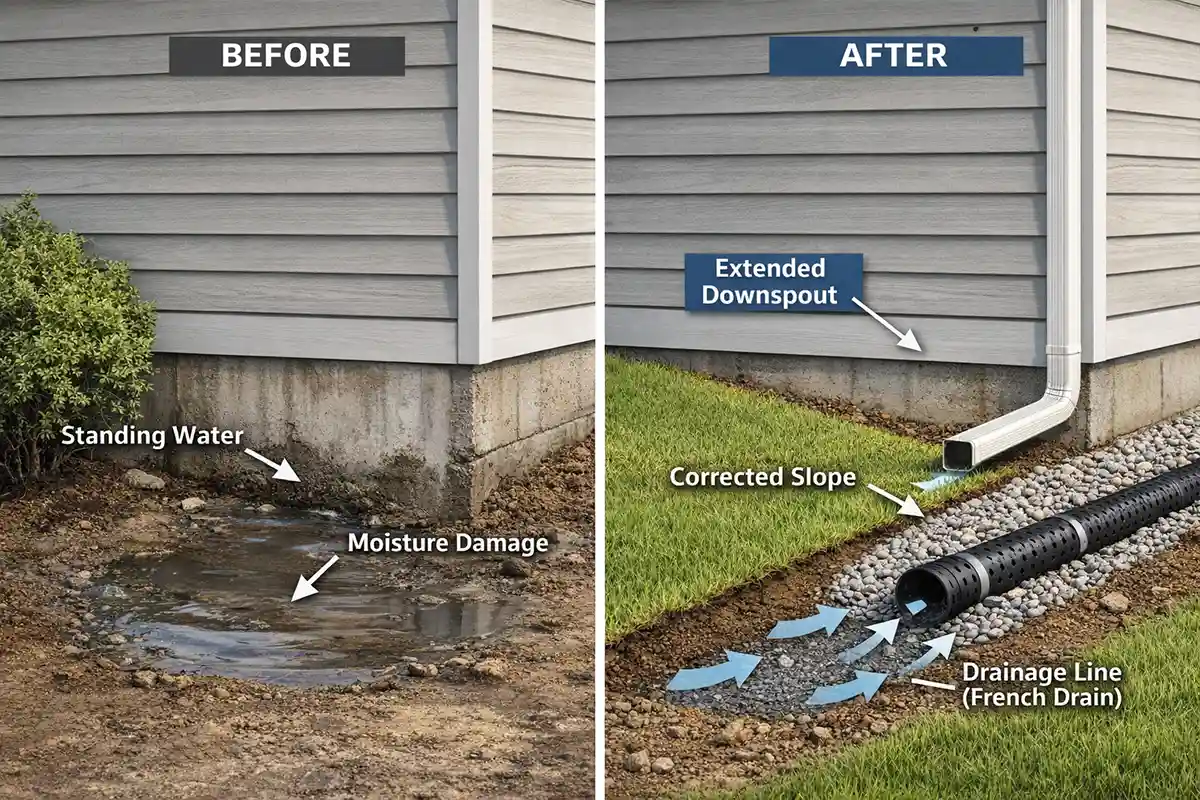
Solving this issue usually involves redirecting roof runoff so that water disperses safely across soil areas rather than concentrating on paved surfaces.
Extend the downspout outlet
A simple downspout extension can redirect water 4–6 feet away from the walkway. Flexible drainage extensions or rigid piping are commonly used to carry runoff toward lawns, garden beds, or designated drainage areas.
This distance helps spread the water across a larger surface area where the soil can absorb it gradually.
Install a splash block or drainage pad
Where extensions are impractical, a splash block can help distribute the force of falling water. Concrete or plastic splash blocks guide runoff away from the outlet while preventing concentrated erosion.
In high-flow locations, placing a shallow bed of decorative stone beneath the outlet can further reduce water velocity and limit soil disturbance.
Adjust grading around the walkway
Outdoor walkways should ideally slope away from buildings at approximately ¼ inch per foot. If runoff currently flows across the path toward the foundation, adjusting nearby soil grading may redirect water toward lawn areas where infiltration occurs naturally.
Even small grading adjustments can significantly change runoff direction.
Reset affected paving sections
If settlement has already occurred, the uneven pavers or slabs may need to be lifted and reset. Proper repair usually involves removing the affected stones, adding compacted crushed gravel beneath the base layer, and restoring a stable foundation.
A typical walkway base should include 4–6 inches of compacted crushed stone, which distributes weight and resists future erosion.
Install an underground drainage line
Homes with large roof areas sometimes produce runoff volumes that exceed the capacity of surface solutions. In these situations, connecting the downspout to an underground drainage pipe provides a more permanent fix.
These systems carry roof water to a drainage basin or outlet point located safely away from the walkway and foundation.
Field Questions
Why does the uneven section appear closest to the downspout?
The highest water velocity occurs where roof runoff exits the drainage system. Impact pressure and repeated soil saturation are strongest within the first few feet of the outlet.
Why do the surface changes become more visible after winter?
Freeze–thaw cycles expand water trapped in the soil beneath the walkway. Areas that remain saturated during winter tend to experience more soil movement as frozen water expands and contracts.
Can minor unevenness eventually lead to larger structural problems?
Yes. Once base material begins shifting or eroding, the walkway loses uniform support. Continued water flow can enlarge the void beneath the paving and gradually increase the visible surface settlement.
Final Field Notes
Small surface irregularities near roof drainage outlets often develop gradually rather than appearing suddenly. Concentrated runoff repeatedly striking the same area slowly alters soil stability beneath the walkway.
Early signs usually include persistent moisture, sediment movement, and slight changes in pavement height. Over time, these small indicators reveal that water is removing or weakening the base material supporting the surface.
Redirecting roof runoff is typically the most effective solution. When drainage extensions, splash blocks, or underground pipes move water away from the walkway, the surrounding soil regains stability and further surface movement usually slows or stops.
Observing water flow during heavy rain can reveal how roof drainage interacts with surrounding surfaces. Once runoff disperses across soil instead of striking pavement directly, walkway stability generally improves significantly.
For additional research on soil stability and drainage practices in residential landscapes, resources from the USDA Natural Resources Conservation Service provide extensive guidance.