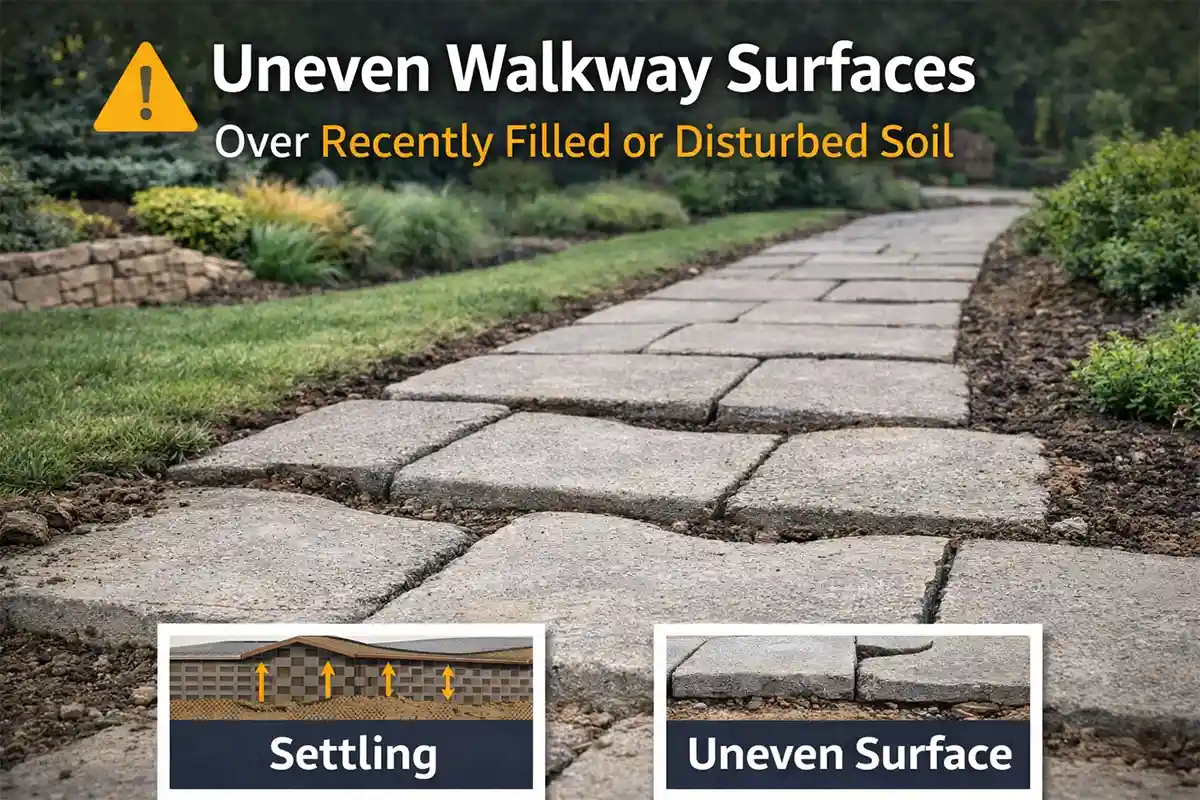
Walkways installed over recently filled or disturbed ground often begin shifting within the first year after construction. Soil that has been moved during landscaping, trenching, or grading contains trapped air pockets and loose particles that compress over time. As the soil settles unevenly, sections of the path begin sinking or tilting. The most reliable first fix is lifting the affected stones or slabs, compacting the base layer properly, and reinstalling the walkway over a stable gravel foundation. Without correcting the ground beneath, surface adjustments rarely last long.
Homeowners commonly notice shallow dips or slightly raised edges forming along the path months after installation. Even small changes matter. A difference of ½ inch between adjacent stones can create a noticeable walking hazard or allow water to collect in low spots.
Why This Happens
Soil behaves very differently once it has been excavated and replaced. When ground is disturbed during yard projects—such as installing irrigation lines, repairing drainage systems, planting trees, or grading the landscape—the natural soil structure breaks apart. Even when the soil is leveled afterward, it rarely returns to its original density immediately.
Loose fill soil contains small air pockets between particles. Over time, gravity, rainfall, and daily foot traffic compress these spaces. Extension research from several U.S. land-grant universities notes that newly placed fill soil may settle 10–20 percent of its original depth during the first year if the soil was not mechanically compacted during installation.
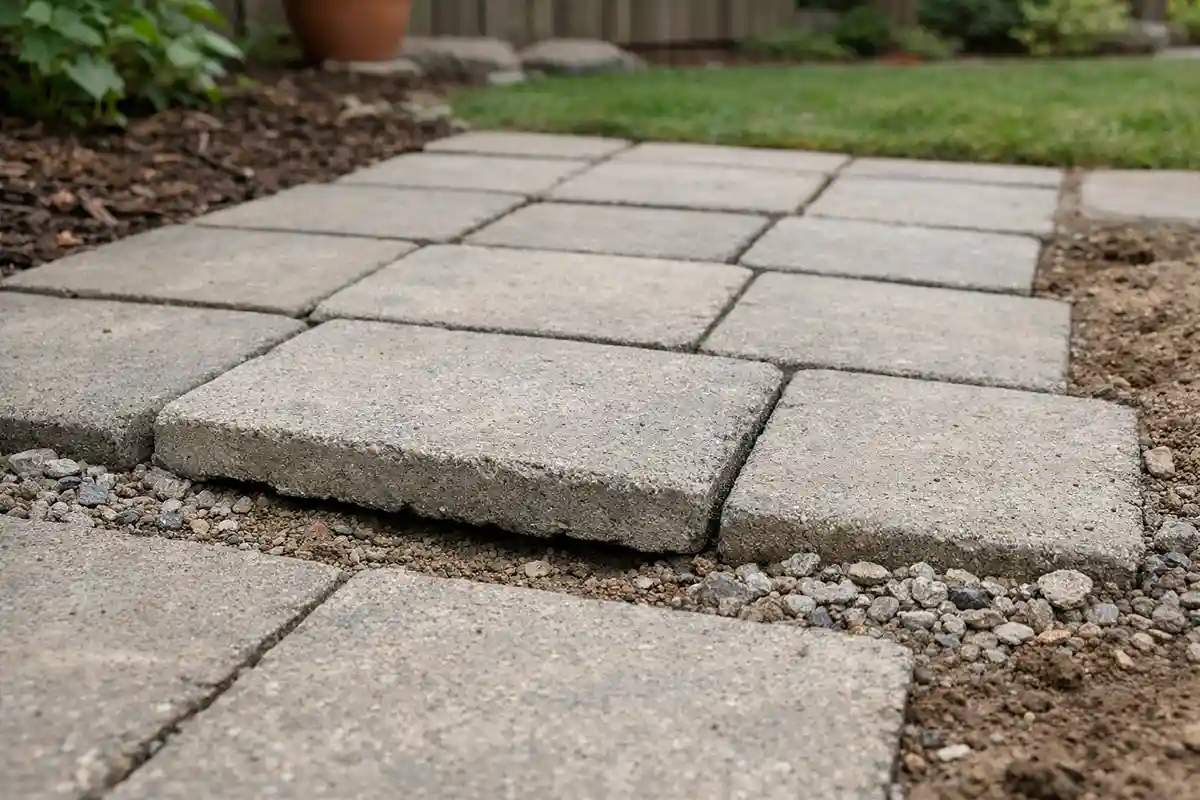
This gradual compression changes how the ground supports hard surfaces. Walkways rely on a layered structure consisting of the subgrade soil, a compacted gravel base, and a thin bedding layer of sand beneath the pavers or slabs. When the soil layer beneath this system compresses unevenly, the base can no longer distribute weight evenly. Some sections begin sinking slightly while nearby areas remain stable, creating tilted pavers or shallow depressions.
Changes in moisture also influence how disturbed soil behaves. Clay-rich soils expand when wet and contract as they dry, slowly altering the pressure beneath outdoor structures. These shifting conditions are part of the broader ground movement patterns explained in Soil Movement Causing Surface Problems, where unstable subsurface layers gradually affect patios, driveways, and walkways.
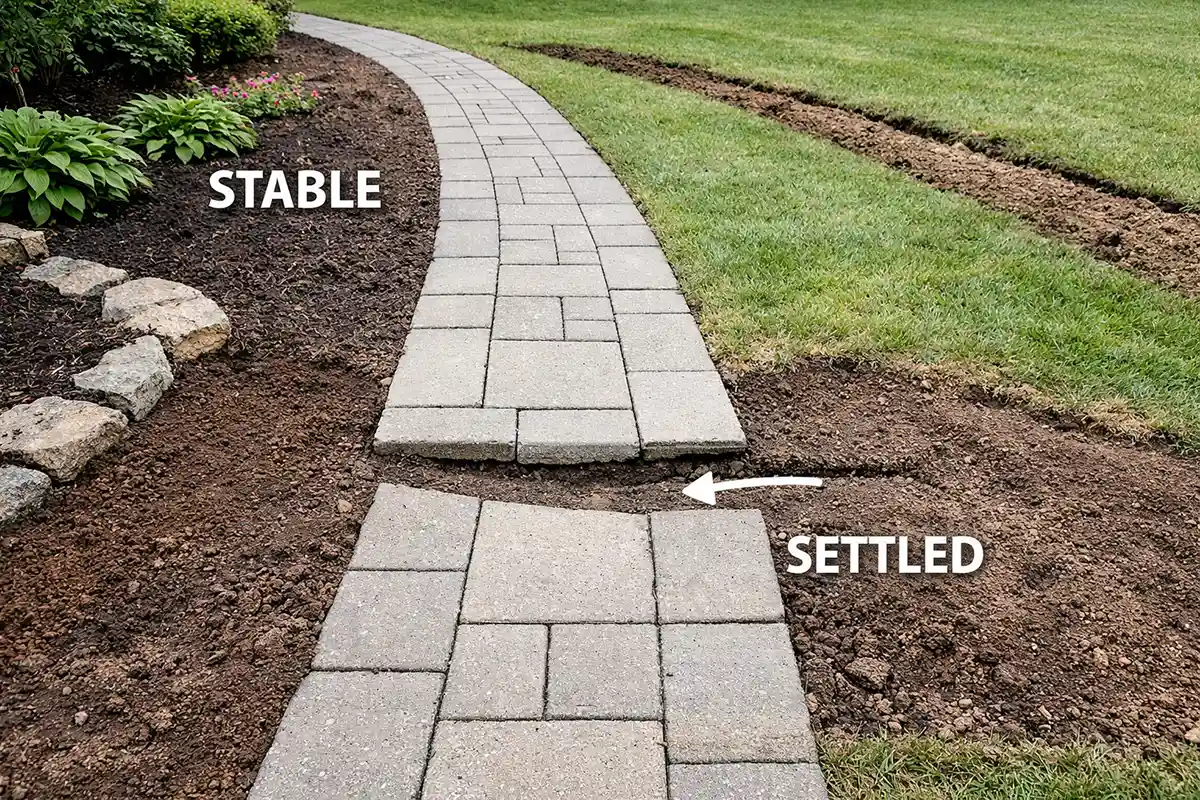
Another common factor involves soil disturbed by trenching work. When contractors dig narrow trenches for irrigation pipes, electrical conduits, or drainage lines, the excavated soil is usually returned to the trench. Unless the soil is compacted in layers, the trench line settles gradually over time, leaving a visible depression that can run directly beneath a walkway.
Professional installations prevent this by compacting soil in 2–3 inch lifts using a plate compactor. Multiple passes compress each layer before the gravel base is installed, creating a stable subgrade capable of supporting the walkway system for many years.
How Settlement Usually Develops Over Time
Ground settlement rarely appears all at once. In most residential walkways, the change develops gradually as the disturbed soil beneath the surface slowly compresses. The progression usually follows a predictable pattern.
Early stage
The first sign is often a slight dip between adjacent stones or slabs. The difference may be less than ¼ inch, and the walkway may still appear mostly level from a distance.
Intermediate stage
As the soil continues settling, some pavers begin rocking slightly when stepped on. Small gaps may appear between stones as the bedding sand shifts.
Advanced stage
Eventually the height difference between stones can exceed ½ inch. At this point the uneven surface becomes more noticeable and may start collecting water after rain.
Addressing the issue during the early stage often prevents larger repairs later, since the base structure beneath the walkway has not yet shifted significantly.
Quick Diagnostic Checklist
Several visible clues suggest that a walkway problem may be connected to recently disturbed ground:
-
The path was installed shortly after landscaping, trenching, or yard grading.
-
Slight dips appeared gradually rather than forming from sudden cracks.
-
Stones rock slightly when stepped on.
-
A narrow strip of settlement follows a straight line across the yard, often indicating an old trench.
-
Water collects along sections of the path after rain.
Drainage patterns can amplify the problem. Runoff from roofs or nearby slopes often concentrates moisture in newly disturbed soil. As the soil repeatedly softens and compresses, sections of the walkway may sink faster. In properties where downspouts release water directly beside paths, similar settlement patterns appear as described in Uneven Outdoor Surfaces Near Downspouts That Drain Water Directly Onto Walkways.
Common Situations Where This Occurs
Settlement problems most often appear in areas where the ground was recently modified before a walkway was installed. Several typical property situations make the issue more likely.
One common example occurs after major landscaping projects. Imagine a backyard where several inches of soil were added to level the lawn. A new paver walkway is installed across the area soon afterward. The path initially looks stable, but over the next year the underlying soil compresses unevenly. Sections near the center begin dipping slightly while the edges remain level.
Another frequent situation appears after underground utilities are installed. Irrigation systems, electrical lines, and drainage pipes often require trenches running across the yard. Even when the soil is replaced neatly, the filled trench tends to settle over time. Walkways crossing these areas often develop narrow depressions following the trench line.
Trees can also influence soil stability. As roots expand underground, they gradually disturb surrounding soil layers. Sometimes the roots directly push paving materials upward, while nearby soil pockets settle slightly as the ground reorganizes around the growing roots. This behavior often overlaps with patterns described in Tree Roots Lifting Pavers and Creating Uneven Outdoor Surfaces.
Sloped properties present another variation. When fill soil is added to level parts of a hillside yard, rainfall slowly carries fine soil particles downhill. The upper section of the path may remain stable while the lower portion settles or shifts. Similar erosion-driven movement is explored in Uneven Outdoor Surfaces on Sloped Yards Where Soil Slowly Washes Downhill.
Causes and Practical Fixes
| Cause | Signal | Fix |
|---|---|---|
| Recently filled soil not compacted | Walkway begins sinking within the first year | Lift the surface and compact soil and base layers using a plate compactor |
| Utility trench settlement beneath walkway | Narrow dip running across the path | Rebuild the base along the trench line using compacted crushed gravel |
| Organic or loose soil beneath pavers | Ground feels soft when stepped on | Remove loose soil and replace with compacted gravel base |
| Water infiltration softening disturbed soil | Low spots hold water after rain | Improve drainage slope and redirect runoff away from the walkway |
When uneven areas grow larger, the surface becomes more than a cosmetic issue. Even small height differences can disrupt safe footing, particularly in frequently used garden paths. Over time these shifts may develop into the type of walking hazards described in Uneven Ground Creating Trip Hazards.
Long-term repairs usually involve rebuilding the structural base beneath the walkway. Professionals often remove the affected section, install 4–6 inches of compacted crushed stone, and then apply a leveling sand layer before reinstalling pavers. This layered base spreads weight evenly and prevents further settlement.
These structural improvements also address the broader factors discussed in Why Outdoor Walkways Become Uneven, where drainage, soil stability, and base preparation combine to influence long-term surface performance.
Quick Questions
How long does soil settlement typically continue after ground is disturbed?
Most noticeable settlement occurs within the first 12–18 months after excavation or filling. Clay-rich soils may continue shifting during seasonal moisture cycles.
Is lifting and resetting the stones enough to fix the problem?
Resetting stones without improving the base usually provides only temporary improvement. Compacted gravel and stable subgrade layers are necessary to stop recurring settlement.
Quick Summary
Walkways installed over recently filled or disturbed soil often become uneven as the ground beneath slowly compresses. Air pockets within loose soil collapse over time, particularly after rainfall or repeated foot traffic. This causes stones or slabs to sink at different rates.
The most reliable repair involves removing the affected section, compacting the underlying soil in layers, installing a stable gravel base, and reinstalling the surface materials. Addressing drainage and soil stability at the same time greatly reduces the chance of future settlement.
Soil compaction and settlement behavior in disturbed ground are widely documented by university research programs such as Purdue University Extension.