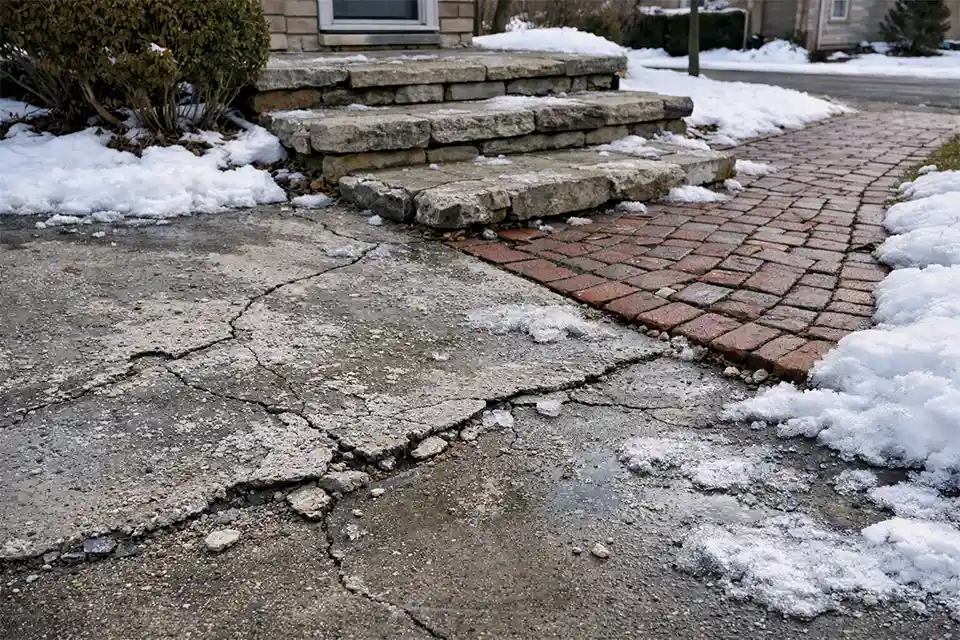
Understanding Freeze–Thaw Damage in Outdoor Surfaces
Freeze–thaw damage occurs when water penetrates small pores or microcracks in outdoor materials and then freezes as temperatures drop below 32°F (0°C). When liquid water turns to ice, its volume increases by roughly 9 percent, generating significant pressure within the material.
That pressure may exceed 3,000 psi in confined pore spaces, gradually breaking down the internal structure of concrete, brick, stone, or asphalt. Over repeated cycles of freezing and thawing, surfaces begin to deteriorate from the inside out.
This process is especially common in northern U.S. regions where temperatures frequently fluctuate around freezing. In places like Michigan, Wisconsin, and Minnesota, outdoor surfaces may experience 40 to 80 freeze–thaw cycles during a single winter.
While patios often receive the most attention, freeze–thaw damage frequently affects driveways, walkways, driveway edges, retaining wall bases, steps, and compacted pathways. These areas tend to collect snowmelt or standing water, allowing moisture to penetrate the surface before freezing again overnight.
Seasonal weather exposure plays a major role in how quickly these surfaces deteriorate. Environmental factors such as temperature swings, moisture exposure, and solar radiation all contribute to material fatigue, which is discussed in How Weather Exposure Damages Outdoor Surfaces.
Quick Diagnostic Checklist
Early freeze–thaw damage can be subtle. Look for these common signs:
-
Thin flakes or surface scaling appearing on concrete
-
Small spider-web cracks forming across the surface
-
Exposed aggregate appearing where the surface layer has worn away
-
Pitted or rough texture developing over time
-
Loose particles or grit accumulating on driveways or walkways
-
Water pooling in shallow depressions after snowmelt
If several of these symptoms appear shortly after winter, repeated freeze–thaw cycles are often the underlying cause.
Why Non-Patio Surfaces Are Often More Vulnerable
Many homeowners assume patios suffer the most winter damage, but several other outdoor surfaces are actually more vulnerable.
Driveways and entry walkways experience constant exposure to snow accumulation, vehicle traffic, and de-icing chemicals. When snow melts during warmer daytime temperatures—often around 34–38°F—water penetrates surface pores. Overnight freezing then expands that trapped moisture.
This repeated expansion gradually weakens the material structure.
Another risk factor is drainage direction. Many walkways slope toward the home or garage, allowing snowmelt to collect rather than drain away. Over time, this trapped moisture creates ideal conditions for freeze–thaw deterioration.
Uneven surfaces may also trap water in shallow depressions, allowing ice pressure to build beneath the surface layer. In some cases, these issues combine with soil movement and base instability, contributing to problems like those explained in Why Outdoor Surfaces Shift Over Time.
Outdoor Surfaces Most Vulnerable to Freeze–Thaw Cycles
Not all materials respond to winter conditions in the same way. Surface porosity, drainage conditions, and base stability all influence how quickly freeze damage develops.
| Surface Type | Risk Level | Reason | Prevention Strategy |
|---|---|---|---|
| Concrete driveways | High | Porous surface absorbs snowmelt | Seal surface and improve drainage |
| Brick walkways | Medium–High | Mortar joints allow water infiltration | Repoint joints and apply sealant |
| Natural stone steps | Medium | Stone may contain micro-fractures | Ensure proper slope and sealing |
| Asphalt driveways | Medium | Softens during summer then cracks in winter | Maintain seal coating |
| Gravel pathways | Low | Flexible structure allows movement | Maintain proper compaction |
| Retaining wall bases | Medium–High | Water collects near structural edges | Install drainage behind wall |
Surface durability also depends heavily on the quality of the material and installation. Poor compaction beneath outdoor surfaces can increase the risk of cracking when freeze expansion stresses the structure, as explained in Poor Compaction Under Outdoor Surfaces Causes Signs and Long-Term Fixes.
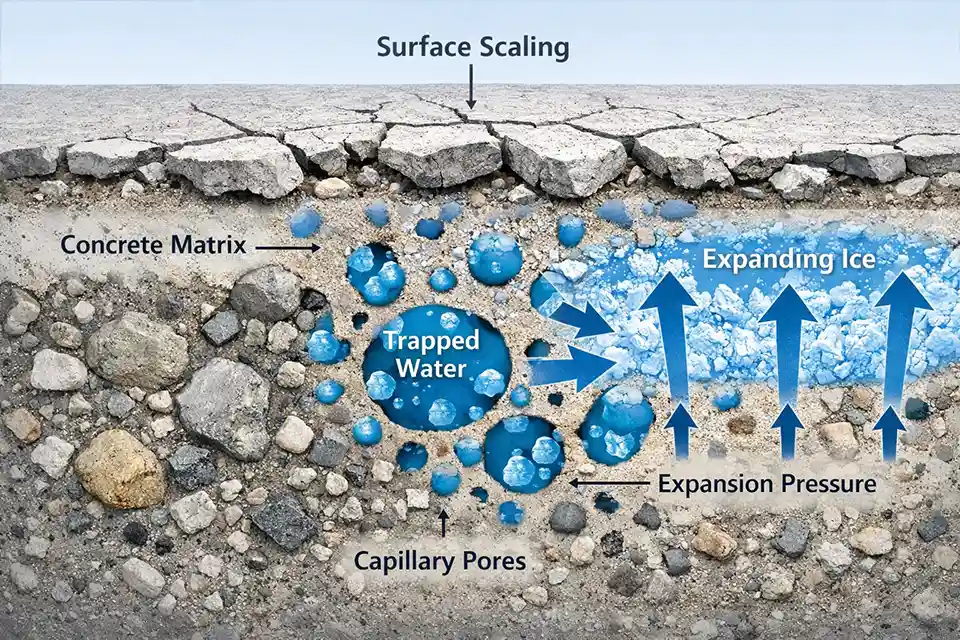
The Mechanical Process Behind Freeze–Thaw Deterioration
Outdoor construction materials contain microscopic voids known as capillary pores. These pores allow water to enter the material during rainfall, snowmelt, or irrigation.
When temperatures fall below freezing, the trapped water expands and exerts outward pressure on the surrounding structure.
Over time, several mechanical processes occur:
-
Micro-fractures develop within the surface layer
-
Surface scaling begins as thin flakes detach
-
Cracks widen and allow deeper water penetration
-
Structural spalling eventually breaks larger sections
This deterioration often accelerates during late winter when daytime temperatures repeatedly climb above freezing before dropping again overnight.
Freeze damage may also worsen when other environmental stresses are present. For example, water runoff or poor grading can keep surfaces saturated, increasing the amount of moisture available to freeze. Situations like these are often linked to drainage issues discussed in Poor Drainage on Outdoor Walkways Causes Risks and Long-Term Damage.
Early vs Severe Freeze–Thaw Damage
Freeze–thaw deterioration usually progresses in stages rather than appearing suddenly.
Early Stage Damage
In the early stages, the damage may appear cosmetic but signals the beginning of structural deterioration.
Typical symptoms include:
-
light surface scaling
-
rough or sandy texture
-
small flakes separating from concrete
-
minor hairline cracking
These signs often appear within 3–5 winters on exposed surfaces.
Advanced Damage
More severe freeze–thaw deterioration develops after repeated seasonal cycles.
Symptoms may include:
-
deep cracking across the surface
-
large chips breaking away from concrete edges
-
exposed aggregate or internal stone fragments
-
loose structural sections along driveway edges
Once damage reaches this stage, structural repair may be necessary. Severe chipping and material loss often require resurfacing or partial replacement similar to the structural repair methods discussed in Best Solutions for Breaking and Chipping Outdoor Surfaces.
Environmental Conditions That Accelerate Freeze–Thaw Damage
Several environmental conditions significantly increase the likelihood of freeze damage.
| Environmental Factor | Impact | Typical Risk Level | Mitigation |
|---|---|---|---|
| Frequent temperature swings | Repeated expansion cycles | High | Seal surfaces and improve drainage |
| Standing snowmelt | Saturates surface pores | Very High | Adjust grading |
| De-icing salts | Increase water absorption and scaling | Moderate–High | Use alternative de-icers |
| Poor surface slope | Water collects on surface | High | Regrade or install drainage |
| High material porosity | Absorbs more moisture | Moderate | Apply penetrating sealant |
In northern states, freeze damage is often worsened by road salt or de-icing chemicals. These materials lower the freezing point of water and keep surfaces wet longer, allowing more moisture to penetrate before freezing again.
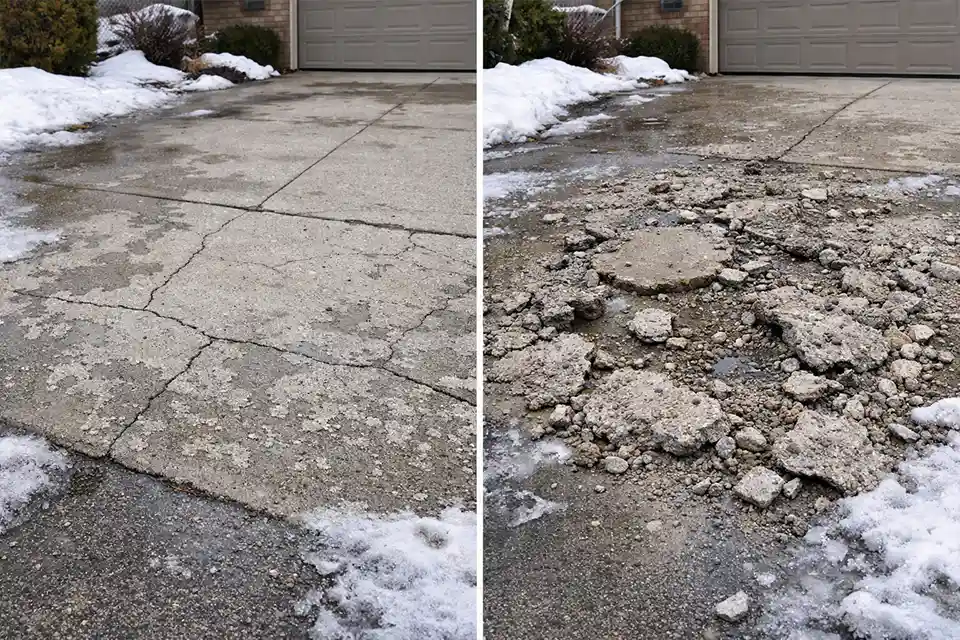
How Freeze–Thaw Damage Connects to Larger Surface Problems
Freeze–thaw damage rarely occurs in isolation. It often interacts with other outdoor surface issues that gradually weaken structural stability.
For example, soil movement beneath outdoor surfaces may create small depressions that collect water. Once water accumulates in these areas, freeze expansion accelerates the deterioration process.
Surface instability may also develop along driveway edges or walkway joints, where soil erosion or drainage failure creates small voids beneath the surface.
Over time, these combined stresses can produce uneven ground conditions that create both structural damage and safety hazards for homeowners.
Practical Ways to Prevent Freeze–Thaw Damage
Preventing freeze–thaw deterioration mainly involves controlling moisture exposure and strengthening the material’s resistance to temperature stress. Small improvements in drainage or sealing can reduce long-term damage dramatically.
Improve Drainage Around Surfaces
Water that remains on outdoor surfaces after rain or snowmelt is the primary trigger for freeze expansion.
Driveways and walkways should typically maintain a slope of 1–2 percent (about 1/8–1/4 inch per foot) to allow water to drain away. If surfaces settle or soil shifts, that slope may disappear, allowing water to pool.
Correcting grading problems, redirecting downspouts, or installing shallow channel drains can prevent moisture from collecting on vulnerable areas.
Drainage problems often worsen after heavy rainfall or saturated soil conditions, which are explained in Why Ground Becomes Unstable After Major Rainfall.
Seal Porous Materials
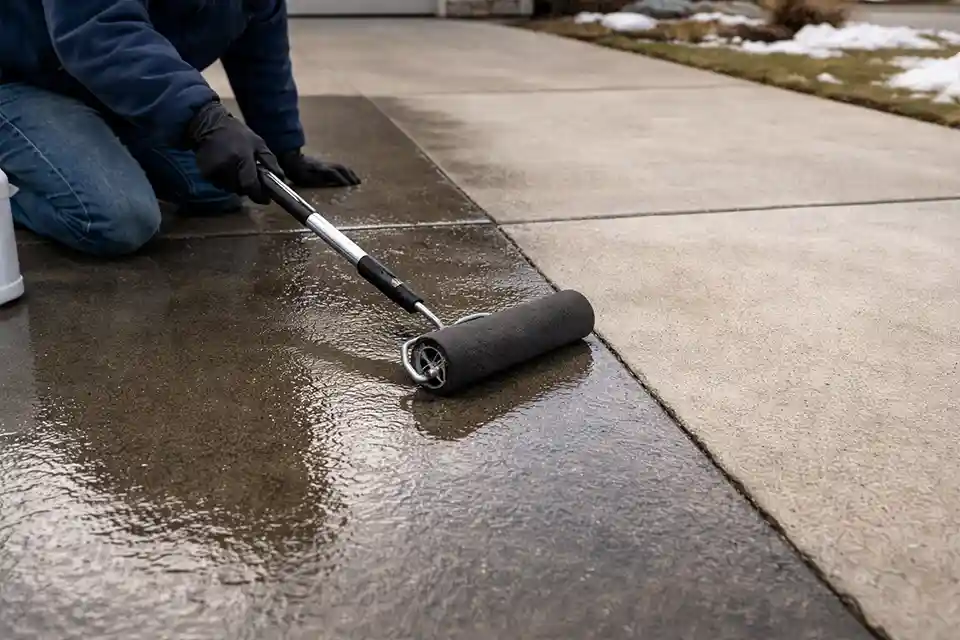
Concrete, natural stone, and brick all contain microscopic pores that absorb water. Applying a penetrating sealant can significantly reduce water infiltration.
High-quality penetrating sealers can lower moisture absorption by 60–90 percent, depending on the material. These products do not form a thick surface coating but instead fill capillary pores inside the material.
Most outdoor sealers remain effective for 3–5 years, although harsh climates may require more frequent reapplication.
Repair Cracks Before Winter
Even small cracks can allow large amounts of moisture to enter the surface.
Repairing cracks wider than 1/16 inch (about 1.5 mm) before winter helps prevent water infiltration that later freezes and expands.
Typical repair approaches include:
-
flexible concrete crack fillers
-
polymer patch compounds
-
mortar repairs for brick joints
-
asphalt crack sealers
Addressing small cracks early prevents freeze damage from spreading deeper into the surface.
Reduce De-Icing Salt Exposure
Traditional rock salt (sodium chloride) lowers the freezing point of water but can accelerate surface scaling.
When salt dissolves into meltwater, it increases the amount of moisture that penetrates porous surfaces. The combination of water absorption and freeze expansion often causes surface flaking.
Safer alternatives may include:
-
calcium magnesium acetate (CMA)
-
sand for traction
-
non-chloride de-icers
These options reduce freeze stress while still improving winter traction.
Repair Options Based on Damage Severity
The correct repair strategy depends largely on how far freeze–thaw deterioration has progressed.
| Damage Type | Visible Signs | Typical Repair | Difficulty |
|---|---|---|---|
| Early scaling | Surface flakes or rough texture | Seal surface and apply patch compound | Low |
| Surface cracking | Hairline or shallow cracks | Crack filling and sealing | Low–Medium |
| Spalling | Chipped sections exposing aggregate | Resurfacing overlay | Medium |
| Structural cracking | Deep cracks or shifting slabs | Partial slab replacement | High |
| Base failure | Surface sinking or uneven areas | Base reconstruction and repouring | Very High |
Small repairs performed early can prevent the need for expensive reconstruction later.
Freeze damage that progresses too far may combine with structural stresses such as soil movement or surface fatigue. Situations like these are often related to broader material degradation processes discussed in Why Surface Materials Fail Early and How to Prevent It.
Long-Term Maintenance Strategies for Cold Climates
Homeowners in northern climates benefit from developing a seasonal maintenance routine to reduce winter damage.
A typical annual plan might include:
Early Fall
-
Inspect surfaces for cracks
-
Repair damaged joints or mortar
-
Apply penetrating sealant if needed
Late Fall
-
Clean debris and organic buildup from surfaces
-
Ensure drainage paths are clear
-
Confirm downspouts direct water away from driveways and walkways
Winter
-
Limit salt use where possible
-
Remove snow accumulation before heavy melt cycles occur
Spring
-
Inspect surfaces for scaling or cracks
-
Repair early freeze damage before summer heat expands cracks further
Regular inspection allows homeowners to identify freeze-thaw damage while repairs remain relatively simple.
Frequently Asked Questions
How many freeze–thaw cycles cause damage?
Damage typically begins after repeated seasonal cycles. In colder regions of the United States, outdoor surfaces may experience 30–80 freeze–thaw cycles per winter, which gradually weakens porous materials.
Does new concrete resist freeze–thaw damage?
New concrete is usually more resistant if it contains air-entrained additives, which create microscopic air pockets that relieve internal pressure during freezing. However, poor drainage or early water exposure can still cause damage.
Why do driveway edges often deteriorate first?
Driveway edges often collect snow piles or runoff from surrounding areas. This moisture saturates the concrete and freezes repeatedly, accelerating scaling and cracking.
Can sealing completely prevent freeze–thaw damage?
Sealing greatly reduces risk but cannot eliminate it entirely. If water consistently pools on the surface, freeze expansion can still cause deterioration over time.
Do warmer winters reduce freeze damage?
Not always. Winters that frequently fluctuate between 28°F and 36°F may actually produce more freeze–thaw cycles than consistently cold climates.
Key Insights
Freeze–thaw damage is a mechanical weathering process driven by moisture infiltration and temperature fluctuation. When water trapped in porous materials freezes, expansion pressure gradually weakens the surface structure.
Driveways, walkways, steps, and retaining wall bases often experience the most damage because they collect snowmelt and runoff.
Early warning signs—such as surface scaling, small cracks, or exposed aggregate—indicate that freeze expansion has already begun affecting the material. Addressing drainage problems, sealing porous surfaces, repairing cracks early, and limiting de-icing salt exposure can significantly slow the deterioration process.
Research from the University of Minnesota Extension highlights freeze–thaw cycles as one of the leading causes of concrete surface scaling and structural deterioration in cold-weather regions of North America.