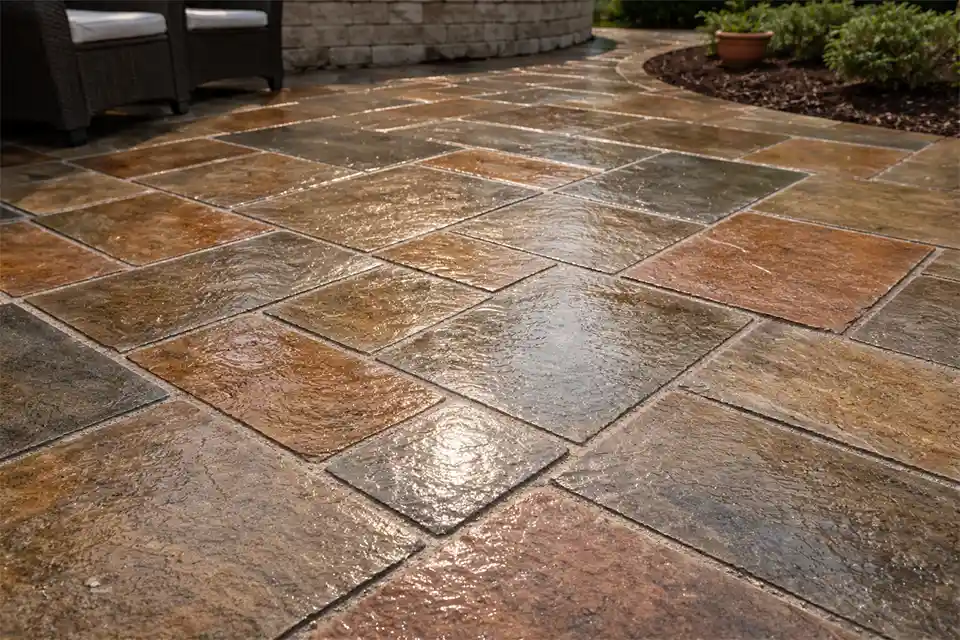
If a natural stone patio felt stable before sealing and slick right after, the sealer is the lead suspect. In most cases, grip drops because the treatment changed the top surface rather than because the stone suddenly “went bad.”
The first checks are practical: whether the finish now reflects more light, whether water beads tightly instead of darkening the stone within about 30 to 60 seconds, and whether the loss of traction showed up within the first 24 to 72 hours after application.
That is a different pattern from algae, grime, or long-term wear, which usually build gradually. When the change is fast, broad, and closely tied to the application window, the problem is usually surface behavior, not structural failure.
That distinction matters because people often treat this like a cleaning issue and lose time. A sealed patio that suddenly turned slick is usually dealing with film build, residue, or an overly appearance-driven finish choice, not ordinary outdoor dirt.
What people misread first
The first mistake is assuming “sealed” means “better protected, therefore safer.” Stain resistance and slip resistance are not the same thing.
Some penetrating sealers keep most of the stone’s micro-texture intact. Others, especially gloss-enhancing or film-forming products, can mute the tiny surface irregularities that create traction.
The second mistake is blaming weather too early. Humid Florida conditions, coastal moisture in California, and long dew cycles in shaded Midwestern yards can expose the problem faster, but they usually are not the root cause. They reveal a finish that was already too slick.
This is also where readers mix up symptom and mechanism. The symptom is slippery stone when damp. The mechanism is reduced friction because the sealer filled texture, left residue, or created a smoother top layer than the stone originally had.
That is why a patio can still look natural while feeling much less secure underfoot. A useful companion read is slippery outdoor stone surfaces explained.
Quick diagnostic checklist
-
The patio became slick within 24 to 72 hours of sealing, not slowly over weeks or months.
-
Water beads very tightly instead of spreading slightly or darkening the stone within 30 to 60 seconds.
-
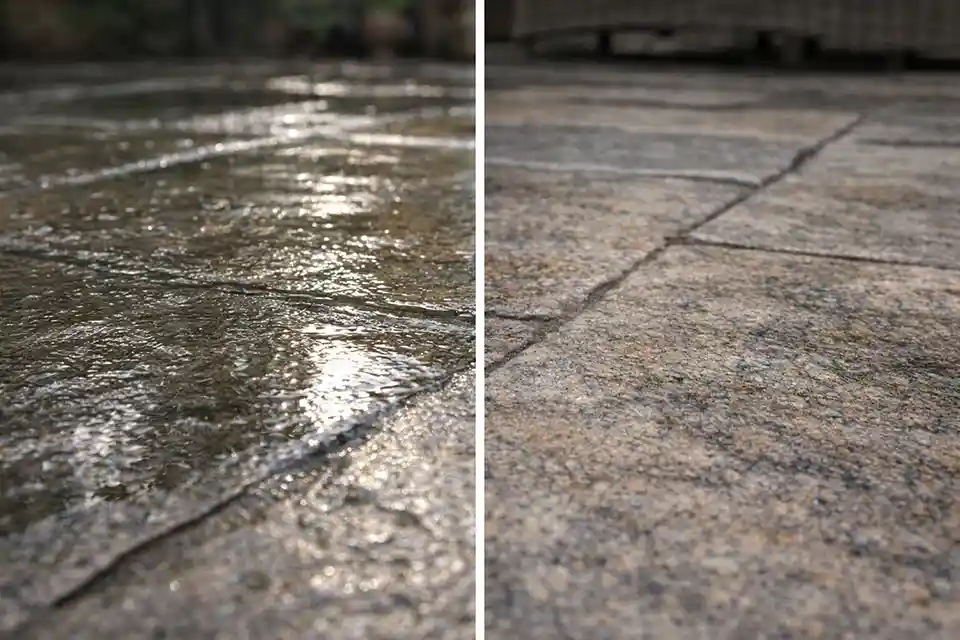
The surface shows more glare or sheen at a low viewing angle than it did before.
-
The slickness is fairly uniform across treated areas, not just in one shaded corner.
-
The problem is worse with light moisture, dew, or a thin rinse film than during full saturation.
-
A white cloth rubbed over the surface picks up slight residue, haze, or tackiness after the cure period.
If most of those are true, this is much more likely a sealer-related traction issue than a basic cleaning problem.
Why the obvious fix often wastes time
The obvious fix is usually to clean the patio again or wait for weathering to “knock the shine down.” Both are often overrated.
Cleaning helps only when surface contamination is part of the problem. If the real issue is excess product or a finish that closed off too much texture, a cleaner will not restore meaningful grip.
Waiting is also less reliable than people think. Sun, foot traffic, and rain can soften the effect of a bad application, but that may take a full season, and on low-traffic patios it can take longer.
The bigger mistake is adding another coat because the first one “didn’t cure right.” That usually makes the patio smoother and more uniform, which is exactly the wrong direction if traction already fell off.
One of the most common disappointments with sealed stone is a cosmetic win that quietly creates a daily-use hazard. That same mismatch shows up in other wet-surface cases, especially where surfaces feel dangerous even when they look dry.
What actually changes the outcome
The fix depends on what is on the stone and how heavily it was applied.
| Condition | What it usually means | Better next step |
|---|---|---|
| Slick only during the first 24–72 hours | Cure may be incomplete | Restrict use, keep it dry, and reassess after full cure |
| Slick after full cure with visible sheen | Film-forming or overapplied sealer | Test remover or stripper on a small area |
| Slick in patches, streaks, or edges | Uneven residue or pooled product | Correct those sections first, then retest |
| Slick mostly in shade or near planters | Moisture plus organics may be contributing | Clean growth first, then reassess the sealer |
| Matte look but still low grip | Stone may already be too smooth | Consider traction treatment, not more sealer |
If the patio is still slick after the stated cure window, usually around 48 to 72 hours for many outdoor products and often longer in cool or damp conditions below roughly 50°F, guessing stops making sense.
The best move is a controlled test patch. Strip or reduce the finish on a 1- to 2-square-foot section and compare wet and dry traction against the untreated area. That one test tells you more than broad re-cleaning or broad resealing.
A healthier result is not “maximum beading at all costs.” That goal gets overvalued. For outdoor stone, a better target is controlled repellency without a slick film.
The National Park Service’s preservation guidance also distinguishes water-repellent treatments from waterproof coatings and warns that coating choices can create unwanted consequences when used inappropriately on masonry.
Pro Tip: Test traction where people pivot, not just where they walk straight. Door thresholds, grill zones, and step approaches reveal grip loss much faster.
When the usual fix stops being enough
A standard correction stops being enough when two conditions overlap: the sealer reduced grip, and the stone was already on the smooth side.
In that case, stripping may improve the patio but not fully solve it. The real answer may be a traction-focused treatment or a different finish strategy rather than a simple reset.
That is especially common on dense stone, honed finishes, and patios near pools, outdoor kitchens, or frequent rinse zones. Similar behavior shows up on polished stone walkways near outdoor kitchens, where repeated moisture turns a marginal surface into a predictable slip point.
Runoff is another factor people underestimate. Even a mild slope of around 2% to 3% can keep refreshing a slick surface film instead of letting it dry evenly. On those patios, drainage and finish choice have to be judged together. That is where slippery sloped patios affected by rainwater runoff becomes relevant.
A better repair decision
The cleanest decision sequence is simple. Confirm the full cure period first. Identify whether the sealer is penetrating or film-forming. Run a small correction test. Then decide whether the patio needs residue removal, partial stripping, full stripping, or a traction-improving re-treatment.
The priority is not getting the richest color back as fast as possible. It is restoring predictable footing. That is the point people tend to underestimate because the patio often still looks “finished.” But a patio that looks better and behaves worse is not a successful treatment.
In practice, the jobs that disappoint most are rarely dramatic failures. They are attractive finishes that quietly trade away too much grip. Once that happens, another cosmetic layer is usually the wrong answer.
Before treating this as a full material failure, it also helps to separate appearance problems from deeper ones. That distinction is exactly where cosmetic vs structural surface problems helps keep the repair decision proportionate.
For broader official guidance, see the National Park Service’s masonry treatment brief.