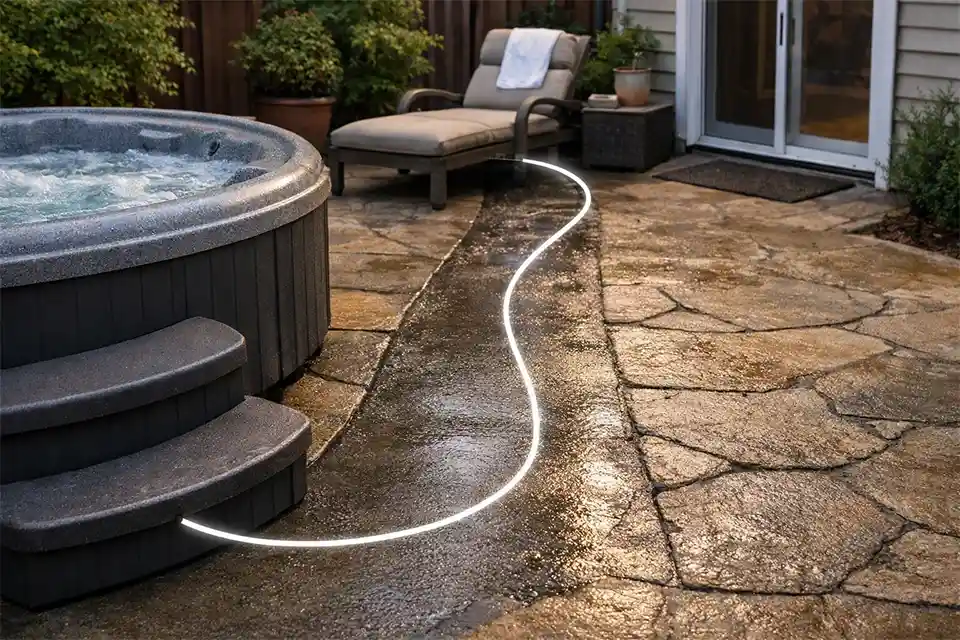
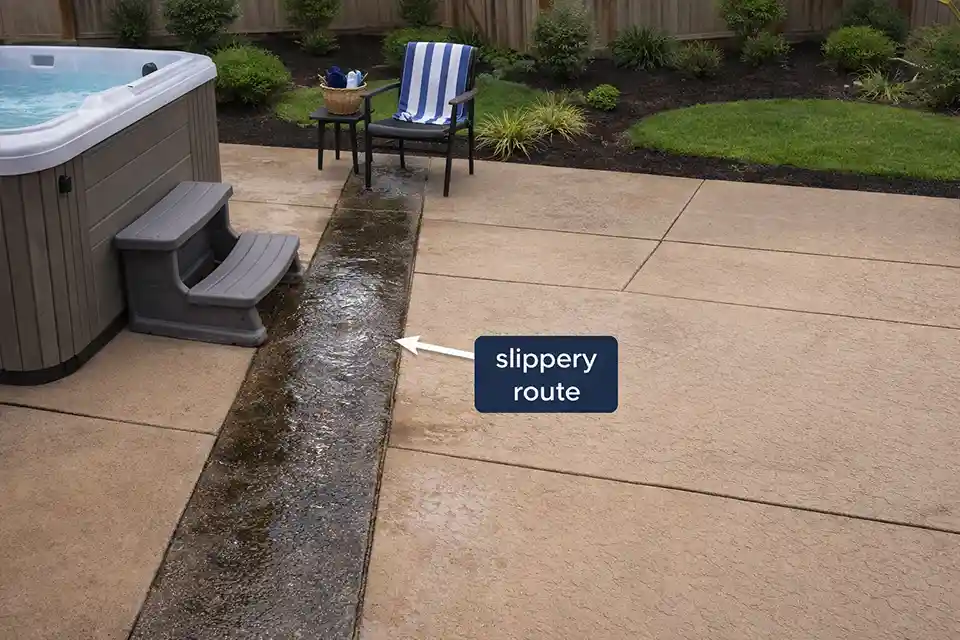
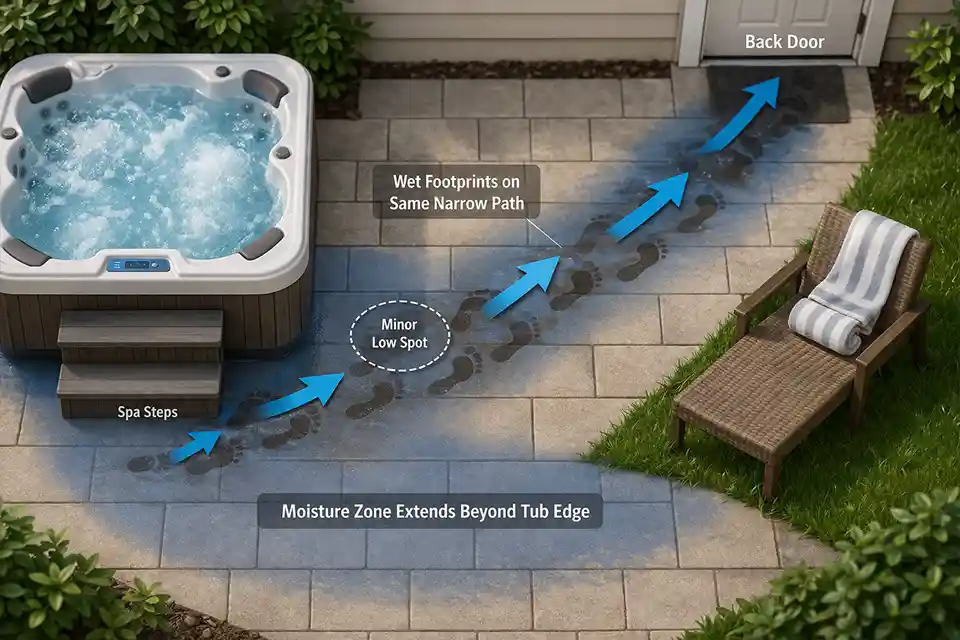
The slippery part around a hot tub is often not the whole surround. It is usually one short route: from the spa steps to the towel area, seating zone, or back door. That distinction matters because the problem is less about a generally wet patio and more about a small access path that gets rewetted, reused, and worn faster than everything around it.
Start with three checks. Is the slickest area concentrated in a 2- to 4-foot-wide route rather than spread across the whole deck?
Does that route stay damp for 30 to 60 minutes after use while adjacent areas dry sooner? Does the middle of the path feel lower-grip than the spa edge itself?
If yes, this is usually a localized performance problem, not a whole-patio cleaning issue.
That is what people miss first. Around hot tubs, the danger often sits in the repeated entry-exit path, not in the full splash zone. The route gets hit by warm splash-out, bare feet, oils, and short wet cycles all day.
Over time, one narrow lane starts behaving like a different surface.
Why the entry path fails first
Most hot tub slip problems do not begin as broad deck failures. They begin where use is most concentrated. The same short route gets wet, walked on, and partially dried again and again. That repeated cycle changes the path faster than the rest of the patio.
The main mechanism is cumulative. Splash-out lands near the steps. Bare feet carry moisture and residue farther out.
Traffic keeps working the same lane until the surface loses more of its usable grip there than anywhere else. That is why a hot tub walkway can feel risky even when the outer patio still feels fairly normal.
This is also where people blame drainage too early. Drainage still matters, but if the worst traction loss follows one predictable path while nearby edges behave better, the first issue is usually route concentration, not a full-area water-management failure.
A similar gap between appearance and actual underfoot behavior shows up on slippery outdoor stone surfaces, where the surface can look acceptable while one use pattern keeps exposing a weak traction margin.
Quick checks for a localized hot tub slip problem
Use these before assuming the whole surface is failing:
- The slickest area sits between the spa steps and the first common destination, not across the whole deck
- The problem route is about 2 to 4 feet wide and easy to trace visually
- That route stays damp 30 to 60 minutes after use while nearby areas dry faster
- The surface feels smoother in the path than at a low-use edge of the same material
- Grip improves after cleaning, but the same lane declines again within several days
- The walkway middle feels riskier than the tub edge because that is where repeated foot placement concentrates
If four or more are true, treat the issue as a failing access path first, not a general patio problem.
What people usually watch too closely
Most people watch the spa edge and first step. That makes sense, but it is not always where the real risk peaks. The more dangerous spot is often 3 to 6 feet out, where the water has been tracked, spread, and worked into the same small route.
That is why a mat at the spa step often disappoints. It covers the obvious exit point, but not always the part of the walkway where grip has dropped most. The mat solves the wrong section when the real hazard sits in the center of the path.
What people overestimate
They overestimate the visible splash zone right against the tub. That area gets attention early, so it is often cleaned or noticed first.
What people underestimate
They underestimate the narrow walkway beyond it. That part may look less dramatic, but it gets the repeated step pattern that wears performance down faster.
A similar mismatch between what looks clean and what actually grips well appears on courtyard tiles that feel slick after pressure washing. Appearance improves quickly. Underfoot control does not always follow.
Why this route keeps staying slick
The hot tub walkway is exposed to short-cycle wetting. It does not just get wet once and dry. It gets rewetted in bursts: in and out of the tub, towels moving, people stepping back and forth, and splash-out reaching the same route again before it fully resets.
That repeated pattern matters more than people think. A route that never gets a real dry recovery window starts holding a different traction profile from the rest of the patio.
In still air or shaded corners, the problem gets worse. A walkway that should dry in 15 to 25 minutes can stay active for 45 minutes or more if the route is flat, enclosed, or lightly settled.
When drainage is not the main issue
If the route is narrow, predictable, and clearly linked to the spa step pattern, drainage is usually not the first thing to blame. The walkway is failing because of repeated use concentration first.
When drainage becomes part of the problem
If water lingers more than about 30 minutes after routine use, if shallow depressions deeper than roughly 1/4 inch are holding moisture, or if the damp zone spreads beyond the usual path, drainage is no longer secondary. It is now helping the route stay hazardous.
That is where the issue starts overlapping with outdoor walkways made slippery by poor drainage, except here the trigger is repeated spa use rather than weather alone.
| Checkpoint | Healthier walkway behavior | Failing walkway behavior | Why it matters |
|---|---|---|---|
| Hazard width | Close to the spa edge only | Clear 2- to 4-foot route outward | Repeated foot traffic is defining the risk |
| Drying time | 15–25 minutes | 30–60+ minutes | The path is not recovering between use cycles |
| Surface feel | Similar to nearby edge areas | Noticeably smoother in the path | Grip reserve is dropping in the route |
| Cleaning result | Improvement holds for 1–2 weeks | Improvement fades within days | This is becoming a surface-performance issue |
| Water movement | Clears without lingering | Hangs in low spots or smears along the route | The path is staying active too long |
When cleaning helps and when it is only buying time
Cleaning helps when the walkway still has enough texture to recover. That usually means grip comes back clearly after a residue-cutting wash, the path feels closer to nearby low-use sections once dry, and the improvement lasts at least a week or two.
Cleaning is only buying time when the same route keeps becoming slick again after a few normal use cycles. That is the threshold many owners miss.
The problem starts looking like dirt because cleaning gives partial relief. But a route that improves briefly and then fails again is usually showing that the surface itself is no longer coping well with the use pattern.
Signs this is still a maintenance problem
The walkway regains obvious grip after proper cleaning, dries on a normal timeline, and does not immediately revert after the next few sessions.
Signs the walkway itself is becoming the problem
The same center line feels smoother than nearby areas even after cleaning, the route turns slick again within days, or the path keeps demanding attention while the rest of the patio behaves normally.
Pro Tip: Compare the walkway center with a low-use edge area of the same material after a full dry-down. If the path reflects light more sharply or feels flatter under bare feet, route wear is already part of the issue.
That same line between “needs cleaning” and “is losing performance” matters on poolside patio stone that turns slippery from water and repeated use, but hot tub paths are usually smaller, more concentrated, and easier to miss until the decline becomes obvious.
When the standard fix stops making sense
Once the walkway shows three conditions together, patch fixes usually stop being worth repeating:
- one consistent access route keeps failing first
- that route dries late compared with matching surrounding areas
- the surface in that lane feels smoother even after proper cleaning
At that point, the logic changes. You are no longer trying to clean away a temporary problem. You are deciding whether that one route now needs traction restoration, localized resetting, or partial resurfacing.
This is where people often waste money treating the whole surround when only one lane is truly failing. If the main hazard is confined to roughly 20 to 40 square feet between the steps and the first destination point, a targeted repair often makes more sense than a broad cosmetic treatment.
The localized repair boundary
If the same walkway keeps turning slick, stays wetter longer, and feels more worn than adjacent areas after cleaning and retesting, it is usually time to repair the lane itself rather than keep rotating through cleaners, mats, or coatings.
If you also see rocking pavers, joint opening, shallow settlement, or water hanging at the same spots, the issue is starting to move beyond traction alone and toward broader early signs of outdoor surface failure.
What actually works better
The best fix is usually targeted. First remove residue properly so you are not judging the walkway through a film. Then retest the exact route after full dry-down and again after light splash exposure. If the same lane still turns slick quickly, treat the route as the problem area.
From there, the right response depends on what is limiting performance:
- If residue is primary, improve cleaning and route-specific upkeep
- If the walkway has lost texture, restore traction or resurface that lane
- If low spots are keeping the route wet, reset or correct that section so water clears faster
- If all three are active, repeated maintenance is usually just delaying the real repair
The key insight is simple: the slip symptom shows up in the walkway, but the mechanism is repeated use concentrated on one short route that no longer has enough traction reserve.
Pro Tip: Test and repair the path people actually use, not the average condition of the whole spa surround. The average surface usually hides the real failure zone.
The useful “aha” here is that hot tub slip risk often behaves like a route problem before it behaves like a full-surface problem.
Once one short walkway starts getting rewetted, reused, and worn faster than the rest, it needs to be judged on its own.
Clean the route if residue is the main issue. Correct the section if moisture is lingering. But if that one path has lost too much grip, the smart move is usually to restore or repair the lane itself rather than keep treating the whole surround like one uniform surface.
For general pool and spa safety information, see the CDC Healthy Swimming guidance.For general safety guidance around home spa and water-use areas, see the CDC Healthy Swimming guidance.