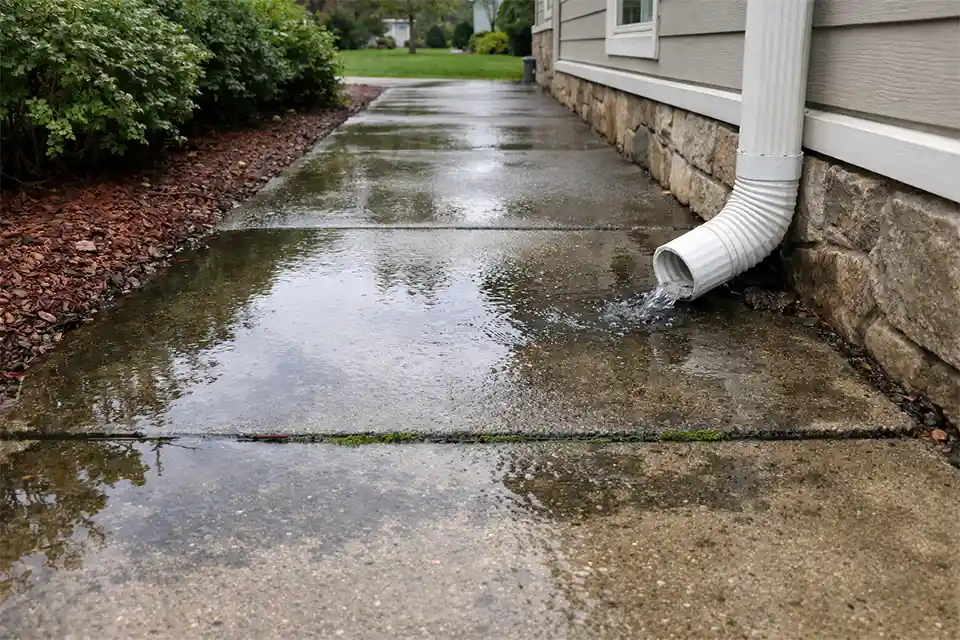
If an outdoor walkway stays slick because of poor drainage, the first fix is usually not a cleaner, a sealer, or a grip coating. It is moving water away from the walking line and restoring enough slope for the surface to dry in a normal window.
Start with three checks: is water still visible 24 hours after rain, is the walkway taking more than 2 to 4 hours longer to dry than nearby pavement, and is a downspout or splash zone releasing water within about 4 to 6 feet of the path? Those answers tell you more than the surface finish alone.
That distinction matters. A naturally smooth stone can be slippery when wet, but a drainage-driven walkway stays hazardous more often, grows biofilm faster, and starts showing darkened joints, green staining, or recurring damp bands in the same place. The surface is the symptom. The water path is the mechanism.
What is usually happening
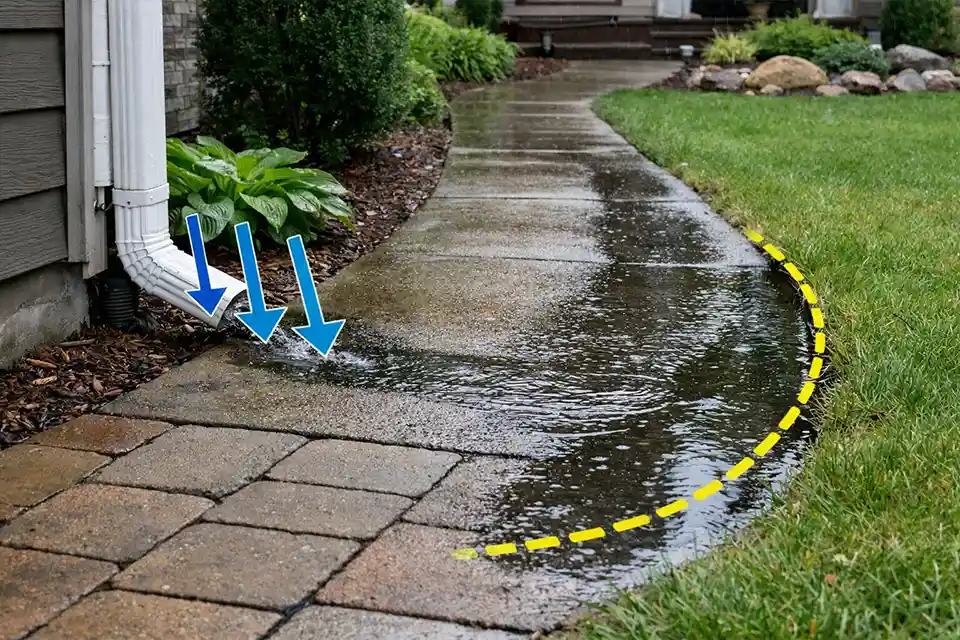
In most homes, the problem starts with runoff direction, not with the walkway material itself. Water from the roof, lawn, planter edge, or neighboring grade keeps feeding the same strip of pavement. Even a small drainage defect is enough if it repeats after every storm or every irrigation cycle.
The most common patterns are straightforward:
-
Downspouts ending too close to the walkway
-
A walkway slope below about 1% to 2%, or a local reverse pitch
-
Depressions around 1/4 to 1/2 inch deep that trap water instead of shedding it
-
Shaded sections that stay damp for 24 to 48 hours
-
Soil, mulch, or fine debris washing onto the surface and holding moisture in joints
This is where people often get the order wrong. They overestimate algae as the cause and underestimate retained moisture as the reason it keeps coming back.
Algae matters because it lowers traction, but repeated wetness is what allows it to re-form. If you clean the surface without changing drainage, the same area can become slick again within 2 to 6 weeks in humid conditions.
That repeat cycle also explains why slippery surfaces after rain can feel dangerous even when they look dry. The problem is often a thin film plus slow drying, not dramatic standing water.
Quick diagnostic checklist
If three or more of these are true, drainage is probably the primary issue:
-
The walkway still looks dark or damp 24 hours after moderate rain
-
One strip dries at least twice as slowly as nearby concrete, pavers, or steps
-
Slickness is concentrated near a downspout, edge bed, or low joint line
-
Water crosses the walking route instead of draining away from it
-
Green, black, or brown film returns within one month or one season after cleaning
-
The same area gets worse after lawn irrigation or winter freeze-thaw cycles
What people usually misread
The most common misread is treating this as a maintenance problem instead of a water-routing problem. Pressure washing is the usual example. It improves appearance quickly, but it does not correct discharge points, reverse pitch, low spots, or a wet base. In some cases it makes the next round come faster by opening joints or stripping away material that was still adding a little texture.
Another misread is assuming downspouts only matter if they discharge directly onto the path. They do not. If the outlet is within a few feet and the grade rolls back toward the walkway, that runoff still reaches the surface or the base below it. Uneven surfaces near downspouts are often the clue that water is doing more than creating a slick film on top.
People also tend to underestimate localized settlement. A section that has dropped even around 1 inch can change how water behaves enough to create a permanent slick strip. At that point, the walkway is no longer just getting wet. It is beginning to fail in a way that cleaning will not solve.
Pro Tip: Watch the walkway during actual rainfall or the next irrigation cycle. Five minutes of seeing where the water travels usually beats a long inspection of dry stains later.
What to fix first
The best repair sequence is usually simple, and the order matters:
-
Redirect roof water and irrigation away from the walking line
-
Restore positive drainage so runoff leaves the path instead of crossing it
-
Correct low spots, settled pavers, or dropped panels
-
Clean and treat the surface only after water behavior improves
That sequence sounds obvious, but it gets skipped all the time. Homeowners often jump to anti-slip coatings because they look like the most direct answer. They can help on a sound, dry-fast surface. They are a weak first move on a walkway that still stays wet for a full day after rain.
If the path is stable and the problem is mostly surface wetting, small grading corrections, downspout extensions, and edge cleanup often change the result quickly.
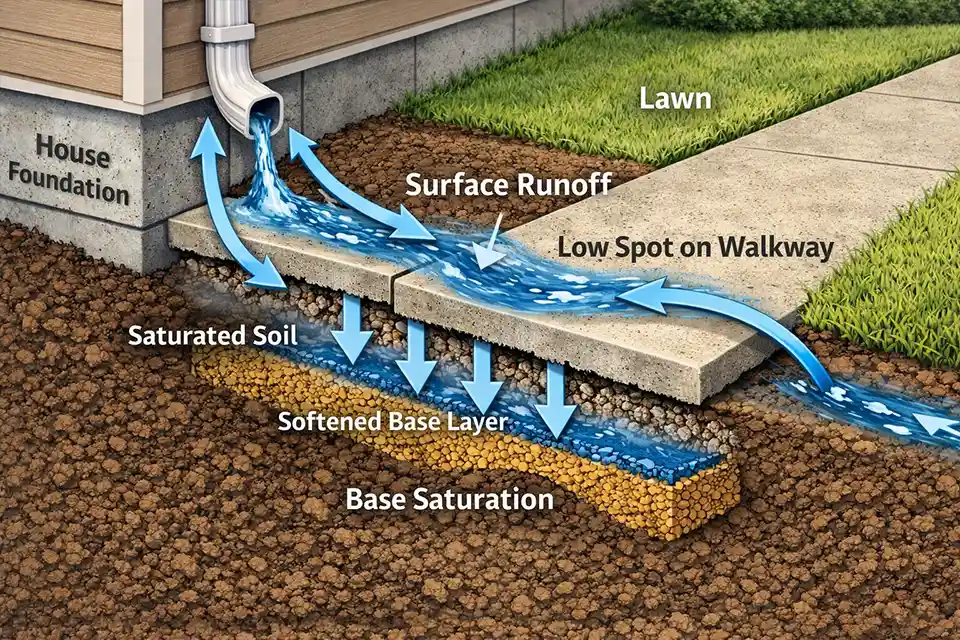
If the walkway rocks, sinks, or shows repeated joint loss, the problem is deeper. Yard drainage problems can create uneven outdoor surfaces when the supporting ground softens over time.
| Condition | What it usually means | Fix that makes sense | Fix that wastes time |
|---|---|---|---|
| Damp surface but stable walkway | Runoff is reaching the path too often | Extend downspouts, improve grade, remove moisture-trapping buildup | Repeated detergent-only cleaning |
| Puddling deeper than about 1/4 to 1/2 inch | Local low spot or settlement | Lift and reset pavers, patch or re-pour the affected area | Sealing over the puddle zone |
| Dark joints and recurring slimy film | Moisture plus trapped fines or organics | Rework drainage and joint material | Pressure washing alone |
| Rocking edge or sinking section | Base is softening or washing out | Rebuild the base and redirect runoff | Traction coating by itself |
| Seasonal slickness in shade | Slow drying is extending the hazard window | Improve drainage and reduce persistent shade where practical | Replacing the whole surface too early |
When routine fixes stop making sense
There is a point where this stops being a simple slip issue and becomes a surface-performance issue. Routine cleaning stops making sense when the same area becomes slippery again within a month or two, when pavers start moving underfoot, when joints keep opening, or when the walkway still ponds after every moderate storm.
That is the useful line between cosmetic and structural. Dark staining is cosmetic. Missing support, recurring washout, and freeze-thaw stress are not. In northern states, once water keeps entering the base and temperatures hover around 32°F, small drainage defects can turn into heaving, cracking, or edge separation much faster than people expect.
A practical boundary is this: if you are seeing more than about 1 inch of settlement, repeated puddling after each rain, or movement underfoot, a cleaning-and-coating strategy is no longer the smart spend.
The base or the drainage layout needs correction first. Water runoff can damage outdoor surfaces over time even before the visible damage looks severe, and drainage failure can start weakening the ground early while the walkway still appears mostly intact.
Pro Tip: If you have cleaned the same slippery strip twice in one season and it keeps returning, stop buying more treatment products and trace the water source instead.
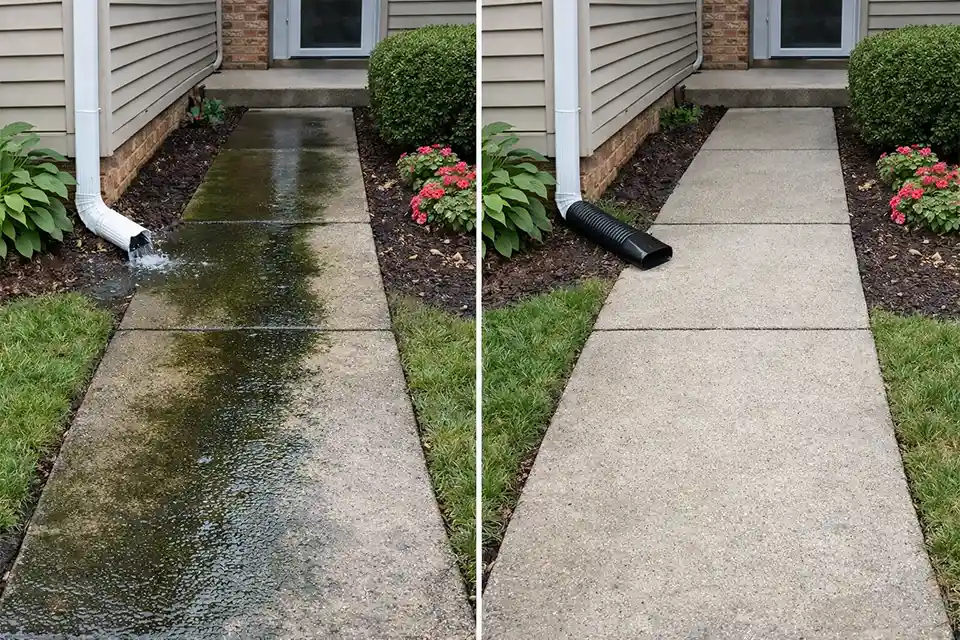
A slippery outdoor walkway around a home usually gets safer fastest when you treat drainage as the main problem and traction as the second one. That order is what prevents repeat cleaning cycles, wasted coatings, and the bigger mistake of missing early base failure under a walkway that still looks mostly serviceable.
For broader official guidance, see the DOE Building America page on site grading and stormwater control.