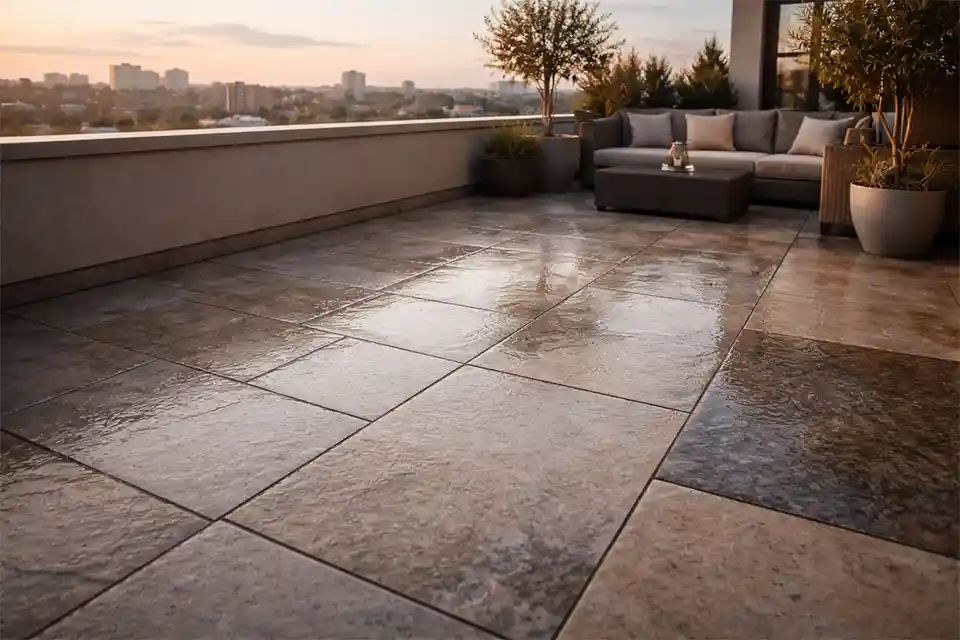
If a rooftop terrace stone floor gets slippery mainly overnight or around sunrise, the most likely issue is not major water intrusion and not usually a failed installation. It is usually a thin condensation film landing on a surface that no longer has enough traction for the conditions it regularly sees.
The first checks that matter are timing, drying speed, and surface feel. If the slickness shows up mostly between about 4 a.m. and 8 a.m., improves within 30 to 90 minutes in direct sun, but lingers 2 to 4 hours in shaded corners, you are usually looking at condensation exposing a traction problem.
If the stone also feels even 3°F to 5°F cooler than nearby railing posts, trim, or furniture bases at daybreak, that diagnosis gets stronger.
That pattern is different from a terrace that stays slick deep into the day, grows dark organic film, or repeatedly holds visible water near drains. Condensation is the trigger.
The useful diagnosis is why that small amount of moisture becomes hazardous. On rooftop stone, the answer is usually one of four things: the finish is too smooth, the sealer changed the surface behavior, the microclimate slows drying, or residue is lowering friction more than people realize.
The first distinction that actually matters
The biggest mistake is assuming “wet” and “slippery” are the same condition. They are not.
A rooftop terrace can become dangerous with barely visible moisture. In fact, people often say the floor feels worse at dawn than after rain, which sounds backward until you understand the mechanism.
Rain is visible. Condensation is often a very thin, even film. That film can sit right where the shoe needs contact. If the stone is honed, worn smooth, or coated with the wrong sealer, the terrace can lose grip fast even though it does not look obviously soaked.
The more likely cause is not unusually heavy dew. The more likely cause is that the surface is operating with too little texture margin for a humid morning. That is why slippery outdoor stone surfaces often catch people off guard even when the area looks mostly clean and mostly dry.
Shade gets too much blame here. Shade can lengthen drying time, but surface finish usually matters more. A textured stone in shade may stay damp longer and still remain reasonably stable underfoot. A smoother dense stone may become slick from a much lighter moisture film. That is a priority judgment worth making early, because it changes the fix path.
Why rooftop terraces behave differently from ground-level patios
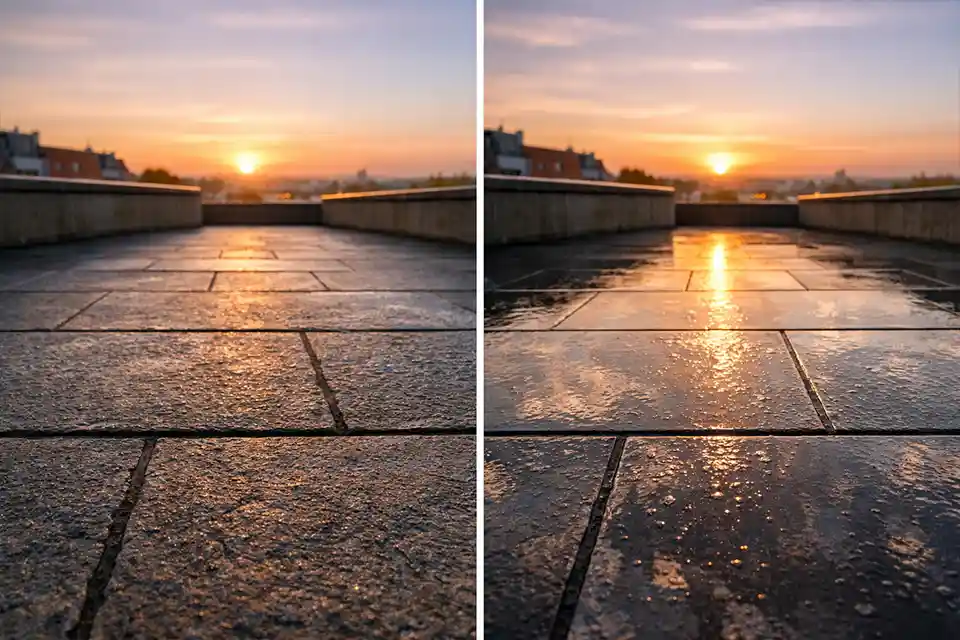
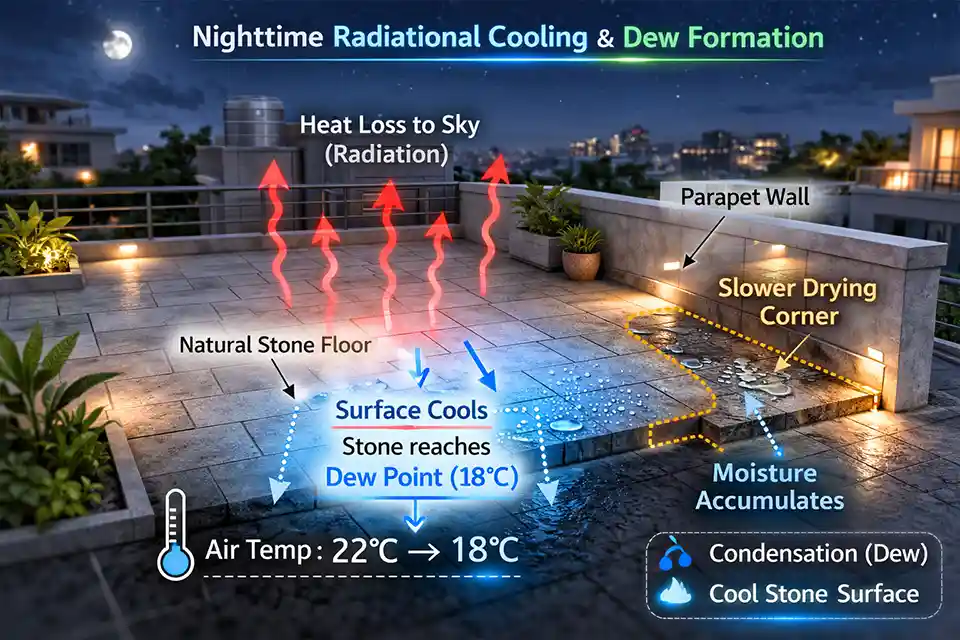
Rooftop terraces cool differently because they are exposed to open night sky and often have more edge effects than patios at grade. On clear nights, stone loses heat upward through radiational cooling.
If the surface temperature falls to the dew point, moisture condenses even when the air does not feel wet in any dramatic way. This tends to become more noticeable when overnight relative humidity rises above roughly 75% to 80% and air movement stays light, often under about 5 mph.
That is why this problem can show up in very different parts of the United States. In Florida and along the Gulf Coast, high humidity makes the window longer and more frequent. In coastal Southern California, marine layer mornings can create a deceptively slick terrace without any storm event.
In the Midwest, late-summer humid nights can produce the same behavior even when the previous day felt dry. By contrast, a similar stone surface in Arizona may feel acceptable much more of the year simply because the overnight moisture pattern is different.
Airflow matters, but not evenly. Corners near parapet returns, privacy screens, large planters, and tight furniture layouts often dry 30 to 60 minutes slower than the more open middle of the terrace. If one area is always the last to recover, that is not random. It is telling you something about the microclimate, not just the stone itself.
This is also where people waste time blaming drainage first. Drainage problems tend to leave repeated evidence in specific areas: damp arcs near thresholds, darker halos around drains, or patches that stay wet long after surrounding stone has recovered.
If that is what you are seeing, the logic starts to overlap with slippery outdoor walkways with poor drainage. But when a broad expanse turns slick at dawn and improves quickly once sun and air movement increase, the leading issue is usually traction under condensation, not slope failure.
Quick diagnostic checklist
- The terrace is worst from pre-dawn to around 1 hour after sunrise.
- The surface looks slightly glossy rather than visibly puddled.
- Direct sun improves grip within 30 to 90 minutes, but shaded corners lag much longer.
- Smooth stone areas feel worse than rougher borders, stair nosings, or adjacent textured bands.
- Calm, humid, clear nights produce worse conditions than breezy nights.
- The floor already feels a little skaty under hard soles even when fully dry.
- The issue gets noticeably worse after sealing or after a finish change.
If four or more apply, start with condensation plus low surface traction as the primary diagnosis.
What people overestimate, and what they underestimate
People usually overestimate how much water it takes to create a serious slip risk. On rooftop stone, the answer can be very little. A faint sheen is sometimes enough.
What they underestimate is the condition of the surface when dry. A terrace that feels only slightly slick while dry can become much more dangerous when the first morning film arrives. That dry-condition test is often more revealing than visual inspection.
| Field signal | Lower concern | Higher concern | Why it matters |
|---|---|---|---|
| Dawn recovery time | Clears in 30–90 minutes of sun | Stays slick 2–4 hours or more | Drying or traction problem beyond normal dew |
| Surface look | Matte dampness | Thin glossy sheen | Thin-film slip risk is active |
| Dry shoe feel | Stable under firm step pressure | Slight skaty feel while dry | Underlying traction is already marginal |
| Moisture pattern | Even temporary film | Repeated dark zones at edges or drains | Microclimate or drainage issue is contributing |
| Surface history | No recent finish change | Worse within days or weeks of sealing | Sealer may have reduced grip |
| Biological signs | No patching | Green, black, or dark organic areas | Dew is not the whole story |
That last row matters because organic growth changes the diagnosis completely. If the terrace is developing visible green or black patching, the issue is no longer just condensation. Moisture retention and biological film are entering the picture, which is why algae and moss making surfaces slippery need a different response than plain morning dew.
Where cleaning helps, and where it mostly wastes time
Cleaning is the right first move when the problem includes residue. Rooftop terraces collect more contamination than many owners think: airborne grime, cooking grease from outdoor kitchens, beverage spills, sunscreen transfer, planter runoff, and cleaner film can all lower friction.
A proper test patch should tell you something quickly. Clean a 3-foot by 3-foot section thoroughly, rinse it well, let it dry fully, and compare it to the adjacent untreated area the next humid morning.
If that cleaned section is meaningfully better, residue was part of the problem. If it performs almost the same, cleaning was never going to be the main answer.
The wasted fix is continuing to scrub long after the evidence says the finish is the issue. If the stone beads water strongly, still feels slick when dry, or became worse after sealing, the surface behavior has changed.
More detergent will not reverse that. This is the same disappointment pattern seen when sealed stone patios become slippery after sealing : owners keep treating it as a maintenance problem long after it has become a finish problem.
Pro Tip: Test the terrace in three stages on the same day: shaded dawn, first direct sun, and fully dry late morning. If the fully dry stage still feels marginal, stop treating this as only a moisture issue.
Condensation, drainage, and biofilm are not the same problem
These three causes are easy to blur together because they can all produce a slick floor. But they behave differently, and the repair logic is different too.
Condensation usually arrives as a broad, thin morning film. It is time-sensitive, often climate-sensitive, and strongly affected by surface finish and overnight cooling.
Drainage issues produce repeated wetness patterns in consistent locations. They often show up after rain too, not just at dawn, and the affected zones usually stay darker longer than surrounding stone.
Biofilm and algae are slower-growing but more persistent. They often appear in corners, around planters, beside walls, or anywhere moisture lingers regularly. Once that layer forms, the floor can stay hazardous beyond the short dew window.
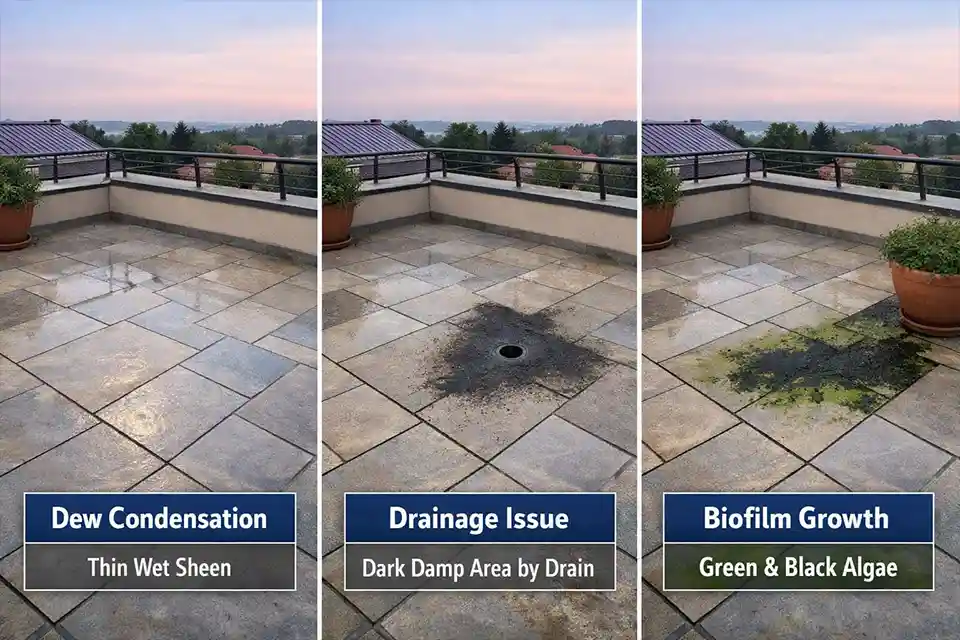
That distinction is what many readers miss first. They see “slick when wet” and assume all wetness deserves the same fix. It does not. Condensation is often the event. Drainage and biofilm are often the supporting conditions that make the event worse or longer.
The fix order that makes practical sense
Start with the reversible work. Remove residue. Clean drains. Open airflow where dense furniture, planters, or privacy screens are trapping damp air. Then watch what the terrace does on the next two or three humid mornings.
If specific corners still lag the rest of the floor by 30 to 60 minutes, the microclimate is contributing. If dark rings remain near drains more than about 60 minutes after nearby stone has dried, localized drainage correction deserves attention. If the whole surface still feels marginal underfoot once fully dry, the finish itself is the bigger problem.
This is where topical anti-slip products often disappoint. Some improve friction briefly, but many wear unevenly, collect dirt in a patchy way, or alter appearance without solving the underlying mismatch between the stone finish and the rooftop environment. On a terrace that sees sun, furniture movement, and regular foot traffic, “quick traction coating” can become an annual experiment rather than a durable fix.
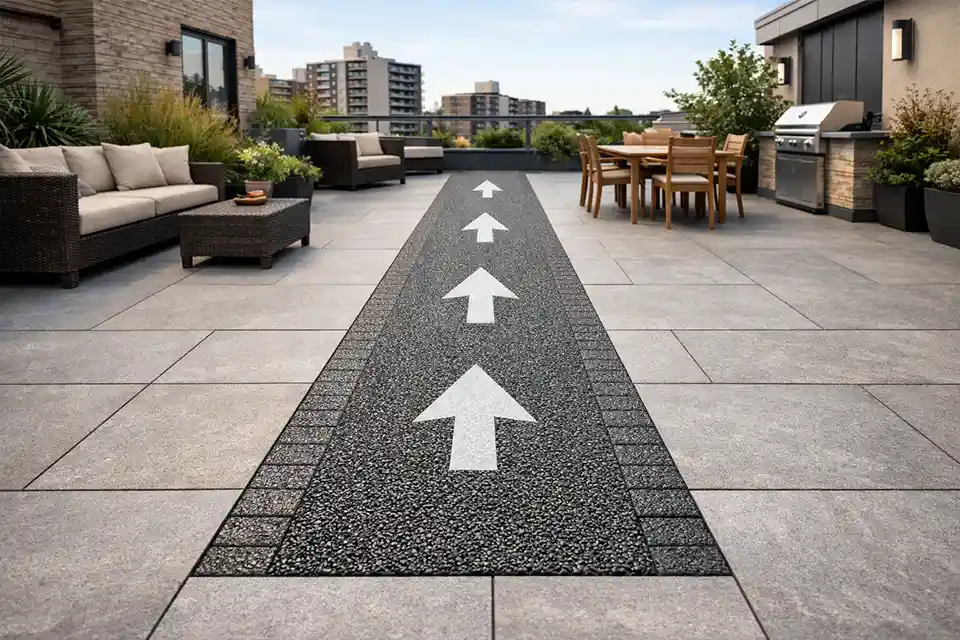
A smarter move for some terraces is to improve traction where people actually walk. Main routes from the door to seating, stairs, grills, or rail views deserve higher priority than decorative perimeter zones. The goal is not cosmetic uniformity. It is reliable footing where routine traffic happens.
When maintenance stops being a sensible plan
There is a clear boundary where repeated cleaning becomes maintenance theater.
If the same walking areas remain slippery for more than 2 hours after sunrise more than twice a week during humid months, you are beyond a minor housekeeping issue. If a properly cleaned test area returns to the same level of slickness within 3 to 7 days under the same weather pattern, contamination is not the main driver. And if the surface already feels a little unstable while dry, condensation is only exposing a deficit that was already there.
That is the moment to stop treating the terrace like it merely needs better upkeep. A walking surface has to match its climate and use pattern. If it does not, the honest choices become mechanical surface treatment, targeted textured walking bands, selective stone replacement, or broader material change.
One thing that often fails first is not the installation but the margin of traction. Once that margin gets too thin, a barely visible film becomes enough to expose it. People often overestimate the need for full replacement too early, but they also underestimate how rarely endless cleaning fixes a fundamentally wrong finish. The smart line sits between those two mistakes.
If the stone is basically sound and the problem is mild, cleaning plus local airflow and drainage corrections may be enough. If the issue clearly worsened after sealing, the finish deserves the next hard look.
If the terrace is inherently smooth, repeatedly slick in seasonal humidity, and used as a primary walking route, targeted traction upgrades or replacement start making more sense than continued trial-and-error maintenance.
For broader official guidance on slip-resistant walking surfaces, see the National Institute of Building Sciences Whole Building Design Guide.