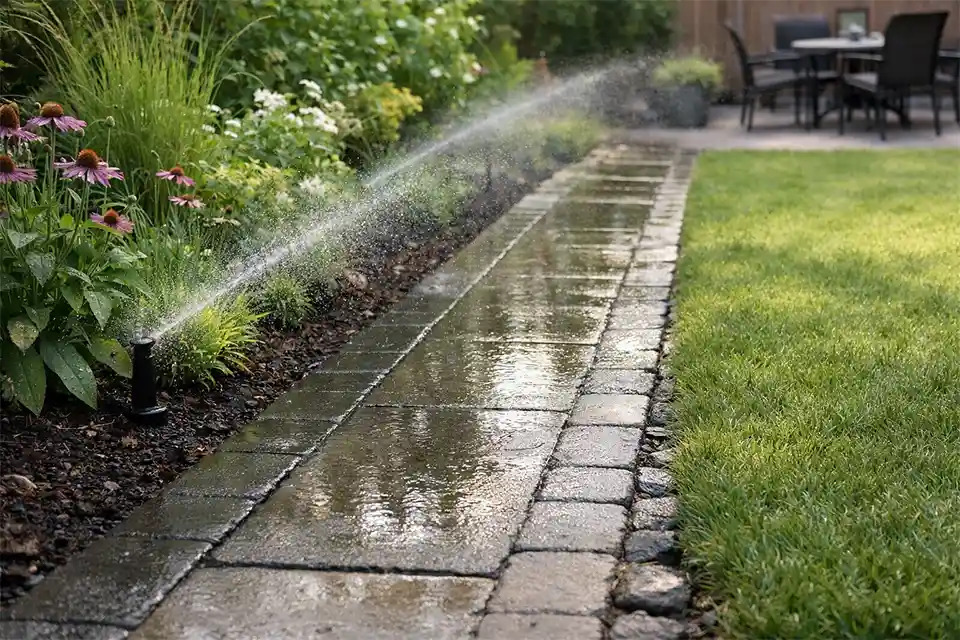
Most slippery garden paths after irrigation are not failing because the surface suddenly changed. They get slick because part of the path is being watered over and over again. That is the first thing people misread. They blame the pavers, the stone, or the moss. In practice, the lead cause is usually simpler: the irrigation zone is throwing water onto the walkway, and the same strip never gets a full drying window.
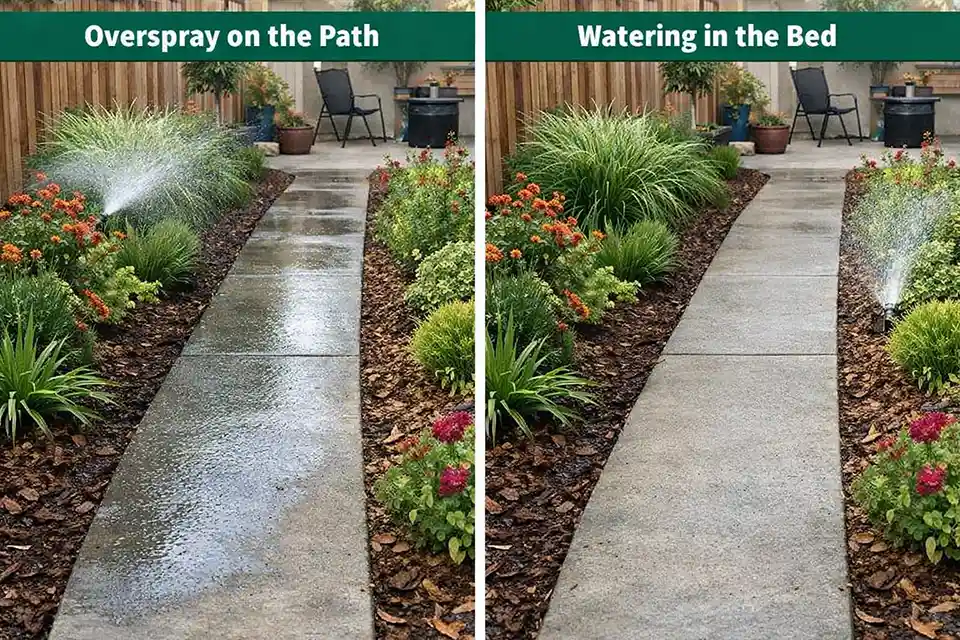
If spray is landing 12 to 24 inches onto the path, or if the wet sheen is still there 30 to 45 minutes after a cycle in mild weather, treat overspray as the main problem until proven otherwise. Drainage can also make a path slippery, but it usually leaves a broader damp area after rain. Overspray leaves a repeatable wet strip that shows up on watering days in the same place, often within minutes of the zone starting.
The useful distinction is this: a slippery garden path after irrigation is usually an irrigation layout problem, not a cleaning problem. Once the walkway sits inside the spray pattern, scrubbing the surface is just cleanup after the real mistake.
Quick diagnostic checklist
- The slick area follows the irrigation schedule more closely than the weather
- One edge of the path is wetter than the center
- The same strip darkens within 5 to 15 minutes of watering
- The surface stays glossy for 30 to 60 minutes instead of drying quickly
- Skipping that zone for 24 to 48 hours improves traction
- Shrubs or groundcover are deflecting spray sideways onto the walkway
What people usually misread first
The first false diagnosis is moss. Moss and algae matter, but they usually show up later. Most of the time, they are evidence of repeated wetting, not the original cause. If the path turns slick right after irrigation, the first question is not what to clean it with. It is why the walkway is getting watered in the first place.
The second false diagnosis is “too much watering” in the general sense. Sometimes the schedule is too heavy, but that is usually not the sharpest read. More often, the system is watering the wrong place because the arc is off, pressure is too high, the nozzle radius does not suit the bed, or nearby planting has started deflecting spray. That is why the same path can feel fine in spring and slick by midsummer without any major timer change.
This is also why Slippery Surfaces After Rain: Why They Feel Dangerous Even When They Look Dry overlaps with this issue. The path does not need standing water to become risky. A thin, repeated surface film is often enough.
The fix people delay too long
The most useful solution is often not better cleaning. It is changing how water is delivered near the path.
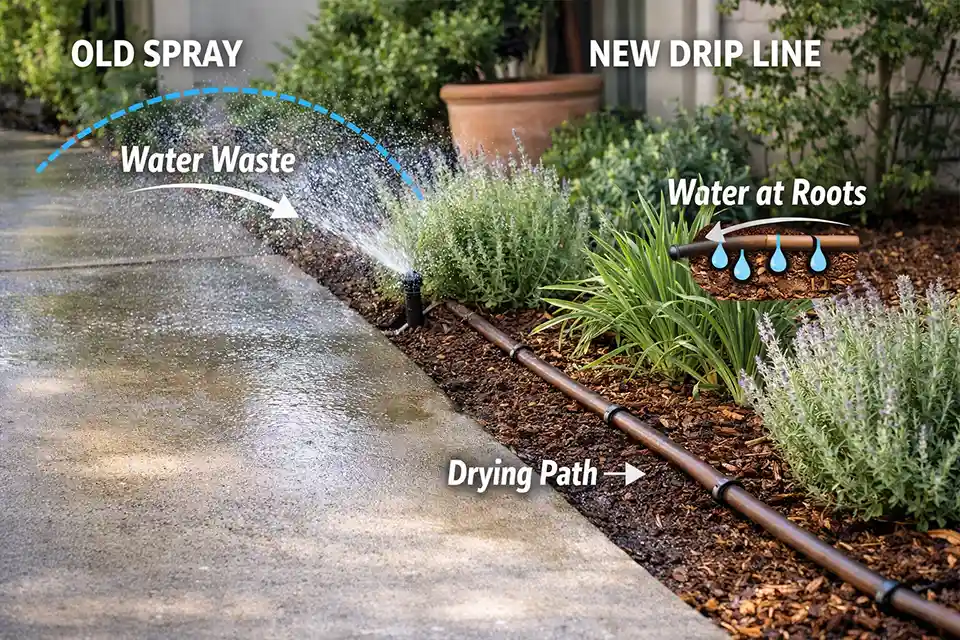
If the planting strip is narrow, the walkway edge sits within roughly 18 inches of the spray line, or wind regularly pushes water sideways, stop assuming a spray head can be dialed in forever. In that setup, the path is living inside the system’s tolerance zone. You can improve it, but you may not really solve it. The more durable move is often to convert that edge zone to drip or micro-irrigation so water is delivered at the soil instead of thrown through the air.
That is the decision point many homeowners miss. If the path sits inside the spray zone’s miss area, small adjustments can help for a while, but the slick band often comes back. Changing the irrigation type is usually the cleaner long-term fix.
Pro Tip: If the same strip turns slippery again a few weeks after cleaning, treat it as a water-placement problem, not a surface-cleaning problem.
What actually changes the outcome
The right order is aim first, pressure second, nozzle third, irrigation type fourth. Most people do it in reverse or go straight to surface cleaning because it feels faster.
Run one full cycle at the normal time of day and watch where the water lands, not where the head appears to point. Deflected spray off leaves matters as much as the direct arc. Then check whether the wet band is localized or broad. A localized strip supports overspray. A broader damp area that also lingers after rain points toward drainage, which is where Slippery Outdoor Walkways from Poor Drainage becomes the better comparison.
If overspray is clear, correct the arc and nozzle before touching the timer. Shortening run time while spray still crosses the path is a classic waste of effort. It often leaves the planting bed under-watered while the path still gets wet every cycle. If the system is visibly misting, pressure is part of the problem, not a side note.
Only after the water is staying off the walkway does surface cleaning make sense. Until then, cleaning is just resetting the clock.
| Condition | What it usually means | Practical threshold | Best next move |
|---|---|---|---|
| Same narrow strip gets slick after irrigation | Overspray or deflected spray | Wet sheen lasts 30–60+ minutes | Adjust arc or nozzle; inspect pressure |
| Path edge is within about 18 inches of spray line | Design tolerance is too tight | Problem keeps returning after adjustment | Convert edge zone to drip |
| Surface stays slick even after irrigation is paused | Biofilm or retained edge moisture | Still slick after 24 hours | Fix water source, then clean surface |
| Area stays dark after rain too | Drainage is also involved | Broad damp zone for hours | Check grade, runoff path, and base |
When this stops being a small fix
Once the path stays slick a full day after irrigation is paused, you are no longer looking at a simple spray-placement issue. At that point, repeated wetting has usually created a second problem: biofilm, trapped residue, or moisture being held at the edge.
There is another threshold people underestimate. Repeated irrigation near hardscape can soften adjacent soils and contribute to slow settlement or washout over time. That is one reason Lawn Irrigation Can Cause Uneven Ground — Here’s Why can become part of the same diagnosis, especially where the path sits slightly lower than the planting bed or runoff is being pushed toward the paving.
The key judgment is simple. If the same slick band returns after you have already cleaned the path once, do not keep treating it as a dirty-surface problem. Treat it as misapplied water. And if that band runs right beside a narrow planted edge, stop trying to win a precision game that spray heads rarely win for long. That is the point where Slippery Outdoor Stone Surfaces Explained stops being the main frame and irrigation design becomes the real one.
For broader official guidance, see the University of Nebraska–Lincoln’s overview of landscape irrigation methods.