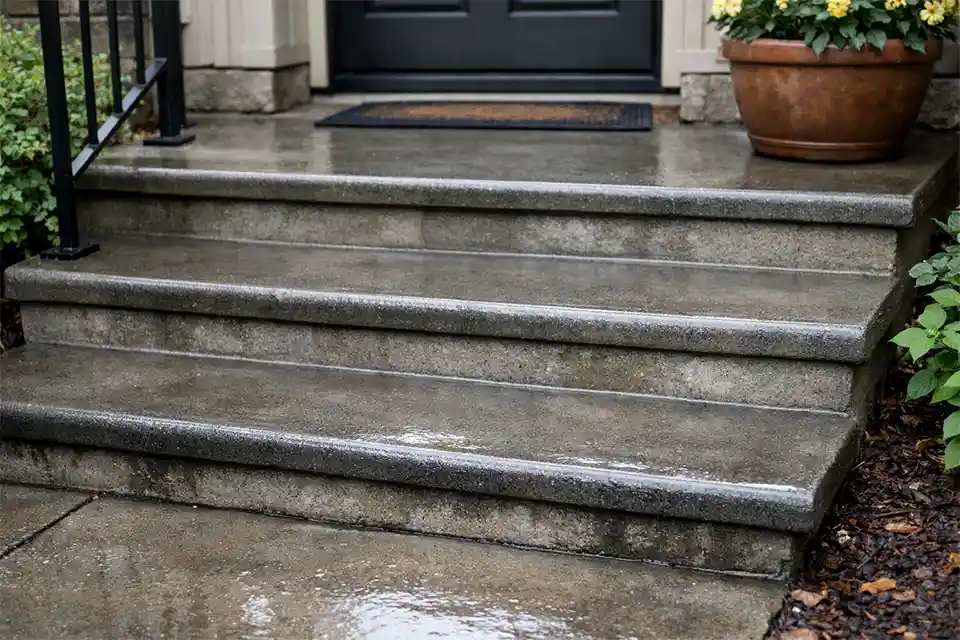
If outdoor stairs feel slippery and there are no proper edge traction strips, the first thing to fix usually is not the whole stair surface. It is the stair edge. On most problem stairs, the front 1 to 2 inches of the tread lose grip first, hold moisture longer, and become harder to read visually in shade or wet weather.
Start with three checks: see whether the nosings stay damp for more than 30 to 60 minutes after nearby concrete has mostly dried, look for gloss or worn sealer at the front edge, and test the stairs in low light rather than only in midday sun.
That distinction matters because this is not the same as a general dirty-stair problem. Dirt reduces traction. Missing edge traction reduces traction and landing accuracy at the same time. On a typical outdoor stair with a 6- to 7-inch riser, that is enough to turn a minor slick spot into a real fall risk.
Quick Diagnostic Checklist
Before cleaning, coating, or replacing anything, check for these signals:
- The front edge feels slicker than the center of the tread
- Water stays on the step edge at least twice as long as on nearby walkways
- The stairs feel riskier stepping down than stepping up
- A full cleaning helps for less than 1 to 2 weeks
- The nosing blends into the step below in shade, rain, or early morning light
- The worst slipping is concentrated on the same 2 to 4 steps each time
If most of those are true, the missing or weak edge treatment is probably the lead problem. Dirt, algae, and runoff may still be involved, but they are not all equally important. That same “still unsafe even when it looks almost dry” pattern shows up on surfaces that feel slippery after rain, but stairs make the mistake more dangerous because foot placement is less forgiving.
What to Fix First
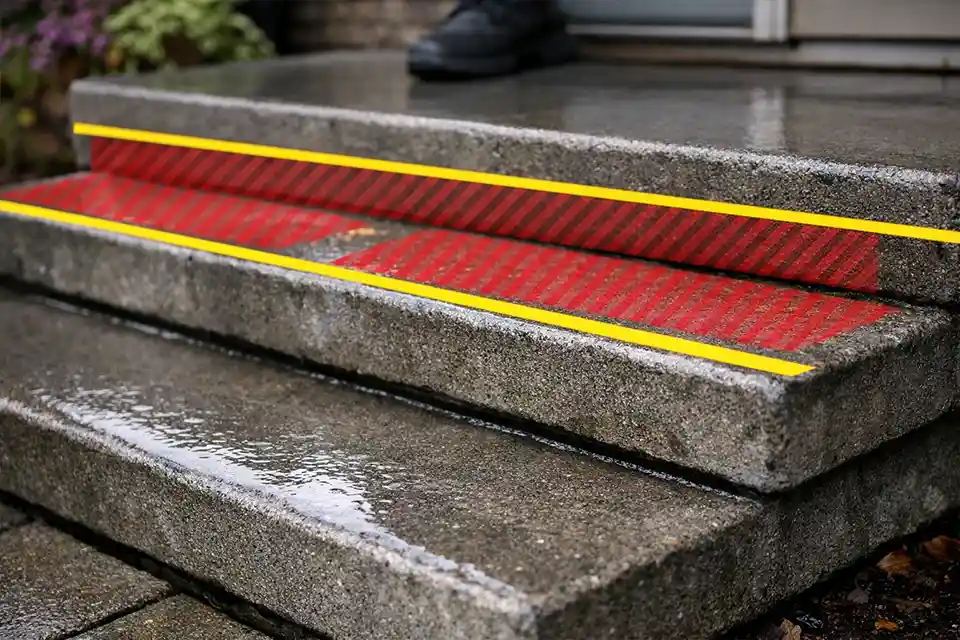
Fix the edge before you try to improve the whole stair.
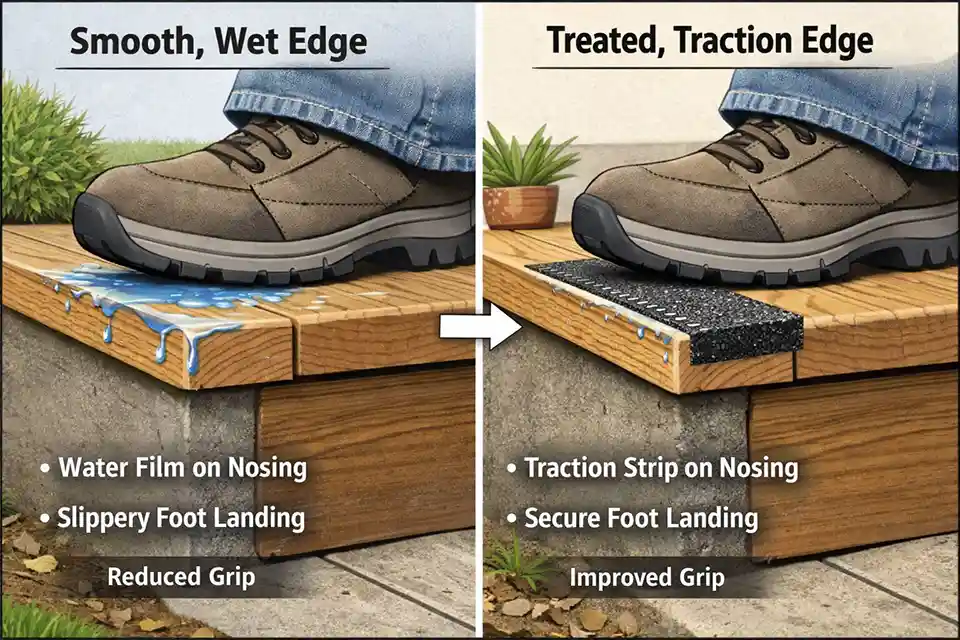
That means prioritizing a durable exterior-grade traction treatment at the nosing. The best options are usually anti-slip strips, retrofit nosings, or mechanically bonded edge profiles designed for outdoor use.
They work because they solve the two failures that matter most: they increase grip at first foot contact, and they make the step edge easier to read in wet or dim conditions.
This is where many homeowners waste time. They coat the full tread with anti-slip paint, broadcast grit over the surface, or keep pressure-washing the stairs. Those steps can help temporarily, but they often miss the actual failure zone. If the front edge is still smooth, visually weak, or slow to dry, the main hazard remains.
That is also why broad material advice can be misleading. On stairs, the question is not “Is the surface textured overall?” It is “Does the edge stay readable and grippy when wet?” Smooth vs. textured outdoor surfaces is a useful general comparison, but stair safety depends much more on edge performance than on the marketing description of the material.
What People Usually Overestimate and Underestimate
The most overestimated fix is cleaning.
Cleaning matters when there is obvious moss, leaf film, sunscreen residue, or dirt buildup. But if the stair still feels uncertain 24 hours after cleaning and full drying, maintenance is no longer the main answer. At that point, you are looking at a grip-and-visibility problem, not just a dirt problem.
The most underestimated factor is edge visibility. A stair can be only moderately slick and still feel dangerous if the nosing visually disappears against the step below. People tend to blame slipperiness because that is what they feel underfoot.
But on stairs without traction strips, misreading the edge is often part of the mechanism. That is why outdoor slip risks homeowners miss are often not dramatic surface failures. They are small, repeated errors in where the foot lands.
One practical detail that gets ignored a lot: the same stair can feel acceptable at 2 p.m. and risky at 7 a.m. if dew, shade, or porch lighting reduce contrast at the nosing.
When Moisture Is the Supporting Problem
Not every slippery stair starts with drainage, but moisture often determines whether a fix lasts.
If irrigation hits the stairs for 10 to 15 minutes each morning, if runoff crosses the treads during storms, or if deep shade keeps the edges damp for hours, even a good traction strip will stay dirtier and wear faster.
In those cases, you still fix the edge first, but you should correct the water source right after. Otherwise the repair holds less reliably through repeated wet-dry cycles over 30 days or more.
A useful threshold is drying time. If nearby paving dries in 20 to 30 minutes but the stair nosings are still visibly damp after 60 minutes, the stairs are being fed by something more than normal surface wetting.
That can be overspray, poor runoff direction, trapped shade, or a finish that holds water differently than the surrounding path. Similar moisture patterns show up on outdoor walkways with poor drainage, but stairs usually feel the effect sooner because the user loads the edge, not just the flat surface.
When the Standard Fix Stops Making Sense
There is a point where adding strips is no longer the right answer by itself.
If the stair nose is crumbling, if the treads slope inward, or if the surface face is flaking off in pieces, the symptom is slipperiness but the underlying mechanism is material failure. In that case, a traction strip may cover the problem briefly without giving you a durable repair.
A practical cutoff is around 20% of the stair noses showing chipping, scaling, delamination, or uneven material loss. Past that point, resurfacing or rebuilding usually makes more sense than bonding traction products over a failing edge. The same is true if individual stair heights visibly vary, or if ponding sits on the tread instead of draining off.
People also underestimate leaf film here. On shaded stairs, a thin layer of wet leaves can hide the nosing within 24 hours and cancel out a weak traction treatment surprisingly fast. That is why outdoor steps during heavy leaf fall often become hazardous before they look severely dirty.
Pro Tip: If you have to scrape off old sealer, chalking paint, or loose surface film at the nosing, test adhesion before installing any strip system. A strip bonded to a failing layer is a short-lived fix.
What a Better Repair Order Looks Like
Use this order if you want the repair to hold up:
| Priority | What to do | Why it comes first |
|---|---|---|
| 1 | Inspect the nosing and front tread edge | That is where grip and visibility usually fail first |
| 2 | Clean enough to expose the real surface | Cleaning reveals whether dirt is the cause or just a layer on top |
| 3 | Remove incompatible sealers or loose coatings | Weak surface films reduce both grip and strip adhesion |
| 4 | Install exterior-grade edge traction on every tread | Partial repairs leave the same hazard on untreated steps |
| 5 | Correct overspray, runoff, or chronic shade if needed | Moisture problems shorten the life of otherwise good repairs |
| 6 | Recheck after 2 to 4 wet events | A stair fix is not proven by one dry afternoon |
That sequence is more effective than treating every cause equally. The edge problem is usually more important than the cleaning problem, and the cleaning problem is usually more important than rare edge cases like unusual contamination.
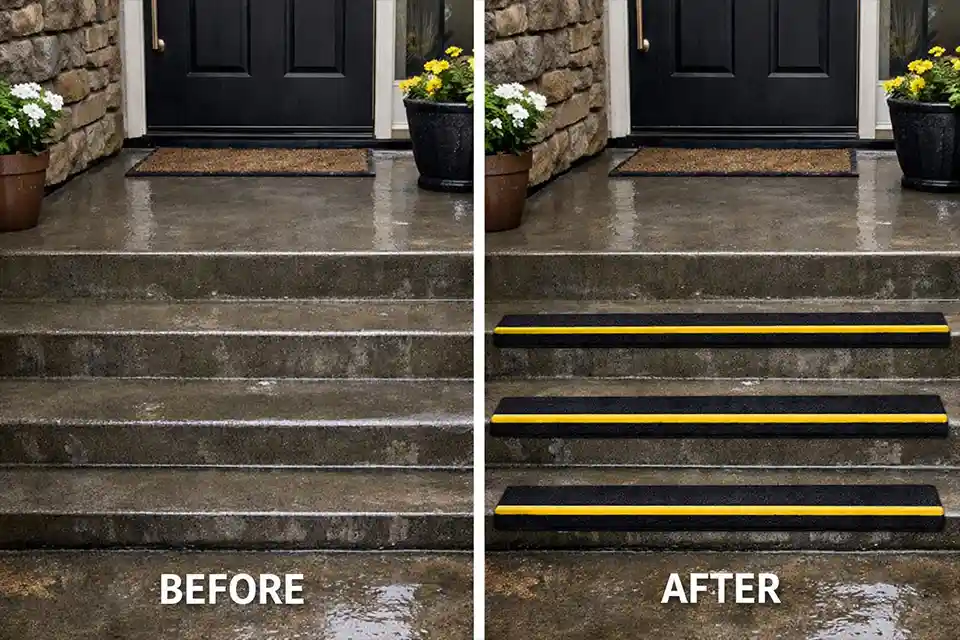
Slippery outdoor stairs without edge traction strips usually need edge-first repair, not just cleaning. Learn what to fix first and what actually lasts.
For broader guidance on reducing slip risks on stairs and other walking surfaces, see the OSHA walking-working surfaces page.