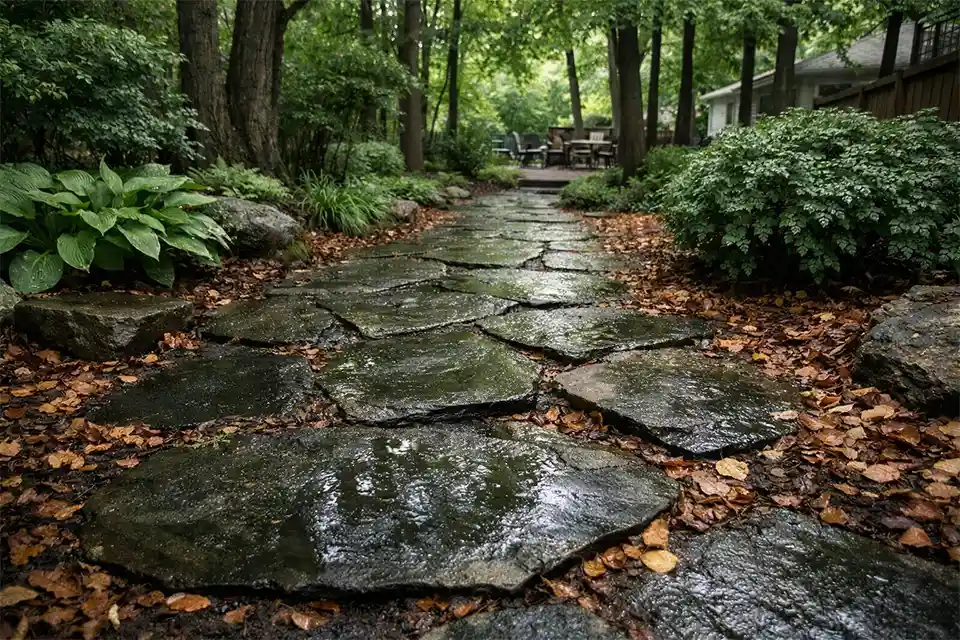
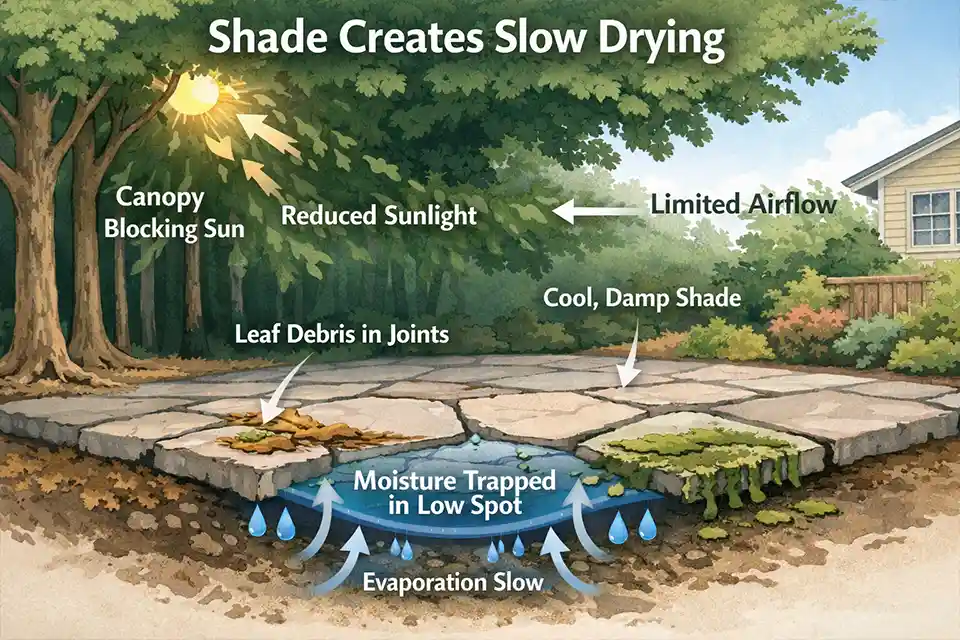
Most stone pathways that turn slick under tall trees are not failing because the stone suddenly changed. They are failing because the surface stops drying. Constant shade cuts solar drying, leaf debris holds moisture against the stone, and a thin biological film starts forming long before thick moss becomes obvious.
The first checks are simple: does the shaded section stay visibly dark 8 to 12 hours after nearby areas have dried, does it feel slick even when it does not look wet, and does water from a hose linger in shallow joints or depressions for more than 30 minutes? That pattern points to moisture retention first.
This is different from a path that is inherently slippery because it is polished or badly sealed. Those surfaces are usually slick more evenly whenever they get wet. Shade-driven slickness is selective.
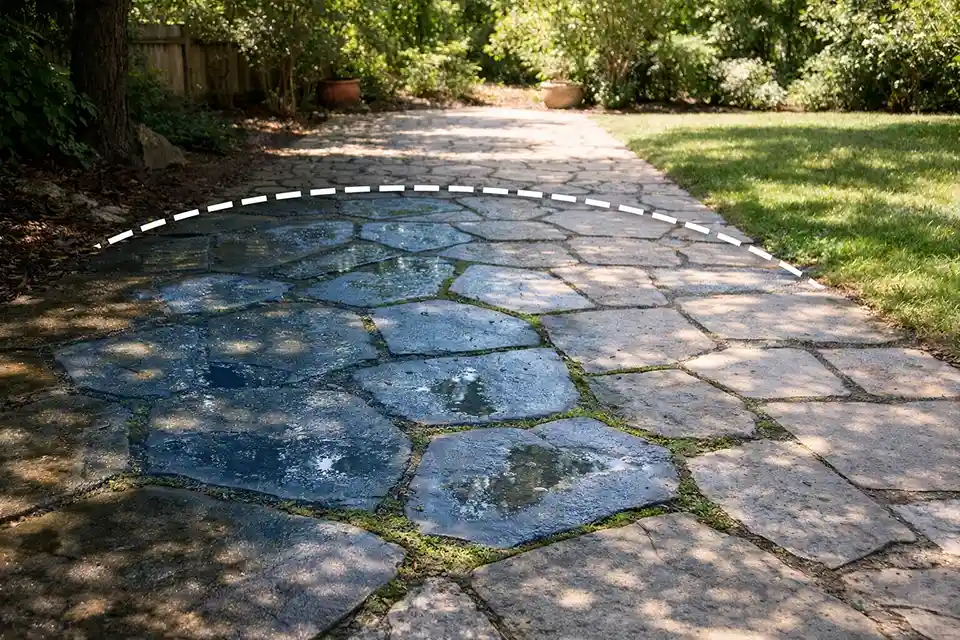
It follows the canopy line, the north-facing side, the leaf-trap corners, or the spots that stay damp more than 24 hours after rain. If the path gets slimy again within 2 to 6 weeks of cleaning, or receives less than about 3 hours of direct sun per day, cleaning alone is usually the wrong answer.
Quick Diagnostic Checklist
- The slick area matches the tree canopy, not the entire path.
- The stone stays dark or cool to the touch more than 8 hours after dew should have burned off.
- Fine green or black film appears in joints before thick moss shows up.
- Leaf litter or seed drop builds to even 1/4 inch in seams, corners, or along edges.
- A hose test reveals water sitting in low spots for 30 minutes or more instead of draining off quickly.
- The problem returns within a month after pressure washing.
What People Usually Misread First
The most common mistake is waiting for obvious moss. By the time you can see a fuzzy green layer, the slip problem has usually been there for a while. The dangerous stage often starts as a nearly invisible biofilm that makes textured stone feel greasy under rubber-soled shoes.
That is why shaded paths can be risky before they look neglected. Why Algae and Moss Make Surfaces Slippery explains that hidden early stage better than most people expect.
The second mistake is blaming the stone itself too early. Yes, worn stone can lose texture, but under tall trees the earlier and more likely driver is persistent dampness. A path that dries in 2 to 4 hours after a light rinse is behaving very differently from one that stays dark until evening.
People tend to overestimate how much a sealer is causing the problem and underestimate how much shade, leaf tannins, and trapped moisture are doing it.
The third mistake is trusting appearance after rain. A shaded path can look merely stained while still carrying enough surface film to slip underfoot, especially in humid stretches of the Southeast or on cool mornings in the Pacific Northwest. That is part of why slippery surfaces after rain can still feel dangerous even when they look dry in the first place.
What the Pattern Usually Means
| What you see | Most likely cause | Useful threshold | What actually changes the outcome |
|---|---|---|---|
| Dark stone only under canopy | Slow drying and biofilm | More than 8–12 hours to dry after dew or rinse | Reduce shade, remove organics, clean properly |
| Slick joints and edge bands | Leaf debris holding moisture | Debris depth around 1/4 inch or more | Frequent debris removal and joint cleaning |
| Small puddles or damp spots after cleaning | Low spots or weak drainage | Water remains longer than 30 minutes | Reset affected stones or correct slope |
| Slickness returns fast after washing | Underlying moisture not addressed | Returns within 2–6 weeks | Fix shade, irrigation, and drainage before recoating |
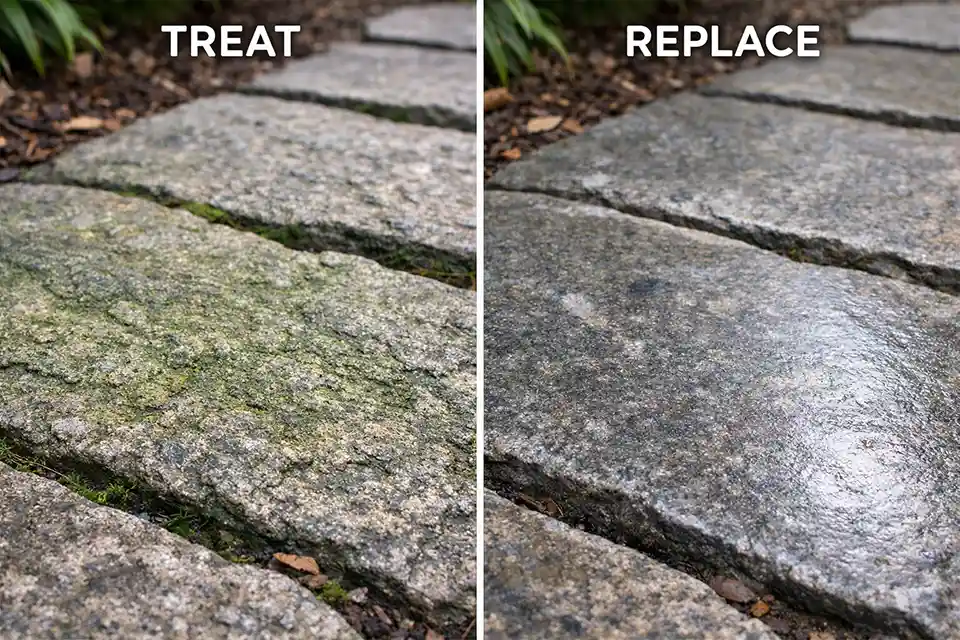
| Smooth glossy wear on walking line | Texture loss in stone face | More than 25% of route visibly polished | Replace, retexture, or change surface finish |
Why the Obvious Fix Often Fails
Pressure washing is the favorite time-waster here. It removes the visible growth, so the path looks fixed for a week or two. But if the surface still dries slowly, the film comes back fast. In some cases, aggressive washing makes the outcome worse by opening softer stone, stripping joint material, or polishing traffic lines.
A clean-looking path is not the same as a path that now drains and dries correctly.
Bleach-only treatments are another weak fix. They may lighten staining, but they do not change shade density, leaf accumulation, irrigation overspray, or shallow depressions.
On some stone, they also create color inconsistency that looks like a stain problem instead of a traction problem. A lot of homeowners lose time chasing cleaning chemistry when the real issue is that the path never gets a recovery window.
If you are dealing with recurring wetness, why outdoor walkways get slippery from poor drainage is often more relevant than product choice. Constant shade and weak drainage amplify each other. Shade alone can be manageable. Shade plus trapped water is when the pathway starts acting like a repeat problem.
Pro Tip: Run the hose test early in the morning, then check the same spots at 30 minutes, 2 hours, and 6 hours. The timing tells you more than a quick glance ever will.
What Actually Changes the Outcome
Start with the moisture cycle, not the cleaner. If branches can be thinned without harming the tree, opening even a few feet of overhead clearance and gaining 3 to 4 more hours of filtered light can make a noticeable difference.
That does not mean cutting down mature trees. It means reducing the canopy density over the walking line and stopping drip concentration in the same spots.
Next, remove the organic reservoir. In heavy leaf-drop periods, weekly clearing matters more than a once-a-season deep clean. Seed pods, needles, and decomposed leaf paste in the joints can hold moisture against the stone for days. That is why how to clean mold and moss off outdoor surfaces becomes relevant only after debris control is part of the routine.
Then check water input. Irrigation heads that hit the path every morning can keep it damp continuously, especially if it gets less than 3 hours of sun and sits in 60% to 80% relative humidity for long stretches. Redirecting spray or cutting run time by even 5 to 10 minutes can matter more than buying a stronger cleaner.
Last, correct the physical path if needed. Low spots deeper than about 1/8 inch, loose joints, or cross-slope that is too flat to move water off the path should be repaired. On a healthy walkway, a light rinse should not leave isolated wet pockets half an hour later.
When the Standard Fix Stops Working
There is a point where maintenance stops being the right answer. If the path has been cleaned, the canopy has been opened somewhat, irrigation is not feeding it, and the surface still turns slick again within 2 to 4 weeks, the stone itself may be too worn or too smooth for the location.
That is especially true on high-traffic routes where the walking line has become glossy while the edges still show original texture.
This is the condition people often underestimate. They assume “a little moss” is the problem when the real issue is texture loss. The moss is the symptom. The underlying mechanism is a damp microclimate acting on a surface that no longer has enough grip margin.
At that stage, coating over the problem rarely makes long-term sense. Anti-slip treatments can help when the stone is structurally sound and the moisture cycle is under control, but they are not a substitute for resetting sunken stones or replacing a route that has become broadly polished.
Once roughly 25% to 30% of the main walking line is worn smooth, replacement or resurfacing is usually the more honest fix.
Pro Tip: Compare the center walking line to a protected edge stone. If the edge still feels gritty and the center feels slick and slightly glossy, you are no longer dealing with cleaning alone.
The Practical Bottom Line
If a stone pathway becomes slick under constant shade from tall trees, the best first assumption is not “bad stone.” It is “stone that never gets dry enough.” Treat the moisture cycle first, the organic buildup second, the drainage geometry third, and the surface finish last. That order saves time because it deals with the cause instead of chasing the symptom.
For broader university guidance on removing moss from pavement, see Oregon State Uniersity Extension.