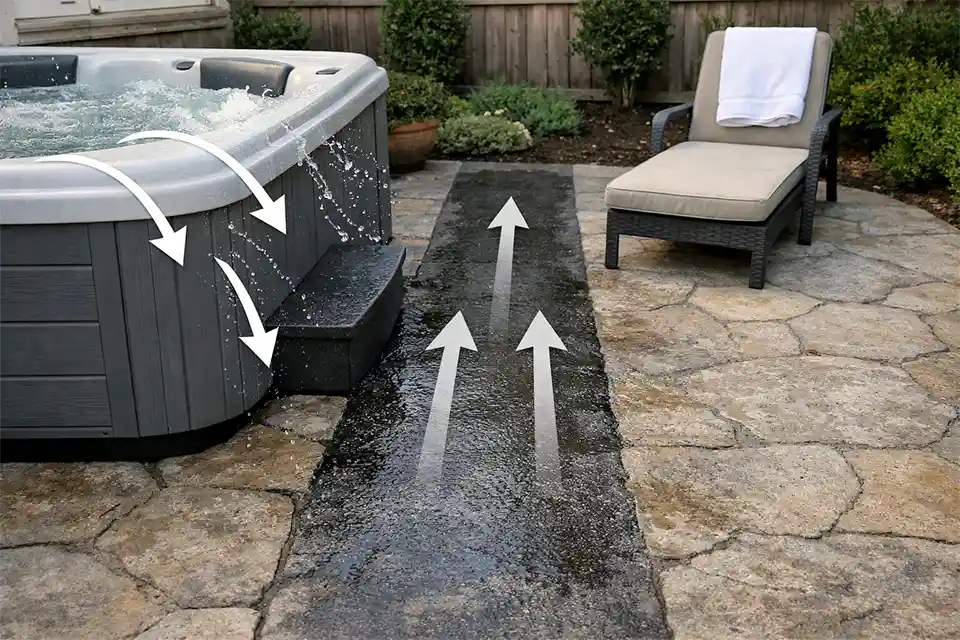
Around hot tubs, the slippery part is often not the whole patio. It is the same short route used again and again: from spa step to towel area, door, or chair. That matters because the problem usually is not just water on stone.
It is warm splash-out mixed with body oils, lotion, and product residue, working on the same 2- to 4-foot zone until the surface loses grip. Start with three checks. See whether the slick area sits in a defined walking lane, whether it stays damp more than 30 to 60 minutes after use, and whether it still feels slick after visible water is gone. If yes, this is already moving beyond a simple wet-surface issue.
That is the first thing people misread. Rain can make an outdoor surface slippery for a while. Spa areas behave differently. The moisture is frequent, warm, and contaminated, and it lands where foot traffic is concentrated most. A surface can look clean and nearly dry but still be more dangerous than a visibly wet patio after a storm.
Why one narrow spa route fails first
The most common cause is not algae, and it is not usually a mysterious defect in the stone. It is a polished contamination path. Repeated wet barefoot traffic smooths the surface’s micro-texture while oils and residue fill what texture remains. That is why the worst slip zone is usually a narrow band, not the whole deck.
People often blame drainage too early. Drainage matters, but it is usually the multiplier, not the first cause. If one short access path feels slick while the rest of the patio performs normally, that points more strongly to residue concentration and traffic wear than to a whole-area water-management failure.
A useful comparison helps here. If the outer patio dries in 20 to 30 minutes but the spa path stays slick for close to an hour, the issue is not simply that the surface gets wet. The surface in that lane is performing differently. That same pattern shows up on poolside patio stone that turns slippery from water and repeated use, but spa areas usually get a heavier mix of warm water, oils, and short-cycle rewetting.
Quick diagnostic checklist
Use this before buying coatings, mats, or specialty cleaners you may not need:
- The slickest area sits within about 2 to 4 feet of the tub edge or steps
- The hazard follows a walking route instead of spreading evenly across the patio
- The area stays damp 45 to 60 minutes after use while nearby surfaces dry sooner
- Bare feet slide more than rubber-soled sandals
- Cleaning improves grip briefly, but the slick feel returns within a few days
- The surface looks slightly darker or more reflective at a low angle than the surrounding area
If four or more of those are true, treat it as a surface-condition problem, not just a temporary wet patch.
What people usually get wrong first
The biggest mistake is assuming visible dirt or growth must be the main problem. Around spas, the more dangerous surface is often the cleaner-looking one. A thin invisible film plus worn-down texture can be worse than obvious debris. People trust appearance too much here.
The second mistake is assuming sealer must be the culprit. Sometimes sealer does make the surface worse, especially if it leaves a film or adds shine. But in many spa areas, the sealer did not create the problem. It exposed a weak surface that already had low texture for a wet barefoot environment. Blaming the sealer alone sends people toward the wrong fix.
The third mistake is assuming pressure washing restores safety. It usually restores appearance first. That is not the same thing. A clean surface can still be polished smooth. That is why courtyard tiles that feel slick after pressure washing are such a common disappointment. Dirt removal and traction recovery are not interchangeable.
What readers overestimate
Algae, moss, and visible grime get blamed quickly because they are easy to see. Around hot tubs, they are often secondary. They can absolutely add risk, but they are not always the first reason the surface stopped gripping well.
What readers underestimate
Micro-texture loss is easier to miss because the surface can still look intact. That is why some spa surrounds feel slick even when they look cleaner than the rest of the patio.
Why the obvious fix wastes time
A small mat near the spa steps feels logical, but it usually solves the wrong 2 feet. Many slips happen in the approach lane, not on the first step out of the tub. The mat covers the most obvious spot, not always the most dangerous one.
The other common time-waster is a generic “non-slip” coating applied before the real mechanism is sorted out. If the surface is holding residue, staying wet too long, and already losing texture, the coating is being asked to cover for too much. In heavy-use spa zones, that kind of fix often wears unevenly within one season.
The smarter order is simple: remove residue, judge drying behavior, compare texture in the spa lane against a less-used edge area, and only then decide whether treatment, retexturing, or replacement is justified.
That sequence matters because it separates a maintenance problem from a performance problem. If the surface still feels slick after a proper degreasing clean and full drying, cleaning was never the real answer.
Pro Tip: Check traction in the middle of the path from spa to towel area, not only at the spa edge. That is often where the false sense of safety breaks down.
Why drainage matters later than people think
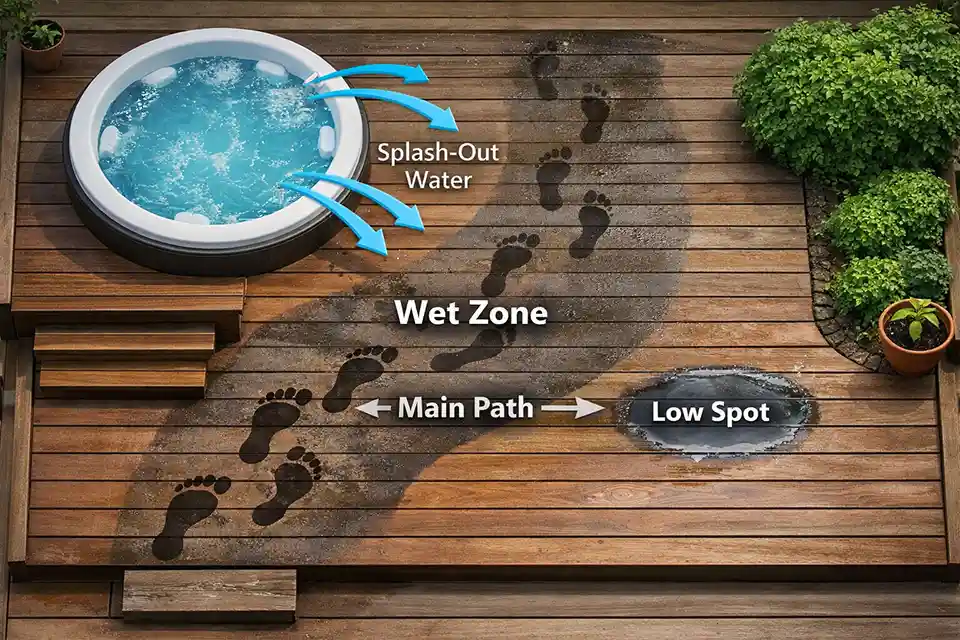
Drainage becomes important when it keeps an already weakened lane active longer. A healthy spa surround can usually shed routine splash-out with about 1/8 to 1/4 inch of fall per foot away from the tub. When the slope is flatter than that, or when settled pavers create low spots deeper than about 1/4 inch, water lingers where people are already walking most.
That is the point many readers underestimate. Weak drainage does not always create the first loss of traction. But it does make every other problem last longer. The surface stays wet longer, residue stays mobile longer, and cleaning resets the condition for less time.
When drainage is only a multiplier
If the surface feels worst in one narrow lane but the rest of the patio drains acceptably, the first problem is usually wear and contamination, not grading alone.
When drainage becomes part of the main failure
If water repeatedly sits in shallow depressions, if the damp zone spreads beyond the normal traffic lane, or if drying time pushes past 60 minutes after routine use, drainage is no longer just assisting the problem. It is now part of it.
In shaded yards, enclosed privacy corners, or humid regions, airflow can make this worse. A spa path that stays damp for 60 minutes in still air may dry in roughly half that time in a more open exposure. When wetting cycles repeat several times a day, the surface stops getting a real recovery window. That pattern starts to overlap with outdoor walkways made slippery by poor drainage, even though the water source here is daily use rather than rainfall.
| Condition | Lower concern | Higher concern | What it usually means |
|---|---|---|---|
| Drying time after use | 15–30 minutes | 45–60+ minutes | Drainage or airflow is prolonging the hazard |
| Surface feel when dry | Grainy, textured | Smooth or slightly waxy | Texture loss or residue film |
| Hazard zone size | Close to splash edge only | Extends through the access path | Traffic wear is involved |
| Water behavior | Clears quickly | Sits in shallow depressions | Grade or settlement issue |
| Cleaning result | Improvement lasts weeks | Improvement lasts days | The surface is losing performance, not just getting dirty |
When cleaning is a fix and when it is only delay
Cleaning is worth treating as the main fix only when the texture is still there. That usually means grip improves clearly after a residue-cutting wash, the area feels rough again once dry, and the improvement lasts for weeks rather than 48 to 72 hours.
That is the line many people miss. They keep cleaning because cleaning helps a little. But partial improvement is not the same as correction. If the surface repeatedly looks better but returns quickly to the same slick feel, the texture is no longer doing enough of the work.
Signs cleaning still makes sense
The surface regains clear traction after degreasing, drying time is close to the surrounding patio, and the slick feel does not return after the next few normal use cycles.
Signs cleaning is now just maintenance
The area looks cleaner but still feels smoother than nearby sections, the improvement fades within days, or the same lane keeps demanding attention while the rest of the patio behaves normally.
A simple field comparison helps. After cleaning and full drying, compare the spa lane with a less-used edge section of the same material. If the problem area reflects light more sharply or feels noticeably smoother under bare feet, the surface has likely been polished by use. At that point, routine cleaning becomes maintenance, not correction. That same distinction matters on slippery outdoor stone surfaces, where people often over-credit cleaning and under-credit wear.
When the standard fix stops making sense
Once three conditions are present together, patch fixes usually stop being economical:
- a consistent traffic lane with clear texture loss
- slow drying from weak pitch, low spots, or limited airflow
- frequent wet cycles, especially most days of the week
That combination defeats the usual tricks. The issue is no longer that the surface gets wet. It is that the surface, the drainage behavior, and the use pattern no longer fit each other.
This is where delay gets underestimated. What begins as a traction complaint can start affecting joints, bedding layers, and perimeter stability if water keeps hanging around. If pavers begin rocking, joints open up, or isolated pieces settle at the spa surround, the problem is moving beyond slip resistance and toward broader early signs of outdoor surface failure.
The replacement boundary
If the same 20 to 40 square feet stays slick, dries late, and feels smoother than matching areas even after proper cleaning, replacement or resurfacing usually makes more sense than repeated spot treatments.
What actually changes the outcome
The fix that usually works is not a miracle product. It is the right pairing of actions: restore traction and reduce moisture persistence. Depending on the surface, that may mean deep residue removal plus mechanical retexturing, selective replacement of the worn spa lane, or lifting and resetting settled units so water stops collecting where people step most.
The important decision is not “What product should I put on this?” It is “What is doing most of the damage here?” If residue is primary, clean better. If texture loss is primary, restore or replace surface grip. If standing water is extending every wet cycle, correct grade or settlement. If all three are active, cosmetic maintenance is just slower failure.
Pro Tip: When only one narrow route is failing, test and repair that route first. Treating the whole patio often costs more without changing the actual risk.
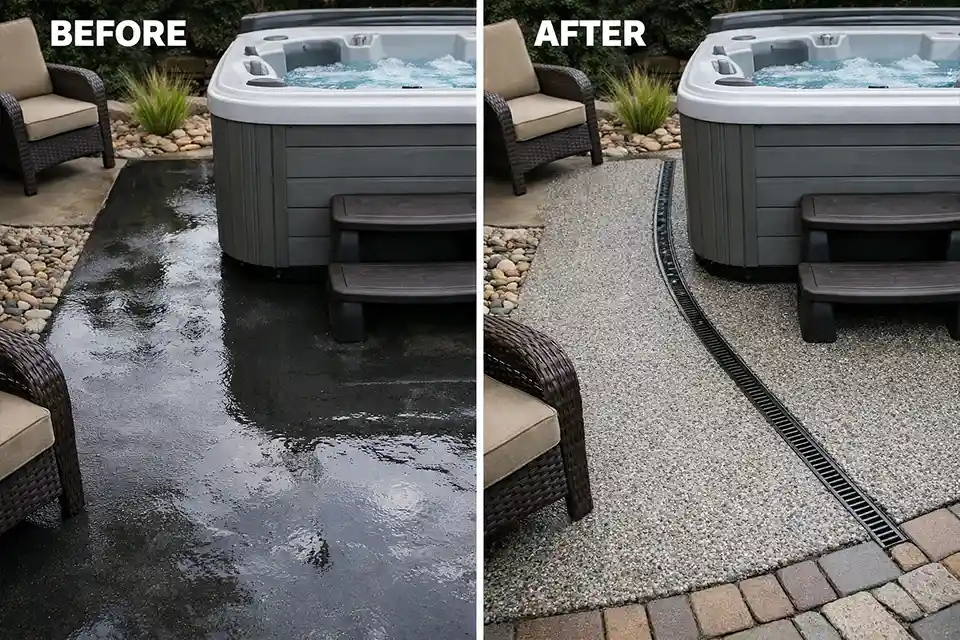
The real “aha” around hot tubs is this: the danger usually is not the water by itself. It is what repeated splash-out leaves behind on the same short path, day after day, after the surface has already started losing texture.
Once you see that, the fix gets much clearer. Clean residue when residue is the issue. Correct drainage when water is lingering too long.
But when the access lane has been polished smooth by use, the right move is usually to restore or replace the surface, not keep trying to wash performance back into it.
For practical public-health guidance around recreational water areas, see the CDC Healthy Swimming guidance.