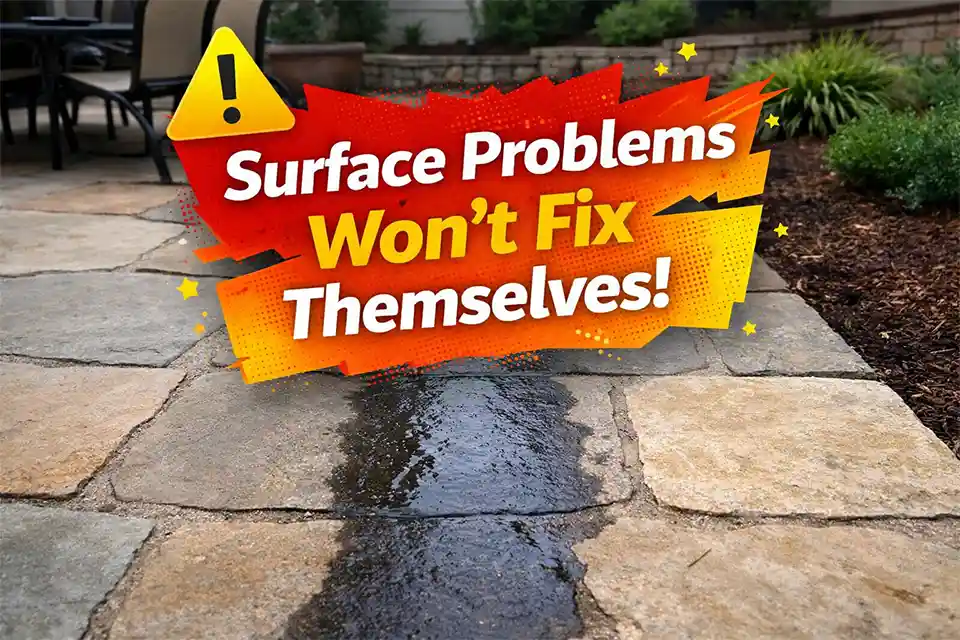
Most outdoor surface problems do not improve just because they are left alone. A patio that feels slick again after the next rain is rarely dealing with moisture alone. A low spot that comes back after you fill it is rarely just missing soil. A small crack that reopens after winter was probably never a surface-only issue to begin with.
That is the first distinction that matters. Outdoor surfaces sit inside an active system: water movement, foot traffic, soil support, weather cycling, contamination, and surface wear keep acting on them whether the defect looks dramatic or not. If the same mechanism is still active, the surface is not recovering. It is only looking quieter between events.
The first checks should be simple. Does one section stay damp for 24 to 48 hours longer than nearby areas? Does a slick area still feel risky 10 to 15 minutes after visible water is gone? Has a low edge, crack, or gap widened by 1/4 inch or more over a season? Those are not dramatic numbers, but they are often the point where a small-looking problem stops being harmless.
Why waiting usually does not work
The most common mistake is treating outdoor defects like cosmetic flaws. Indoors, a minor finish issue may stay mostly unchanged. Outdoors, the same-looking defect is often being reactivated over and over.
The symptom is what you see
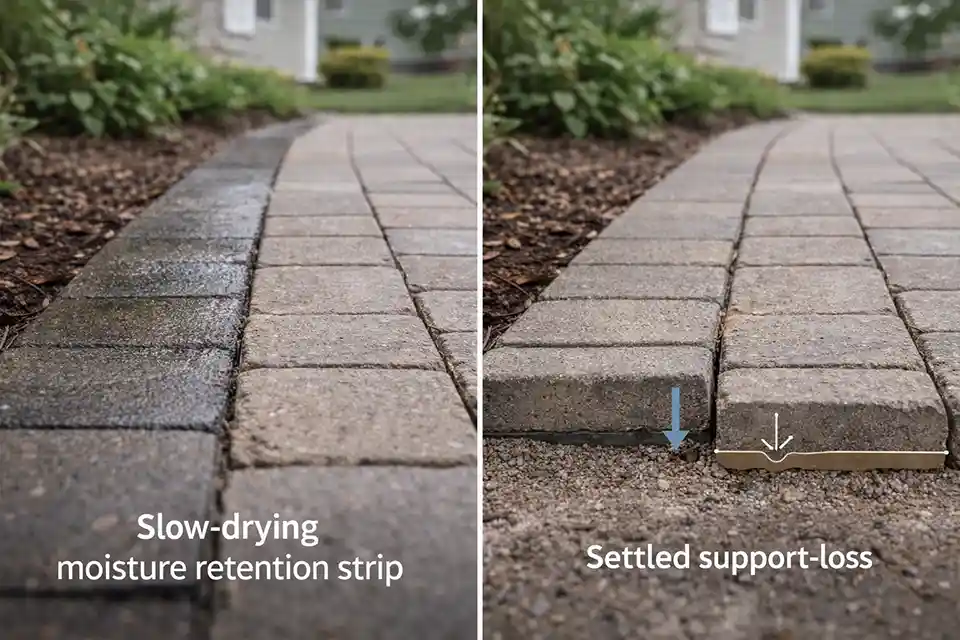
A slippery patch may be caused by slow drying, residue, algae, or worn texture. A settled edge may reflect support loss below grade. A damp strip may point to runoff concentration rather than a simple cleaning problem.
That is why surface-level fixes often disappoint. They improve the appearance briefly while leaving the cause in place.
The mechanism is what keeps it coming back
Most outdoor damage is cumulative.
Water keeps using the same route. Fine material keeps washing out. Repeated traffic keeps smoothing the surface. Seasonal expansion and contraction keep stressing weak points. Organic buildup keeps holding moisture where it should not.
Dry weather can reduce the symptoms for a few days. It rarely removes the reason the problem started.
The four problem types that usually get worse
The better way to understand outdoor surface problems is to group them by what keeps reactivating them.
Moisture-retention problems
These are surfaces that stay slick, damp, or biologically active longer than they should.
What they usually look like
This is common on shaded stone, splash-prone walkways, hot tub surrounds, irrigated edges, and surfaces with poor airflow. The surface may look acceptable in dry weather, then become slippery again after a light rain, morning humidity, or a short splash cycle.
If traction still feels poor 10 to 15 minutes after visible water has cleared, the issue is often no longer simple wetness. It is usually a persistence problem: slow drying, film buildup, organic growth, or lost surface texture.
What people usually misread
People tend to overestimate how much plain moisture explains and underestimate how often the same condition returns.
That is why repeated cleaning often underdelivers. Cleaning may remove the top film for a while, but if the area still traps moisture or the surface has already worn smoother, the same slip pattern returns. That is the same progression described in slippery surfaces after rain that still feel dangerous when they look dry.
Support-loss problems
These are surfaces that drop, tilt, soften, or become uneven because the material below them is no longer supporting them properly.
What they usually look like
This category includes settled ground beside walkways, pavers that start rocking, patio edges that begin holding water, and filled areas that keep dipping after storms. A depression of 1/2 inch may still be manageable. Once the drop reaches 1 to 2 inches, especially near paving, steps, or drainage paths, the issue usually moves beyond appearance.
What people usually misread
People often blame a single storm when the real cause is older: poor compaction, disturbed fill, trench settlement, or slow washout. Rain may expose the weakness, but it does not always create it.
This is also where topping off the surface becomes a time-wasting fix. If the support below is still moving, the new material usually follows it down. That is why uneven walkway surfaces caused by recently filled or disturbed soil tends to be a deeper problem than it first appears.
Wear-driven problems
These are surfaces that still look intact but no longer behave the way they used to.
What they usually look like
A courtyard stone surface may still look solid. Outdoor tile may still seem clean and unbroken. Concrete may show no major cracking. But underfoot, the surface feels less forgiving in damp conditions than it did before.
That change often comes from gradual wear. Repeated foot traffic, abrasive cleaning, and weather exposure can reduce the fine texture that helps the surface maintain traction. In practice, this is a functional failure even when the surface still looks visually intact.
What people usually misread
People trust visible condition too much. A surface can remain structurally whole while becoming less safe. That is why outdoor courtyard stone worn smooth is more than a cosmetic aging issue. The material may still be there, but the performance has changed.
Water-path problems
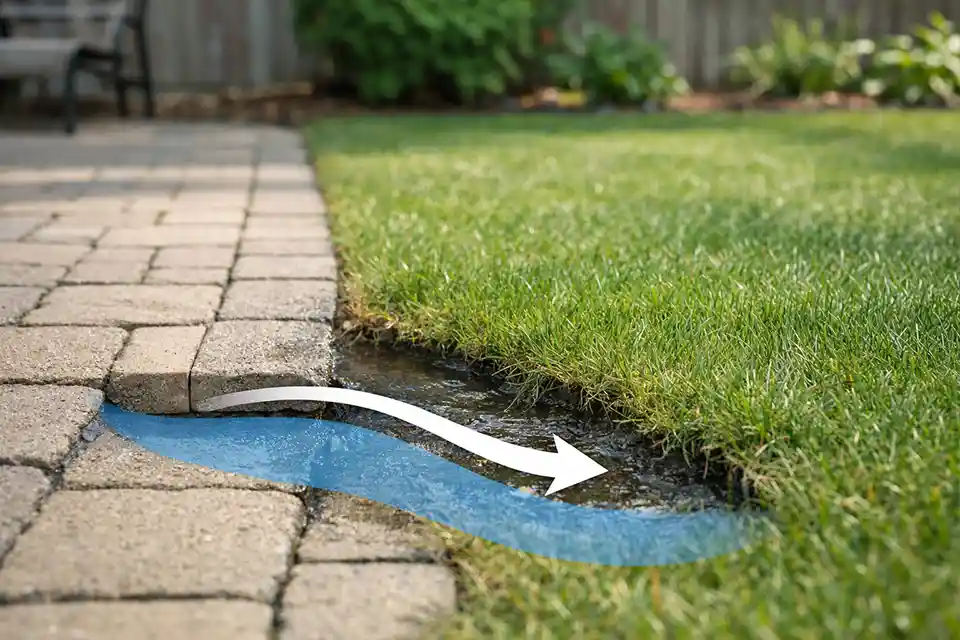
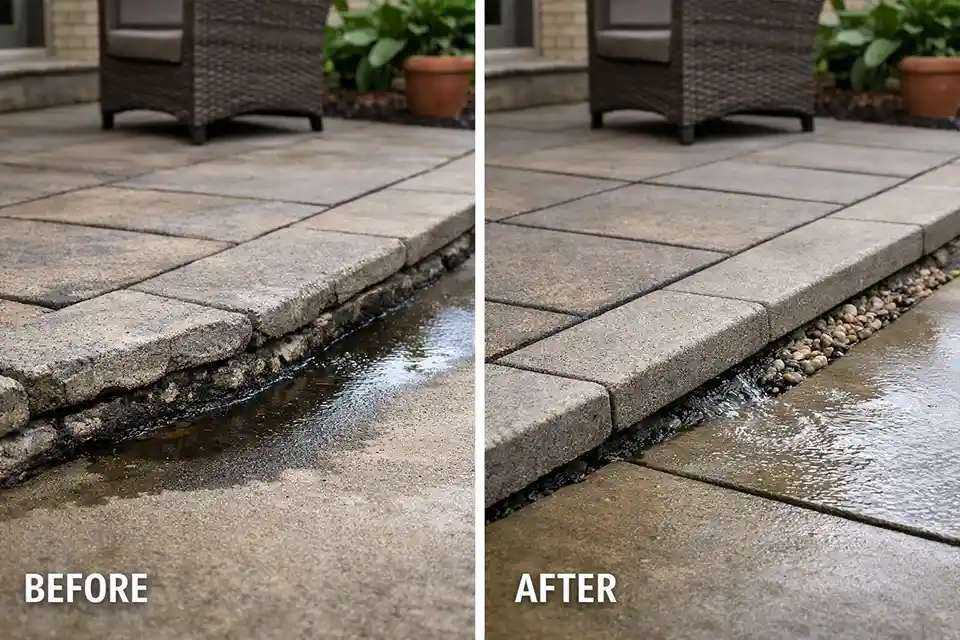
These are defects that keep returning because water continues using the same route across, under, or beside the surface.
What they usually look like
A walkway section that always dries last. A low channel forming along one edge. Soft ground near a downspout. A patio corner that gets slick every time runoff crosses it. Even a modest 2% to 5% slope can keep directing water toward the same weak point if grading or drainage layout is poor.
What people usually misread
The trigger is the rain or irrigation event. The mechanism is the repeated water path.
As long as that path stays the same, the problem keeps reactivating. That is why water-path issues rarely stay local. They can drive slickness, erosion, settlement, and winter damage at the same time. You see that pattern clearly in slippery outdoor walkways caused by poor drainage.
What people usually overestimate and underestimate
Small surface problems often get misclassified for predictable reasons.
What gets overestimated
Rain as the root cause
Rain gets blamed early because it is the event people notice. But many outdoor problems are already primed by poor drainage, weak support, shade, contamination, or earlier surface wear.
Cleaning as a full solution
Cleaning matters when contamination is truly the main issue. It does not restore lost texture, rebuild support, or redirect water.
Appearance as the best indicator
A surface can look better and still be failing. Dry-looking is not the same as stable. Clean-looking is not the same as safe.
What gets underestimated
Repetition
A problem returning in the same place matters more than one dramatic day. Recurrence is often the clearest sign that the underlying mechanism is still active.
Drying time
If one section stays damp 24 hours longer than surrounding areas under similar conditions, that difference is useful. It points to moisture retention, poor drainage, reduced airflow, or persistent contamination.
Small movement
A change of 1/4 inch sounds minor, but outdoors that can be the start of pooling, rocking units, widening joints, or traction loss.
When routine maintenance still makes sense
Not every outdoor defect needs immediate repair. Some do respond to maintenance, at least early on.
Problems that may still respond to maintenance
A residue-driven slick patch, a light organic film on a shaded surface, or a broad shallow depression after a single heavy weather event may still be manageable if the condition does not return. If the area dries normally again, stays stable through 2 to 3 ordinary weather cycles, and does not change shape or behavior, monitoring can still be reasonable.
Problems that have moved beyond maintenance
Once the same issue returns after repeated rain, keeps drying late, reopens after patching, or begins affecting nearby surfaces, the maintenance phase is usually over. At that point, cleaning, topping off, or waiting is not a strategy. It is delay.
This is where many people lose time. They keep repeating the most convenient fix long after the pattern has already shown that the underlying cause is still active.
Pro Tip: Mark the edge of the affected area and recheck it after the next two storms. A problem you can measure is easier to classify than one you are trying to remember.
Why the standard fix often disappoints
A lot of outdoor repairs fail because they target the visible defect and not the reason it keeps returning.
Cleaning without changing the conditions
This works when surface contamination is truly the main cause. It fails when the area still dries slowly, keeps collecting splash-out, or has already lost traction from wear. That is why slippery hot tub surrounds from splash-out residue often need more than a basic wash-down mindset.
Filling low spots without addressing support loss
This can improve appearance briefly, but if the base or surrounding soil is still moving, the depression usually returns.
Treating a drainage problem like a surface problem
This is one of the most expensive misreads. If water keeps re-entering the same zone, the surface defect is often just the visible endpoint of a larger flow problem.
A practical comparison table
| Problem pattern | What keeps it active | Early useful threshold | When it becomes a bigger concern |
|---|---|---|---|
| Surface stays slick after water clears | moisture retention, residue, worn texture | still slick after 10–15 minutes | repeats after several wet cycles |
| One area dries much later | shade, airflow limits, drainage, buildup | 24+ hours slower than nearby areas | recurring dampness, algae, freeze-thaw stress |
| Low spot or settled edge | support loss, poor compaction, washout | about 1/2 inch visible change | 1–2 inches, pooling, rocking, spread |
| Surface feels smoother but looks intact | wear, traffic, abrasive cleaning | grip changes mainly in wet conditions | repeated slickness despite cleaning |
| Defect returns in the same exact place | unresolved water path or weak base | returns after 2–3 events | wider area, faster recurrence, adjacent damage |
How to use this page
This page is most useful as a sorter.
If the main issue is slippery behavior
Start with moisture-retention and wear-driven problems. Those are the categories most likely to explain repeated slickness without obvious breakage.
If the main issue is sinking or unevenness
Start with support-loss and water-path problems. Those are the categories most likely to explain why the same low area keeps coming back.
If the main issue is recurring dampness
Treat it as a moisture-management or drainage pattern first, not just a stain or cleaning issue. That logic also connects naturally to yard drainage problems that create uneven outdoor surfaces.
If the main issue still seems small
Do not classify it by size alone. Classify it by whether the same mechanism is likely to keep reappearing.
The point that matters most
Outdoor surface problems rarely fix themselves because most of them are not isolated defects. They are active outcomes of water movement, support weakness, surface wear, contamination, or environmental cycling. Time alone does not usually improve those conditions. It gives them another chance to keep working.
A problem becomes serious before it looks severe. The real cutoff is when the same mechanism proves it is still active.
For broader official guidance on soil compaction and how it affects water movement and drainage, see the University of Minnesota Extension soil compaction guide.