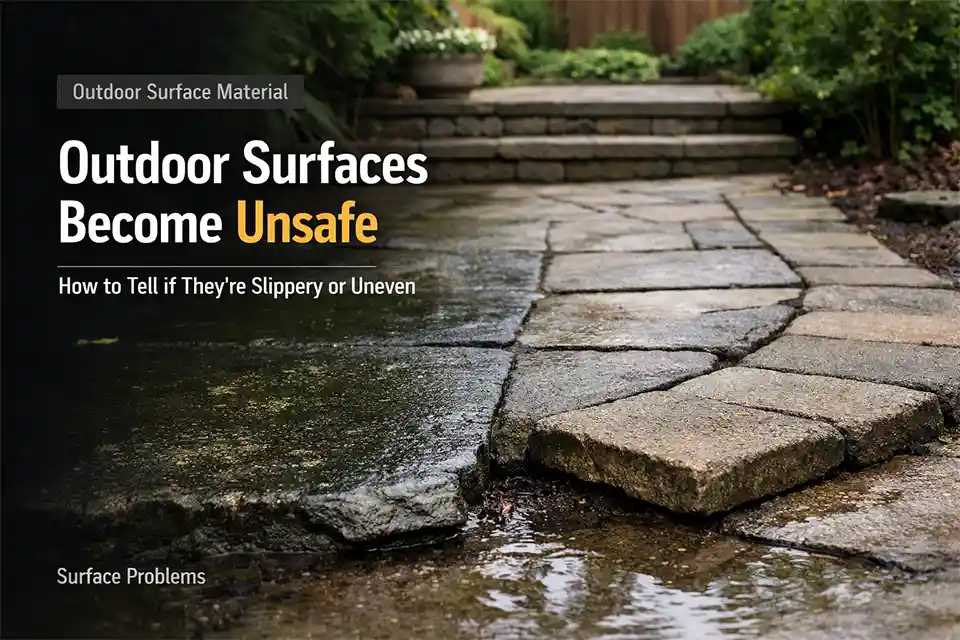
Most unsafe outdoor surfaces fail in one of two ways: they get slippery when wet, or they become uneven even when dry. That split matters because the fixes are different from the start. First, measure any vertical lip between adjacent sections.
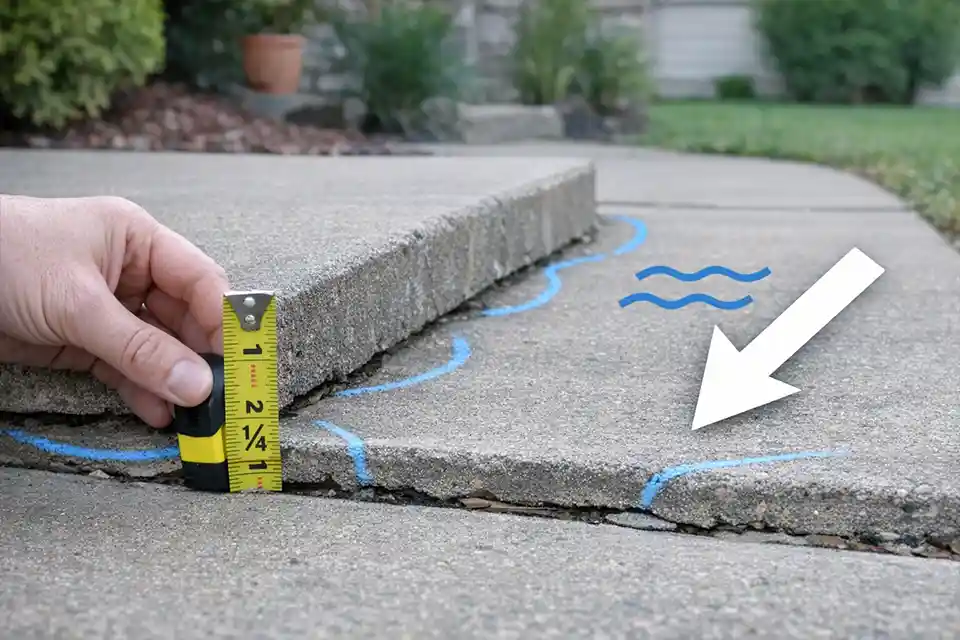
Once the change gets past about 1/4 inch, it stops being a harmless flaw and starts becoming a real trip concern.
As it approaches 1/2 inch, patch-and-ignore logic usually stops making sense. Second, watch how long the surface stays damp after normal rain or irrigation. If one area is still dark and tacky-feeling 2 to 4 hours later while the rest has dried, moisture retention is feeding the problem.
Third, decide whether the danger is about footing or support. Slick underfoot points to traction loss. Rocking, drifting, or hollow spots point to movement underneath. That is the first distinction people miss, and it is why the same “clean it and see” approach often wastes time.
Quick Diagnostic Checklist
- A vertical lip between units is more than 1/4 inch
- One section stays damp for 2 to 4 hours after normal wetting
- The area becomes slick again within 3 to 7 days of cleaning
- Joints have opened to roughly 1/8 inch or keep losing fill
- A chair, grill, or planter rocks in the same spot every time
- The problem is strongest in shade, at the bottom of a slope, or beside overspray
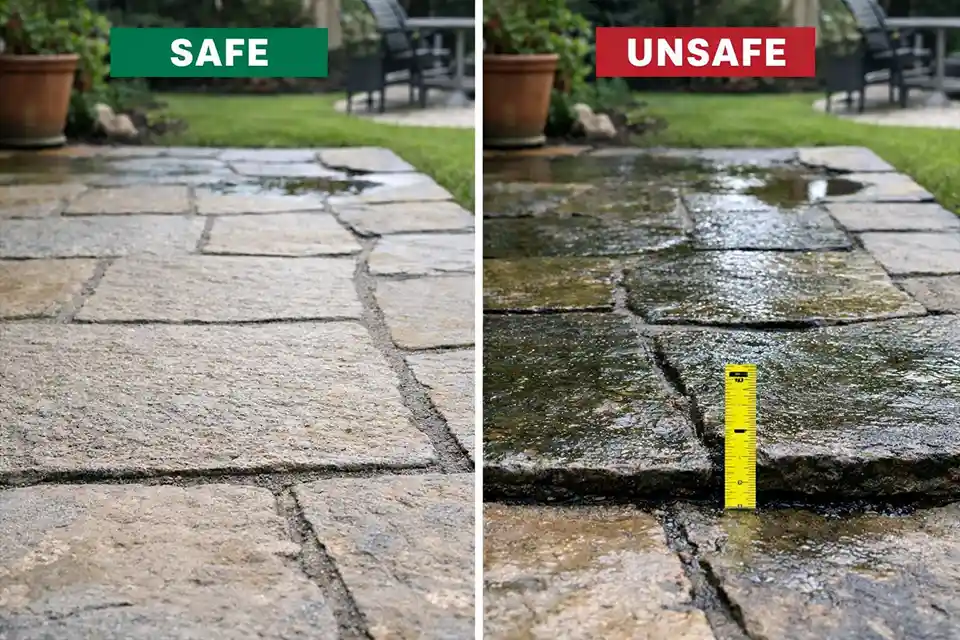
What usually goes wrong first
Slippery surfaces usually fail at the top
On patios, garden paths, entry walks, pool decks, and outdoor stairs, the first safety problem is usually reduced grip, not structural failure.
Thin organic film, residue from hard water, leftover sealer, leaf tannins, and constantly damp shade can change footing long before the surface looks damaged. That is why the first useful question is not “Is it old?” but “When is it worst?”
A surface that feels dangerous only after rain, morning dew, splash-out, or sprinkler overspray is usually telling you the mechanism is on the surface or just above it.
That is the pattern behind Slippery Surfaces After Rain: Why They Feel Dangerous Even When They Look Dry. The hazard may look minor because the surface is not visibly flooded, but the traction has already changed.
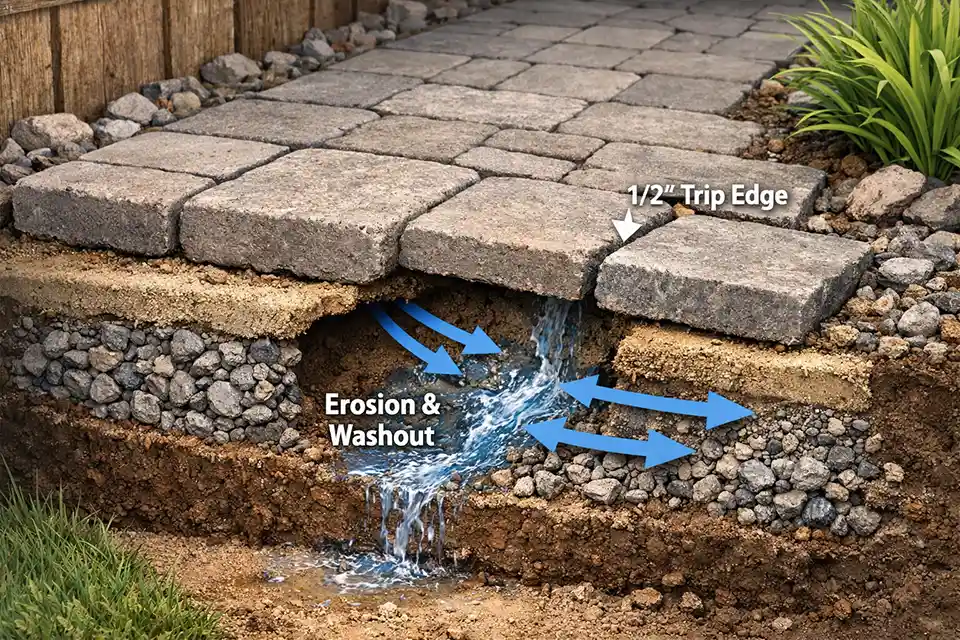
Uneven surfaces usually fail from below
Trip hazards are different. They usually trace back to washout, poor compaction, settling, root pressure, or repeated runoff concentration. The visible symptom is the raised edge.
The underlying problem is movement. That matters because a surface can be ugly and still mostly stable, while a surface that looks only slightly off can already be unsafe to walk.
What people often overestimate is staining. What they underestimate is repeat movement. A small dark patch can be a cleaning issue. A walkway lip that was barely noticeable last season and now measures 3/8 inch is not a cleaning issue.
What people usually misread first
“It just needs pressure washing”
Sometimes it does. But if the same strip turns slick again within a few days, pressure washing only reset the clock. It did not remove the cause.
That usually means water is lingering, the finish is too smooth, or the area is being rewetted by design. In practice, the surface is not getting dirty faster than normal. It is staying wet longer than it should.
That is why Poor Drainage on Outdoor Walkways: Causes, Risks, and Long-Term Damage is often more useful than another cleaning pass. If the damp pattern stays the same after cleaning, the site condition is telling the truth.
“If it feels unsafe, replacement must be next”
Not always. Many unsafe surfaces are locally unsafe, not globally failed. If 80 to 90 percent of the patio or path stays flat and dries normally, and one recurring trouble spot sits near a downspout, slope transition, hose bib, or deep shade line, replacement may be premature.
The mistake here is not being too cautious. It is choosing the wrong scale of fix. Readers often jump past drainage correction and moisture control because replacement feels more decisive. But a local hazard tied to a local water source is usually where the work should start.
The repair path depends on the hazard type
If the surface is slippery only when wet
Start with the quickest risk reducers: remove surface film, stop overspray, clear blocked drains, and correct splash paths. Then reassess after the next wetting cycle. If the area dries normally and grip returns, the issue was mostly traction-related.
| What you see | More likely cause | Better first move |
|---|---|---|
| Slick only after rain | Surface film or low texture | Deep clean, then reassess grip |
| Damp strip that stays dark for hours | Drainage or shade-held moisture | Redirect water before treating the surface |
| Slickness near irrigation or hot tub areas | Overspray or splash residue | Change the water pattern |
| Worse after sealing | Finish changed the traction | Strip or correct the sealer |
| Dark slick patches in shade | Moisture-supported biofilm | Clean it, then reduce the moisture cycle |
One thing that gets missed here is material behavior. Outdoor tile often becomes risky because the finish is too smooth when wet. Pavers tend to fail through joint loss and movement. Natural stone in shade often looks fine until wear and biofilm combine.
Concrete is more likely to create trouble through sealer choice, runoff, or worn texture. That is why Why Outdoor Tiles Become Slippery is relevant to one type of surface, but not to all of them in the same way.
If the surface is uneven even when dry
Shift your attention below the finish. Look for repeated lips, rocking sections, hollow sounds, washed joints, edge settlement, or one area drifting lower after every storm. Once the hazard exists in dry weather, traction products and repeated cleaning are solving the wrong problem.
That is the logic behind Why Outdoor Walkways Become Uneven. The problem is not that the edge is visible. The problem is that the support below that edge is changing.
Where routine fixes stop making sense
Cleaning has a ceiling
Cleaning is maintenance, not diagnosis. If slickness returns within 72 hours to one week, there is usually a moisture pattern driving it. That does not mean cleaning was pointless. It means cleaning alone was never going to hold.
Pro Tip: Check the same area early in the morning and again around midday after a normal wetting event. The sections that stay dark longest usually mark the real problem area more accurately than the dirtiest-looking sections.
Coatings and patches are not universal fixes
Anti-slip coatings help when the surface is sound, stable, and only lacking enough grip. They disappoint on surfaces that stay wet for long stretches or move underneath.
The same goes for filling a single lip while nearby joints are widening and bedding material is disappearing. That is not a durable repair plan. It is short-term camouflage.
A practical decision line is this: when more than about 10 to 15 percent of the walking area has recurring slickness, instability, or edge displacement, isolated spot work often becomes less efficient than partial reset, drainage correction, or base repair.
What changes under different conditions
Shade, freeze-thaw, and irrigation shift the diagnosis
In humid climates, especially where shade and organic debris combine, slickness often shows up earlier than visible deterioration. In colder northern states, freeze-thaw cycles can turn small water-entry points into lifted edges and loosened sections by the next season.
In dry parts of the Southwest, surfaces may stay visually clean yet still become uneven because runoff concentrates hard during short storms and washes support away faster than people expect.
That is why the same symptom should not be read the same way everywhere. A dark slippery strip in Florida and a lifted joint after a winter in Minnesota may both create the same safety risk, but not for the same reason.
Visibility can make a moderate hazard worse
Poor lighting, deep shadows, and weak visual contrast at steps and transitions often make a manageable defect more dangerous in real use. A 1/4-inch lip is easier to catch when it sits at the end of a shaded run, near a threshold, or where the walking line changes direction. Temporary marking is not a substitute for repair, but it can reduce risk while the real fix is being planned.
What to do first, in the right order
1. Remove the fast-risk factors
Clean film, debris, algae, and residue. Stop overspray. Open drainage paths. If the surface is flat and the danger drops immediately, traction loss was likely the main issue.
2. Measure before guessing
Use a tape, straightedge, or even a small level across the transition. Once lips get past 1/4 inch, they deserve more than casual observation. Near 1/2 inch, proper transition work starts making more sense than hoping the spot stays stable.
3. Decide whether the pattern is local or spreading
One failure point near one water source is different from a whole path showing drift, joint loss, and multiple lips. This is where Early Signs of Outdoor Surface Failure becomes useful, because the pattern usually declares itself before the worst section looks dramatic.
4. Match the fix to the mechanism
If the problem is traction, solve water and surface condition first. If the problem is movement, plan for reset, regrading, drainage correction, or partial rebuild. The wrong fix can look active and still leave the hazard in place.
Outdoor surfaces do not become unsafe all at once. Most of the time, they tell you early whether the danger is about grip or support. If you sort that out first, you stop wasting effort on fixes that look logical but do not change the outcome.
For broader official guidance, see the U.S. Access Board guide to floor and ground surfaces.