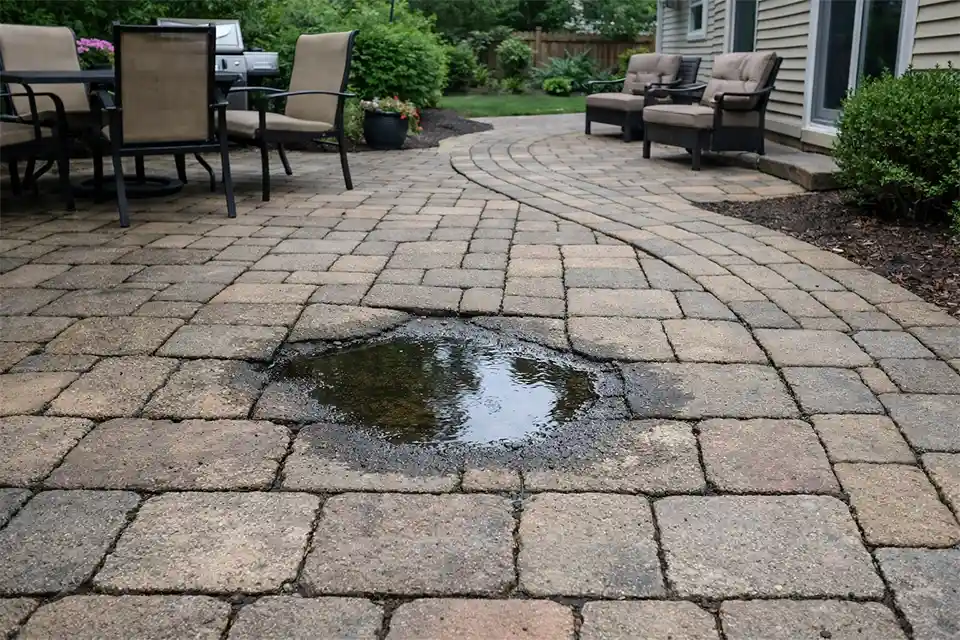
Most outdoor surfaces last longer than their first cosmetic flaws suggest, but not as long as people assume once water, movement, or support loss enters the picture.
As a broad guide, concrete patios and walkways often remain serviceable for 25 to 40 years, concrete driveways for 20 to 30 years, paver surfaces for 20 to 30 years or more, natural stone for 30 to 50+ years, brick pavers for 25 to 40 years, and gravel usually needs major refreshing within 5 to 10 years.
The quickest way to judge whether a surface is aging normally is to ignore color first and watch performance instead. Does rainwater clear within 30 to 60 minutes in ordinary conditions? Are joints opening beyond about 1/4 inch? Does one area stay damp 6 to 12 hours longer than the surrounding surface? Those signals usually tell you more than fading or mild staining ever will.
Typical lifespan ranges by surface type
These ranges assume the surface was installed over a stable base and is not dealing with chronic runoff, washout, or ongoing ground movement.
| Surface type | Typical service life | Early trouble usually starts with | Most common life-shortener |
|---|---|---|---|
| Concrete patio or walkway | 25–40 years | Hairline cracking, slow drainage, edge settlement | Weak base, freeze-thaw, runoff concentration |
| Concrete driveway | 20–30 years | Surface scaling, cracking, edge breakdown | Vehicle loads, salts, wet subgrade |
| Concrete pavers | 20–30+ years | Joint loss, rocking units, shifting pattern | Washout, poor edge restraint, root pressure |
| Brick pavers | 25–40 years | Joint erosion, localized settling | Moisture cycling, weak bedding, traffic concentration |
| Natural stone | 30–50+ years | Isolated rocking, spalling, worn smooth paths | Base failure, trapped moisture, repeated saturation |
| Gravel | 5–10 years before major refresh | Rutting, migration, thin spots | Slope, runoff, poor confinement |
If a surface begins showing active problems in the first 3 to 7 years, that usually points to drainage, compaction, or installation quality rather than normal aging. If it is under 10 years old and already showing movement, pooling, or widening joints, assume a site or support problem before assuming ordinary wear.
What “lasting” really means in practice
People often ask how long a surface should last as if the answer sits entirely in the top layer. In practice, it is more useful to ask how long it stays stable, drains properly, and remains safe to walk or drive on.
Cosmetic aging is often overestimated
Fading, mild surface dullness, and isolated staining usually look worse than they are. They may affect appearance and sometimes traction, but they do not automatically mean the surface is near the end of its life.
Slight movement is often underestimated
A paver or stone that rocks only 1/8 inch underfoot does not look dramatic, but it often signals that support conditions are changing below the surface. Once movement starts, joints open faster, edges chip faster, and water gets easier access. That is one reason Early Signs of Outdoor Surface Failure matters more than appearance alone.
Still present is not the same as still performing well
A patio may still be in place after 30 years and still be a poor-performing surface. It may look acceptable from a distance while draining badly, developing slick zones, loosening joints, or shifting enough to create trip points.
What shortens lifespan sooner than most people expect
Outdoor surfaces rarely wear out from age alone. They fail early because site conditions keep pushing them in the wrong direction.
Drainage problems
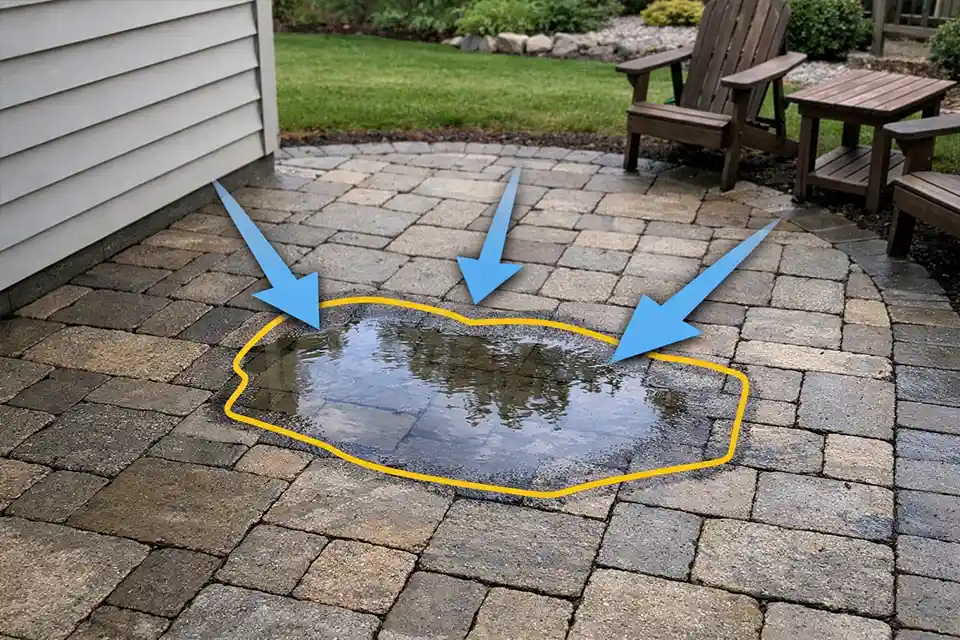
Water is one of the most reliable lifespan reducers. If the surface holds water longer than 30 to 60 minutes after an ordinary rain, or if edges remain damp a full day later, service life usually starts compressing.
In colder regions, trapped moisture followed by freezing is especially hard on concrete, stone, and bedding layers. In humid climates, slow drying also increases algae, residue, and slip risk.
This is where Poor Drainage on Outdoor Walkways: Causes, Risks, and Long-Term Damage becomes directly relevant: drainage problems often look minor at first, but they steadily reduce service life before dramatic cracking or settlement appears.
Weak base or poor compaction
A surface installed over poorly compacted fill may look fine at first, then start moving after one wet season or one freeze-thaw cycle. That is common near trench lines, recently built homes, and yard areas with disturbed soil. A depression only 1/2 inch deep can start redirecting water enough to accelerate further settlement.
Repeated traffic in the same path
The center of a patio may age slowly while the grill path, gate approach, or front-entry route ages much faster. Concentrated foot traffic can wear some sections 2 to 3 times faster than adjacent ones, especially on stone, brick, or pavers with fine jointing material.
Dirt, debris, and moisture retention
Organic buildup is not just a cleaning issue. It keeps surfaces wet longer, masks drainage behavior, and can increase wear by trapping grit underfoot. Dirt and Debris Accelerating Surface Wear fits here because the effect is cumulative: it rarely destroys a surface by itself, but it can speed decline when other weaknesses already exist.
What people usually try first, and why it often disappoints
Small repairs are not useless. They just stop making sense sooner than many people think.
Cleaning and sealing
Cleaning helps when the problem is surface residue, algae, or traction loss from buildup. Sealing can help when the surface is still stable and the goal is stain resistance or moisture moderation. But neither one fixes movement, support loss, or trapped runoff.
Spot patching
Spot repairs make sense when the issue is truly local. They make less sense when the same crack, depression, or settled patch returns within 6 to 18 months.
That pattern usually means the visible symptom is only the top expression of a deeper problem. Surface Problems Rarely Fix Themselves is useful in exactly that situation: repeated cosmetic corrections often delay the right repair instead of preventing it.
Re-sanding pavers again and again
Joint sand replacement is normal from time to time. Having to do it every season is not. That usually points to washout, edge movement, slope issues, or recurring runoff through the surface.
Pro Tip: Take photos from the same angle after major rain events. Drainage and settlement patterns are easier to judge from repeat images than from memory.
Quick diagnostic checklist
If two or more of these are true, the surface is probably aging poorly rather than simply getting older.
- Water stays on the surface more than 30 to 60 minutes after normal rain
- One area dries 6 to 12 hours slower than nearby sections
- Joints have opened beyond about 1/4 inch
- A unit rocks more than about 1/8 inch underfoot
- The same crack, low spot, or repair returns within 6 to 18 months
- Unevenness is measurably worse than it was one season ago
That checklist matters because it separates an older surface from an active failure process.
Maintenance can add years, but only while the structure is still stable
Maintenance matters, but it has a boundary. Routine cleaning, joint maintenance, vegetation control, and small corrective repairs can extend service life when the surface is still structurally stable. They do very little once the base is moving or water is repeatedly being trapped below.
When maintenance still helps
Maintenance is worth doing when the surface remains mostly level, joints are largely stable, and moisture behavior is still predictable. In that stage, selective lifting and resetting, crack sealing, traction improvement, and joint refresh can buy real time.
When maintenance turns into stalling
Once more than about 15% to 20% of the area shows recurring movement, chronic dampness, spreading settlement, or repeat repairs, you are usually no longer preserving the surface efficiently. You are managing decline.
This is also where Weather Exposure Damage in Outdoor Surfaces helps with perspective: sun and seasonal exposure matter, but they rarely shorten service life as aggressively as bad drainage and unstable support do.
When small repairs stop making sense
The right question is not “Can this be repaired?” Almost everything can be repaired somehow. The better question is whether the repair changes the mechanism that is shortening lifespan.
Small repair is still rational when
The surface is mostly level, the problem area is contained, water still drains correctly, and the defect is not spreading. A localized reset, joint rebuild, or targeted crack repair may then be a sensible move.
Rebuild becomes more rational when
The site stays wet, multiple areas are moving, or repeated repairs keep failing in the same zone. If a repair does not change slope, drainage path, base stability, or support conditions, it usually does not change the long-term outcome much either.
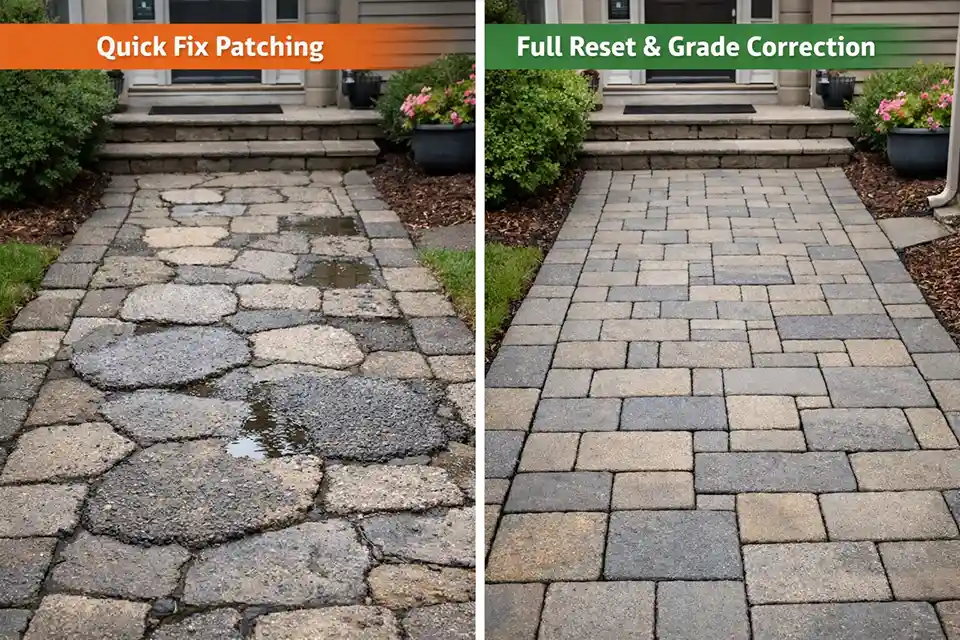
A practical threshold: when expected repairs approach roughly 25% to 35% of replacement cost and still do not solve drainage or support failure, small fixes often stop making financial sense. For someone trying to get another 5+ years of reliable use, structural correction matters more than repeated surface touch-ups.
Pro Tip: Ask one blunt question before approving a repair: what exactly will be different about how this area sheds water or holds support afterward?
Climate changes the timeline, but not the logic
In northern states, freeze-thaw cycling can shorten life sharply when moisture is trapped under or within the surface. In humid areas such as Florida, long drying times and biological buildup may produce failure through wetness and slipperiness before dramatic cracking appears.
In hot dry climates such as Arizona, surfaces may look older from fading and heat exposure without being structurally near failure.
Outdoor surfaces usually do not reach the end of life because the material suddenly gets old. They reach it because water, movement, and support conditions stop cooperating.
If drainage still works, the base remains stable, and wear stays controlled, a surface may have years left. If those conditions are no longer true, age matters less than the mechanism actively shortening what remains.
For broader official guidance, see the USDA Natural Resources Conservation Service.