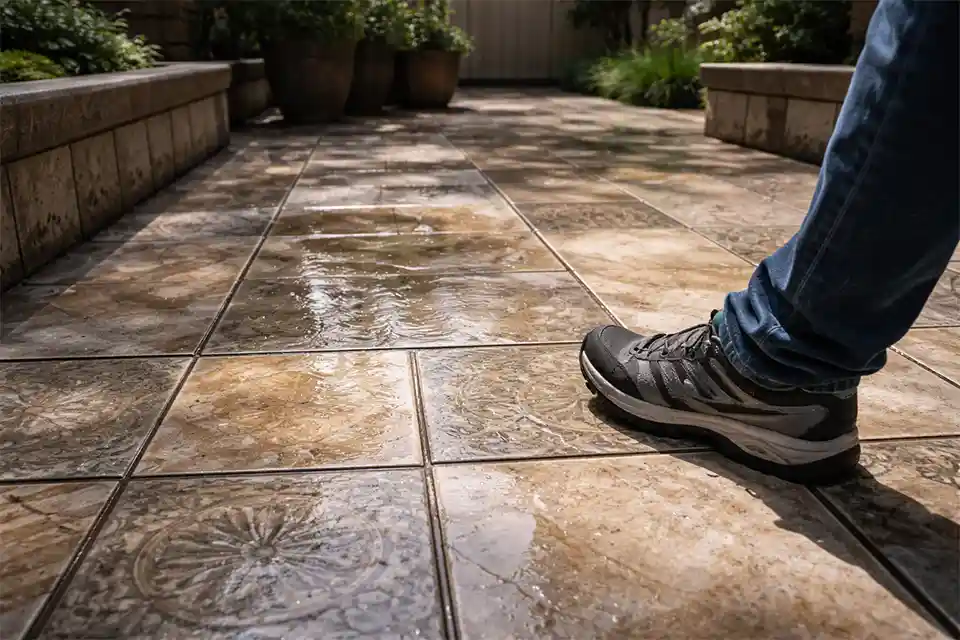
If decorative courtyard tiles turned slick right after pressure washing, the wash usually did not create a new problem. It exposed one. In most cases, the cause is one of three things: cleaner residue left behind, a sealer that was weakened or stripped unevenly, or a tile surface that now holds water longer than it should. Start with timing.
If the slick feel showed up the same day, residue or sealer disruption is more likely than algae. If the surface looked better for a few days and then got slippery again within 7 to 14 days, moisture retention and biofilm move higher on the list.
Dry time matters too. On a mild 70°F day, courtyard tile that stays damp more than 30 to 45 minutes longer than nearby sections is usually showing a surface or drainage problem, not just leftover dirt. That is the distinction people miss most: slipperiness is the symptom, but the mechanism is usually film, finish failure, or slow drying.
What people misread first
The most common bad assumption is that pressure washing simply did not clean deeply enough, so the answer is to wash again harder.
That is often the wrong move. Decorative courtyard tile is not the same as plain broom-finished concrete. The visual finish matters, the sealer matters, and the low spots in textured faces matter. A pressure washer in the 1,800 to 2,500 PSI range is not automatically a problem, but once the wand is held too close—often under 8 to 10 inches—it becomes much easier to disturb aging sealers, leave uneven rinse patterns, and drive dirty solution toward grout edges instead of fully clearing it.
People also trust appearance too much. A cleaner-looking tile can be less safe. A light glossy cast after washing is not a good sign on this kind of surface. It often means surfactant film, loosened finish, or a smeared organic layer that was redistributed rather than fully removed.
What deserves more attention is dry-back behavior. If the courtyard still feels tacky, cool, or slick 1 to 2 hours after washing while nearby hardscape has already dried, the problem is no longer simple cleanliness.
Quick diagnostic checklist
-
The surface became slick within 24 hours of pressure washing
-
One area stays damp at least 30 minutes longer than surrounding tiles
-
Slipperiness is worst in shaded corners or near planters
-
The tile looks slightly shinier after drying, not just cleaner
-
Water beads in patches instead of evenly across the surface
-
The problem repeats after both washing and rainfall
The most likely causes, in order
These causes are not equally likely.
1. Cleaner residue or rinse failure
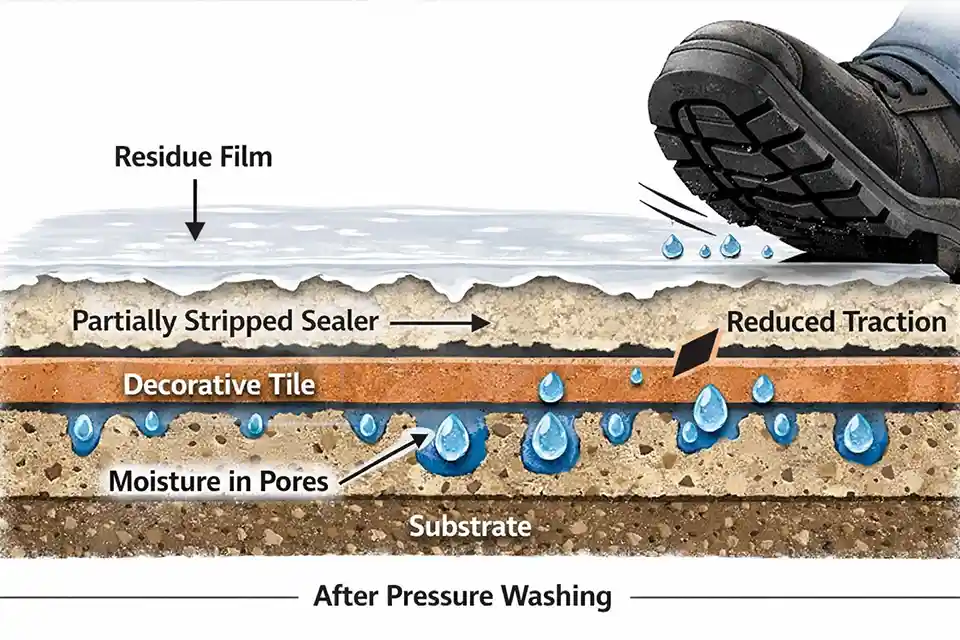
This is the first thing to suspect when the slick feel shows up immediately after washing. Decorative tile cleaners, degreasers, and “safe for outdoor surfaces” soaps can still leave a thin film if the mix was too strong or the rinse was too light. Courtyards make this worse because runoff often has nowhere good to go. Dirty wash water settles back into texture, joints, and corners.
A useful threshold helps here: if it takes more than 2 to 3 thorough rinse passes before runoff looks fully clear, residue was probably part of the problem.
That is also why people waste time by repeating the same cleaner. Another wash with the same product often adds another round of film instead of fixing the first one.
2. Uneven sealer damage
If the tile had an older sealer—often 2 to 4 years into service—pressure washing may have exposed a finish that was already failing. The wash did not always create the weakness. It often accelerated one that was already there.
This matters because homeowners tend to overestimate how much cleaning can solve. Once traction becomes patchy because the finish is patchy, routine washing stops being the main answer. That is when resealing, stripping, or applying a traction-oriented treatment becomes more logical than another cleaning pass. That broader surface logic is part of Why Outdoor Tiles Become Slippery, especially when the tile still looks attractive but behaves poorly when wet.
3. Biofilm returning in damp zones
If the courtyard looked improved at first and then became slick again within 1 to 2 weeks, especially in shade, moisture retention and biofilm deserve more weight than cleaner residue. This pattern is common around enclosed walls, dense planters, drip zones, and areas that stay humid overnight for 8 hours or more.
The mistake here is treating visible growth as the whole problem. Early biofilm can be nearly invisible and still reduce grip. That is why Algae and Moss Making Surfaces Slippery matters even when the courtyard does not look obviously green.
4. Slow drainage or poor pitch
This is the condition people underestimate because the courtyard may not show standing water. But even without puddles, weak pitch or trapped runoff can leave a thin moisture film in place longer than the eye catches.
Pressure washing often reveals this because it is the first time the surface gets saturated evenly. If the same tiles repeatedly stay darker, cooler, or wetter after both washing and rainfall, the tile is not the real starting point. The moisture path is.
| Cause | Usual timing | Most useful clue | Better fix |
|---|---|---|---|
| Cleaner residue | Same day to 24 hours | Slight film or post-wash gloss | Thorough rinse and full dry cycle |
| Sealer disruption | Immediate or after drying | Patchy grip and uneven darkening | Strip, reseal, or traction treatment |
| Biofilm return | 7 to 14 days | Shade-related slickness | Biocidal treatment and moisture control |
| Drainage issue | Repeats after every wash or rain | Slow dry zones in the same locations | Correct runoff and drying conditions |
Why the obvious fix fails
Pressure washing is good at removing visible grime. It is not good at judging what should be left alone.
If the tile was sealed for color enhancement rather than traction, the wash can leave the surface uneven without making the damage obvious. Some tiles absorb water faster, some hold it on top, and the walking feel becomes inconsistent. That kind of inconsistency is more dangerous than a surface that is uniformly poor because it catches people during turning steps or quick transitions from dry to wet sections.
This is where generic cleaning advice starts to fail. A slick courtyard after washing is rarely just a dirty tile story. It is usually a surface-performance problem. That is why Slippery Surfaces After Rain: Why They Feel Dangerous Even When They Look Dry overlaps so closely with this issue. The danger often comes from a thin retained film, not obvious standing water.
Pro Tip: Test a single 2 ft by 2 ft area with clean water after the whole surface has dried for 12 to 24 hours. If that patch still feels slick when rewetted, the problem is not lingering loose dirt.
When washing stops making sense
There is a practical line where more cleaning becomes wasted effort.
If you have pressure washed the same courtyard twice within 30 days and the same sections still turn slick after wetting, cleaning is no longer the primary fix. By then, one of three things is more likely true: the finish is wrong for the exposure, moisture is lingering too long, or the tile has weak wet traction for that setting.
That is also where people overestimate sealer refreshes. A fresh coat does not automatically improve grip. Some sealers improve appearance and worsen footing. If the tile is decorative first and performance second, the wrong finish choice can recreate the same problem again and again. That larger pattern is part of Slippery Outdoor Stone Surfaces Explained, because the real question is whether the surface can recover safe traction after wetting, not whether it still looks good when dry.
Practical fix path
Use the least destructive sequence, but do not confuse that with the weakest response.
First, rinse with clean water only and allow 12 to 24 hours of drying.
Then re-wet one small area and compare it with a safer section.
If grip is still patchy, inspect for uneven sealer behavior or moisture-retaining zones.
If slickness returns within 7 to 14 days, treat biofilm and moisture conditions instead of just rewashing.
If the same surface remains hazardous after those steps, move to a traction treatment, finish correction, or replacement strategy.
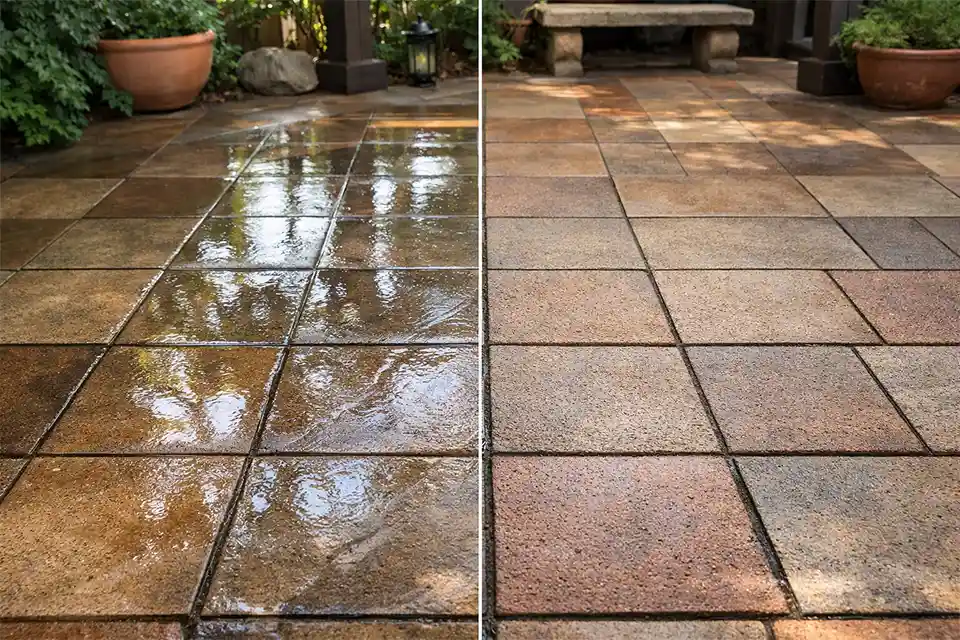
One useful threshold: if two sections of similar tile in the same courtyard dry more than 45 minutes apart after the same wash, that difference is meaningful. It usually points to retained moisture, surface inconsistency, or both. Where repeated wet zones line up with planter runoff, wall edges, or slow-draining corners, Poor Drainage on Outdoor Walkways Causes Risks and Long-Term Damage becomes relevant even if the visible complaint seems limited to tile.
Pro Tip: Shoe testing is more reliable than hand testing. A tile that feels only mildly slick to the hand can still perform poorly under body weight and a turning step.
For a more practical reference point on slip risk and surface safety, see the National Floor Safety Institute.