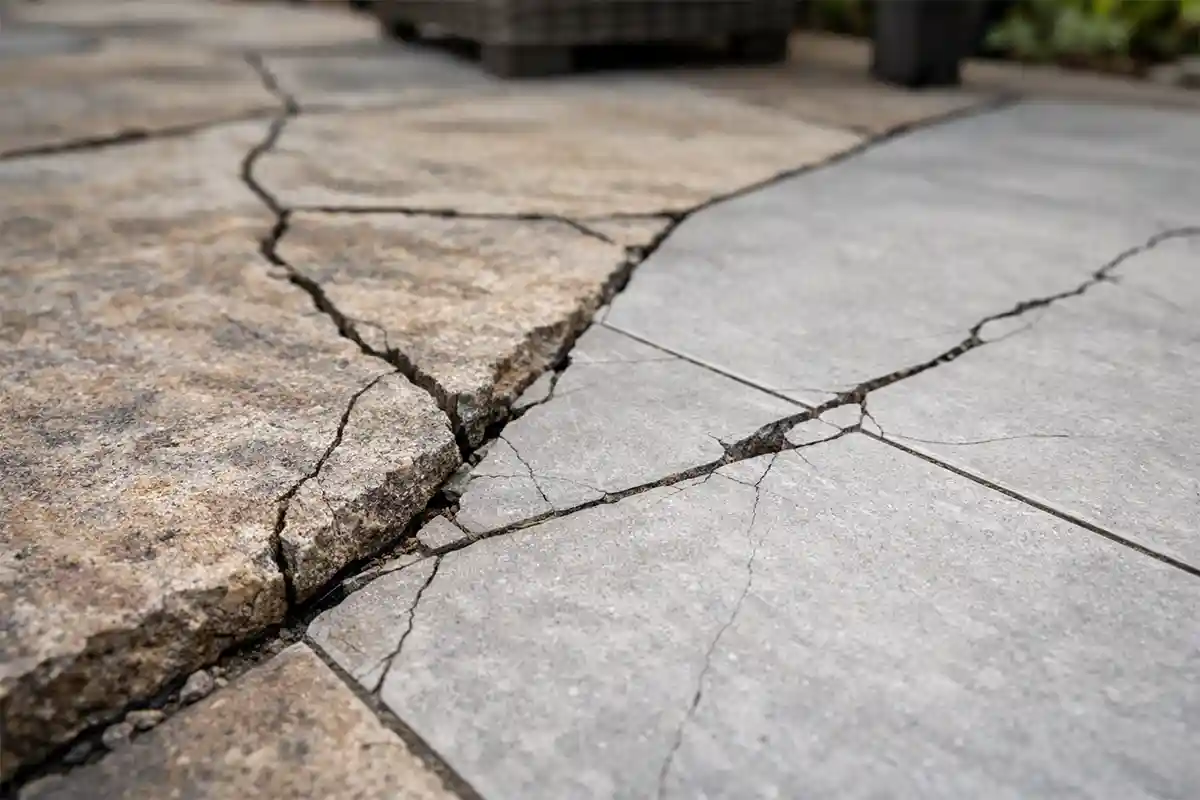
A quiet afternoon, the patio looks exactly as it always has—until a thin line catches the eye across one tile. At first, it blends into the natural pattern of the stone. Only when stepping over it does the surface feel slightly different.
After the next rainfall, that same line appears darker than the surrounding area. Water lingers there a bit longer before drying. The crack has not spread dramatically, yet the surface no longer feels as solid as it once did.
Outdoor stone and tile rarely crack without a reason. What seems like a minor cosmetic flaw is often the first visible signal that something beneath the surface has started to shift.
Surface Cracks Often Signal Subsurface Movement
Walking across the patio, the surface appears level at first glance. Then a subtle difference under one step becomes noticeable. The tile looks flat, yet something beneath it feels slightly off.
Stone and tile are rigid. They do not bend to follow movement below. So when the base shifts—even slightly—the material responds by cracking instead of flexing. What you see on top is often just the surface reaction.
Soil expands when it gets wet and shrinks as it dries. Over time, that constant movement creates uneven support under certain sections. The tile above begins to absorb pressure from one side more than the other, and eventually a fracture appears.
Soil movement beneath outdoor surfaces gradually alters load distribution and can create repeated stress points that lead to cracking. Even if the crack seems small today, ongoing ground movement can slowly widen it.
Temperature Cycles Create Hidden Expansion Stress
On a hot afternoon, the patio feels warm under bare feet. By nighttime, it cools quickly. That daily shift in temperature may seem minor, but the material reacts every single time.
Stone and tile expand in heat and contract as temperatures drop. The movement is tiny, but across a wide surface, it adds up. Without enough space to expand, pressure builds inside the material.
You may not see anything happen during the first summer. But after several seasons of heating and cooling, hairline cracks begin to form. They often appear near edges or along grout lines where stress naturally concentrates.
Moisture makes this worse. Water seeps into small openings and, in colder regions, can freeze and expand. Even in milder climates, repeated wetting and drying slowly weakens certain natural stones, making them more vulnerable to stress.
Installation Gaps and Base Irregularities
Picture a section of tile that sounds slightly hollow when tapped. That hollow sound often points to a small gap underneath. Even if the surface looks perfectly aligned, the support below may not be consistent.
Outdoor surfaces rely on a solid, evenly compacted base. If parts of that base were loosely packed or uneven during installation, small voids can remain hidden. Those weak spots start to matter once weight is applied.
When you place heavy furniture in one area or walk the same path daily, pressure concentrates over those unsupported sections. The tile cannot handle the uneven load forever. Small edge chips appear first, then longer cracks follow.
Shallow or inconsistent compaction also allows gradual settling. You might notice a slight slope that was not there before. The crack is not random; it is the visible result of that slow shift.
Cracks Change Water Behavior on the Surface
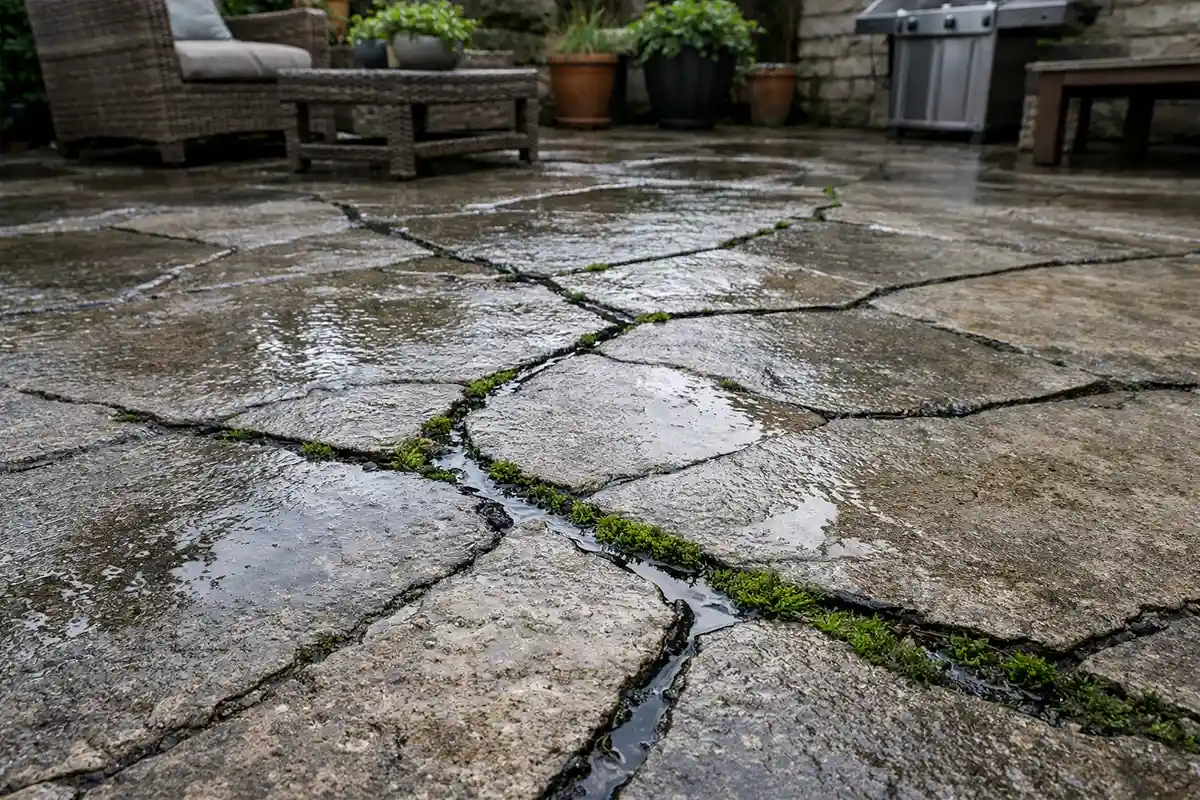
After a heavy rain, you may notice water sitting directly along the crack while the rest of the patio dries faster. That thin line changes how water moves across the surface. Instead of flowing evenly, it begins to collect and slow down.
As water seeps into the crack, it reaches the bedding layer below. Saturated material loses strength, especially if it contains fine soil mixed with aggregate. You might not see the base softening, but the surface will respond over time.
Repeated wetting and drying causes subtle settling beneath the crack. The tile may dip slightly or the edges may begin to separate. What started as a surface flaw slowly becomes a structural issue.
In shaded areas, moss or small plants can begin growing inside widened cracks. That greenery holds moisture longer, keeping the area damp and increasing the chance of slip risk.
Structural Impact Extends Beyond Aesthetics
You might still use the patio normally, setting chairs or walking across it without hesitation. Yet once a crack forms, weight no longer spreads evenly. The pressure shifts toward surrounding tiles.
Over time, you may notice one edge sitting just a bit higher or lower than the tile next to it. It may only be a few millimeters, but your foot can feel the difference. That unevenness signals that the surface plane has changed.
As cracks expand, nearby sections start carrying extra load. This increases the chance of additional fractures forming close by. What looked like a single cosmetic line can slowly turn into a broader pattern.
The longer the crack remains, the more complex repair becomes. Replacing one tile is simpler than correcting deeper settlement. Catching these early signs helps prevent the surface from gradually losing its stability.
Early Signs vs. What They Usually Mean Beneath the Surface
| What You Notice on the Surface | How It Usually Feels in Daily Use | What May Be Happening Underneath | Why It Matters Over Time |
|---|---|---|---|
| Thin hairline crack across one tile | Slight change underfoot in one step | Minor base shift or early soil movement | Crack can widen as stress repeats |
| Crack looks darker after rain | That section dries slower | Water entering bedding layer | Moisture weakens support and speeds settlement |
| Tile edge feels barely raised | Toe lightly catches when walking | Uneven compression under one side | Elevation difference can increase gradually |
| Hollow sound when tapped | Subtle vibration or softness | Small void beneath tile | Unsupported areas crack more easily |
| Grout line starting to separate | Grit collects in the gap | Micro-movement between tiles | Gaps allow more water intrusion |
| Water pools along fracture line | Surface looks flat but stays wet | Slight depression forming along crack | Pooling increases long-term instability |
| One area feels firmer than another | Different pressure response under weight | Uneven load distribution | Surrounding tiles begin absorbing extra stress |
| Moss or growth inside crack | Area stays damp longer | Persistent moisture retention | Organic growth accelerates material breakdown |
Minor Fractures Can Lead to Load Redistribution
A heavy planter goes back to its usual corner, right beside a thin crack that barely draws attention. Weeks later, that same area feels slightly less firm underfoot. The tile hasn’t broken apart, but the way it handles weight is no longer the same.
When a surface cracks, the load it once spread evenly begins to shift. Pressure that used to move smoothly across several tiles starts concentrating along the fracture line and into neighboring pieces. Over time, those adjacent tiles begin taking on stress they were not designed to handle alone.
This is why a single crack often leads to more. Outdoor seating areas, grills, and repeated walking paths create consistent pressure patterns. Once the surface loses its structural continuity, surrounding sections gradually join the stress cycle.
Edge Lifting and Micro-Separation at Joints
Walking barefoot across the patio, you might notice a faint ridge that catches your attention. It is not dramatic, but your foot feels the difference immediately. That small height change often begins at a cracked joint.
As the base shifts underneath, one side of a tile can settle slightly more than the other. The result is a subtle lift along an edge or a thin opening in the grout line. At first, it may only appear as a narrow shadow or a hairline gap.
When grout loosens, tiles stop locking tightly together. Tiny openings allow debris and moisture to work their way inside. That added movement increases flex in areas that were once stable, which puts more stress on the surrounding surface.
Over time, the patio stops behaving like one solid plane. It starts functioning more like connected sections that move just enough to create new pressure points.
Why does my cracked patio feel uneven even though the tiles look flat?
You cross the area and everything appears level from eye height. Yet under your shoes, it feels slightly tilted or softer in one spot. That disconnect between what you see and what you feel is often the first sign of deeper change.
The surface can remain visually aligned while the support underneath shifts by just a fraction of an inch. Those small differences are enough for your stride to detect, even if they are hard to spot in natural light.
Is it normal for a cracked tile to feel raised on one side?
Yes. A minor shift in the base can tilt one edge upward without making the entire tile look uneven.
Why does it feel more obvious in certain shoes?
Thin soles and harder footwear transmit subtle height changes more clearly than cushioned athletic shoes.
Does rain make the uneven feeling worse?
Yes. Moisture can temporarily soften the base layer, increasing slight movement under pressure.
Can bright sunlight hide the problem?
Yes. Strong light and patterned stone can mask shallow elevation changes that your foot immediately senses.
These small perception changes often show up before visible displacement becomes obvious. The surface might still look clean and aligned, but your footing tells a more accurate story.
Base Instability from Compaction Failure
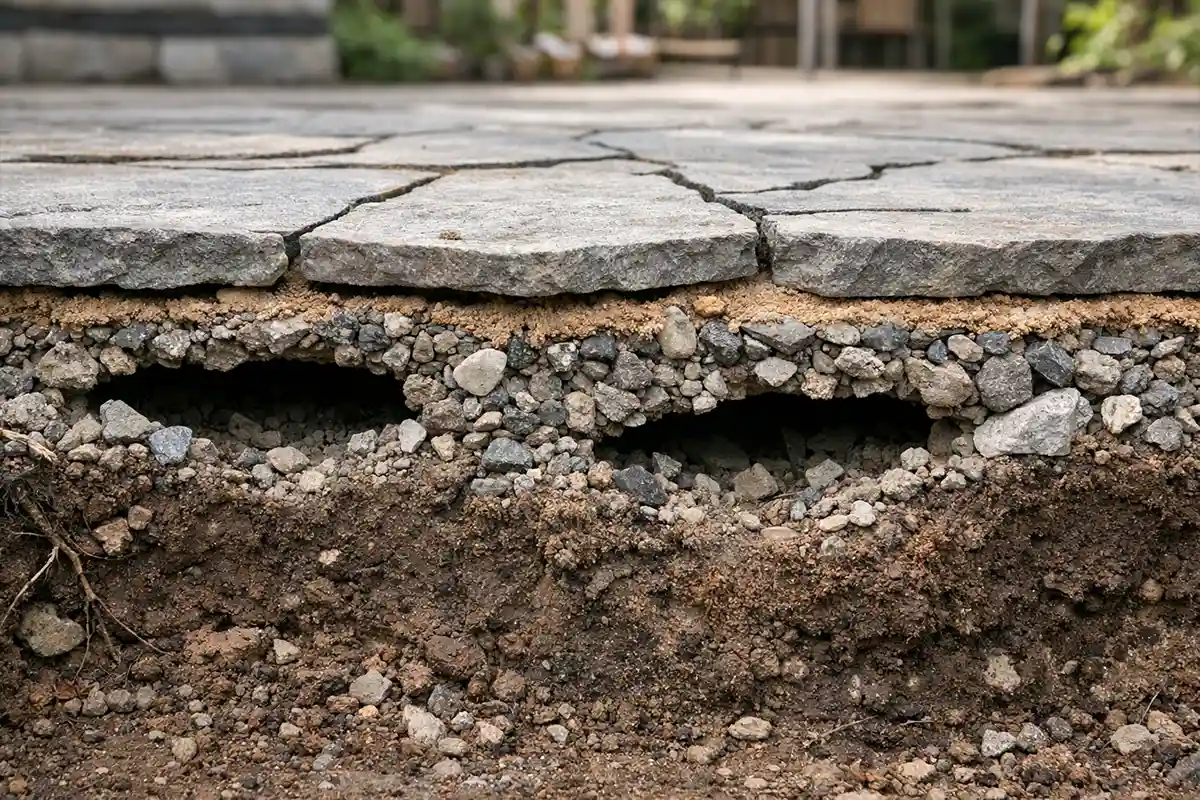
If you tap a cracked tile and hear a hollow sound, that usually points to a gap underneath. Even if the patio looked solid when installed, uneven compaction can leave weak spots hidden below. Those spots only become noticeable after repeated use.
A properly compacted base spreads weight evenly. When compaction is inconsistent, certain areas compress more over time. The tile above begins to carry uneven pressure, and cracking follows.
In many cases, long-term cracking originates from insufficient or uneven base compaction that gradually reduces structural stability. The fracture you see now often reflects what was happening below the surface long before the crack appeared.
This type of settling is rarely sudden. It develops slowly, often becoming noticeable only after seasonal moisture changes and repeated load cycles.
Water Intrusion Expands Structural Weakness
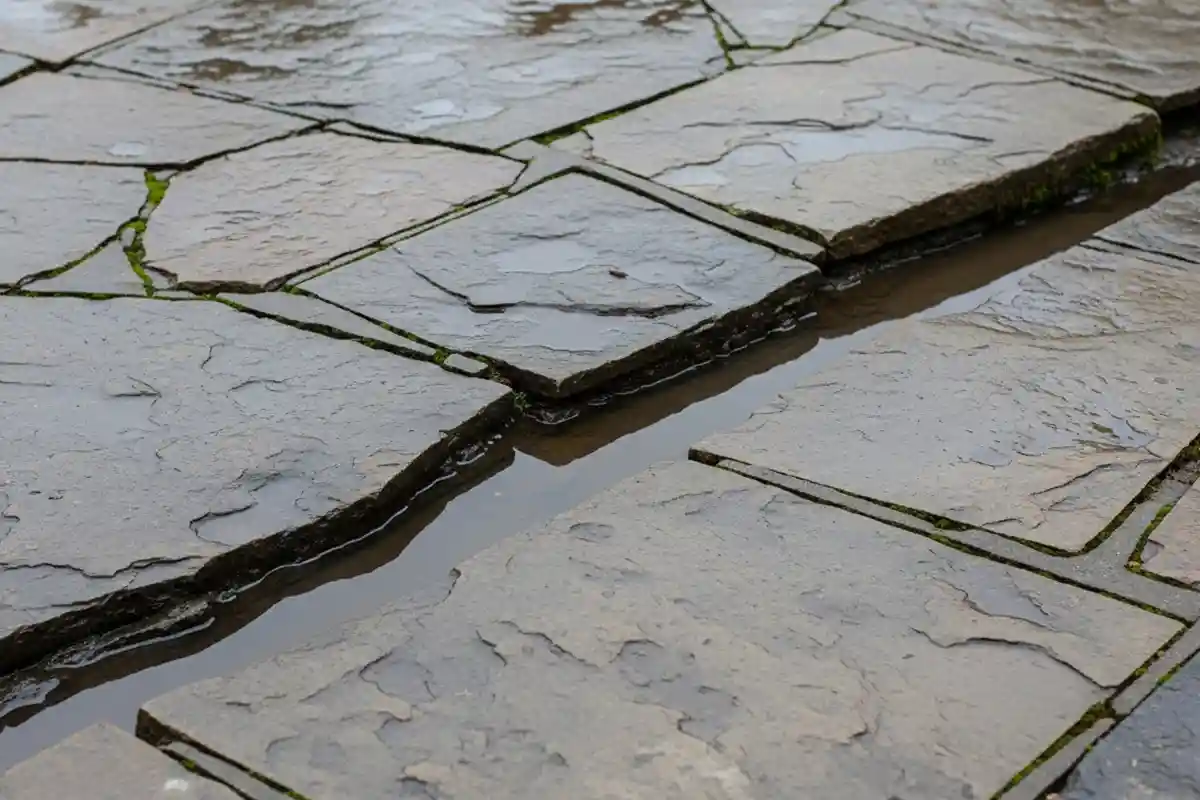
After a storm, you may notice water sitting directly along the crack while other areas dry faster. That thin opening changes how water moves across the surface. Instead of flowing away, it slows down and seeps inward.
When moisture reaches the bedding layer, it reduces the strength of that material. Saturated sections compress more easily under weight. You may not see immediate sinking, but the surface gradually responds to that softened support.
Repeated wet and dry cycles shift fine particles within the base. Over time, small voids can enlarge and increase instability. The crack becomes a channel that speeds up the weakening process.
Trip Risk Develops Gradually, Not Suddenly
A chair slides across the patio and catches slightly at the edge of one tile. The difference is small, but it wasn’t there before. That subtle lip often develops from the same structural shift that caused the original crack.
Even a few millimeters of height difference can affect balance, especially in areas near steps or doorways. The risk builds slowly as edges lift or settle unevenly. What began as a cosmetic flaw can quietly evolve into a walking hazard.
As displacement spreads, nearby tiles begin absorbing uneven force. This can expand the affected area beyond the original fracture. The longer the movement continues, the more the surface loses its consistent, stable feel.
Patterned Cracking Reveals Directional Stress
Several cracks begin running in the same direction across the patio. They do not look random; instead, they seem to follow an invisible path. That pattern often mirrors the direction in which the ground beneath is slowly shifting.
When stress builds from one side—such as along a retaining edge or near a garden bed—the surface tends to fracture in parallel or diagonal lines. These lines show where pressure repeatedly concentrates. Over time, individual cracks begin linking together, creating segments that no longer move as one solid plane.
Once the surface becomes segmented, each section responds differently to weight and temperature. One area may feel firm while another feels slightly reactive under the same step. That uneven response is a sign that the stress is not just surface-deep.
Structural Repair Becomes More Complex Over Time
At first, replacing a single cracked tile may seem straightforward. The surface damage looks isolated, and the surrounding area appears stable. But once the tile is lifted, uneven bedding or small voids often become visible underneath.
Addressing only the visible crack tends to reset the surface without correcting the deeper imbalance. When the base remains inconsistent, new fractures often form near the repaired section. Over time, the repair zone can expand beyond the original damage.
In cases where moisture has softened the bedding layer, partial removal of that material may be necessary to restore stability. Recompacting and leveling the base before reinstalling tile helps redistribute weight more evenly. The focus shifts from cosmetic replacement to structural correction.
Uneven Settlement Can Extend Beyond the Original Crack
The problem often appears in a single tile at first, almost easy to dismiss. Months later, a nearby section begins to dip slightly. Settlement rarely stays confined to one spot; once the base shifts in one area, surrounding sections slowly begin to adjust as well.
Small depressions can redirect water flow, causing new low spots to collect moisture. That added saturation increases softening beneath adjacent tiles. The process feeds itself, even if the changes remain subtle at first.
Edges near steps or borders often show these shifts earlier because they carry additional structural load. When settlement spreads toward those boundaries, the surface can begin to feel less predictable underfoot.
Cracks and Emerging Trip Hazards
A crack that once felt purely cosmetic may begin catching the edge of a shoe. The difference might be minimal, yet it changes how people move across the space. Slight vertical shifts alter stride patterns long before they become visually dramatic.
Small elevation shifts caused by surface cracking can gradually evolve into uneven walking zones that increase trip risk over time. What starts as a hairline fracture can slowly become a defined lip as the base continues adjusting.
In high-traffic areas, these minor changes accumulate faster. Repeated footfall reinforces weak spots and encourages additional displacement. The connection between cracking and safety becomes clearer as alignment changes expand outward.
Long-Term Stability Depends on Addressing Root Movement
The most effective improvements tend to happen beneath the surface rather than on top of it. When the base is stabilized and properly supported, the visible layer regains consistent load distribution. Surface repairs then hold their integrity longer because they rest on balanced support.
In some cases, improving drainage around the patio reduces moisture-driven movement. In others, reinforcing edge restraints prevents lateral shifting. The key difference lies in correcting the source of stress instead of repeatedly replacing damaged tiles.
There is often a moment when homeowners recognize the pattern:
• The crack reappears near the same spot after a previous repair.
• Water seems to settle along the same line after every storm.
• One corner feels slightly lower each season.
• Furniture begins to wobble where it once stood evenly.
• A familiar walking path feels subtly different underfoot.
These observations rarely arrive all at once. They build gradually, forming a clearer picture of underlying movement.
Once those signs become noticeable, the conversation shifts from appearance to performance. The surface is no longer judged only by how it looks but by how it behaves over time. That shift in perspective often opens the door to deeper evaluation of drainage, compaction, and ground stability across the entire outdoor area.