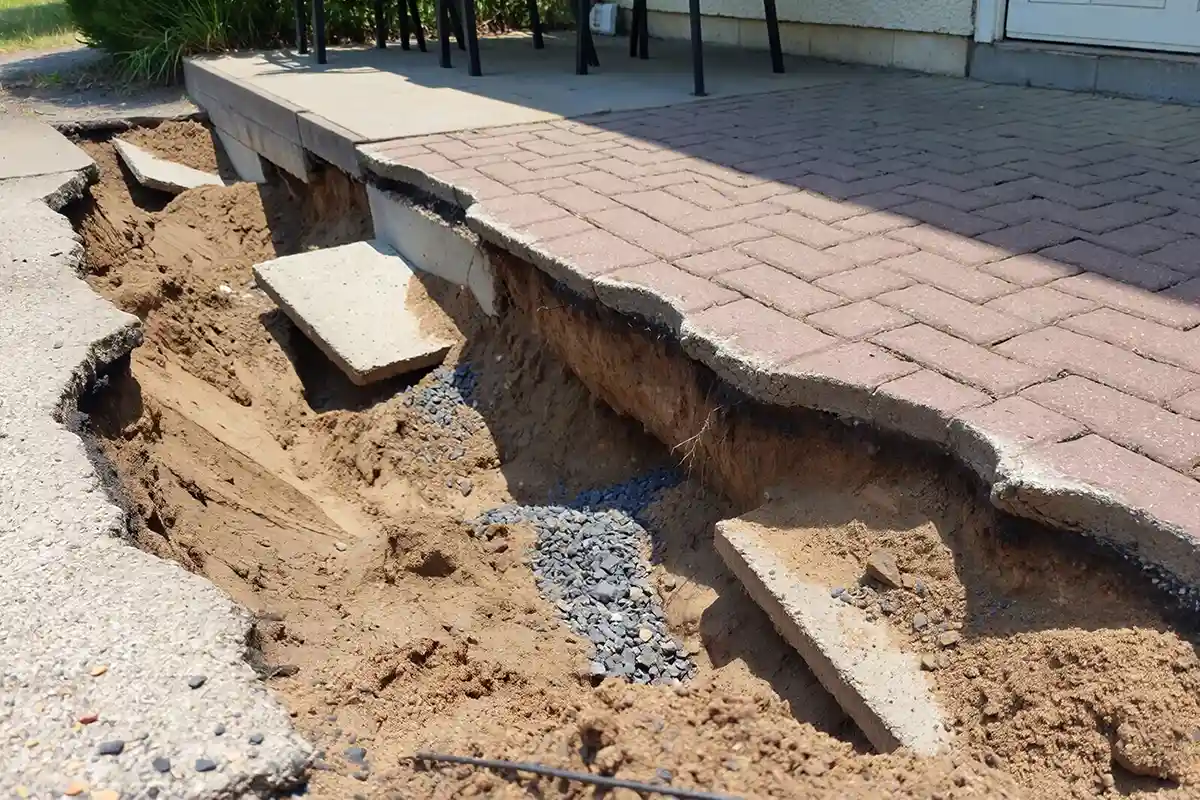
You walk across your driveway and notice one corner feels slightly lower than the rest. It does not look dramatic, but it feels different under your feet. That subtle change is often how erosion and washout beneath outdoor surfaces begin to reveal themselves.
From the street, everything may still look solid. The surface is intact, the color is even, and nothing appears broken. What has changed is the soil underneath, not the concrete or pavers on top.
Most homeowners do not think about what supports their outdoor surfaces. Yet patios, walkways, and driveways rely completely on compacted soil staying in place. When that support shifts, the surface has no choice but to respond.
What Erosion and Washout Really Mean Beneath Outdoor Surfaces
You tap a section of concrete and it sounds hollow compared to the rest. That hollow sound raises a simple concern: something is missing below. Erosion and washout happen when water slowly carries soil away from under an outdoor surface.
This does not require a flood. Normal rainfall can be enough. Water moves through small gaps, lifts fine particles, and leaves behind empty spaces that grow over time.
In everyday use, you might notice:
-
A crack that keeps getting slightly longer.
-
Pavers that shift just a little when stepped on.
-
A slab edge that no longer lines up perfectly with the lawn.
These are early signs of uneven support. The surface is reacting to what is happening below it.
A common but incorrect belief is that concrete simply cracks because it is old. Age alone does not create hollow gaps underneath. In most cases, moving water and soil loss are the real causes.
Why Water Is the Primary Trigger
After a steady rain, you may see water collecting along one side of your patio. Even if it disappears by the next morning, that repeated pooling matters. Water is the main force behind erosion and washout beneath outdoor surfaces.
Small but repeated drainage patterns often create the problem:
-
Downspouts emptying too close to hard surfaces.
-
Slight slopes that push runoff toward one corner.
-
Irrigation hitting the same area every day.
Each time water flows across or under the surface, it carries tiny soil particles with it. You will not see the soil moving, but the support layer slowly thins out.
Improper runoff control makes this worse over time. Preventing water runoff damage outdoors requires controlled drainage planning, proper grading, and redirecting downspouts away from structural surfaces. When runoff repeatedly targets the same zone, erosion accelerates in that specific area.
In colder climates, freeze-thaw cycles add pressure. Water seeps into small spaces, freezes, expands, and loosens the soil. When it melts, the soil is easier to wash away during the next storm.
Early Surface Clues Most People Miss
You might walk across a walkway and feel a slight dip but assume it is normal settling. That instinct to ignore small changes is common. Early signs of erosion beneath outdoor surfaces often feel minor and easy to dismiss.
Look for patterns such as:
-
Joint sand that keeps disappearing after rain.
-
A crack that reopens even after sealing.
-
A small height difference between adjacent slabs.
These issues may show up one at a time. Because each one seems manageable, they rarely trigger deeper investigation.
Here is how these signals are often misunderstood:
| What You Notice | What You Assume | What Is Actually Happening |
|---|---|---|
| A narrow crack along the driveway edge | “Concrete always cracks over time.” | Soil beneath that edge may be eroding and losing support. |
| Pavers that rock slightly | “They were not installed tightly enough.” | The base layer may be washing out under repeated runoff. |
| A hollow sound when tapping the slab | “The concrete was poured thin.” | A void may have formed between the slab and the soil below. |
These assumptions delay attention. Meanwhile, the empty space under the surface continues to expand.
High-Risk Areas Around Your Property
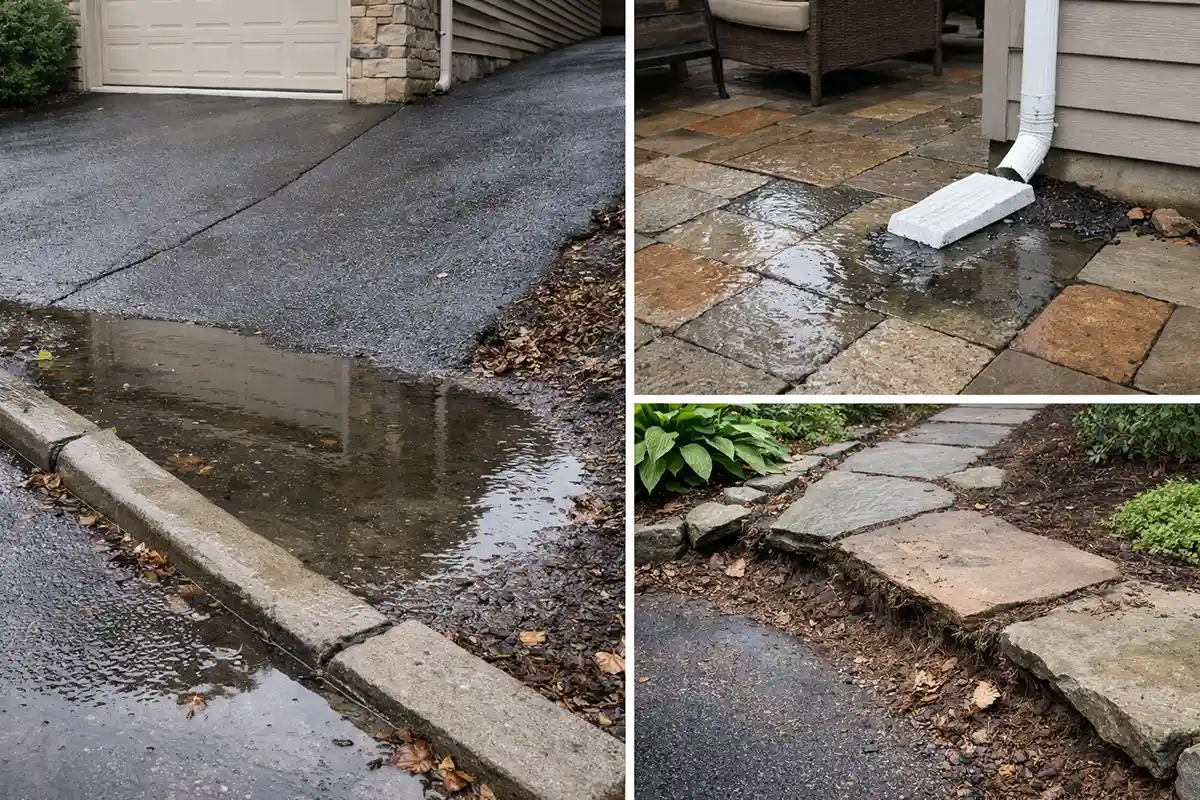
Watch where water flows during a storm. You will often see darker patches or damp streaks along certain edges. Those visible clues point to high-risk areas for washout beneath outdoor surfaces.
The most vulnerable spots usually include:
-
Downspout discharge locations.
-
The lower end of a sloped driveway.
-
Walkway edges with exposed soil.
-
Areas next to retaining walls.
Each of these zones channels water in predictable ways. When runoff keeps returning to the same section, soil loss increases there first.
Walkway edges are especially revealing. When the soil along the side starts separating or sinking, the interior often follows later. Uneven ground creating trip hazards often begins with subtle subsurface erosion that destabilizes walking surfaces. What feels like a minor height change can reflect a deeper structural imbalance underneath.
Another warning sign is an area that stays damp longer than surrounding sections. If one corner of your patio dries slowly after rain, it may be sitting above disturbed soil that holds moisture differently.
The Cost of Waiting Too Long
You may decide to watch a small crack for another season. It does not look urgent, and the surface still supports weight. The issue is that erosion beneath outdoor surfaces does not pause.
As soil continues to shift:
-
Voids grow larger.
-
Slabs begin to bridge unsupported gaps.
-
Cracks widen and spread.
-
Sections settle unevenly.
What started as a barely noticeable dip can turn into visible sinking. At that point, the problem is no longer just about appearance.
The longer soil loss continues, the more stress builds into the structure above. By the time movement becomes obvious, the supporting layer has already changed significantly. Understanding the early context and everyday triggers is what makes this issue recognizable before it becomes structural damage.
Soil Composition and Load Behavior Beneath Hard Surfaces
You park in the same spot every day, and months later that section of the driveway feels slightly lower. Nothing dramatic has happened, yet the surface no longer feels perfectly flat. That subtle shift usually traces back to what the soil is doing underneath.
Different soils react differently under pressure and moisture. Sandy soil drains quickly but loses particles easily when water moves through it. Clay holds water longer, expands when wet, and shrinks when dry, slowly weakening support. Mixed soils can seem firm at first but still lose density if they were not compacted properly during installation.
Load makes a difference as well:
-
Vehicle weight concentrates stress in driveways.
-
Repeated parking in the same spot increases compression.
-
Heavier vehicles accelerate settlement.
-
Light foot traffic causes slower, but still measurable, change.
When compaction is uneven, small air gaps remain below the slab. Water finds those gaps, shifts fine particles, and reduces support gradually. The surface above begins to respond long before obvious cracks appear.
Drainage Flow Patterns and Subsurface Migration
After a storm, water disappears from the surface and it is easy to assume everything drained correctly. What matters more is how that water moved beneath the slab. Drainage flow patterns quietly shape how erosion and washout beneath outdoor surfaces progress.
Subsurface movement tends to follow predictable behavior:
-
Water travels toward the lowest point.
-
Fine particles move first.
-
Repeated flow enlarges the same internal path.
-
Edges become weak before the center.
When runoff keeps targeting one side of a walkway or driveway, that section loses bearing capacity first. Poor drainage on outdoor walkways can cause long-term structural damage when water repeatedly saturates the base layers beneath the surface. Saturation reduces soil friction, which makes it easier for the ground to shift under normal use.
Over time, these internal shifts create uneven load transfer. Cracks that appear isolated are often connected through a shared subsurface void. The visible surface is simply revealing what has been happening below for months or years.
Why does my driveway feel slightly uneven even though it looks fine?
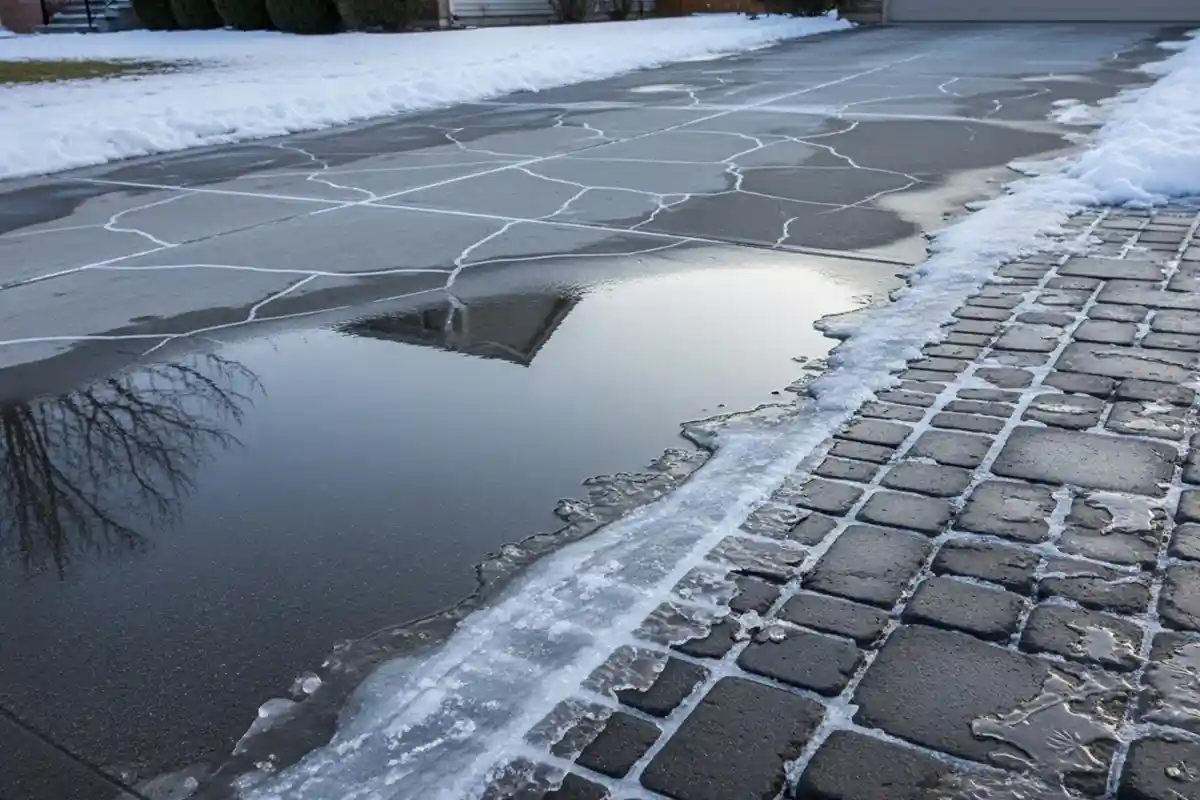
You step out of your car and sense a slight tilt under your foot, but your eyes see a flat slab. That disconnect between feeling and appearance is a common confusion moment. The surface can still look intact while the base is already changing.
Is it normal for concrete to feel uneven after rain? Yes, moisture can temporarily highlight subtle settlement that is less noticeable when dry.
Can temperature swings change how the surface feels? Yes, expansion in heat and contraction in cold can exaggerate small elevation differences already forming underneath.
Do shoes affect what I notice? Yes, thin soles make dips more obvious than cushioned footwear.
Could lighting hide small height differences? Yes, overhead light reduces shadows that would normally reveal unevenness.
Can the base shift without visible cracks? Yes, voids often form before surface fractures appear.
These small questions often arise before damage becomes visible. The body detects imbalance earlier than the eye does. That early sensory cue is often the first sign that erosion and washout beneath outdoor surfaces are advancing quietly.
Seasonal Amplification of Hidden Voids
Late winter often reveals small changes that were not noticeable in fall. Snow melts slowly, water lingers, and soil remains saturated longer than during a quick summer storm. Seasonal shifts amplify the progression of hidden voids.
The cycle typically unfolds like this:
-
Winter: water freezes in small gaps and expands them.
-
Early spring: thawed soil loses stiffness.
-
Rainy periods: loosened particles migrate further.
-
Dry months: settlement becomes easier to feel underfoot.
Even if each season causes only minor movement, the cumulative effect builds year after year. Freeze-thaw regions experience faster progression because expansion repeatedly widens internal gaps.
The table below outlines how environmental forces interact with subsurface behavior.
| Trigger Condition | Subsurface Response | Surface-Level Symptom | Development Pattern |
|---|---|---|---|
| Heavy rainfall | Fine soil displacement | Edge settling | Gradual |
| Freeze-thaw cycle | Micro-void expansion | Hairline cracking | Seasonal acceleration |
| Prolonged saturation | Reduced soil friction | Slab instability under load | Moderate |
| Repeated vehicle weight | Uneven compaction | Localized depression | Progressive |
| Poor grading | Concentrated runoff flow | Patterned edge erosion | Increasing over time |
This comparison shows that visible cracking is often the final stage of a longer underground process.
Structural Differences Across Conditions
Two properties can look similar but behave very differently over time. The way erosion and washout beneath outdoor surfaces develop depends on structure, climate, and usage patterns.
On sloped driveways:
-
Runoff moves faster.
-
Lower edges erode first.
-
Settlement appears near the bottom.
On patios with heavy furniture:
-
Weight concentrates in fixed areas.
-
Compression increases under grills or tables.
-
Cracks may spread outward from load points.
In colder climates:
-
Freeze-thaw expands voids more quickly.
-
Seasonal shifts are more noticeable.
-
Cracks appear sooner.
In consistently wet climates:
-
Soil remains saturated longer.
-
Friction between particles decreases.
-
Gradual washout continues steadily.
These variations explain why damage does not progress uniformly. The interaction between soil type, water movement, load, and climate determines how quickly subsurface instability becomes visible.
Long-Term Prevention and Corrective Pathways
A patio corner that keeps dipping slightly after every heavy rain usually signals that surface-level fixes were not enough. At this point, erosion and washout beneath outdoor surfaces have moved beyond minor cosmetic concern. The real question becomes whether the issue is localized or part of a broader soil instability pattern.
Minor settlement typically shows up as isolated hollow spots or slight edge drops. In these situations, lifting and filling small voids can restore support beneath the slab. When surrounding soil remains structurally intact and drainage is improved at the same time, stability often returns without large-scale reconstruction.
Moderate scenarios involve multiple cracks or recurring low points in the same general area. Here, partial reconstruction may be required to rebuild the base layer. If soil has already shifted unevenly across a wider zone, isolated repairs may temporarily level the surface but fail to correct the underlying imbalance.
Severe cases present with deep voids, rapid settlement under vehicle weight, or clear slab displacement. When support loss extends beyond surface sections, removing and rebuilding the subgrade becomes the most reliable corrective path. Recompacting and redesigning drainage at that stage prevents repetition of the same failure cycle.
Where Targeted Corrections Work—and Where They Fail
Some properties respond well to localized stabilization. Foam or grout injection can fill voids and reestablish uniform load contact. When paired with drainage adjustments, these corrections interrupt ongoing soil migration.
However, stabilization alone may not succeed under certain conditions:
-
Persistent underground moisture keeps soil soft.
-
Freeze-thaw expansion continues widening internal gaps.
-
Heavy loads exceed soil bearing strength.
-
Runoff still targets the same vulnerable area.
If water flow is not addressed, voids may reform beneath newly stabilized sections. Overcorrection can also create stress in adjacent slabs, leading to new cracking patterns. Partial fixes that ignore grading changes may shift erosion from one corner to another rather than eliminate it.
Soil movement causing surface problems often continues beneath repaired areas if foundational soil behavior is not fully stabilized. Surface-level correction without addressing subsurface dynamics rarely delivers long-term stability.
Solution Focus: Integrated Stabilization and Drainage Realignment
When erosion beneath outdoor surfaces has progressed but not reached total structural failure, combining stabilization with drainage realignment produces stronger outcomes than treating either alone. Restoring slab support addresses the visible symptom. Redirecting water flow addresses the cause.
In practice, this integrated correction may involve:
-
Lifting and leveling settled concrete.
-
Filling voids to restore contact with the base.
-
Regrading soil to move runoff away from edges.
-
Extending downspouts farther from paved areas.
-
Installing or adjusting surface drains.
This approach can fail if underlying soil remains chronically saturated or if runoff pathways are misunderstood. Incorrect grading may redirect water toward foundations or adjacent walkways. Over-injection beneath slabs can create uneven pressure points that lead to secondary cracking.
Structured Self-Assessment: Monitor or Intervene?
A careful walk across your driveway or patio often reveals more than visual inspection alone. The following indicators help determine whether monitoring is reasonable or deeper intervention may be needed:
-
Noticeable height differences greater than half an inch.
-
Cracks that expand within a single season.
-
Persistent pooling after moderate rainfall.
-
Joint material washing out repeatedly.
-
Hollow sounds over large slab sections.
-
Surface movement under normal vehicle weight.
-
Increased instability following freeze-thaw cycles.
-
Edges separating from surrounding soil.
If several of these signs appear together or worsen over time, structural correction becomes more urgent than observation.
Evaluating Long-Term Stability After Correction
After stabilization or reconstruction, the surface must endure environmental stress without renewed movement. Minor corrections tend to remain stable when water has been permanently redirected. Moderate repairs require seasonal monitoring to confirm that settlement does not resume in adjacent areas.
Safety conditions should also be reassessed. Slippery surfaces after rain can feel dangerous even when they look dry, especially if subtle settlement alters traction and surface angle. Slight shifts in elevation can change how water spreads and how feet or tires grip the surface.
Severe reconstructions must perform consistently across freeze-thaw cycles and heavy load periods. If water flow, soil compaction, and load distribution are properly aligned, stability becomes predictable. If any one factor remains unbalanced, subtle movement may return gradually rather than dramatically.
Erosion and washout beneath outdoor surfaces reflect an ongoing interaction between soil, water, and structural load. Corrective pathways succeed when they recalibrate that interaction rather than temporarily mask its symptoms.
For a broader technical overview of soil behavior, drainage dynamics, and erosion mechanisms affecting structural surfaces, the U.S. Geological Survey provides foundational research and publicly accessible resources.