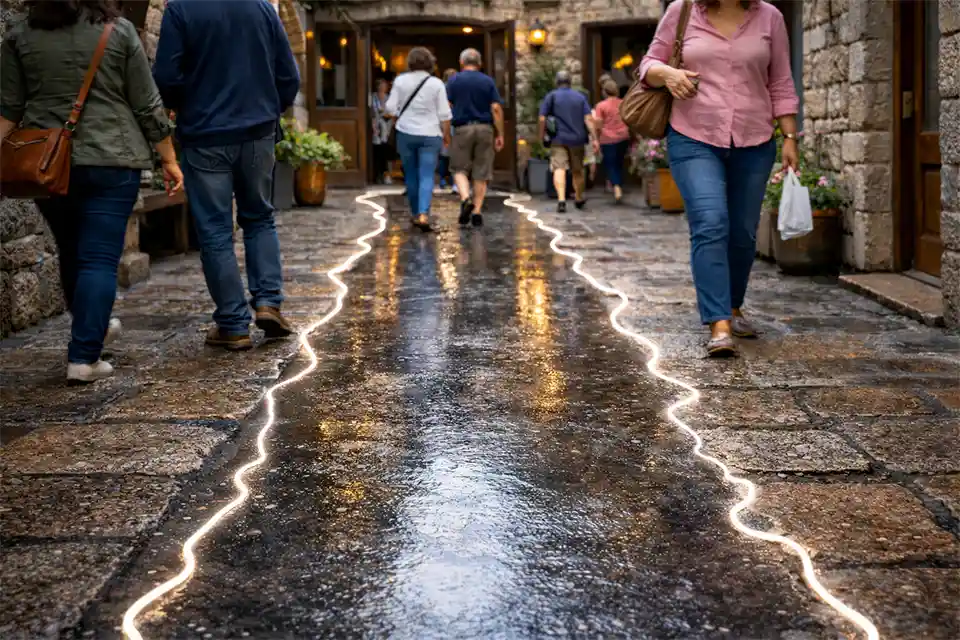
In busy courtyards, slick stone usually comes from wear concentration, not a mystery coating and not sudden surface contamination. Repeated foot traffic slowly grinds down texture along the route people actually use, and the loss of grip often shows up first when the stone is only slightly damp. Start with three checks.
Look for a travel lane that appears darker, smoother, or more reflective than the surrounding field. Compare the main route with low-traffic edges after a light wetting. Then watch timing: if the surface gets noticeably slick within 5 to 15 minutes of light rain, irrigation mist, or morning condensation, that usually points to texture loss rather than drainage alone.
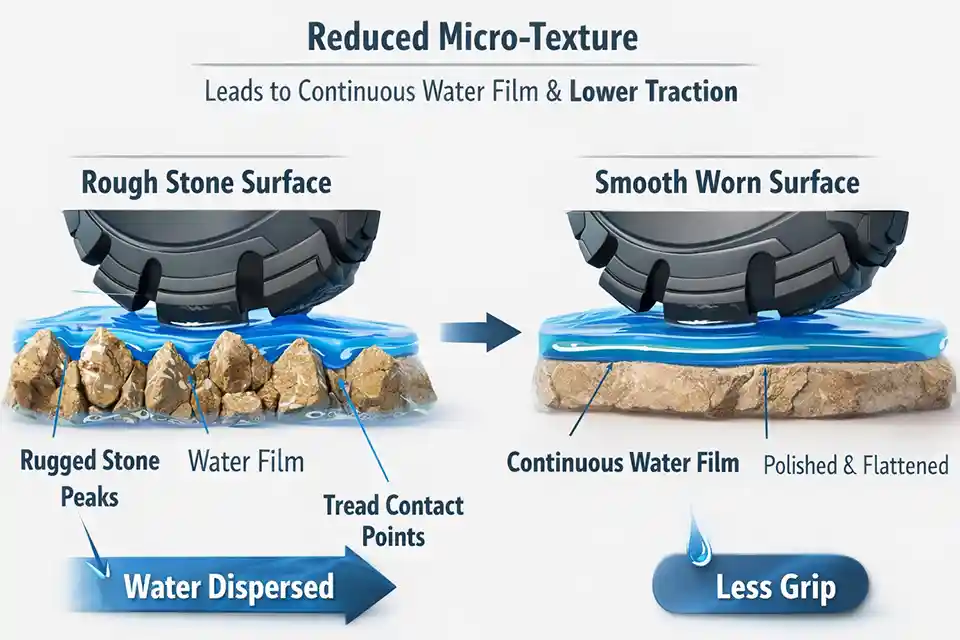
That distinction matters because the symptom and the mechanism are not the same thing. The symptom is wet slipperiness. The mechanism is a worn surface profile that no longer gives shoes enough micro-texture to bite into.
Drainage failures usually create broader wet areas or puddles that linger 30 minutes or more. Traffic polishing follows movement—entries, turns, bottlenecks, shortcuts—and often stays riskier than adjacent stone even after the courtyard looks mostly dry.
What this usually gets confused with
The most common false diagnosis is algae or moss. Biological growth absolutely makes stone dangerous, but it usually follows shade, chronic dampness, planter drip lines, or irrigation overspray. It does not usually create a clean walking lane from one doorway to another. If the slick area mirrors foot traffic more than moisture patterns, wear belongs at the top of the list.
The second false diagnosis is dirt alone. Dirt can reduce traction, especially when fine grit and residue stay trapped on dense stone, but cleaning should materially change performance if contamination is the main problem. With traffic polishing, cleaning improves appearance faster than grip. The courtyard may look better that afternoon and still feel wrong the next damp morning.
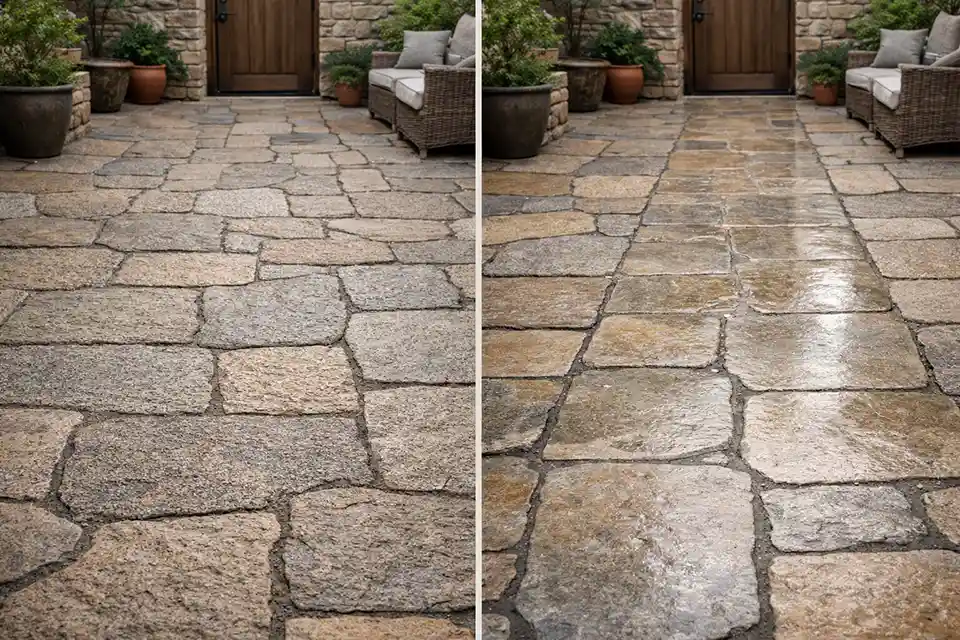
That same wear-first pattern shows up on worn stone on restaurant patios, where the busiest route becomes smoother first while surrounding sections still look serviceable.
A simple field test helps separate wear from residue. Wet two equal areas—one in the main path and one in a low-traffic edge—with about 8 to 12 ounces of water per 2 square feet. Wait 60 seconds, then test both with the same rubber-soled shoe. If the traffic lane feels distinctly faster underfoot and reflects more light at a shallow angle, the stone itself has probably been polished down.
Why dense traffic changes the surface
Dense foot traffic does not have to mean a stadium or transit plaza. A multifamily courtyard, hotel entry court, school passage, or restaurant extension can accumulate hundreds of crossings per day. On softer or more open-textured stone, visible smoothing can show up in 2 to 4 years. On harder stone, it may take 5 to 10 years. The pattern matters more than the calendar.
The mechanism is straightforward. Shoe soles carry fine mineral grit, and that grit acts like a mild abrasive. Over time it shaves down the small peaks and edges that created traction in the first place.
Straight paths wear steadily. Turns wear faster because people pivot, decelerate, and twist across a smaller contact area. A polished arc near an entry is often more diagnostic than a uniformly dull courtyard.
What many owners overestimate is the role of occasional heavy rain. What they underestimate is light abrasion plus frequent minor wetting. In humid parts of Florida, on the California coast, or anywhere with regular irrigation drift, the courtyard does not need a storm to become slippery. Dew, mist, or overspray can create a thin water film that exposes lost texture almost immediately.
This overlap with moisture is why some sites get treated as drainage problems first. Sometimes that is right. But if water is affecting the whole area, not just the worn route, the broader comparison is slippery outdoor walkways with poor drainage rather than a pure wear issue.
Pro Tip: Check the courtyard early or late in the day. Low-angle light exposes polished travel lanes much faster than overhead midday light.
The fix that wastes the most time
The biggest time-waster is repeated pressure washing. It can clean the surface, brighten the courtyard, and temporarily reduce the visual contrast between worn and unworn stone. That is exactly why it gets overvalued. Once the next damp period arrives, the slick lane returns because the missing texture never came back.
The second waste is resealing before confirming the real condition of the stone. If the traffic route is already polished smooth, the wrong sealer can make it worse, especially on dense stone with limited absorption. Some courtyards start behaving more like a sealed stone patio that turns slippery after sealing even though the original issue was wear.
What people usually underestimate is how early selective repair starts making sense. They wait for broken corners, open joints, or rocking units, when the real service problem appeared earlier as traction loss. A courtyard can still look respectable and already be failing where it matters most: underfoot performance.
Quick diagnostic checklist
- The slick area follows walking routes instead of shade lines or planter edges.
- Door approaches, turns, and shortcuts are worse than open low-traffic areas.
- The main lane looks slightly shinier or darker at a low viewing angle.
- Cleaning changes appearance more than slip behavior.
- Light wetting exposes the problem within 5 to 15 minutes.
- Adjacent low-traffic stone feels better under the same shoe and same moisture level.
If at least four of these are true, traffic polishing is probably the primary cause.
What actually changes the outcome
The useful question is not whether the courtyard can be cleaned again. It is whether the worn route can still be retextured evenly enough to restore dependable grip.
| Courtyard condition | What it usually means | Best next move |
|---|---|---|
| Slick only when dirty, no visible wear lane | Contamination is doing most of the work | Deep clean and reset maintenance frequency |
| Slick in a defined walking path, especially near turns | Mechanical polishing is primary | Test professional retexturing in the busiest route |
| Slick across a whole treated section | Finish or treatment issue may be amplifying risk | Review sealer history before surface treatment |
| Water remains for 30 to 60 minutes in the same spots | Drainage is adding risk beyond wear | Correct runoff or slope along with traction work |
| Worn lane plus rocking, chipped, or open-joint units | The problem is no longer just surface texture | Move from treatment to partial rebuild planning |
Minor color variation is usually cosmetic. Slight wear at edges may still be manageable. A polished walking route that turns slick during normal damp conditions is not cosmetic. It is a performance defect, even if the courtyard still looks acceptable from a distance.
For moderate wear, professional mechanical retexturing or a purpose-built traction treatment can work. But there is a clear boundary where the standard fix stops paying off. If the worn route covers roughly 20% to 30% of the active walking area, if multiple stones are wearing unevenly, or if the traffic lane is obvious even to someone seeing the site for the first time, repeated treatments start acting more like delay purchases than repairs.
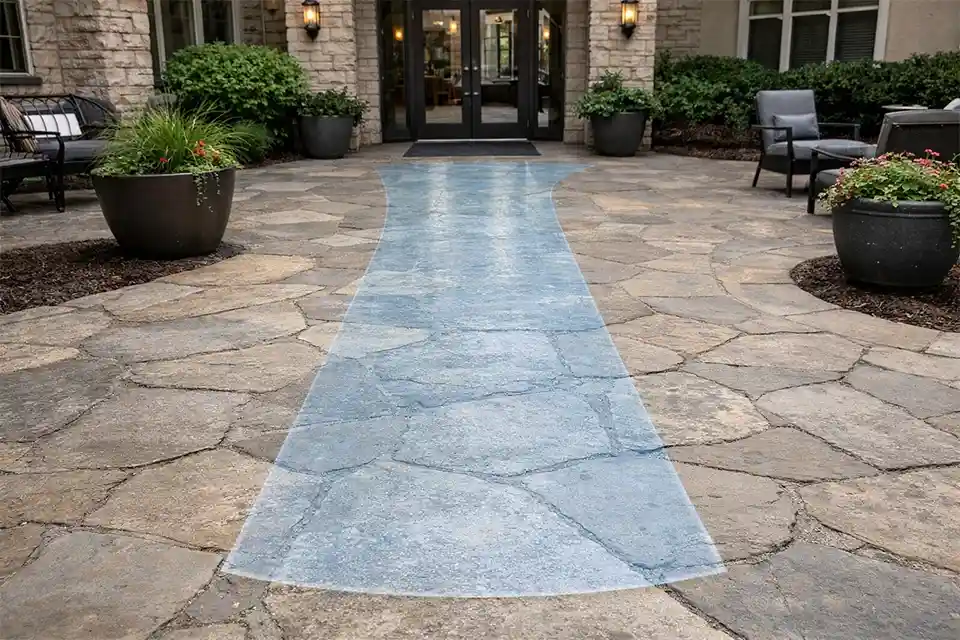
That is also where many owners overestimate the cost of targeted replacement and underestimate the cost of failed maintenance cycles. Reworking the busiest 10 to 20 linear feet often changes the outcome more than treating an entire courtyard that is only partly affected.
If irrigation regularly wets the main route, the courtyard may start behaving more like garden paths that turn slippery after irrigation than a purely dry-wear site, and that changes which fix deserves priority.
When replacement starts making more sense
Replacement is not the first answer, but there is a point where it becomes the honest one. If traction loss is confined to a narrow path and the surrounding field is still sound, selective retexturing or selective replacement is usually the best-value move. If the courtyard shows traction loss plus joint failure, uneven wear, rocking units, or recurring moisture that cannot be controlled, broader replacement deserves serious consideration.
A good rule is to stop chasing routine fixes when the same complaints return after each cleaning cycle or each damp-weather event. At that point the problem has moved past maintenance and into condition management.
One practical detail gets missed all the time: repair priority should follow the path people actually use, not the path the original layout intended. In real courtyards, those are often different. Desire lines wear first, fail first, and create the first meaningful slip risk. That is also why broader guidance on outdoor slip risks homeowners miss matters more than surface appearance alone.
For broader official guidance on slip, trip, and fall prevention, see the NIOSH Slip, Trip, and Fall Prevention page.