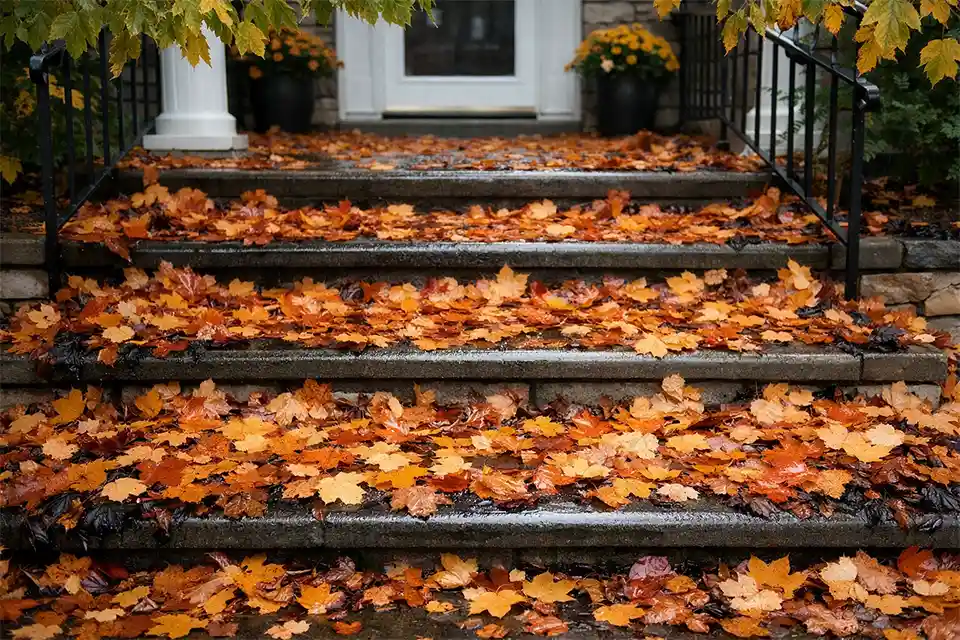
In homes with heavy leaf fall, slippery steps are usually not caused by leaves alone. The bigger issue is compacted organic debris holding moisture against a tread that already drains poorly or has lost texture. That is why some steps stay slick for half a day to two days after rain, even when nearby pavement looks dry.
The first checks that matter are whether leaves collect at the nosing, whether the treads stay damp more than 6 to 8 hours after light rain, and whether the walking line feels smoother than the rest of the step.
That matters because this is not the same as an ordinary wet-step problem. In fall, the hazard often comes from a thin organic film forming under shredded leaves, not just surface moisture.
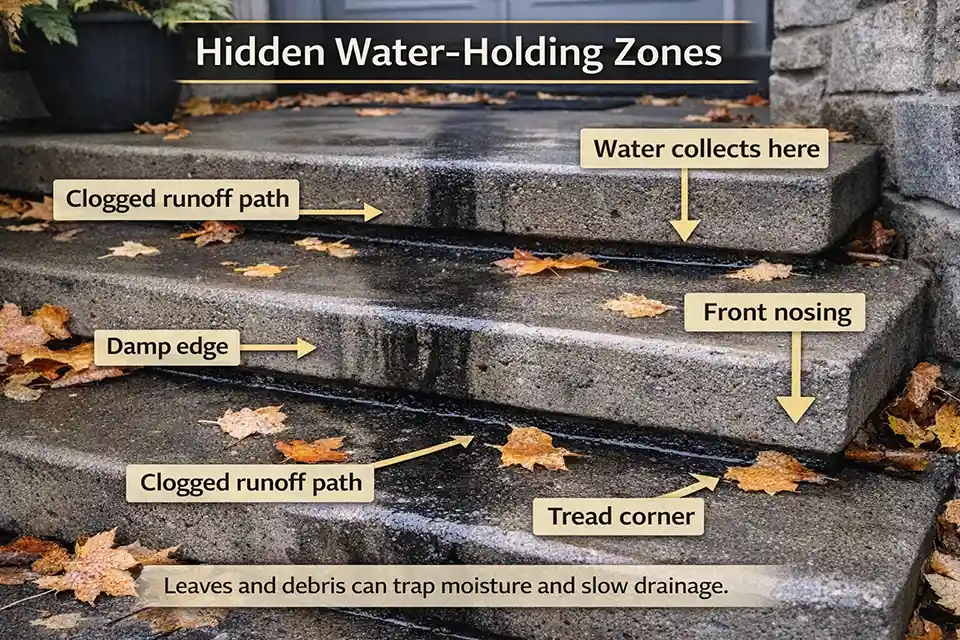
A step does not need major drainage failure to become risky. Even a slight runoff blockage at the front edge can leave a damp band right where shoes land. Shade, cool mornings, and limited airflow stretch that window even further.
What actually makes these steps slippery
Three conditions usually overlap.
Leaves hold moisture longer than people expect
A layer of fallen leaves traps water against the tread and slows drying. Dense materials like sealed concrete, stone, and some exterior tile do not absorb much of that moisture, so the surface stays wet rather than clearing quickly. In shaded entries, that damp layer can linger well into the next day after a modest rain.
Foot traffic turns leaf buildup into a slick film
Once people walk over wet leaves, the problem changes. You are no longer dealing with loose debris that can be swept away cleanly. You are dealing with a thin organic paste that clings to the tread and reduces grip where feet land most often. That is also why the slickest part of the step is often the walking line, not the corner with the heaviest leaf pile.
Fall exposes steps that were already borderline
Autumn tends to reveal surfaces that were already close to underperforming. A tread that feels acceptable in dry summer weather can become unreliable once leaf residue starts bonding to it. That same pattern shows up on slippery surfaces after rain, where the real issue is often what stays behind after the water should have cleared.
A useful threshold: if the steps are still visibly damp more than 6 to 8 hours after light rain while nearby pavement has mostly dried, the issue is no longer just seasonal mess. Something is causing those treads to retain moisture or residue.
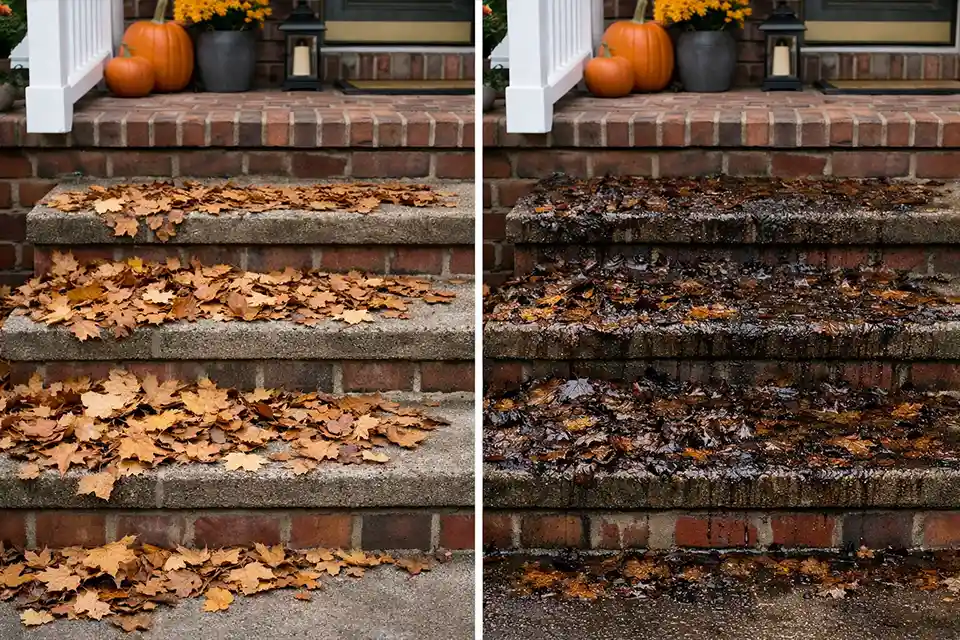
Quick diagnostic checklist
-
Leaves collect at the same tread edge or corner after every wind event
-
The steps stay damp half a day or longer after light rain or morning dew
-
Sweeping improves traction for only 1 to 3 days
-
The slickest area is the walking line, not the leafiest area
-
Dark staining, green film, or black speckling appears after debris is cleared
-
The front edge of the tread feels smoother than the back half
If four or more of those are true, the problem is usually bigger than routine leaf cleanup.
What people usually misread
They blame the trees more than the steps
Heavy leaf fall matters, but it is rarely the whole story. The more important question is whether the surface lets wet debris cling and stay active. Two homes can get the same amount of leaf drop and end up with very different slip risk depending on shade, runoff, and tread texture.
They assume stronger washing solves it
Pressure washing can remove the visible mess while leaving the main traction problem untouched. On some materials, it can also leave a worn tread feeling even more exposed. A similar pattern appears with courtyard tiles that turn slick after pressure washing: the dirt changes, but the grip problem remains.
They underestimate the tread edge
On residential steps around 10 to 11 inches deep, a shallow low spot or blocked runoff line near the nosing is enough to keep a thin damp band right where shoes land. That is a better clue than total leaf volume.
Why the obvious fix often fails
Sweeping is necessary, but it is not a traction fix once residue has started sticking to the tread. It removes bulk debris, not the slickest layer underneath.
Cleaning alone stops making sense quickly
If the steps feel slick again within a few days of clearing them, the issue is no longer just maintenance frequency. Either the treads are not drying properly, or the surface has too little texture left to tolerate normal fall conditions.
Sealing often solves the wrong problem
Homeowners sometimes reach for sealer because the steps look weathered or porous. On an already slick tread, that can improve appearance and make cleanup easier without improving grip. In some cases it makes wet performance feel worse, which is why sealed stone patios that become slippery after treatment are such a useful comparison.
Repeated fall slickness is not temporary anymore
If the same steps have been getting slick for two or three fall seasons, there is a good chance you are no longer dealing with a short-term debris issue. At that stage, leaf fall is the trigger. The underlying problem is usually persistent organic film, poor drying, or worn tread texture.
Pro Tip: If traction drops again within a week during peak leaf fall, stop treating it as a cleanup problem and start checking runoff, shade, and tread texture together.
Where the risk is usually highest
The most dangerous steps are not always the ones with the deepest leaf cover. They are usually the ones that combine shade, slow drying, and smooth traffic wear.
Common high-risk locations
North-facing front entries, side-yard stairs under trees, and steps below gutters or roof drips are common trouble spots. In humid parts of the Southeast, organic residue can stay active for much of the season. In colder northern states, the risk rises again when daytime moisture turns to a thin frozen bond overnight below 32°F.
Why repeat contamination matters
Steps that stay dirty and damp do not just get slick; they wear differently over time. Surface texture breaks down faster when grit, moisture, and organic residue sit in the same areas season after season. That is part of the same pattern seen with dirt and debris accelerating surface wear.
The fix that actually changes the outcome
Start with removal, but do it in the right order: clear loose debris first, then break up the residue that is sticking to the tread, then decide whether the real issue is drying or texture.
If drying is the main problem
Clean out packed debris at the tread edge, check whether water is escaping consistently, and look for nearby drips from gutters, planters, or roof lines. You do not need a dramatic slope change. You need the tread to stop holding isolated wet bands where foot traffic lands.
If texture is the main problem
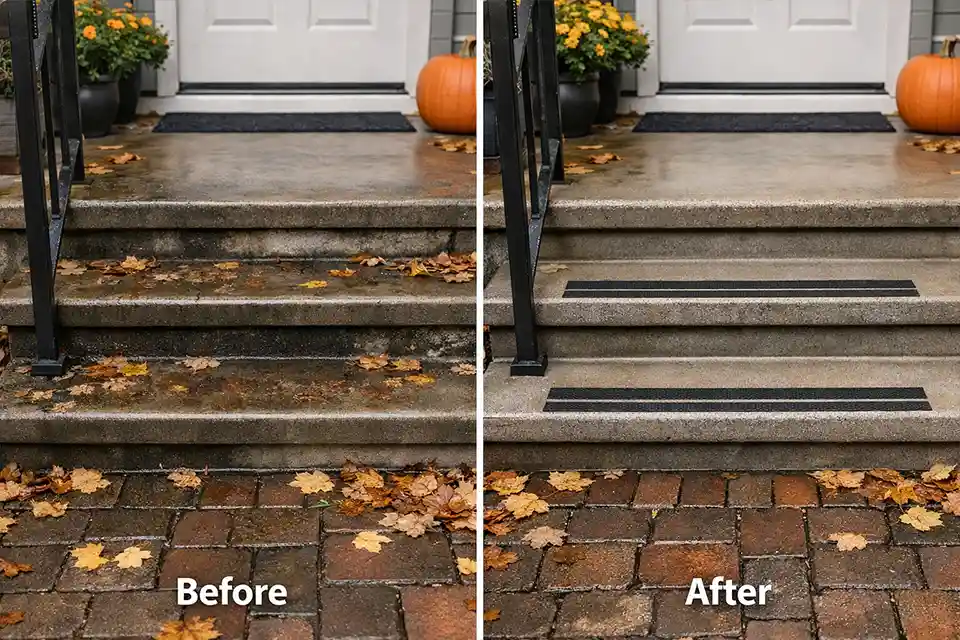
Add traction instead of pretending cleaning restored grip. On many residential steps, a targeted anti-slip treatment, abrasive strip, or traction insert on the walking line works better than resurfacing everything. This matters most when the nosing is visibly smoother than the rest of the tread.
| Condition | What it usually means | Best next move |
|---|---|---|
| Leaves clear, surface dries in under 3 hours, grip feels normal | Seasonal debris only | Routine removal |
| Leaves clear, surface stays damp 6+ hours | Moisture retention or drainage issue | Improve runoff and drying |
| Surface looks clean but still feels slick when wet | Worn or low-texture tread | Add traction treatment |
| Dark film returns within 1 week | Active organic residue in shade | Deep clean and shorten maintenance cycle |
| Slickness repeats every fall | Surface or drainage mismatch | Upgrade traction or rework runoff |
When the standard fix stops making sense
There is a point where repeated cleanup becomes wasted effort.
Too much maintenance for too little result
If you are clearing the same steps three or more times per week during peak leaf fall and they still become slick between cleanings, the problem has moved beyond leaf volume. At that point, the steps are telling you something about drainage, shade, or worn texture.
Visible wear changes the decision
If the nosings are rounded, polished, chipped, or noticeably smoother than the rest of the tread, no cleaning plan will restore what the surface has lost. And if the stairs also show movement, cracking, or uneven water flow, the slip issue should not be treated in isolation.
That broader overlap is exactly why outdoor slip risks homeowners miss often turn out to involve both contamination and surface condition.
Appearance is the wrong standard
These steps can look mostly fine and still be underperforming. If normal fall weather makes the walking line slick again after reasonable cleaning, the surface is already failing the real test.
Pro Tip: Check the same steps at the same hour on two similar mornings. If one section stays damp or slick 2 to 4 hours longer than the rest, that localized zone deserves the first fix.
Bottom line
In heavy fall leaf zones, slippery outdoor steps are usually a moisture-retention and tread-performance problem before they are a leaf-volume problem.
Check how long the treads stay damp, where debris packs in, and whether the walking line has already worn smooth. Once slickness returns quickly after cleaning, better runoff and added traction usually do more than stronger washing.
For broader official guidance on keeping walking surfaces free of slip hazards, see OSHA’s walking-working surfaces requirements.