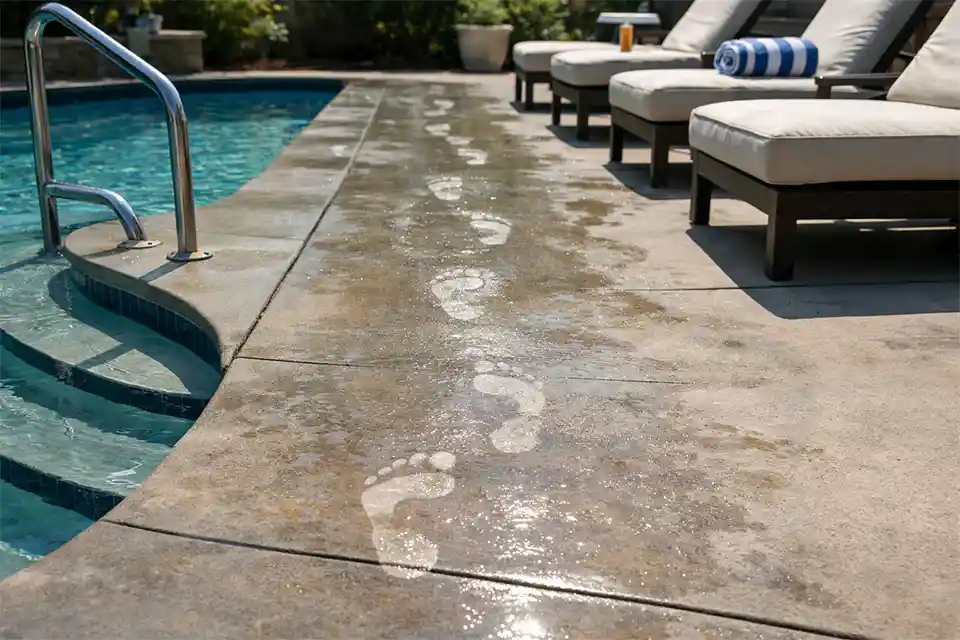
The main problem is usually not pool water by itself. It is a smooth deck that has picked up a thin film of sunscreen, body oil, and repeated barefoot traffic.
That film builds fastest in the 3 to 6 feet around pool steps, ladders, and the path to chairs or towels. Once it forms, splash water stops breaking against the surface and starts smearing across it instead. That is the shift that matters.
The first checks should be simple. Does the deck stay slick for more than 10 to 15 minutes after visible water is gone? Is the worst traction loss concentrated in the main walking lane rather than the whole deck? Does it feel more dangerous after a busy afternoon than it did that morning?
Those signs point to residue buildup more than drainage failure. People often misread this as a generic wet-surface problem, but that is too broad. A textured deck can be wet and still feel controlled. A smooth deck coated with sunscreen residue loses margin much sooner.
What matters first
Before blaming the entire surface, separate three patterns that look similar but do not mean the same thing:
-
slippery only while water is actively present
-
slippery mainly in high-traffic zones after partial drying
-
slippery across nearly the whole deck, including low-use edges
The second pattern is the most common here, and it usually tells you more than broad guesses about weather or age. If the risk follows foot traffic, contamination is usually the first layer of the problem and surface profile is the second.
That same logic shows up on other outdoor surfaces where a thin film changes grip faster than people expect. It is one reason slippery poolside patio stone causes and fixes often come down to contamination patterns before they become full material-failure problems.
Quick diagnostic checklist
If 4 or more of these are true, sunscreen residue is probably a primary cause:
-
The deck is slickest within 3 to 8 feet of pool entry points.
-
Bare feet leave darker damp marks that linger longer in one main route.
-
Water beads or streaks instead of fading evenly.
-
The deck feels worse after a busy weekend than after 24 to 48 quiet hours.
-
Cleaning helps, but the improvement fades within 2 to 5 days in peak season.
-
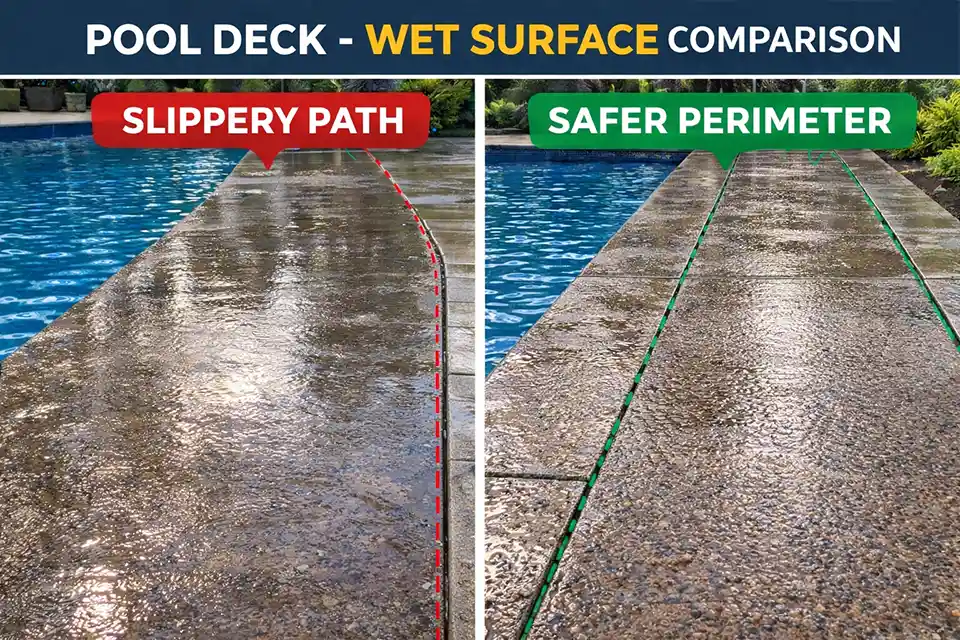
Low-traffic perimeter areas feel noticeably safer under the same weather conditions.
That last comparison is especially useful. If the safest edge and the slickest lane behave very differently on the same day, the issue is not uniform moisture. It is use-driven buildup on a surface that is already too forgiving to residue.
Why the obvious fix often wastes time
The obvious fix is usually to wash the deck more often. That helps briefly, but it often turns into a maintenance loop instead of a solution. Plain rinsing removes loose dirt, not the waxy binders and oils that make sunscreen residue behave like a thin coating.
Pressure washing is often overrated here. It can make the deck look cleaner in an afternoon without meaningfully restoring grip if the cleaner is wrong or the finish was already too smooth. In some cases, aggressive washing improves appearance while leaving the real problem untouched.
That same disconnect shows up on courtyard tiles slick after pressure washing: visual cleanliness and traction recovery are not the same result.
What people overestimate is visible water. What they underestimate is how little residue it takes to change surface behavior. A deck does not need puddles to become hazardous. Once water starts beading or skating over a worn walking lane, the traction margin is already too low.
Pro Tip: If the deck feels slickest 20 to 40 minutes after swim activity slows down, residue film is usually a bigger factor than active splash water.
Why sunscreen changes the deck so quickly
The bigger issue is not the sunscreen alone. It is sunscreen meeting a finish that gives it nowhere to go. Dense stone, smooth concrete coatings, sealed surfaces, and worn acrylic overlays all make it easier for residue to sit on top and spread.
Here is the practical comparison that usually matters most:
| Condition | Healthier deck behavior | Failing deck behavior | Why it matters |
|---|---|---|---|
| Splash water | Breaks and dulls quickly | Smears or beads in traffic lanes | Surface is resisting wet-out |
| Barefoot traffic | Grip changes only slightly | Feels greasy by mid-use | Residue is accumulating faster than it clears |
| Dry-down after use | 5 to 15 minutes in warm conditions | 20 to 45 minutes in slick zones | Water is lingering on top of the film |
| After proper cleaning | Improvement holds 1 to 2 weeks | Improvement fades in 2 to 5 days | Surface profile is too smooth for current use |
| Next-day condition | Surface feels fairly consistent | Main lane reverts faster than deck edges | Traffic path is exposing a finish weakness |
This is also why treated surfaces sometimes disappoint so quickly. If a deck was sealed, coated, or refinished mainly for appearance, sunscreen residue may not be the root problem at all.
It just exposes the weak traction margin faster. That pattern is easy to miss on sealed stone patio slippery after sealing, where the treatment changes water behavior before owners realize grip has narrowed.
When routine cleaning stops making sense
Routine cleaning stops being enough when the deck becomes slick again in less than a week of normal use, or when it still feels low-grip after a proper degreasing wash and full dry-down. At that point, residue is no longer the whole story. The finish itself is too smooth, too sealed, too worn, or too polished for the environment.
That is the threshold many owners miss. Sunscreen buildup is often the trigger, but the underlying vulnerability is a surface that has very little traction reserve left.
If the deck was already borderline in rain, humidity, or morning condensation, pool use simply exposes it faster. A similar pattern appears on slippery surfaces after rain that feel dangerous even when they look dry, where the real problem is not how much water you can see but how the top layer handles it.
What actually changes the outcome
The best fix is usually sequential, not cosmetic.
Start by removing the film with a cleaner designed to cut oils, not just brighten the deck. One real reset is more useful than multiple quick rinses.
Then test the busiest route after full dry-down and again after light splash exposure. If the same lane becomes slick quickly, the surface profile is now the limiting factor.
From there, choose the response by recurrence:
-
If traction stays improved for 1 to 2 weeks, maintenance may be enough.
-
If the hazard returns within 2 to 5 days, a traction-focused treatment or micro-texture strategy is usually the better next step.
-
If the deck still feels slick right after proper cleaning, it is time to evaluate resurfacing, coating replacement, or a less residue-sensitive finish.
This is where people often waste money on decorative sealers or glossy refresh coats. Those can improve color while making the deck even more sensitive to oil-and-water traffic. A finish that looks cleaner but loses grip in the same 2-foot-wide route is not a successful repair.
Pro Tip: Test the route from the steps to the chairs, not the deck average. Most slip incidents happen in the predictable path, not in the corners that stay relatively clean.
The right priority order
Do not start with drainage unless water is actually collecting for more than about 30 minutes after normal use, or unless you also see puddling, slope failure, or obvious runoff concentration. For this problem, residue and finish condition deserve priority over runoff theories.
Do not jump straight to replacement either unless cleaning and retesting show the deck has almost no usable traction margin left.
The practical order is:
-
Map the slick zones.
-
Remove the residue properly.
-
Recheck after drying and light rewetting.
-
Decide whether the issue is maintenance-sensitive or material-sensitive.
That is the key distinction: slipperiness is the symptom, but low traction margin under oily wet foot traffic is the mechanism.
For broader pool-deck safety guidance, see the CDC Healthy Swimming.