A slippery walkway around a home is usually a drainage problem before it is a surface problem. The first things worth checking are not coatings or cleaners.
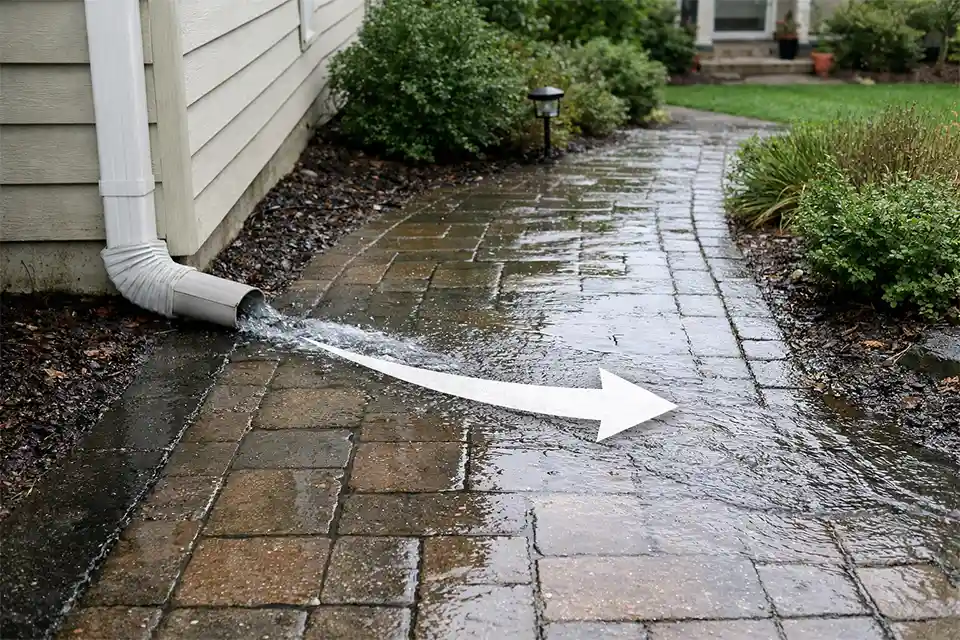
Check whether water still sits on the walkway 30 to 60 minutes after rain stops, whether one strip stays darker for 8 to 12 hours longer than the rest, and whether runoff from a downspout, bed edge, or slight yard slope is crossing the walking line instead of moving away from it.
That is the important distinction. A walkway that is briefly wet after rain is normal. A walkway that stays damp half a day, grows film again within 2 to 6 weeks after cleaning, or develops a recurring slick zone in the same 2- to 4-foot section is showing a moisture-path failure.
The slipperiness is the symptom. The real mechanism is repeated wetting, slow drying, and residue left behind.
What Usually Matters First
Follow the water path before blaming the material
Most homeowners start by blaming the paver, concrete finish, or stone texture. That is usually the wrong first call. On residential walkways, the more common pattern is simple: water is arriving too often, sitting too long, or carrying debris onto the path.
The highest-value checks are usually these:
-
runoff crossing the walkway from a downspout or gutter outlet
-
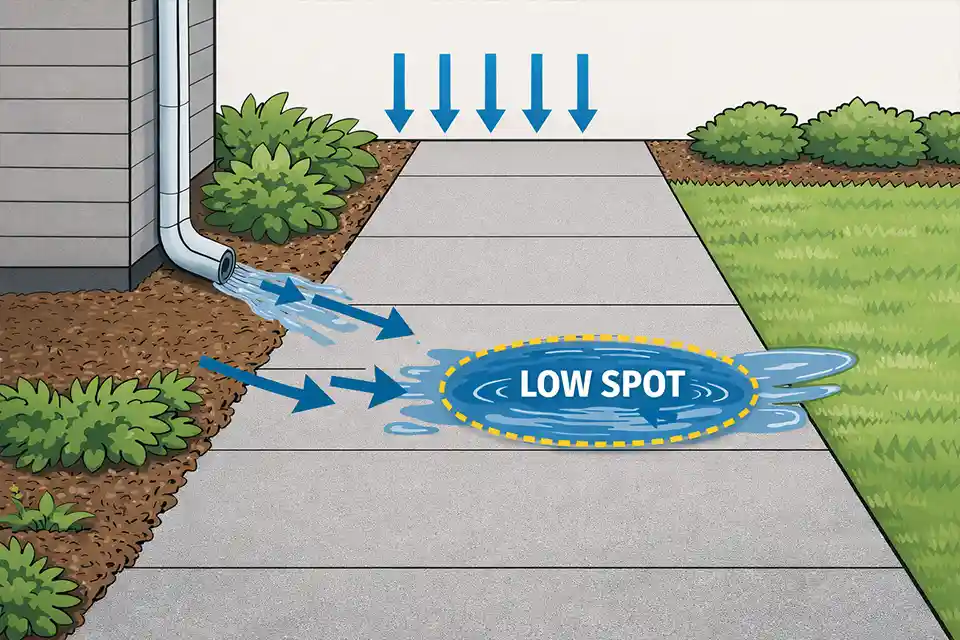
a low area holding roughly 1/8 to 1/4 inch of water
-
mulch or soil sitting above walkway edge height
-
cross-slope flatter than about 1%
-
a section still damp the next morning after ordinary rain
That last one is especially useful because it separates normal weather exposure from a real drainage issue. Brief wetness is not a defect. Slow drying is.
What is more likely than people think
Downspout discharge, shallow sheet flow from adjacent beds, and minor low spots deserve more attention than exotic surface explanations.
A walkway does not need major flooding to become slippery. A thin film of runoff carrying soil fines, leaf tannins, fertilizer residue, or organic matter is enough to cut traction.
This is also why slippery surfaces after rain often feel worse than they look. The danger is rarely just “it rained.” The danger is repeated wetting in the same place with poor drying.
What People Usually Misread
Cleaning can help and still be the wrong priority
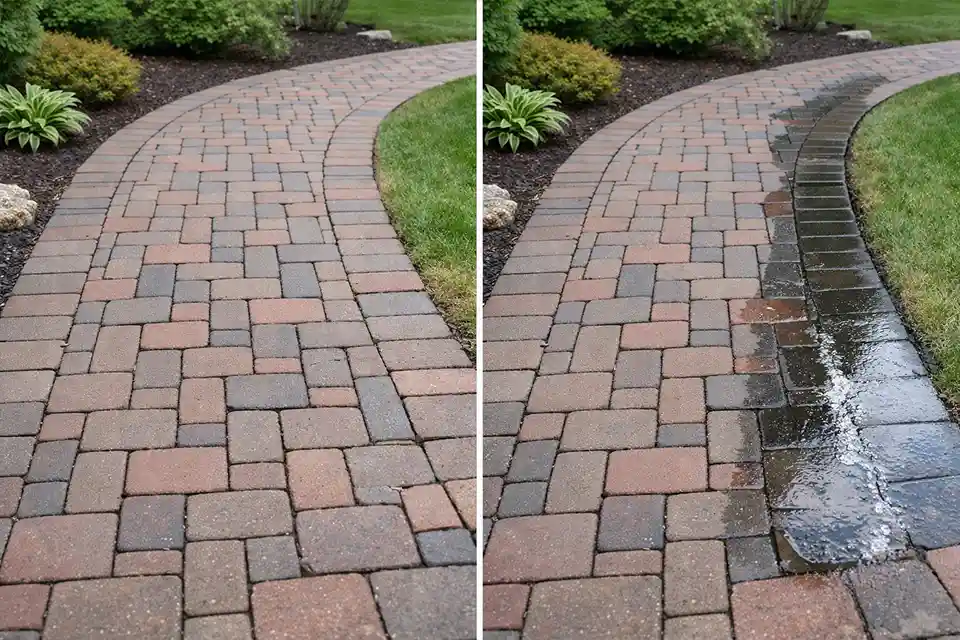
Pressure washing often makes the walkway look fixed because it removes film and brightens the surface. But if the same section gets slick again after the next few storms, cleaning was only cosmetic.
That is one of the biggest time-wasters with this issue. People treat the visible layer and ignore the repeatable water path underneath it. If the walkway keeps re-wetting from the same direction, the surface will keep re-contaminating.
Algae is often secondary, not primary
Green or dark growth gets blamed first because it is easy to see. But growth is often the result, not the origin. The drainage issue created the conditions for it. If film returns quickly after cleaning, especially in shaded areas that stay damp for 8 or more hours, moisture management matters more than biocide choice.
That point is easy to underestimate. Homeowners usually overestimate how much growth alone explains the hazard, and underestimate how much recurring moisture is telling them about runoff direction and drying failure.
Pro Tip: After the next rain, check the same spot at 30 minutes, 2 hours, and the next morning. A drying timeline is more useful than one visual inspection.
Why the Obvious Fix Often Fails
Surface treatments do not correct runoff geometry
Anti-slip coatings and grit additives can help when the walkway is basically sound and only mildly slick during occasional wet weather. They make much less sense when water repeatedly crosses the path, ponds in one low spot, or seeps in from a saturated edge.
Once that happens, the top surface is no longer the main decision point. The site geometry is. This is where poor drainage on outdoor walkways becomes more relevant than any product label.
Re-cleaning the same strip is already a warning sign
If the same 2- to 4-foot section becomes slick every few weeks, routine maintenance has stopped making sense. That repetition usually means the walkway is acting as a collection point.
The routine fix also stops making sense once you see more than one of these at the same time:
-
recurring slickness
-
local settlement of about 1/4 inch or more
-
softened edge soil after rain
-
joint washout or widening
-
moisture lingering for 12 to 24 hours
At that point, continued cleaning or coating is usually a delay tactic.
Quick Diagnostic Checklist
Signs the walkway is drainage-led, not just dirty
-
the slick area appears in the same zone after each rain
-
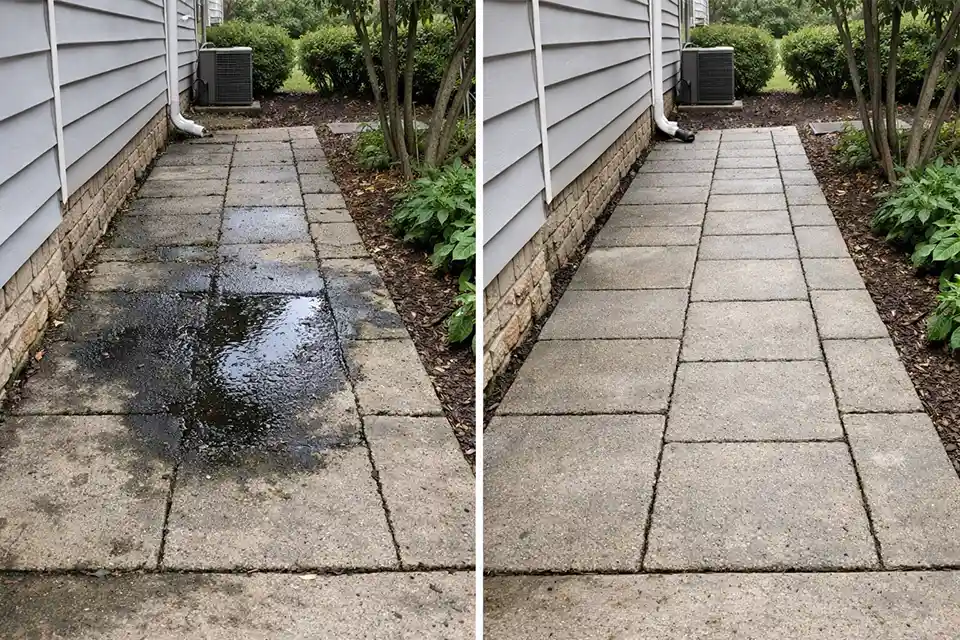
one strip dries much slower than the rest
-
runoff reaches the path from roof discharge, beds, or lawn slope
-
film returns within 2 to 6 weeks after cleaning
-
the edge next to the walkway stays soft after storms
-
the surface has a local dip of around 1/4 to 1/2 inch
Where the Water Is Usually Coming From
Downspouts and roof runoff
This is one of the most common residential causes. If a downspout outlet ends within about 2 to 4 feet of the walkway, it does not take a major storm to keep that section wet. Even moderate rainfall can repeatedly load the same spot.
Raised beds and lawn runoff
A slightly higher planting bed or compacted lawn can send shallow sheet flow across the walkway. The volume may look minor, but the effect adds up because the flow carries organics and fine sediment. Over time, that changes grip and stains the surface.
That pattern often overlaps with yard drainage problems and uneven outdoor surfaces, because the same runoff that creates slickness can also start weakening adjacent support.
Low spots and flat pitch
A walkway only needs a small geometric problem to become annoyingly slippery. A local depression of 1/4 to 1/2 inch or a cross-slope under about 1% can be enough to trap water longer than it should. That is why a walkway can look almost level and still perform badly.
When It Stops Being Just a Slip Issue
Persistent moisture starts affecting support
The surface hazard gets attention first, but it is not always the biggest consequence. If water keeps sitting at joints and edges, the base can gradually soften, joint material can wash out, and edge restraint can start losing support.
This is where the issue shifts from maintenance to deterioration. Drainage failure is weakening your ground matters here because the same moisture pattern that makes a walkway slick can start making it unstable.
Cosmetic versus decision-useful signs
Discoloration alone is not the signal to prioritize. The more useful signs are repeated pooling, slow drying, recurring film, and measurable settlement.
| Condition | Lower concern | Higher concern | What it usually means |
|---|---|---|---|
| Drying time | dries in 1 to 2 hours | stays damp 8 to 24 hours | drainage is likely failing |
| Water on surface | light sheen only | 1/8 to 1/4 inch pooling | low spot or weak pitch |
| Film return | months after cleaning | 2 to 6 weeks after cleaning | moisture source still active |
| Surface level | stable | 1/4 to 1/2 inch local dip | settlement or washout starting |
| Edge condition | firm after rain | soft after rain | saturation near walkway edge |
Fixes That Actually Change the Outcome
Redirect concentrated water first
If a downspout or roof outlet is feeding the problem, move that water path before doing anything cosmetic. Extending or redirecting discharge several feet away often changes more than any surface treatment.
Correct the drainage geometry
If the issue is at the edge, adjacent regrading may be enough. If the surface itself has settled, partial lifting and resetting is usually the smarter move. This is the point many homeowners miss: once the walkway has a measurable low area, the repair is often geometric, not chemical.
Reduce the residue source too
Even after the water path is fixed, the problem can linger if mulch, soil, and organics keep washing across the path. That is why dirt and debris accelerating surface wear still matters in a drainage article. A cleaner water path stays safer longer.
Pro Tip: If you correct runoff but leave the bed edge slightly higher than the walkway, the slickness often returns in a weaker but still persistent form.
The Bottom Line
Poor drainage makes walkways slippery because it keeps them wet longer than they should stay wet. That deserves priority over texture, coatings, or one more round of cleaning.
If the same area stays damp for hours after rain, keeps regrowing film, or shows early settlement near wet edges, stop treating it like a surface-only problem. Follow the water path first, then decide whether the walkway needs regrading, reset work, or both.
For broader homeowner guidance on moisture and runoff control, see the EPA’s Soak Up the Rain page on redirecting downspouts.