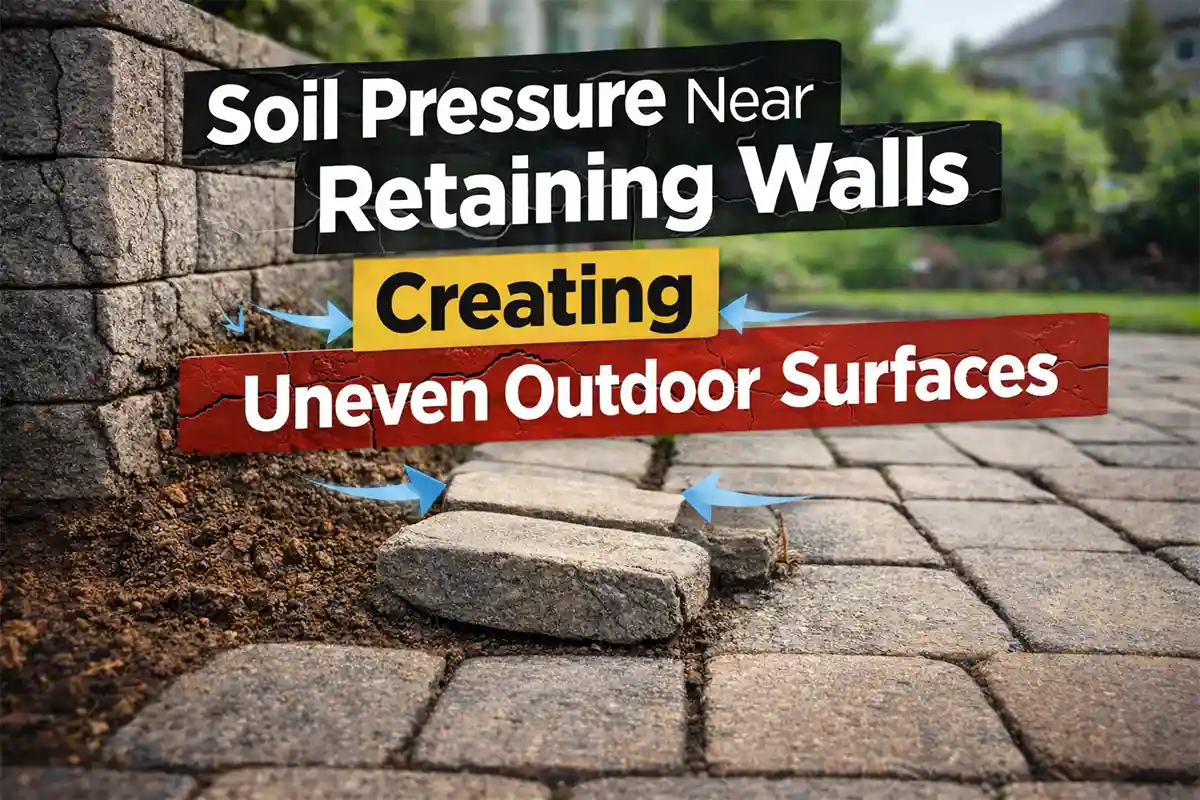
Uneven patios, shifting walkways, or sinking driveway edges sometimes appear close to retaining walls. Homeowners often notice that the ground becomes slightly raised, sloped, or depressed within a few feet of the wall.
In many cases, the underlying cause is soil pressure building behind the retaining wall. As the soil mass expands, absorbs water, or slowly moves downhill, it redistributes weight through the ground supporting nearby outdoor surfaces.
This pressure—known in engineering as lateral earth pressure—can gradually push soil outward or downward. When the soil supporting a patio base or walkway foundation shifts even slightly, surfaces begin to tilt, separate, or settle unevenly.
The problem often develops slowly. Small paver gaps of ¼ inch may appear first, followed by slight surface slopes or minor depressions. Depending on soil type, moisture levels, and wall construction, visible changes can emerge within 1–4 years after installation.
Understanding how retaining wall pressure interacts with surrounding soil is the first step toward preventing long-term outdoor surface damage.
Why Soil Pressure Builds Behind Retaining Walls
Retaining walls are designed to resist the pressure of soil that would otherwise slide downhill. However, soil is not a static material. Its weight, moisture content, and density constantly change.
Three major forces drive pressure buildup behind retaining structures.
Soil Weight and Lateral Earth Pressure
Every cubic foot of soil weighs between 90 and 120 pounds, depending on moisture and composition. When stacked behind a retaining wall, this mass creates horizontal force pushing against the structure.
Walls taller than 4–6 feet experience significantly higher lateral pressure, especially when backfill soil becomes saturated.
Clay-heavy soils found in many Midwestern states may expand 10–15% in volume when wet, increasing pressure dramatically.
Water Saturation and Hydrostatic Pressure
When water accumulates behind a wall, it increases the total load acting on the soil mass.
Saturated soil can weigh 20–30% more than dry soil. Without proper drainage, this additional weight pushes soil outward and downward.
This is why water management is critical in retaining wall construction. Persistent rainfall or irrigation overspray can quickly destabilize soil structure.
Water-related ground instability is often discussed alongside soil movement issues explained in
Soil Movement Causing Surface Problems.
Gradual Soil Creep
Gravity slowly pulls soil downhill over time, especially on slopes steeper than 12–15 degrees. This slow movement, called soil creep, may shift the ground supporting patios or walkways near retaining walls.
Regions with seasonal rainfall patterns—such as parts of the Midwest—or freeze–thaw cycles in northern states tend to experience stronger soil creep effects.
Quick Diagnostic Checklist
The following signs often indicate that soil pressure near a retaining wall is affecting nearby outdoor surfaces.
-
Uneven pavers or concrete slabs within 2–6 feet of the wall
-
Minor wall bulging or slight leaning
-
Small ridges of soil forming near the base of the wall
-
Gaps forming between pavers (¼–½ inch)
-
Walkways sloping slightly away from the wall
-
Drainage holes releasing muddy water after heavy rain
When several of these symptoms appear together, soil pressure is frequently involved.
How Soil Pressure Affects Patios, Walkways, and Driveways
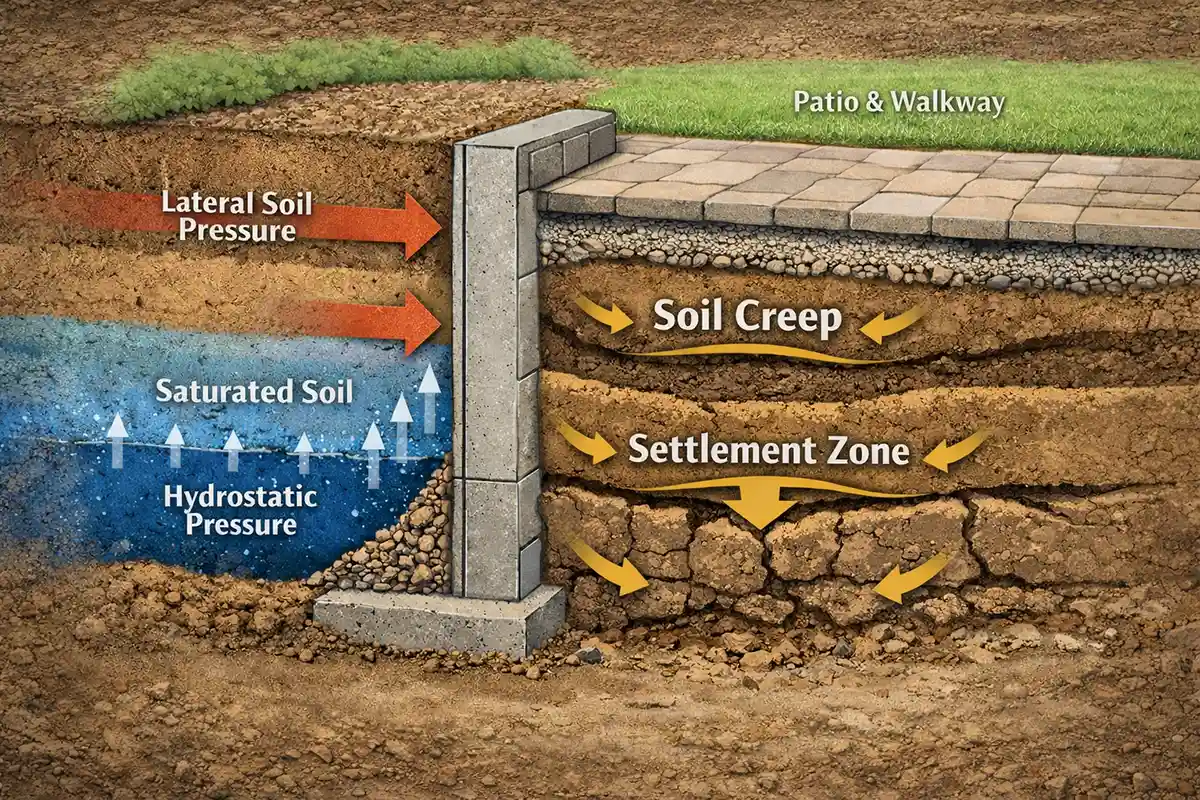
Soil pressure rarely affects only the wall itself. The surrounding ground often absorbs part of that pressure.
When the soil structure beneath outdoor surfaces shifts, several types of surface distortion may appear.
| Pressure Effect | Surface Result | Typical Severity |
|---|---|---|
| Soil expansion | Pavers lifting slightly | Moderate |
| Backfill settlement | Depressions near the wall | Moderate |
| Hydrostatic pressure | Concrete slab tilting | Moderate to severe |
| Soil creep | Gradual slope changes | Mild |
| Compaction loss | Uneven gravel surfaces | Mild |
Freeze–thaw cycles can amplify these movements. When water trapped in soil freezes, it expands by about 9%, temporarily increasing pressure on both the retaining wall and nearby surfaces.
In drier regions such as Arizona, the opposite may occur. Soil contraction during extended dry periods can create voids beneath pavers or slabs.
Types of Retaining Walls and Their Pressure Behavior
Not all retaining walls distribute soil pressure the same way. The construction type often determines how surrounding ground responds.
| Wall Type | Construction Method | Pressure Behavior |
|---|---|---|
| Gravity wall | Heavy stone or concrete mass | Relies on weight to resist pressure |
| Segmental block wall | Interlocking concrete blocks | Uses setback angle to distribute load |
| Reinforced wall | Includes geogrid layers | Stabilizes soil mass behind wall |
| Timber wall | Wooden beams anchored into soil | More vulnerable to long-term movement |
Segmental retaining walls commonly used in residential landscaping are designed to reduce outward pressure by stepping slightly backward. However, if drainage is poor or backfill soil settles unevenly, nearby ground surfaces may still shift.
Poor drainage behind retaining structures is a frequent cause of instability and is explored further in
Why Ground Becomes Unstable After Major Rainfall.
How Backfill Soil Type Influences Surface Stability
The soil placed behind a retaining wall—called backfill—plays a major role in long-term stability.
| Soil Type | Behavior | Risk Level |
|---|---|---|
| Clay | Expands when wet, shrinks when dry | High |
| Silty soil | Holds water easily | Moderate |
| Sandy soil | Drains quickly but shifts easily | Moderate |
| Engineered gravel backfill | Highly stable with drainage | Low |
Well-built retaining walls usually include drainage gravel layers 12–18 inches thick behind the structure. These layers reduce hydrostatic pressure and help prevent soil saturation.
When poor backfill material is used, uneven surface problems are more likely to appear.
Similar ground movement patterns are often observed when soil was recently disturbed during landscaping work, as explained in
Uneven Walkway Surfaces Caused by Recently Filled or Disturbed Soil.
Practical Ways to Reduce Uneven Surfaces Near Retaining Walls
Several solutions can stabilize the ground and restore surface alignment depending on the severity of movement.
Improve Drainage Behind the Wall
Drainage improvements often provide the greatest benefit. Typical upgrades include:
-
Installing perforated 4-inch drainage pipe behind the wall
-
Adding 12–18 inches of gravel backfill
-
Cleaning blocked weep holes
-
Redirecting irrigation spray away from the wall
Reducing water accumulation significantly lowers soil pressure.
Re-Level Paver or Patio Surfaces
If pavers have shifted less than 1 inch, they can usually be repaired without replacing the entire surface.
Common techniques include:
-
Lifting pavers and regrading the base layer
-
Adding compacted base material
-
Resetting pavers with polymeric sand
Slab Leveling or Mudjacking
For concrete slabs that have tilted or settled, contractors sometimes use mudjacking or polyurethane foam injection.
These techniques lift slabs by injecting material beneath them, restoring level surfaces.
Install Surface Drainage Systems
Surface drainage solutions help prevent additional soil saturation.
Examples include:
-
French drains installed along retaining walls
-
Channel drains along patios
-
Downspout extensions directing water away
In many cases, uneven surfaces near retaining walls develop alongside broader ground settling problems discussed in
Ground Settling in Outdoor Areas Explained.
When Retaining Wall Structural Repairs Are Needed
In severe cases, soil pressure may compromise the retaining wall itself.
Signs that structural repair may be required include:
-
Wall leaning more than 1 inch per 4 feet of height
-
Large horizontal cracks in masonry
-
Bulging sections of wall
-
Soil escaping through joints
Structural engineers typically evaluate the wall by measuring soil density, drainage conditions, and lateral pressure forces.
Guidelines for soil stability and drainage design are published by the
U.S. Department of Agriculture Natural Resources Conservation Service:
https://www.nrcs.usda.gov
Common Questions About Uneven Ground Near Retaining Walls
How close to a retaining wall do uneven surfaces usually appear?
Most surface movement occurs within 2–6 feet of the wall, where soil pressure is highest.
Can drainage improvements stop the problem?
In many cases, improving drainage significantly reduces soil pressure and prevents additional ground movement.
Do taller retaining walls create more surface problems?
Yes. Walls taller than 4–6 feet generate greater lateral pressure and therefore increase the likelihood of soil movement.
Can uneven surfaces be fixed without rebuilding the wall?
If the wall structure is still stable, surface repairs such as paver resetting or slab leveling are often sufficient.
Key Takeaways
Soil pressure behind retaining walls is a common cause of uneven patios, walkways, and driveway edges. As soil absorbs water, expands, or slowly moves downhill, the resulting lateral earth pressure can shift the ground supporting nearby surfaces.
The risk is greatest within several feet of the wall, particularly when drainage is poor or backfill soil was not properly compacted.
Early warning signs—such as small paver gaps, surface slopes, or minor depressions—should not be ignored. Improving drainage, stabilizing soil, and repairing minor surface movement early can prevent more extensive structural damage over time.