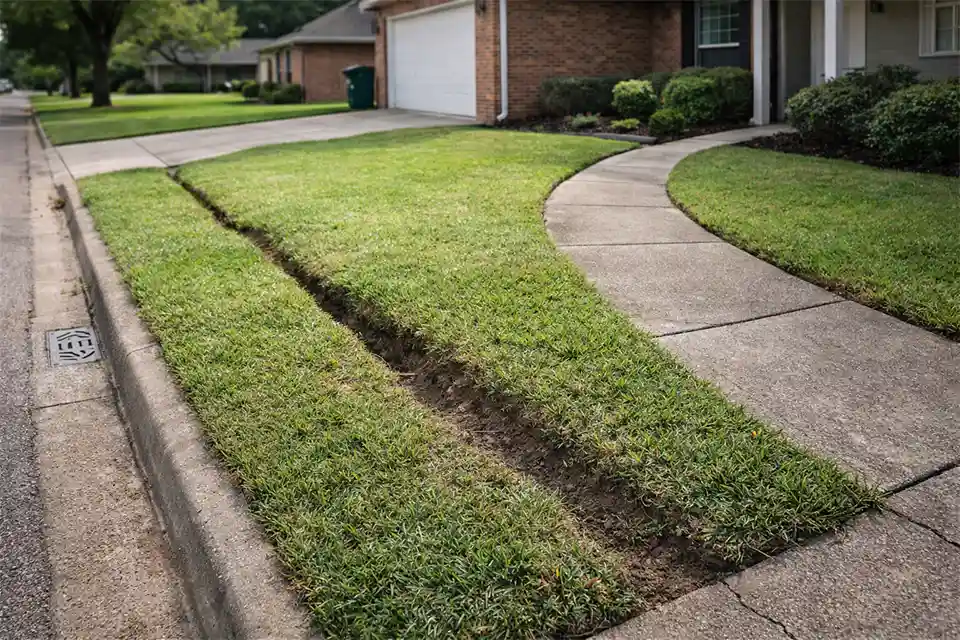
When underground utilities such as water lines, gas pipes, electrical conduits, or fiber-optic cables are installed, contractors excavate long trenches that typically range from 18 inches to 6 feet deep. After the pipe or conduit is placed, the trench is filled again with excavated soil.
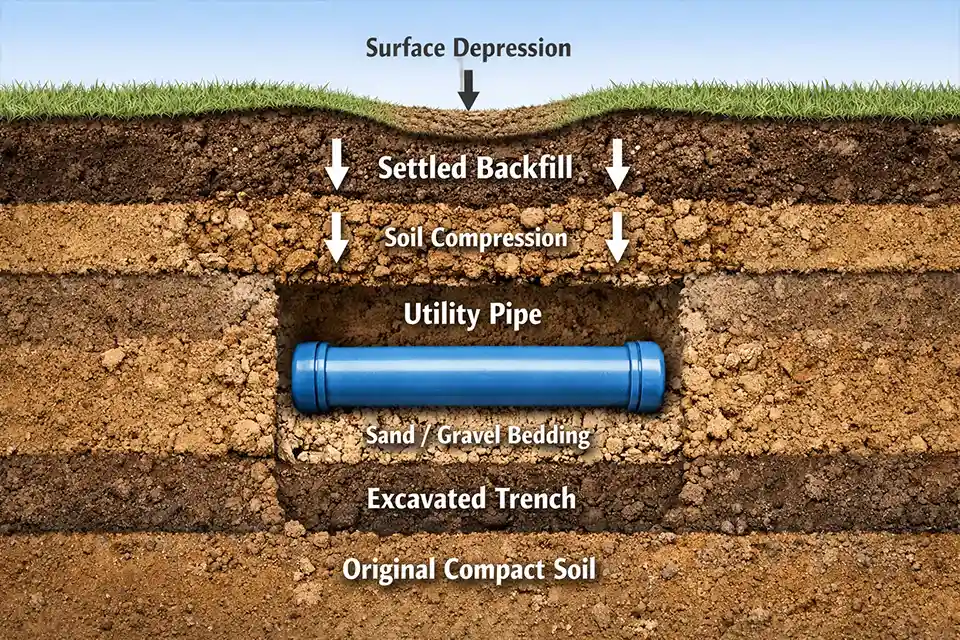
Even when the backfill is done carefully, the soil rarely returns to its original density. Disturbed soil contains microscopic air pockets and loose particles that gradually compress under gravity, moisture changes, and seasonal ground movement.
Over time, the soil above the trench slowly settles. The surface directly above it may drop 1–3 inches, creating a visible dip across lawns, gravel paths, or concrete walkways.
This process often continues for 6 months to 5 years, depending on soil type and climate conditions.
The behavior is part of broader ground movement processes described in Ground Settling in Outdoor Areas Explained, where disturbed soil layers gradually consolidate after excavation.
Typical visual signs include:
-
Long narrow depressions across the yard
-
Sunken lines following the path from street utilities toward the house
-
Slight drops along walkways or driveways
-
Uneven grass growth along trench routes
These patterns often appear months after installation because soil compaction occurs gradually.
How Excavation Disrupts Soil Stability
Natural soil becomes compacted over decades. Rainfall, plant roots, and soil pressure slowly create a dense structure capable of supporting patios, landscaping, and walkways.
Excavating a trench breaks that structure completely.
When the soil is removed and replaced, the internal particle arrangement changes. Even with mechanical compaction equipment, the restored soil often reaches only 85–95% of its original density.
Three mechanical processes drive the settlement that follows:
-
Soil consolidation under gravity
-
Water infiltration filling air voids
-
Seasonal expansion and contraction
These mechanisms are examples of broader ground dynamics discussed in Soil Movement Causing Surface Problems, where moisture cycles and structural soil changes alter surface stability.
In cold northern states such as Minnesota or Michigan, freeze–thaw cycles can expand soil volume by up to 9% during winter. When thawing occurs in spring, the soil collapses slightly, accelerating settlement.
In humid regions like Florida, frequent rainfall infiltrates disturbed soil and gradually compresses the trench fill material.
Signs That a Utility Trench Is Causing Surface Settlement
Homeowners often notice uneven ground but do not immediately connect it to buried utilities.
Trench settlement typically follows a very specific visual pattern.
Quick Diagnostic Checklist
-
A straight or gently curved dip across the lawn
-
Surface sinking appearing months after utility installation
-
Depressions roughly 12–36 inches wide
-
Uneven surfaces running between the street and the home
-
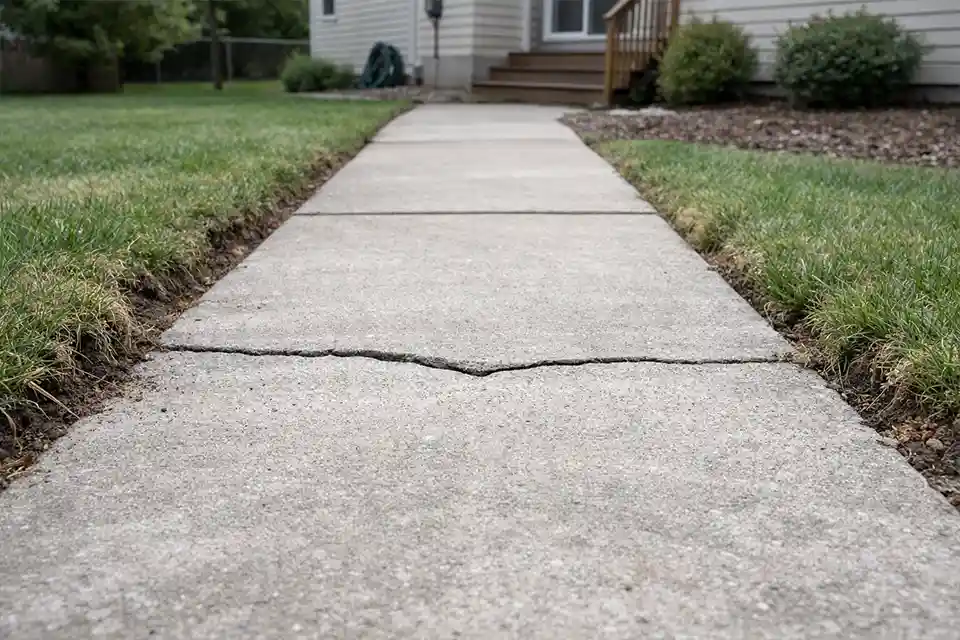
Minor cracks forming along sidewalks crossing the trench path
If the uneven area forms a clear line rather than random low spots, disturbed trench soil is a common cause.
This is closely related to conditions explained in Uneven Walkway Surfaces Caused by Recently Filled or Disturbed Soil, where recently replaced soil continues compacting under hardscape surfaces.
Environmental Conditions That Accelerate Trench Settlement
The speed of settlement varies significantly depending on soil composition and climate.
| Condition | Impact on Soil | Typical Result |
|---|---|---|
| Heavy clay soils | Retain water and shrink during dry periods | Cracks and dips |
| Sandy soils | Drain quickly but compact slowly | Gradual depressions |
| High rainfall regions | Water fills and drains soil voids | Faster consolidation |
| Freeze–thaw climates | Seasonal expansion cycles | Repeated soil collapse |
| Poor backfill compaction | Large air pockets remain | Rapid settlement |
In desert climates such as Arizona, settlement may occur slowly because dry soils consolidate gradually. However, sudden monsoon storms can accelerate compaction dramatically.
In contrast, Midwest states with frequent rainfall experience faster soil consolidation due to repeated moisture infiltration.
Why Walkways and Driveways Often Sink Along Trench Lines
Utility trenches frequently run beneath sidewalks, driveway edges, or garden paths. These surfaces rely on stable base layers to remain level.
When soil beneath a portion of the base layer compresses unevenly, the structure above begins to shift.
A settlement of even ½ inch beneath a concrete slab can tilt the surface enough to create a noticeable trip hazard.
Older concrete surfaces are particularly vulnerable, especially when the base layer has already deteriorated. This type of structural weakening is explained further in Why Older Concrete Walkways Become Uneven Over Time.
Typical Timeline of Utility Trench Settlement
Settlement does not occur immediately after installation. Instead, the process usually unfolds over several years.
| Time After Installation | Soil Behavior | Surface Effect |
|---|---|---|
| 0–6 months | Initial soil compression begins | Slight lowering |
| 6–18 months | Rainfall cycles compact soil | Visible depressions |
| 2–3 years | Ongoing consolidation | Walkways begin tilting |
| 3–5 years | Soil stabilizes | Settlement slows |
The exact timeline depends heavily on backfill quality and moisture exposure.
Poorly compacted trench fill can contain 20–40% air void space, which takes years to collapse completely.
Rainfall also plays a major role in soil movement. Heavy storms can rapidly accelerate the process, a phenomenon discussed in Why Ground Becomes Unstable After Major Rainfall.
Practical Ways to Fix Uneven Surfaces Above Trenches
Once the majority of settlement has occurred, the surface can usually be repaired without major excavation.
Common Repair Methods
| Repair Method | Best For | Difficulty |
|---|---|---|
| Adding topsoil and regrading | Lawn depressions | Easy |
| Mechanical soil compaction | Minor yard dips | Moderate |
| Sand base leveling | Paver pathways | Moderate |
| Polyurethane foam slab lifting | Concrete slabs | Professional |
| Partial slab replacement | Severe settlement | High |
For lawns, homeowners often add 1–2 inches of topsoil, level the area, and reseed grass.
For hardscapes, professional slab lifting can stabilize surfaces without removing the entire concrete section.
Preventing Future Settlement After Utility Work
Contractors can reduce future settlement risk by following proper trench backfill compaction standards.
Best practices include:
-
Compacting soil in 6–12 inch layers
-
Using crushed gravel for structural support
-
Maintaining proper soil moisture during compaction
-
Allowing soil to stabilize before installing walkways
-
Monitoring trench lines after heavy rainfall
These practices significantly reduce the air voids that cause long-term settlement.
Engineering guidelines published by the USDA Natural Resources Conservation Service emphasize how proper soil compaction and moisture management improve long-term soil stability.
Questions Homeowners Often Ask
Is trench settlement dangerous for house foundations?
Usually not. Utility trenches are normally placed several feet away from the foundation. However, severe settlement close to structural walls should be evaluated.
Can trench settlement continue for several years?
Yes. Depending on soil composition and moisture exposure, settlement may continue gradually for three to five years.
Should uneven areas be repaired immediately?
Minor depressions may continue settling if repairs are done too early. Waiting until soil movement slows often leads to more permanent fixes.
Why does the depression appear as a straight line?
Utility trenches are excavated in long straight paths. The soil settlement mirrors that same linear route across the yard.
Key Takeaways
Uneven outdoor surfaces forming above utility trenches are a common result of disturbed soil consolidation. During utility installation, excavated soil loses its natural structure and contains air pockets that compress gradually under weight and moisture cycles.
Over time, the soil settles, creating long shallow depressions across lawns, walkways, and driveways.
Climate conditions—such as freeze–thaw cycles in northern states, heavy rainfall in the Midwest, or moisture changes in humid coastal areas—can accelerate the process.
Fortunately, once the soil stabilizes, most uneven surfaces can be corrected through regrading, base reinforcement, or professional slab lifting.
Recognizing the early signs of trench settlement helps homeowners address the issue before it spreads to surrounding outdoor structures.