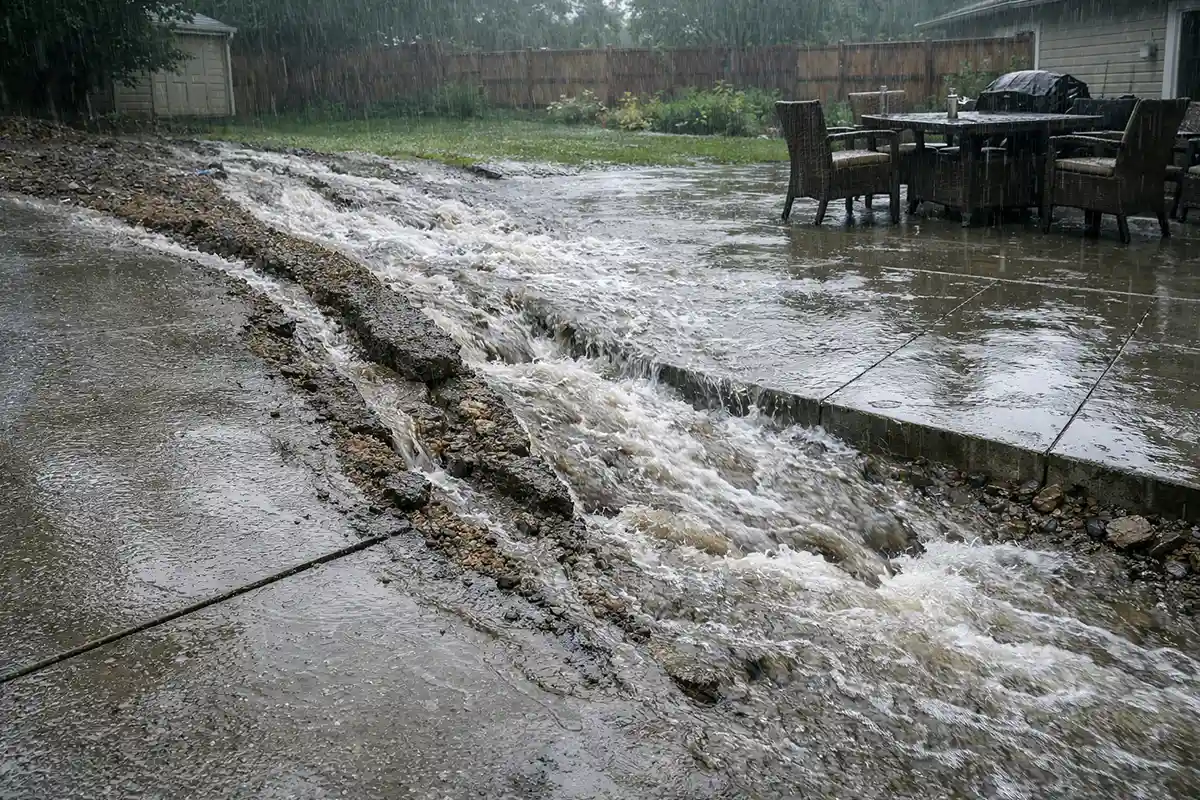
After a heavy rain, you step outside and notice thin streams of water sliding across the driveway. Nothing looks broken. The surface seems solid, flat, and unchanged.
A few months later, that same path looks slightly darker than the rest. The edge near the grass feels rougher under your shoe. These small shifts often begin long before cracks or sinking appear.
Most people assume outdoor concrete fails suddenly. In reality, damage from water runoff builds slowly, repeating the same motion again and again until the surface starts to react.
How Water Runoff Interacts With Hard Surfaces
You watch rain move across a patio and think it is simply draining away. What is easy to miss is how that water chooses the same path every time it rains. The surface may look smooth, but tiny texture differences guide the flow in predictable lines.
Over time, that repeated movement starts changing the top layer. You may notice:
-
Slight dark streaks that never fully fade.
-
Areas that feel smoother underfoot.
-
Fine sand collecting near edges after storms.
These are not stains alone. Moving water creates friction. It slowly loosens fine particles at the surface and carries them away. The change is subtle, but each rainfall reinforces it.
Water also slips into tiny openings you cannot see. When temperatures drop, that trapped moisture expands. Even without visible cracks, the material inside begins to weaken from repeated swelling and drying cycles. What feels like a simple rain event is quietly reshaping the surface structure.
Why Sloped Areas Experience Accelerated Damage
Stand at the top of a sloped driveway during a storm and you can see the difference. Water does not drift slowly there. It moves with speed and direction.
The faster water travels, the more force it carries. On sloped areas, that often leads to:
-
Joint sand washing out more quickly.
-
Edge material softening near the bottom.
-
Small debris lines forming along one side.
The lowest point of the slope takes the most stress. Water exits in the same narrow strip each time it rains. Months later, that exit zone may look slightly rounded or chipped compared to the rest.
A common belief is that stronger concrete would prevent this. In many cases, the material is not weak at all. The issue is concentrated flow. Even durable surfaces wear down when force is repeatedly focused on one small area.
The Connection Between Runoff and Soil Instability
After heavy rainfall, the ground beside a patio often feels softer. You might press your foot into the soil and notice it gives more than usual. That softness matters more than it seems.
When runoff consistently pours toward one edge, the soil beneath that section absorbs extra moisture. Over time, this uneven wetting can lead to:
-
Soil losing density in one spot.
-
Fine particles washing away from beneath slab edges.
-
Small voids forming under the surface.
At first, you may only feel a faint difference when walking across the area. The slab might flex ever so slightly under weight. That minor movement signals that the support underneath is no longer uniform.
Many people assume cracks cause soil problems. In reality, soil movement often starts first. The surface shifts because its base has changed, not the other way around.
| What You Notice | What You Assume | What Is Actually Happening |
|---|---|---|
| A darker strip along the driveway | It is just a stain | Water is repeatedly flowing along that exact path, slowly wearing the surface |
| A slightly softer edge near the lawn | The concrete is weak there | The soil beneath that edge is losing density from repeated saturation |
| Fine sand collecting after rain | The material was installed poorly | Runoff is carrying loose particles away over time |
Visual Indicators of Early Runoff Damage
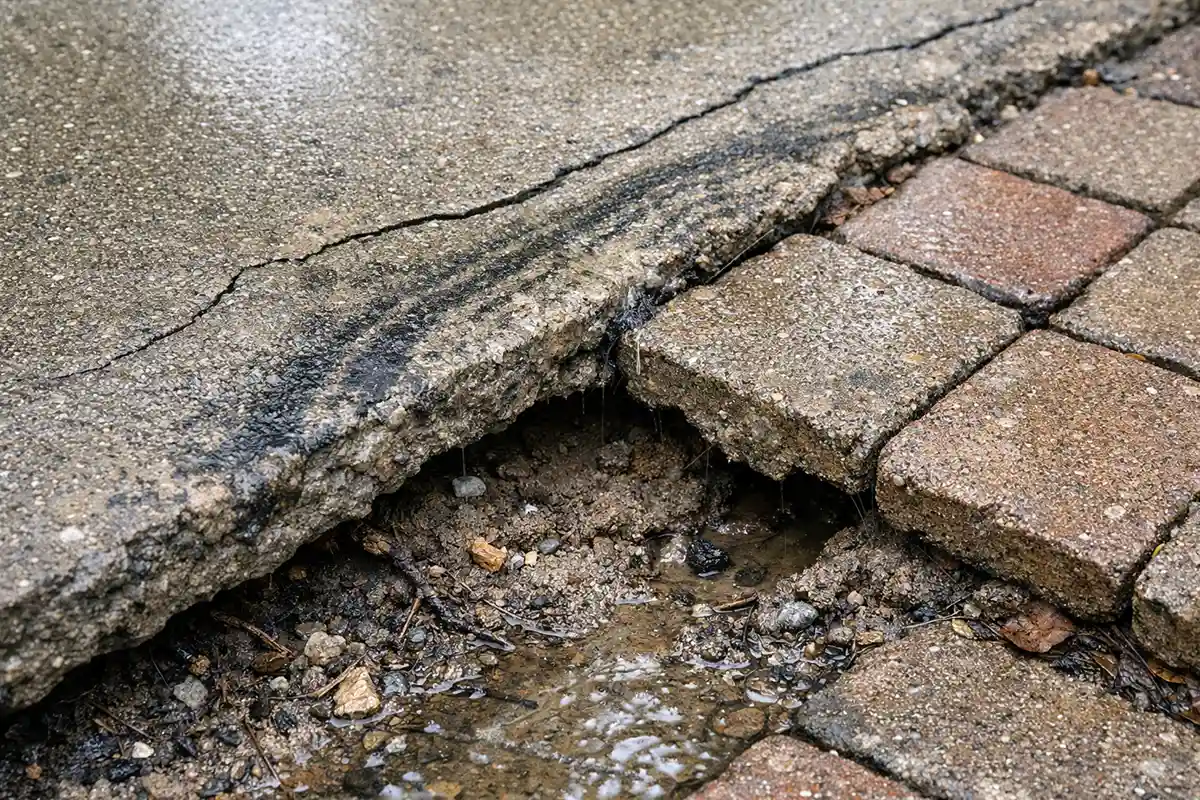
You might first notice that one corner of the patio looks slightly different after storms. The color does not match the rest. The edge near a downspout feels rougher or more brittle.
Common early signs include:
-
Rounded slab corners instead of sharp edges.
-
Small gaps appearing between pavers.
-
Tiny depressions where water tends to sit.
These changes often seem cosmetic. However, they point to repeated stress in the same areas. Each rainfall deepens those patterns just a little more.
Ignoring them is easy because the surface still looks mostly intact. The problem is that once small voids or weak spots form, future storms accelerate the process.
How Poor Drainage Patterns Amplify Surface Deterioration
Picture water pooling on a walkway before it slowly drains away. That extra time sitting on the surface increases contact and saturation. The longer moisture remains, the more the material absorbs it.
In areas with incomplete drainage, you may observe:
-
Water lingering longer than expected.
-
Slippery patches that dry unevenly.
-
Repeated wet spots in the same location.
Another widespread assumption is that once water moves away, the risk is gone. The real issue is repetition. When runoff follows the same path and pools in the same zones, stress builds quietly beneath the surface.
What looks like simple rainwater today can, over seasons, reshape how the surface sits, how it drains, and how stable it feels under daily use.
When Runoff Begins to Shift Surface Alignment
You walk across a patio that has always felt solid, and one step lands slightly lower than the rest. Nothing looks dramatically wrong, yet your footing changes for a split second. That subtle difference often marks the point where runoff has already begun altering support beneath the surface.
Water rarely removes soil evenly. Instead, it concentrates along predictable exit paths and perimeter edges. As fine particles migrate or compact under repeated saturation, one section of the slab settles differently from the next. The change may measure only fractions of an inch, but it modifies how weight transfers across joints and connection points.
As seasons pass, these small variations compound. A surface that once drained efficiently may begin collecting water in a newly formed shallow depression. That pooling reinforces saturation in the same weakened zone, accelerating the shift from minor settlement to measurable misalignment.
Why Does My Driveway Feel Uneven After Heavy Rain Even Though It Looks Fine?
After a storm, you might step onto the driveway and sense a faint tilt or softness under one foot. Visually, everything appears level. The confusion comes from the mismatch between what you see and what you feel.
Why does it feel softer in one spot after rain? Moisture may be temporarily reducing soil stiffness beneath that section, allowing slight downward movement under load.
Why does the uneven feeling disappear on dry days? As the soil dries, it regains some rigidity, masking the subtle settlement that remains underneath.
Why do certain shoes make the problem more noticeable? Soft soles compress into shallow depressions more easily, amplifying minor elevation differences.
Why does the surface look flat but still feel off? The change can be too small to detect visually yet large enough to alter load transfer when you step across it.
Why does the issue seem worse in colder weather mornings? Lower temperatures can stiffen the slab surface while the subgrade remains uneven, increasing the contrast in how the surface responds under pressure.
These moments often signal evolving subgrade conditions rather than immediate structural failure. The surface may still appear intact, but the interaction between moisture, soil density, and slab weight is already shifting beneath it.
Edge Erosion and Load Redistribution Over Time
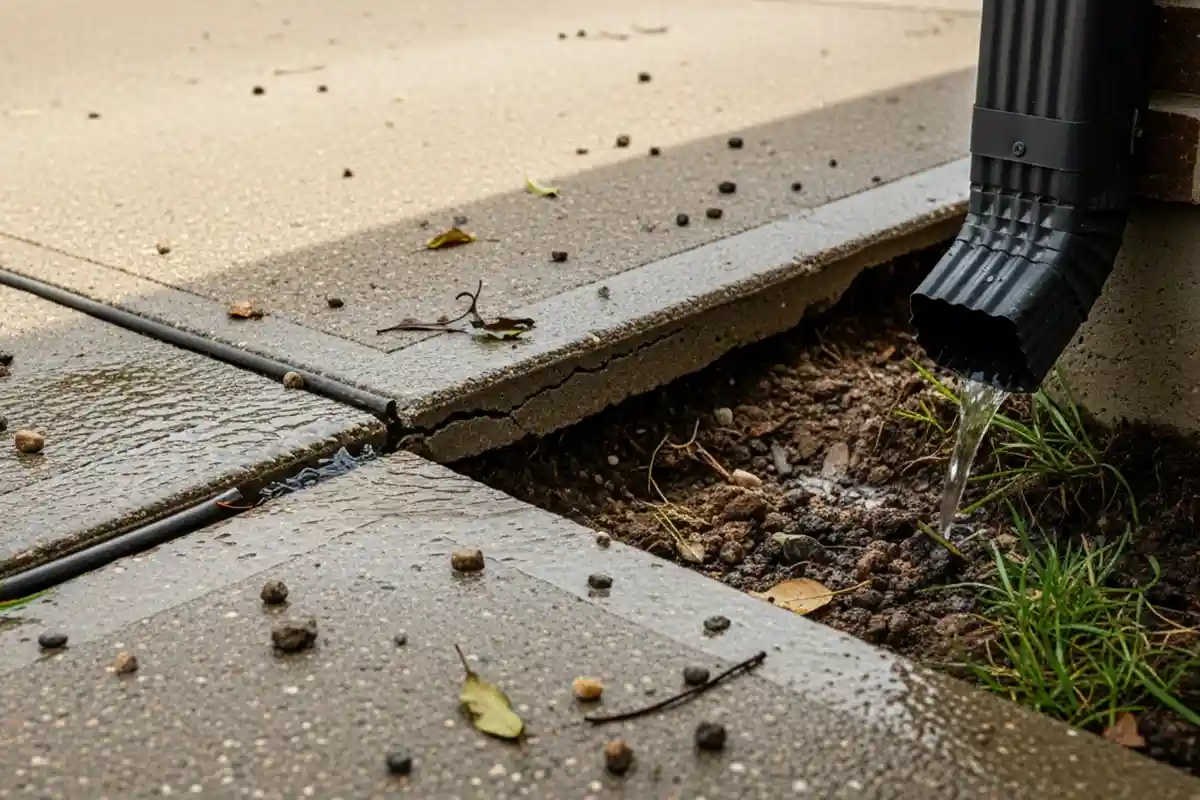
At the edge of a slab, support exists only on one side. When runoff repeatedly saturates that boundary, the soil beneath it becomes less stable than the interior base. This imbalance increases tensile stress along the edge.
As soil particles wash out, small voids may form underneath. Even if the overhang is slight, daily loads from vehicles or foot traffic magnify internal stress. Over time, chipping and spalling appear not because the material was defective, but because its support became uneven.
Concentrated discharge from roof downspouts intensifies the effect. A focused stream striking the same area multiplies hydraulic force. Months of repetition can transform a barely visible erosion line into measurable edge settlement that alters overall load distribution.
Material Fatigue Under Repeated Moisture Cycling
Surfaces exposed to alternating wet and dry conditions behave differently than those in balanced environments. Repeated saturation weakens bonding within concrete paste and joint materials. As moisture penetrates small openings, expansion and contraction cycles create internal strain.
The progression often follows a predictable pattern. Micro-cracks form first. Those openings allow deeper infiltration during the next storm. With each cycle, the damaged zone expands outward from the original runoff path.
The following table outlines how runoff-driven moisture cycling affects different components of an outdoor surface system.
| Component Affected | Runoff Influence | Structural Response |
|---|---|---|
| Surface paste layer | Repeated abrasion and wetting | Gradual thinning and scaling |
| Joint material | Particle displacement during flow | Loss of interlock and shifting units |
| Subgrade soil | Uneven saturation and washout | Differential settlement |
| Slab edges | Concentrated discharge impact | Increased tensile stress and chipping |
| Embedded reinforcement | Moisture infiltration through cracks | Corrosion expansion pressure |
These interactions show how visible surface wear often reflects deeper system-level stress rather than isolated cosmetic damage.
Differing Runoff Behavior Across Conditions
Runoff does not affect every surface the same way. Its impact varies depending on material, climate, and surrounding structure.
Material differences:
-
Concrete slabs resist abrasion but are vulnerable to edge stress and freeze-thaw expansion.
-
Interlocking pavers tolerate minor movement yet lose stability when joint material erodes.
Climate variations:
-
In colder regions, freeze-thaw cycles magnify internal cracking.
-
In warmer climates, repeated wet-dry cycles accelerate surface scaling and discoloration.
Structural layout factors:
-
Surfaces with steep gradients concentrate hydraulic force at exit points.
-
Flat areas with poor drainage experience longer saturation times and pooling stress.
As runoff patterns continue interacting with material and soil conditions, the surface transitions from uniformly supported to selectively stressed. The visible symptoms may remain modest, but the internal dynamics grow increasingly complex as environmental cycles repeat.
Redirecting Water Before Structural Damage Deepens
When runoff patterns are still mild, changes in water behavior can significantly slow deterioration. Surfaces that shed water evenly tend to age more uniformly. The goal at this stage is not cosmetic repair but flow redistribution.
Minor scenarios often involve shallow depressions or early edge softening. In these cases, corrective measures focus on:
-
Adjusting discharge points so roof runoff no longer strikes slab edges directly.
-
Improving slope consistency to prevent isolated pooling zones.
-
Reinforcing perimeter soil to reduce washout along boundaries.
Moderate cases show visible settlement or joint displacement. Here, correction typically combines surface stabilization with drainage modification. Without altering how water moves, any surface repair remains vulnerable to repeat stress.
Severe conditions involve measurable structural separation, persistent void formation, or widespread cracking. In these situations, addressing subgrade instability becomes essential before surface-level restoration can hold long term. The intensity of correction scales with the depth of soil movement already present.
Concentrated Flow Correction Through Drainage Reconfiguration
When runoff repeatedly follows the same narrow path, redistributing that flow reduces concentrated stress. Linear trench drains along slab edges intercept high-velocity discharge before it erodes boundary soil. Downspout extensions redirect vertical water impact away from vulnerable points.
In moderate cases, regrading adjacent soil changes how water approaches the surface entirely. Rather than forcing flow across the slab, water is guided around it. Gravel trenches absorb and disperse runoff gradually, lowering hydraulic force at any single point.
Severe situations sometimes require partial slab lifting or base reconstruction. When voids have formed beneath edges, restoring uniform subgrade density is necessary before drainage improvements can stabilize the surface. The effectiveness of any correction depends on whether the flow path itself has truly changed.
Surface Stabilization After Subgrade Adjustment
Once drainage behavior is corrected, surface stabilization addresses the structural imbalance created over time. In minor cases, re-leveling isolated sections may restore alignment if soil density has not been severely compromised.
Moderate settlement may require localized lifting and void filling to eliminate unsupported pockets beneath the slab. This restores even load transfer across the surface plane. Without reestablishing consistent support, cracking patterns often reappear.
In severe scenarios, full-depth section replacement may be necessary where internal reinforcement has corroded or large fractures have developed. The structural response must match the depth of degradation. Superficial resurfacing alone does not correct subgrade-driven misalignment.
When Corrective Measures Can Fail
Not all drainage corrections succeed if underlying conditions are misread. Failure often occurs in situations such as:
-
Redirecting water without addressing saturated subgrade that has already lost density.
-
Installing drainage components that discharge toward another vulnerable surface zone.
-
Re-leveling slabs while leaving concentrated roof runoff unchanged.
-
Ignoring seasonal freeze-thaw amplification in colder climates.
Improper implementation can create secondary problems. For example, diverting water too close to foundations may shift instability elsewhere. Overcompaction during soil adjustment can also reduce natural drainage capacity, trapping moisture instead of dispersing it.
Correction fails when only visible symptoms are addressed. Sustainable improvement depends on aligning surface behavior, subgrade stability, and environmental flow patterns simultaneously.
Self-Assessment: Evaluating Runoff-Related Surface Risk
Use the following indicators to gauge the current condition of an outdoor surface system:
-
Noticeable pooling that persists longer than surrounding areas.
-
Fine soil accumulation at slab edges after rainfall.
-
Slight vertical displacement between adjacent slabs or pavers.
-
Hairline cracks expanding after seasonal temperature shifts.
-
Soft ground adjacent to slab boundaries following storms.
-
Chipping or rounding at discharge points.
-
Recurrent joint material loss in the same area.
-
Subtle movement felt under load during wet conditions.
If multiple indicators appear simultaneously or intensify over time, deeper structural intervention may be required.
As runoff patterns evolve with seasonal cycles, ongoing evaluation ensures that corrective adjustments remain aligned with changing environmental pressures.
For authoritative federal guidance on stormwater management and runoff impacts, refer to the U.S. Environmental Protection Agency (EPA).