-
You will understand how water saturation reduces soil strength beneath patios and driveways.
-
You will see why small depressions near edges often signal deeper base changes.
-
You will recognize the difference between one heavy storm and repeated rain cycles.
-
You will learn which visible ground shifts matter and which ones usually do not.
-
You will know why runoff direction can matter more than rainfall volume.
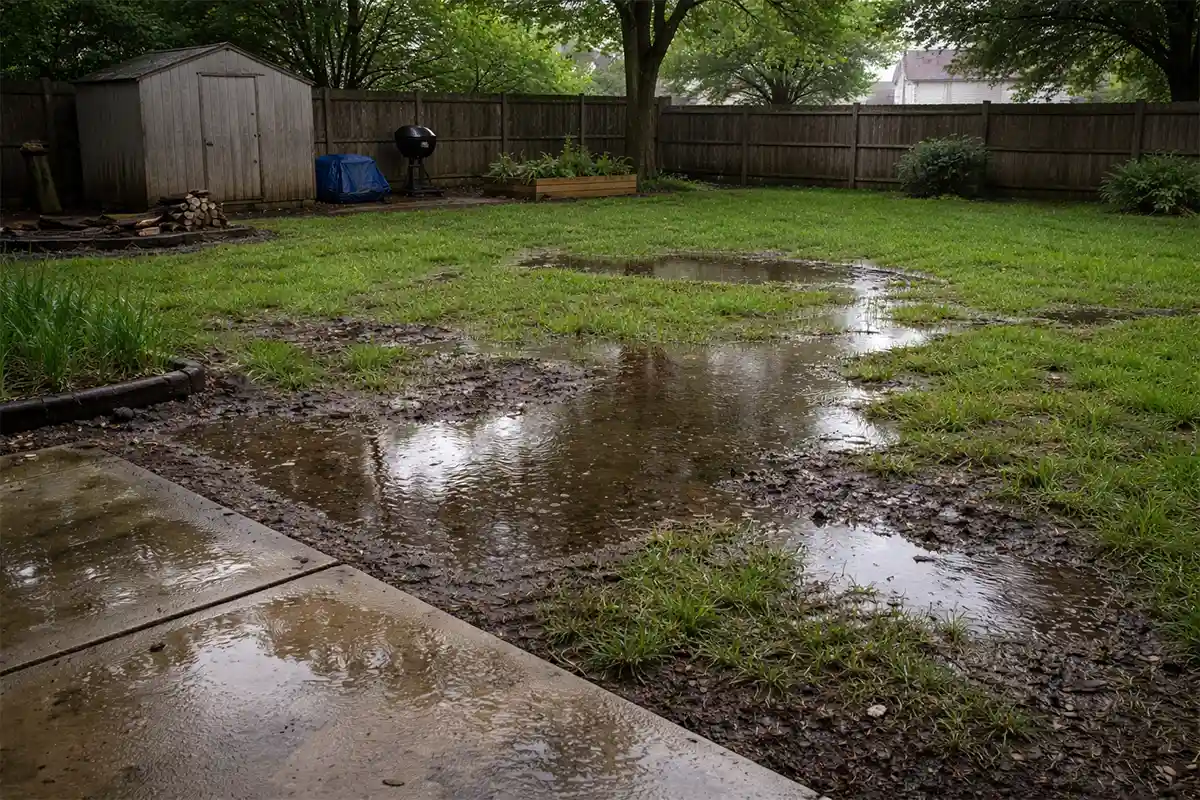
After a major storm, the backyard may look calm, but small physical cues tell a different story. Along the outer 12 to 18 inches of the patio edge, the soil can appear darker and slightly sunken, with shallow puddles forming in dips less than half an inch deep. Those details often reveal more about ground stability than the total rainfall reported on a weather app.
When soil becomes saturated, water fills the tiny air spaces between particles and reduces internal friction. That friction is what normally allows the ground to support weight. If you step near the slab edge and feel a slight give under your shoe, the soil is temporarily carrying less load than it did before the storm, even if the concrete still looks level along the window line.
Many homeowners assume that no cracks mean no problem, but subsurface movement can begin while the surface remains flat. A slab may appear straight, yet one corner can shift by a quarter inch after repeated storms without full drying time. Subtle signs—a wobbling chair leg, a stepping stone tilting slightly, or runoff forming a new 1-inch-wide channel toward the driveway—often signal that soil moisture has exceeded optimal compaction and load distribution has become uneven.
Saturation Changes How Soil Carries Weight
When the ground absorbs prolonged rainfall, the top few inches may look firm while deeper layers soften. If you press a screwdriver into the soil beside the slab and it slides in more easily than before, that resistance loss reflects reduced shear strength. Weight from the slab, furniture, or foot traffic now concentrates in fewer stable zones.
Clay soils often expand during saturation and hold water longer. Sandy soils drain faster but can shift more quickly if runoff moves through them at an angle. In both cases, once water occupies the pore space, the soil’s ability to resist compression drops. The result may show up as a slight slope change across a four-foot section of patio.
The longer the soil remains wet, the greater the risk of uneven settlement. It is not only about inches of rainfall. It is about how many hours or days the base stays saturated.
Subsurface Movement Does Not Always Mirror Surface Damage
Visible cracking is often treated as the starting point of a problem, but movement beneath the surface can happen first. You might notice a hairline gap forming between the patio and the adjacent soil bed. That separation, even if only a quarter inch wide, can signal that the supporting layer has shifted.
Load redistribution begins quietly. If one section softens, nearby areas take on more stress. Over time, that imbalance may change how rainwater flows across the surface, creating new pooling spots that were not there before.
Ignoring these early signs allows minor shifts to compound. The surface may still look aligned with the siding of the house, yet the support beneath it is no longer uniform.
Water Pathways Redirect Structural Pressure
Rain does not soak in evenly across a yard. It follows slope, compacted paths, and low spots. If runoff repeatedly moves toward a driveway edge or the corner of a patio, that section will experience more frequent saturation than the rest.
Over multiple storms, this uneven moisture exposure leads to differential settlement. One side may remain firm while the other drops slightly, changing the angle of the surface by a few degrees. Even that small change can alter future water direction, reinforcing the weak zone.
Understanding where water travels across your property helps explain why instability often appears in predictable places rather than at random.
Why Loose Aggregate Areas React Faster
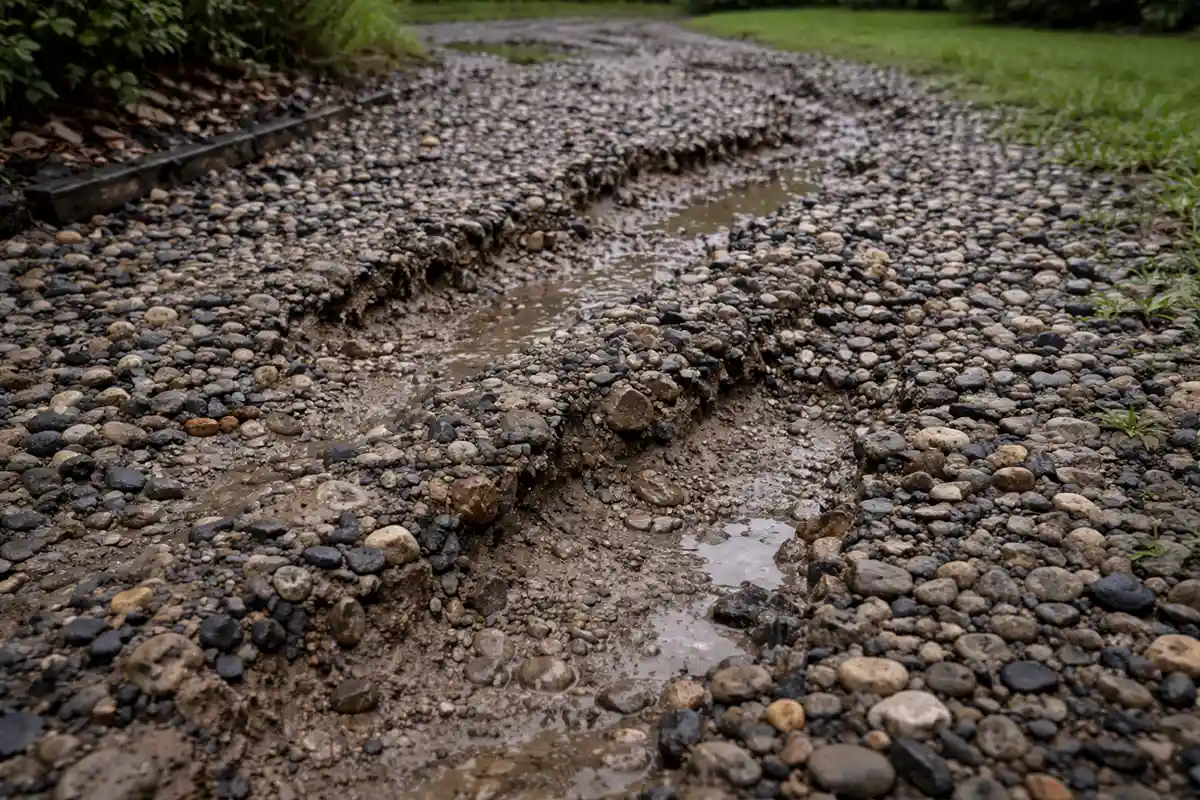
Gravel paths and loose stone driveways respond more quickly to heavy rain because their structure depends on tight particle interlock. When water flows through the surface, it can wash fine material downward, leaving small ruts that are only an inch deep but structurally important.
Repeated storms loosen the base layer under the visible stones. The surface may look intact from a distance, yet walking across it reveals uneven resistance from one step to the next. This early change often appears before larger depressions form.
A detailed breakdown of how this progression unfolds is explained in Why Loose Stone and Aggregate Surfaces Start Failing, where the relationship between moisture intrusion and base erosion is examined step by step.
By the time wheel tracks or footpaths begin sinking more than an inch, the support layer beneath has already changed significantly.
Repeated Storm Cycles Compound Instability
One intense rainfall may soften soil temporarily. Several storms within a short period create cumulative stress. Each cycle interrupts the soil’s recovery and leaves it slightly less dense than before.
In colder climates, water trapped in the top few inches can freeze and expand. That expansion widens tiny voids under slabs and along driveway edges. When thawing occurs, those voids remain, increasing the chance of uneven settlement.
Even in warmer regions, alternating wet and dry phases can cause minor expansion and contraction. Over months, these small movements add up, shifting elevation enough to affect drainage direction.
Early Indicators That Should Not Be Ignored
⚠️ Persistent damp strips along a patio edge, slight soil separation from a slab, or new pooling within a three-foot radius are early warning signs. A fence post leaning a few degrees after repeated storms may reflect soil softening below grade.
These indicators are easy to dismiss because they seem minor. Yet they often represent the first stage of broader instability.
Ground movement after major rainfall rarely starts with dramatic collapse. It begins with small, measurable shifts that alter how the surface interacts with water and weight.
Drainage Design Determines Long-Term Stability
Many homeowners respond to soft ground by adding more gravel or packing soil against the patio edge. On the surface, this looks like progress. The low spot along the driveway edge disappears, and the water seems to spread out instead of pooling in a 2-foot circle. But this common fix often fails because it treats height, not movement.
When soil has already shifted below grade, simply raising the top layer does not restore strength. The added material sits on top of a weakened base, much like placing a book over a soft cushion. After the next heavy rain, the new layer sinks into the same area, and the slope returns to its previous angle.
A widespread belief is that more material always equals more stability. In reality, stability depends on compaction and water control, not volume. Without correcting how water travels across the yard and under the slab, the added gravel becomes temporary filler.
Edge Zones Experience the Most Stress
The first visible changes often appear within the outer 12 inches of a slab or walkway. You may notice a slight gap forming between the concrete and the surrounding soil bed. That separation, even if only a quarter inch wide, signals that the perimeter is moving differently than the center.
Edges are more exposed to runoff from roofs and siding. Water traveling down a downspout can strike the ground at a steep angle and soak the same 3-foot section repeatedly. Over time, this repeated saturation weakens the outer band of support.
As that outer zone softens, pressure shifts inward. The slab may tilt by a fraction of a degree, enough to redirect rain toward one corner. This shift creates a cycle where the stressed edge continues absorbing more water with each storm.
Soil Erosion Beneath Solid Surfaces
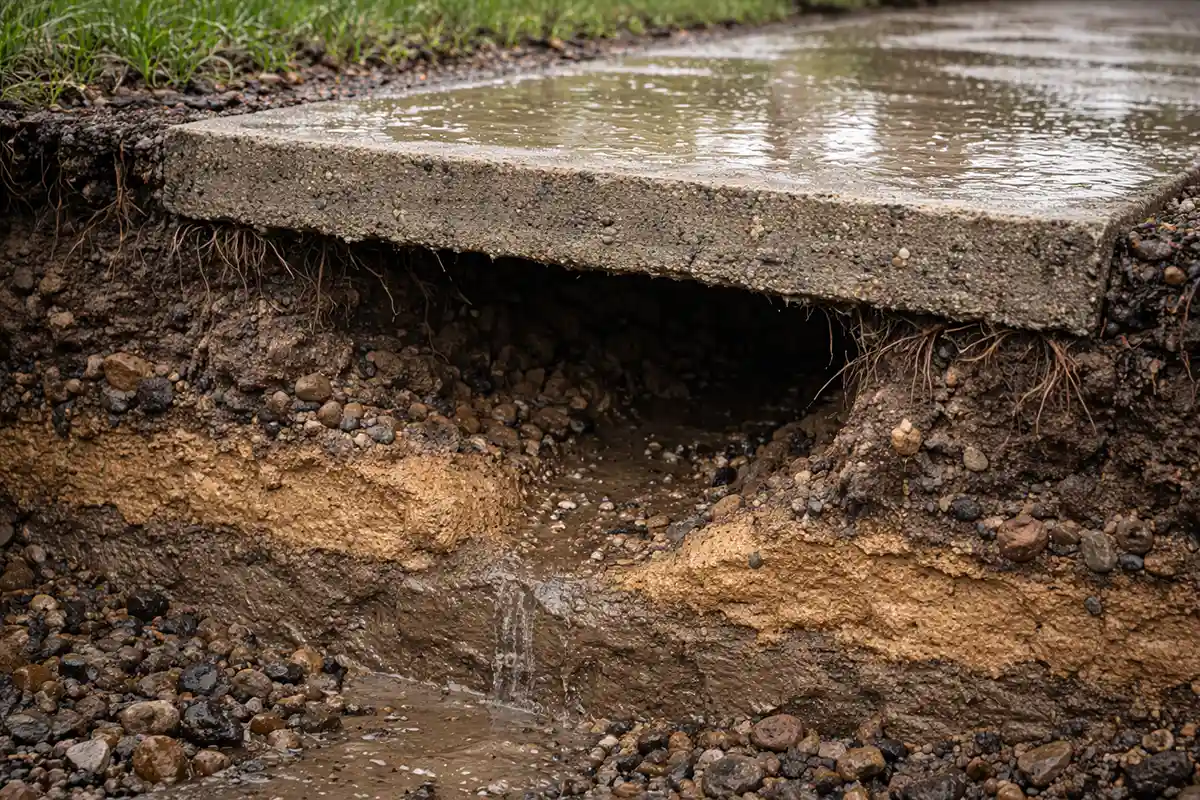
When runoff seeps beneath a slab, it can carry fine particles away from the base. This does not require a dramatic washout. Even slow movement through a small crack or edge gap can remove enough soil to create a hollow space the size of a dinner plate.
From above, the surface may remain level and aligned with the window line of the house. Below, however, a void can form 1 to 2 inches deep. When weight presses down over that area, stress concentrates along the surrounding solid zones.
Over time, these unsupported pockets increase the chance of cracking or corner settlement. The damage appears sudden, but the erosion process may have been active for months.
Compaction Quality Influences Rain Response
Ground that was not compacted evenly during installation behaves differently under heavy rain. If the base layer was placed in thick lifts instead of compacted in thinner 4- to 6-inch layers, density may vary across the surface. One side of the driveway might resist pressure, while another compresses slightly under the same load.
You may feel this difference when walking from one end of a patio to the other. One section feels firm under your heel. Another feels faintly cushioned after a storm. That variation often traces back to compaction quality.
Rain magnifies these differences. Water fills the looser zones more easily, lowering their strength further. The result is uneven settlement that mirrors the original inconsistencies in the base.
Surface Damage vs. Structural Weakness
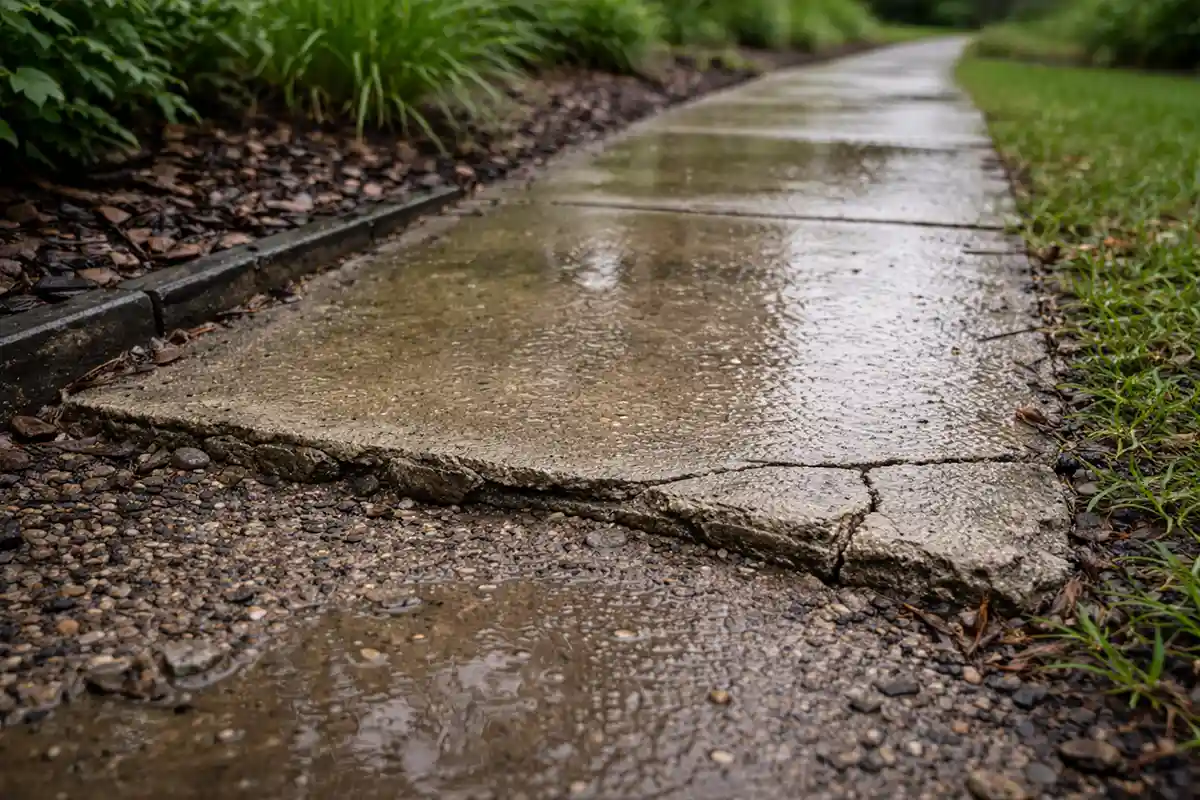
When a crack appears along the driveway edge, many people assume sealing it will stop the problem. Sealing may block visible water entry, but it does not restore support beneath the slab. If the soil has already shifted by half an inch, the structural imbalance remains.
A chipped corner or widening joint is often the result of movement below, not above. Repairing the surface alone is like repainting siding without addressing the leaning wall behind it. The appearance improves, but the underlying stress continues.
A broader framework for distinguishing between cosmetic and structural failure is outlined in Best Solutions for Breaking and Chipping Outdoor Surfaces, where solution paths are matched to the severity of underlying instability.
Layered Solutions That Actually Change Behavior
The first layer is placement correction. The goal is simple: restore proper slope so water moves away from the structure at about a quarter inch per foot. When that angle is corrected, the patio surface no longer flattens toward one edge. Rain stops collecting in the same 18-inch strip, and runoff follows a steady downhill path instead of stalling near the slab.
The second layer focuses on flow direction. Downspouts should discharge at least 4 to 6 feet away from the foundation so water does not strike the same 2-foot zone over and over. Changing that impact point spreads moisture across a wider yard area. The dark, damp patch along the siding begins to shrink because the soil is no longer being overloaded in one spot.
The third layer is entry plane balancing. This means making sure the driveway, walkway, and lawn meet at consistent height and density. Re-compacting a 2-foot border zone can eliminate small elevation differences that cause load to concentrate along one edge. Once the base becomes uniform, furniture legs stop rocking and subtle tilt along the slab edge often disappears.
If the surface is patched without correcting slope or redirecting water, the pattern returns. The same low spot reforms within inches of its previous location after the next heavy rain. Stabilization works only when slope, flow, and base support are corrected together so pooling, tilt, and separation stop repeating.
Moisture Residue Alters Surface Friction
After the rain stops and the surface looks dry, a thin moisture layer often remains inside the top fraction of an inch of concrete or stone. You may not see it, but you can feel it when your shoe slides slightly across a patio slab that sits level with the back door threshold. The surface appears firm and aligned with the siding, yet traction feels different.
Many homeowners believe that once standing water disappears, slip risk disappears with it. That is incorrect. Porous materials can hold moisture below the visible layer, especially along a driveway edge or a shaded 3-foot strip near the house wall. That hidden dampness reduces friction and makes the surface react differently under weight.
This is why a patio can feel stable in the center but slightly slick near the outer 12 inches where runoff repeatedly flows. A closer look at this friction shift is explored in Slippery Surfaces After Rain: Why They Feel Dangerous Even When They Look Dry, where the link between moisture retention and surface behavior is explained in practical terms.
Load Redistribution After Saturation
When soil beneath a slab softens by even half an inch in one corner, the load above does not disappear. It shifts. Weight moves toward firmer sections, often toward the center or the opposite edge. You might notice that a patio table leans slightly toward one side even though the slab still appears mostly level to the eye.
This redistribution increases stress in specific zones. A driveway section that used to carry even tire pressure across its width may now concentrate more force along a 2-foot band. Over time, that repeated pressure deepens the imbalance.
Some assume that if the slab has not cracked yet, the structure is still safe. That belief overlooks the fact that stress can build gradually along internal planes before visible damage forms. By the time a crack appears, the pressure pattern has already been active for multiple storm cycles.
If the surface looks level but objects shift or tilt after storms, the problem is structural, not cosmetic.
Drainage Corrections vs. Structural Reinforcement
If water pools within 2 feet of the slab after storms, the problem is drainage direction. If a corner settles more than half an inch over a season, the base has weakened. If cracks reopen in the same spot after patching, support below is still uneven. Each sign points to a specific layer of correction.
A stable system shows a clear quarter-inch-per-foot slope away from the patio, and downspouts discharge at least 5 feet from the foundation. Water no longer gathers in a 2-foot circle near the slab. Reinforcing the base restores full contact where erosion created a void, eliminating the hollow space beneath a 1-foot section.
If only the surface is sealed, the pattern returns. Rain follows the same low path, soil softens along the same 18-inch strip, and small gaps widen from a quarter inch toward half an inch as the weak zone spreads.
Visual Stability Snapshot
Picture the patio from the side. The slab edge sits flush and even with the surrounding soil, with no visible gap along the 10-foot span. Water from a hose flows away in a steady sheet, traveling downhill without pooling within the first 3 feet. Furniture legs rest flat, with all four points touching evenly. The surface, slope, and soil contact are aligned and predictable.
Safety Implications of Subtle Ground Movement
⚠️ Even a small height difference of three-quarters of an inch can create a tripping edge where the driveway meets the walkway. After heavy rain, that raised lip may also direct runoff sideways instead of forward, increasing pooling along the siding.
In colder climates, water trapped in shallow depressions can freeze overnight. That thin ice layer forms exactly where soil had previously softened. In warmer regions, slight settlement can cause gates to drag or fence posts to lean a few degrees off vertical.
Ignoring these small changes allows risk to grow gradually. The surface does not need to collapse to become unsafe. It only needs to behave differently under normal use.
Long-Term Monitoring After Major Rainfall
A stable system does not change direction after every storm. Water follows the same predictable slope. The patio edge remains aligned with the base of the siding. Soil stays firm within the top inch even a day after heavy rainfall.
Monitoring means watching for repetition. If pooling reappears in the same 2-foot circle or if a previously level section begins tilting again, the system is signaling imbalance. Consistency in drainage and support is the true indicator of stability.
According to Federal Emergency Management Agency (FEMA), prolonged soil saturation reduces load-bearing capacity in residential settings.