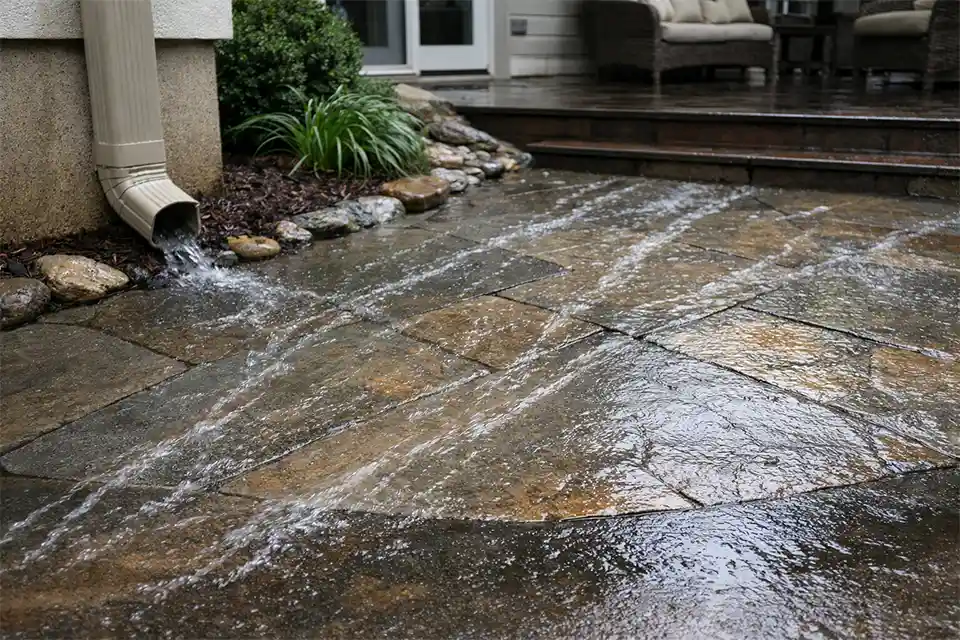
A sloped patio can feel unsafe after rain even when there is no obvious puddling. That is what throws people off. The surface may look only damp, or in some cases nearly dry, yet footing still feels uncertain. Usually that is not because rain simply landed on the patio. It is because runoff kept moving across it, carrying fine debris, extending dry time in the wrong areas, and gradually reducing traction where people actually walk.
That distinction matters. A wet patio is not automatically a dangerous patio. A patio with uncontrolled runoff often is.
On a slope, water does not just sit. It accelerates, finds repeat paths, concentrates at low points, and leaves behind a thin layer of silt, organic residue, or biofilm-supporting moisture. Over time, even a surface with decent texture can become slick in narrow bands or at the lower third of the patio. People often blame the material first—stone, concrete, pavers, tile—but the more important question is where the water is coming from and what happens after it hits the surface.
Quick Solution Summary
If rainwater runoff is making a sloped patio slippery, the most effective fix is usually to stop water from crossing the walking surface in the first place. That often means extending downspouts, adjusting surrounding grade by roughly 2% to 5%, intercepting runoff with a channel drain, or correcting irrigation and planter overflow that keeps the patio damp too long. After that, the surface should be cleaned to remove embedded residue, and only then should you consider a traction treatment or slip-resistant additive.
This order is important. Cleaning alone often helps for a week or two, then the slick zone returns after the next storm. A traction coating may improve grip temporarily, but it will not hold up well if runoff keeps washing sediment and moisture over the same path. The patio has to stop acting like part of the drainage system before the surface fix can last.
Why Sloped Patios Become Slippery Faster Than They Look
The hazard usually develops before the patio looks obviously dirty or damaged. That is one reason people underestimate it.
Runoff on a slope creates a repeating pattern. Water travels along the same route, especially on grades around 2% to 6%, and those repeat paths slowly change how the surface behaves. Fine particles settle out near the lower edge. Moisture remains longer in textured pockets and joints. Organic residue starts feeding algae or biofilm in climates where humidity stays elevated. In other cases, runoff polishes the very areas that see the most foot traffic.
The result is a patio that may not show standing water at all but still feels slick under shoes. That is closely related to why slippery surfaces after rain can feel dangerous even when they look dry. Visual dryness is not the same as restored traction.
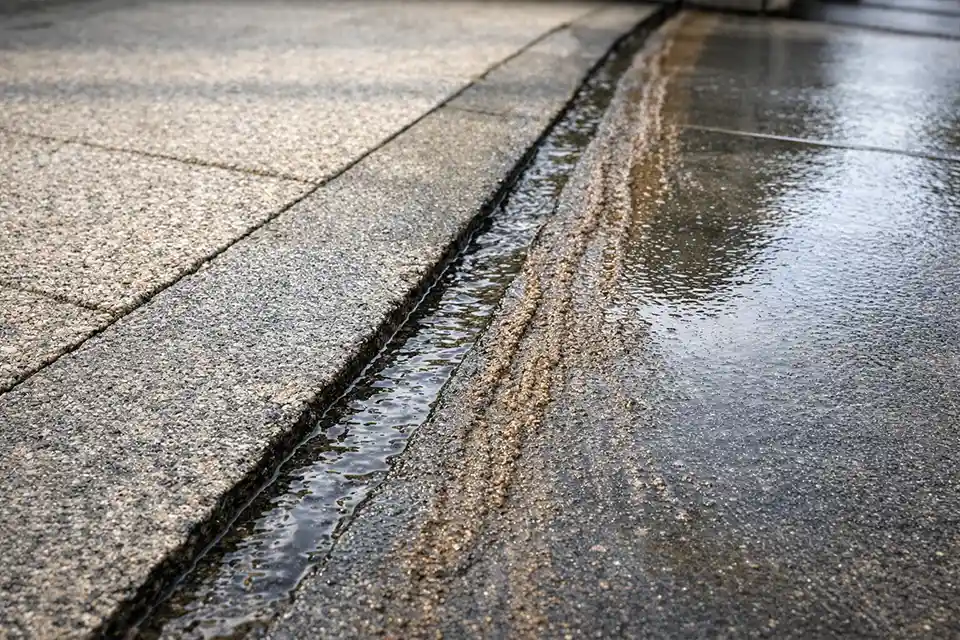
On dense concrete or smooth-finished stone, the problem often shows up as a darkened or slightly glossy lane. On pavers, it may show up first in the joints or near the edge where discharge slows down. On textured surfaces, the danger is more deceptive because the patio still looks rough enough to grip well. But texture filled with residue does not behave like clean texture.
Quick Diagnostic Checklist
-
Does water from a downspout, planter, hill, or lawn cross the patio during rain?
-
Is the slickest area usually in the same strip or near the bottom edge?
-
Does part of the patio stay dark or damp for more than 6 to 12 hours after rainfall?
-
Do you see fine sediment, green film, or joint discoloration returning quickly after cleaning?
-
Is the patio more slippery in shaded areas or near transition points like steps and doorways?
-
Do shoes lose grip even when puddles are not visible?
If several of those signs line up, the core problem is probably runoff behavior rather than simple surface wetness.
The Runoff Sources Homeowners Miss Most Often
The patio itself is often blamed first, but the water path usually starts elsewhere. That is where diagnosis gets more useful.
| Runoff Source | Signal You’ll Notice | Best Action |
|---|---|---|
| Downspout discharge near patio | Narrow water path, repeated slick band | Extend or reroute discharge |
| Higher yard grade above patio | Sheet flow during storms | Regrade soil or add interception drain |
| Irrigation overspray | Morning dampness even without rain | Adjust arc, timing, and spray direction |
| Planter or bed overflow | Soil wash, edge staining, gritty residue | Improve planter drainage and edging |
| Low patio exit point | Damp lower edge, residue accumulation | Correct discharge path or add drain |
| Smooth sealed finish | Surface looks clean but feels slick | Add traction only after water fix |
A lot of patios become slippery because they are functioning as runoff receivers. The water may be coming off the roof, off an adjacent lawn, out of a planting bed, or from a subtle grade shift that was easy to ignore during dry weather. That is why water runoff damaging outdoor surfaces is not just a durability issue. It often shows up first as a safety issue.
What People Usually Misread First
The first mistake is assuming the patio is slippery because it is made from the wrong material. Material matters, but it is rarely the whole story. A moderately textured patio can still become hazardous if runoff keeps laying down fine contaminants and slowing dry time in the same places.
The second mistake is trusting a temporary improvement too quickly. Pressure washing often makes the patio feel better, and sometimes dramatically so. But when the same strip becomes slick again after one or two storms, that is a clue the root cause was never removed. The repeat pattern is the giveaway.
The third mistake is focusing only on visible algae. In humid parts of Florida, green growth may be obvious. In Arizona, the patio may look cleaner, but windblown dust mixed with brief runoff can create a thin muddy film that behaves almost like lubricant underfoot. In colder northern states, water may work into joints and low spots, then leave roughness differences and residue bands after freeze-thaw cycles. Different climates change the appearance of the problem more than the logic behind it.
Pro Tip: If you want to understand the runoff path clearly, inspect the patio the morning after a storm instead of during the heaviest rainfall. The sections that stay dark longest often reveal the real drainage problem more clearly than the water you see in motion.
Why the Obvious Fix Often Disappoints
This is where many patio owners lose time and money. The obvious fix is usually surface-first: cleaner, sealer, traction additive, or anti-slip coating. Those measures can help, but they underperform when the runoff route is still active.
A sealer applied over a patio that continues receiving sheet flow from uphill grade tends to wear unevenly. A traction additive may improve grip at first, but sediment and organic residue can still fill in the surface profile. An aggressive cleaning routine may remove the slick film, yet it does nothing to stop repeated moisture loading. The patio looks improved, but the operating condition has not changed.
I would be especially cautious when the slippery section sits near grill areas, steps, seating zones, or kitchen transitions. Those are the places where runoff risk and everyday foot traffic overlap. Once residue is compressed into the walking path, the patio can feel unsafe before it looks neglected.
This is also why poor drainage on outdoor walkways can lead to safety problems and long-term deterioration instead of remaining a simple cleaning concern. The visible slickness may be the first warning, not the full problem.
How to Fix the Problem in the Right Order
A lasting fix usually requires sequence, not just effort.
Intercept the water upstream
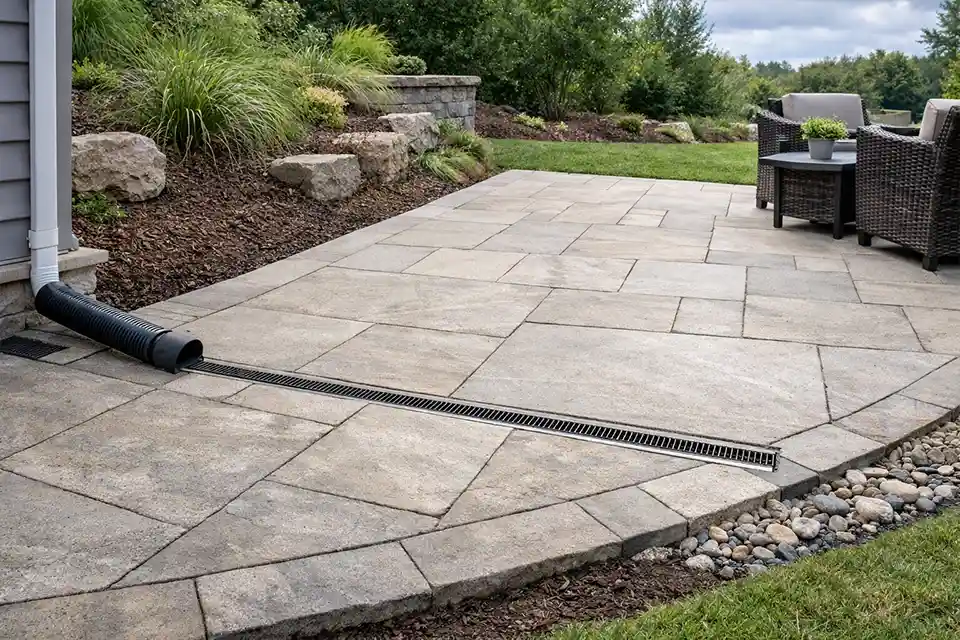
Start with whatever is feeding the runoff. If roof water discharges too close to the patio, extend the downspout farther away. If the yard or bed above the patio pitches toward it, correct the grade or add a swale or linear drain to catch water before it spreads over the walking surface. Even a modest change in flow direction can reduce how often the patio stays slick.
Make sure the patio can discharge water cleanly
Some patios slope properly away from the house but still trap runoff at the lower edge because the exit area settled, the border was built too high, or adjacent soil compacted over time. When that happens, water leaves the main field of the patio but has nowhere efficient to go. The surface then stays damp longer than it should.
That wider site pattern often overlaps with yard drainage problems and uneven outdoor surfaces because runoff that is not released properly tends to keep disturbing surrounding ground.
Remove the residue that changed the traction
Once water movement is improved, clean the surface thoroughly. Organic growth may need a patio-safe treatment designed for algae or biofilm. Fine silt and gritty deposits often need brushing plus repeated rinsing. Pressure washing can help, but it should be used carefully around joints and edges so the cleaning process does not create new drainage or settlement problems.
Add traction only if the surface still needs it
If the patio material is naturally smooth or has been sealed in a way that reduces grip, a compatible slip-resistant treatment may be worth adding after drainage issues are corrected. This step works better as a finishing adjustment than as a first response.
Surface Appearance and Real Mechanism Are Not the Same
One of the most misleading parts of this problem is how ordinary it can look.
| What You See | What It Often Means | What to Do |
|---|---|---|
| Dark damp strip after rain | Slow drying caused by runoff concentration | Improve drainage path |
| Slight green or brown haze | Organic growth supported by repeat moisture | Clean and reduce moisture source |
| Smooth glossy lane | Surface polishing plus contamination | Restore traction after runoff fix |
| Damp joints between pavers | Water being retained below or between units | Check joint condition and drainage |
| “Dry” patio that still feels slick | Thin residue film lowering friction | Deep clean and trace runoff source |
That difference between appearance and mechanism is exactly why wet outdoor surfaces and slip risk can be misunderstood. The patio does not have to look dramatically wet to have a friction problem.
How Climate Changes the Way the Problem Shows Up
The same runoff issue behaves differently depending on region.
In Florida, warm humid conditions make it easier for algae and biofilm to return quickly on patios that stay damp after storms. In California’s coastal areas, marine moisture and shade can slow evaporation enough to keep runoff-fed sections slick longer than expected. In the Midwest, repeated storm cycles can wash fine sediment over the same slope for weeks at a time. In northern states, freezing winters can turn runoff-prone joints and edges into more complicated durability concerns as moisture penetrates, freezes, and expands.
What changes is the visible symptom. What usually does not change is the sequence: water crosses the surface, dry time lengthens, residue accumulates, and traction drops.
Pro Tip: If only one section of the patio becomes slippery after every storm, do not assume that section is defective. In many cases, it is simply where the runoff slows down enough to leave behind what the upper portion carried.
When the Slip Problem Is No Longer Just About Slipping
A patio that stays slick because of runoff may also be moving toward other failures. Joints can begin washing out. Edge support may weaken. Bedding layers under pavers can soften. Low points may hold moisture long enough to invite settlement, staining, or seasonal cracking.
That does not mean every slippery patio has a structural problem. But when runoff repeatedly crosses the same path, the issue has already moved beyond appearance. Safety is usually the first practical consequence people notice. Material decline may follow later.
Where moisture-fed growth is part of the pattern, algae and moss making surfaces slippery is not just about cleaning the visible growth. It is a sign that the patio is staying hospitable to slipperiness longer than it should.
For broader technical guidance on stormwater control and site drainage, the U.S. EPA green infrastructure resources provide useful background on how runoff should be managed before it becomes a recurring surface problem.
Questions That Sharpen the Diagnosis
Why is only one strip of my patio slippery after rain?
Because runoff usually follows a repeat path. That strip is often where water slows down, leaves behind residue, or keeps the surface damp the longest.
Can a textured patio still become slippery from runoff?
Yes. Texture helps only when it stays open and clean. Once fine sediment, biofilm, or organic residue starts filling that texture, traction can drop quickly.
Will sealing the patio solve the problem?
Not on its own. Some sealers help with water shedding, but others can reduce grip. If runoff is still crossing the patio, sealing alone rarely fixes the underlying cause.
When does this point to drainage failure rather than maintenance?
When the same slick area returns after repeated cleanings, stays dark for many hours after rain, or begins showing edge erosion, joint washout, or persistent low-point dampness.
Final Takeaway
Rainwater runoff makes sloped patios slippery because it changes more than moisture levels. It changes how long the surface stays damp, where residue collects, how texture performs underfoot, and where traction gradually breaks down. That is why the problem often returns after cleaning and why the most durable fix almost always starts upstream.
If the patio becomes slick in the same place after each storm, pay attention to that pattern. It usually tells you where the water path is, where the dry time is too long, and where a surface-level fix is most likely to disappoint. Correct the runoff route first, then clean, then restore traction if needed. That is the sequence most likely to hold.