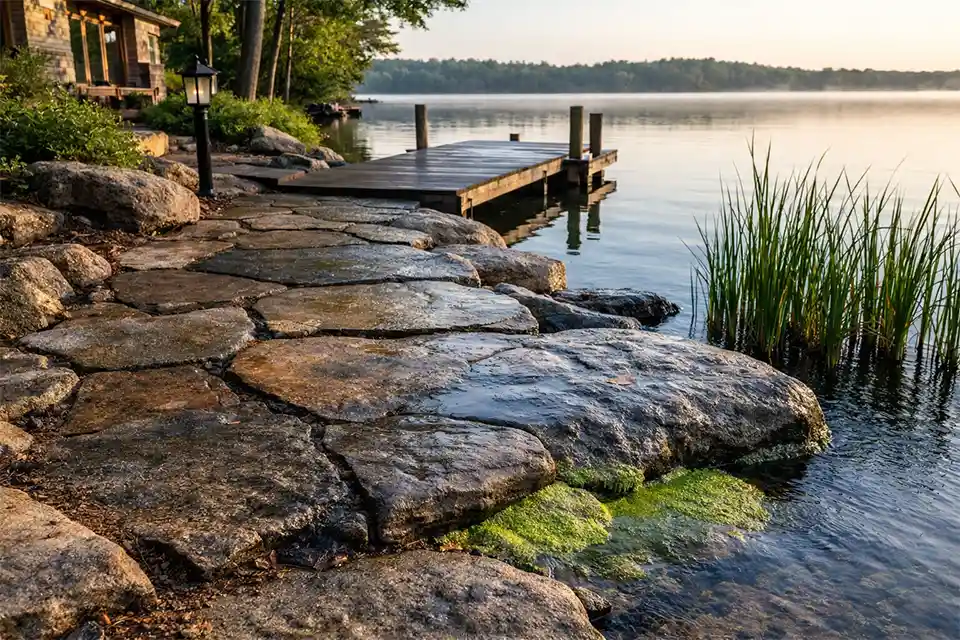
Dockside stone paths near lakes usually become slippery because they stay damp too long, not because the stone suddenly “fails.” The most common pattern is a mix of shoreline splash, slow-drying morning moisture, organic film, and a finish that loses grip once a thin water layer forms.
Start with three checks that actually separate a minor nuisance from a real safety problem: does the same section stay visibly dark more than 3 to 5 hours after dew or light splash, does slickness return within 7 to 14 days of cleaning, and are there low spots holding about 1/8 inch of water or more? Those signs matter more than color alone.
On a lakefront path, the wrong fix is often applied in the right order. People clean first, then keep cleaning harder, when the real issue is that one section keeps drying slower than the rest.
If the path gets fewer than 4 hours of direct sun, sits in the dock approach zone, or stays slick in one repeat traffic lane, treat it as a moisture-management problem first.
Clean it to expose the pattern, correct the water path, then decide whether the stone needs a traction upgrade or replacement.
The right fix depends on what the stone is doing
The biggest mistake here is treating every slippery dockside path as the same problem. It usually falls into one of three buckets: fast-return slime, slow drying, or a surface finish that is simply too smooth for a lakeside setting.
If it gets slimy again fast
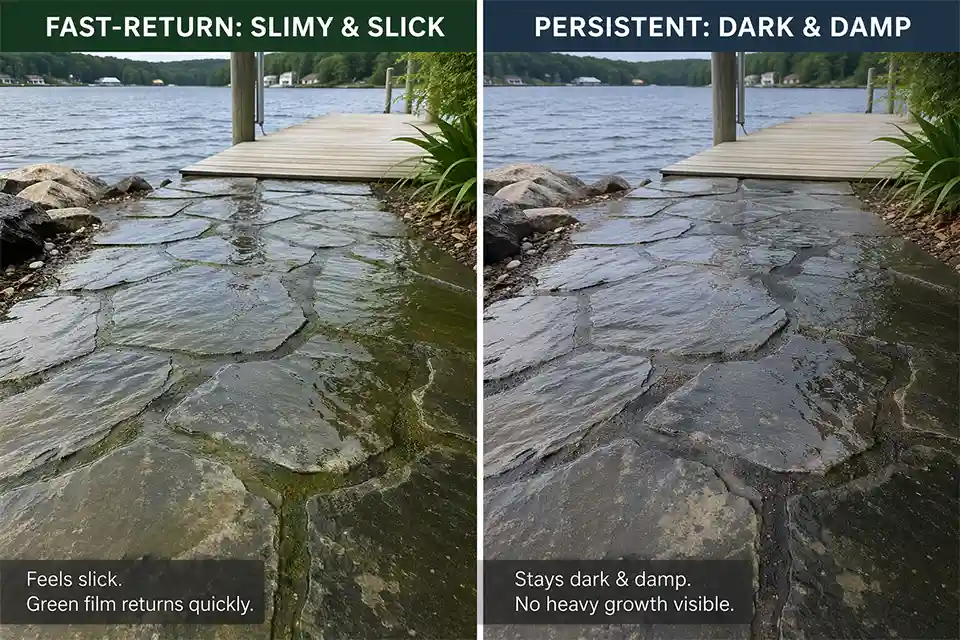
If the path feels better right after cleaning but starts getting slick again in under 2 weeks, the main issue is usually organic film rebuilding on a moisture-fed surface. That is common where wet feet, fishing gear, leaf residue, and shoreline humidity all keep feeding contamination into the same walking line.
In that situation, cleaning is still useful, but only as a reset. If recurrence is fast, the important question is not how strong the cleaner is. It is why the surface keeps staying favorable to film growth. A similar repeat pattern shows up in stone pathways that stay slick in constant shade under tall trees, where biology is the symptom and moisture is the enabler.
If one section stays dark and damp
If a strip near the dock edge or transition point remains darker than the rest by late morning, the path is holding moisture too long. That usually points to low pitch, shallow settlement, splash concentration, or runoff crossing the surface in the wrong direction. Even a 1% to 2% slope problem can be enough to keep water drifting toward the walking line instead of off it.
This is the issue homeowners often underestimate. They see only a slightly darker section and assume it is cosmetic, but if that same section dries twice as slowly as the surrounding stone, it is usually the real hazard zone. Slippery outdoor walkways with poor drainage tend to stay slippery for this reason, not because the entire material is inherently unsafe.
If it still feels slick after drainage is improved
This is where the diagnosis changes. Once the path sheds water better and no longer stays dark for hours, but still feels marginal when lightly wet, the finish itself may be the limiting factor. Dense natural stone, smoother-cut pieces, and some sealed surfaces can all lose wet traction too easily in a lake environment.
That is when surface finish traction problems outdoors becomes the more relevant model. The problem has shifted from moisture retention to surface performance.
What people usually misread
They overestimate visible moss
Moss gets blamed because it is easy to see. But on many dockside paths, the more dangerous layer is thinner and less obvious: a nearly invisible film in the main walking lane. That is why a path can look only mildly discolored and still feel risky under wet sandals or smooth-soled dock shoes.
They underestimate how little standing water it takes
You do not need obvious puddles for a real slip problem. A shallow low spot holding only 1/8 inch of water, or joints that stay damp 3 to 4 hours longer than the stone surface beside them, can rebuild the same hazard cycle over and over. Near a lake, that small moisture difference matters much more than people expect.
They assume every sealer helps
Sometimes it does. Sometimes it makes the path noticeably worse. A film-forming sealer on already smooth stone can reduce wet traction rather than improve it. If the path felt slicker right after sealing, do not treat that as a coincidence.
It may be a direct contributor. That is the same logic behind sealed stone patios that become slippery after sealing, even though a dockside setting usually amplifies the problem with repeated moisture cycling.
Fix sequence that actually works
Step 1: Clean to reveal the pattern
Remove biofilm, algae residue, leaf tannins, sunscreen residue, and grime thoroughly enough to reset the surface. Then give the path 24 to 48 hours of ordinary weather. The goal is not to admire a cleaner path. The goal is to see whether the same strip still dries slower, darkens sooner, or feels slicker under normal use.
Pro Tip: Test the path with the same wet footwear normally used at the lake. A surface that feels acceptable in deep athletic tread can still be unsafe in boat shoes or flip-flops.
Step 2: Fix the water path before buying more traction
This is the highest-value move on most lakefront stone paths. Look for reverse pitch, shallow settlement at the dock transition, runoff entering from planting beds or upper hardscape, clogged joints, and splash concentration where people step on and off the dock.
A useful field target is simple: after a light wetting event, the path should not hold visible wet pockets for hours, and the dock approach zone should not behave noticeably differently from the rest of the path. If the worst section keeps acting like its own microclimate, the fix is still incomplete.
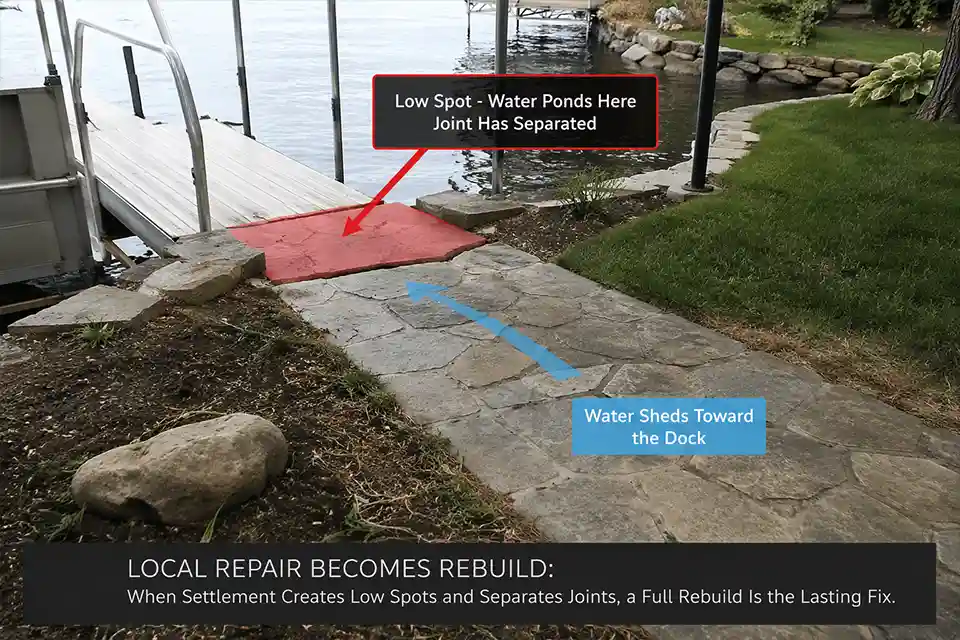
If the stones are shifting, rocking, or separating, the problem is no longer only about slip resistance. Movement keeps recreating tiny low spots and wet joints. In that case, walkway stones breaking from a weak base becomes the more important repair path than any traction product.
Step 3: Use the least aggressive traction upgrade that can change the outcome
Once drainage and drying improve, decide whether the finish still belongs in that location. This is where a lot of wasted spending happens. People either over-treat a path that only needed moisture correction or under-treat a surface that was always too smooth for lakefront use.
The practical order is usually:
- Micro-etch or penetrating anti-slip treatment when the stone is sound but only marginal under light moisture
- Grit-bearing coating or textured overlay when a specific dock approach zone needs more obvious grip and appearance is secondary to safety
- Selective stone replacement when the finish is fundamentally too smooth across the main walking line
- Partial reset or rebuild when traction complaints are tied to movement, low spots, or failing bedding
What people usually overestimate here is maintenance. What they underestimate is “wrong finish for the setting.” If the path still feels slick after moisture behavior is improved, more scrubbing is rarely the answer.
Comparison guide: what to fix first
| What you see | Most likely mechanism | Best first fix | When to escalate |
|---|---|---|---|
| Slickness returns in under 2 weeks | Organic film rebuilding on a damp surface | Deep cleaning, then track recurrence | If same zone re-slimes quickly, fix moisture source |
| One section stays dark for 3–5+ hours | Low spot, poor pitch, splash concentration | Regrade, reset, or improve drainage path | If drying pattern stays uneven after correction |
| Whole path feels slick when lightly wet | Surface finish lacks wet traction | Try texturing or anti-slip treatment | If the finish still fails after moisture issues are reduced |
| Dock transition zone is worst, rest is acceptable | Local splash and concentrated traffic | Targeted traction upgrade in entry zone | If low spots or settlement are also present |
| Joints stay wet and green longest | Water trapped in bedding or joints | Improve joint drainage and edge shedding | If joint softness or movement appears |
| Stones rock, settle, or chip at edges | Base or bedding failure | Partial rebuild or reset | If multiple sections move underfoot |
When maintenance is no longer a real fix
Routine cleaning stops making sense when the path keeps reproducing the same hazard in the same place. Three boundaries matter more than broad advice.
Recurrence is too fast
If the slick feel comes back in days to two weeks, the maintenance cycle is already too short to count as a durable fix. After a proper repair, the path should not need aggressive re-cleaning every week during normal lake-season use.
The same wet zone survives every cleanup
If one dock approach section keeps staying dark after cleaning and after normal drying weather, the problem is no longer “dirty stone.” It is a drainage, settlement, shade, or exposure problem that has not been corrected yet.
The structure is joining the traction problem
Once you have edge chipping, rocking stone, bedding loss, or widening joints, treat slipperiness as part of a larger installation problem. In northern lake homes, freeze-thaw cycles can reopen low spots and joints even after cleaning temporarily improves traction. At that point, outdoor surfaces that are unsafe because they are slippery or uneven is the better framing, because you are no longer choosing between cleaners and coatings. You are deciding whether the installation still makes sense.
A good repair outcome is not just a cleaner-looking path. It is a path that dries faster, behaves more evenly from section to section, and stays safer under ordinary lakeside moisture without falling back into the same hazard pattern.
For broader official guidance, see the CDC’s slip, trip, and fall prevention guidance.