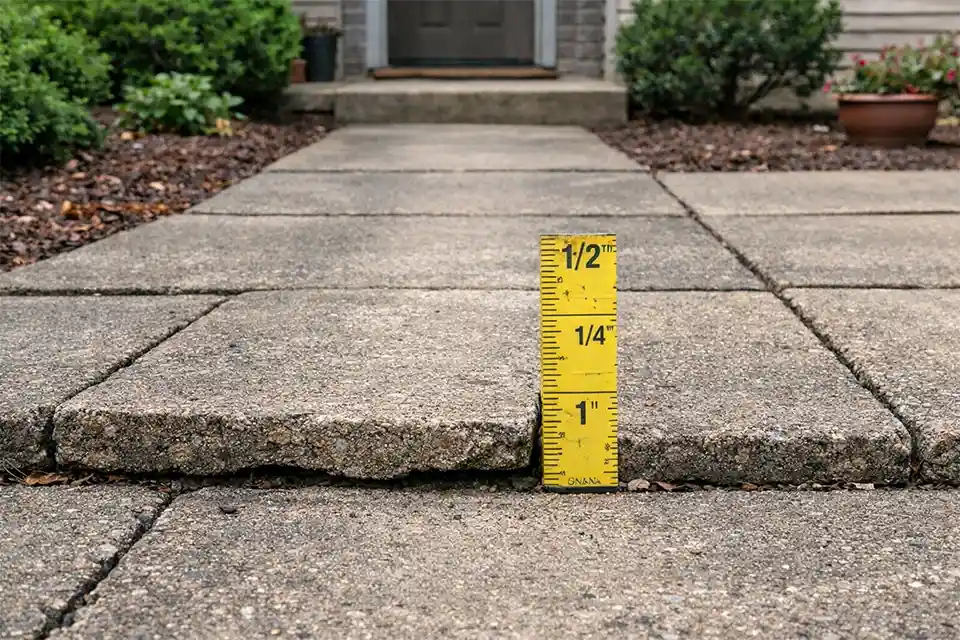
Normal wear makes a walkway look older. Hazardous damage changes how it behaves underfoot.
That is the real line to watch. Start with three checks: measure the biggest vertical offset, see whether water is still sitting there 12 to 24 hours after rain, and notice whether the surface feels firm or slightly loose when you step on it.
A walkway can be faded, lightly stained, or a little rough around the edges for 10 years and still be serviceable. But once a level change reaches about 1/4 inch, traction drops sharply when wet, or a unit starts rocking, the issue has moved beyond ordinary aging.
People usually get this backward. They overreact to discoloration and underestimate slight movement. A dark stain may be cosmetic. A 3/8-inch edge is not. The visible symptom is not the real test. The real test is whether the surface still drains, stays level, and gives predictable footing.
The point where wear becomes a hazard
Appearance is usually the wrong first clue
Color fade, mild surface dulling, softened edges, and minor joint loss are often just normal weathering. On concrete, that may mean slight aggregate exposure or hairline surface cracking that does not widen over time. On stone and pavers, it often means the traffic path looks smoother than the edges and the color is less uniform than it used to be.
None of that automatically makes a walkway unsafe. Outdoor materials age. That matters for maintenance timing, but not every old-looking path is a hazard. That is why expectations around how long outdoor surfaces last help with planning, not with deciding whether someone could trip there this week.
Height difference is one of the clearest decision lines
A walkway starts leaving the normal-wear category when the level change begins to interrupt a normal step. Around 1/4 inch, the difference may already catch shoes, stroller wheels, or the toe of someone not watching the ground closely. Around 1/2 inch, the problem is very hard to defend as merely cosmetic, especially in low light or when the surface is wet.
This is one of the most underestimated thresholds in outdoor walking areas. The defect may look small from standing height. What matters is not how dramatic it looks. What matters is whether it interrupts stride. On a walking path, 1/4 inch or more is no longer just a cosmetic detail.
Surface behavior matters more than surface age
The simplest dividing line is this: a worn walkway still behaves like a stable walkway. A hazardous one does not. If it rocks, sounds hollow, flexes slightly under a 180- to 220-pound person, or dries much slower than the surrounding area, the problem is no longer just wear.
That is especially true when the surface is slick only in the main travel line. A path may look merely aged, but if the center lane is noticeably smoother and more slippery than the protected edge after light wetting, the surface profile has changed in a way that affects safety.
Safety note
Small level changes matter more than most property owners expect. Once a walkway stops feeling flush, stable, and predictable underfoot, the issue is no longer just maintenance. It becomes a walking-safety problem, especially for guests, older adults, children, wheeled access, and anyone crossing the area in dim light or wet conditions.
A worn walkway and a hazardous one can look surprisingly similar until you compare levelness, not age.
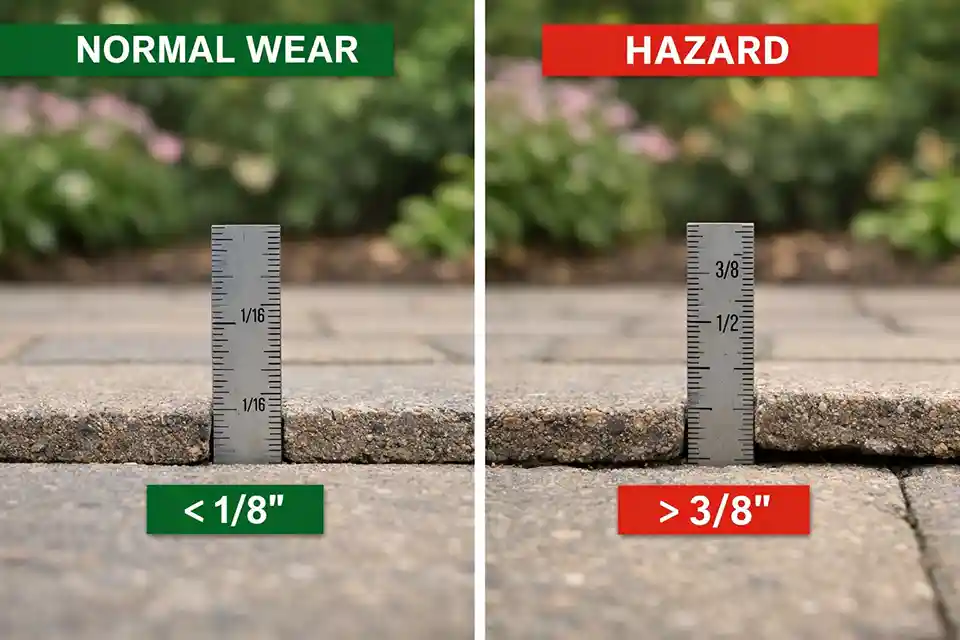
A quick field check that tells you more than looks do
Measure the biggest edge, not the ugliest spot
Find the worst vertical difference on the path and measure it. Do not start with the darkest stain or the most weathered-looking section. Start with the highest edge, the deepest settled corner, or the most obvious transition between adjacent units.
If the change is under about 1/8 inch and the surface feels stable, you are usually still in normal-wear territory. If it is around 1/4 inch or more, that is a real warning sign. If several nearby areas are near or above 3/8 inch, you are usually looking at active movement rather than harmless aging.
Check drainage the next day, not right after rain
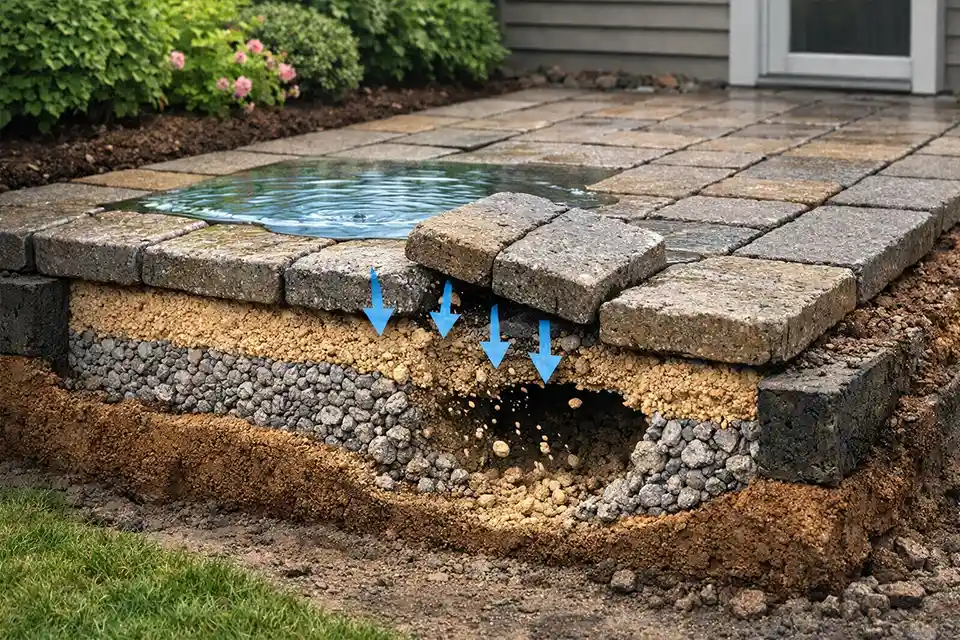
Almost every walkway looks wet during or right after a storm. The more useful check is whether water remains after 12 to 24 hours under ordinary conditions. If one section still holds water while nearby sections are dry, something is changing below or across the surface: slope, drainage path, edge support, or base condition.
Water matters because it is not just a symptom. It is often the mechanism keeping the failure active. It lowers traction, weakens bedding, carries fines out of the base, and makes repeated movement more likely. That is why weather exposure damage on outdoor surfaces becomes a much bigger deal once moisture starts changing how the walkway performs.
When water keeps returning to the same section, the problem is often below the surface, not just on it.
Compare the walking line with the protected edge
Do a simple traction check after light misting, morning dew, or irrigation overspray. The center of the path, where most foot traffic lands, should not feel noticeably slicker than the edge near a wall, curb, or planting bed. If it does, the surface may be wearing smooth or carrying a residue problem that cleaning alone may not fix.
This gets missed because the walkway can look dry in less than an hour and still be less grippy than it appears. That is part of what makes surfaces that feel dangerous after rain even when they look dry so commonly misread.
Look for visible breaks, gaps, and loose pieces
A walkway does not have to collapse to show you it is crossing into hazard territory. Broken edges, widening gaps, loose fragments, and units that no longer sit tightly together are often clearer warning signs than overall appearance. These are especially worth taking seriously if they appear near settled corners, runoff paths, or places where the walking line shifts slightly from one season to the next.
What people usually misread first
They overestimate stains, moss, and color change
Staining gets attention because it is visible from across the yard. But visible does not mean most important. Rust marks, leaf tannins, faded sealers, and dark organic staining often tell you something about moisture or maintenance, not necessarily about immediate hazard.
A walkway should not be judged unsafe because it looks old. It should be judged unsafe because it has become unstable, persistently slick, or uneven enough to alter footing.
They underestimate slight unevenness
This is the bigger mistake. A small edge that barely registers in photos can still catch shoes and wheels every day. The same goes for subtle settlement bowls that hold only about 1/4 inch of water. Those defects are easy to minimize because they do not look dramatic. They are also the ones that quietly turn into repeat problems after one more wet season or one freeze-thaw winter.
They blame age when the real problem is support loss
Most hazardous walkway damage is not simply old material. It is movement underneath or around the surface. Base washout, poor compaction, edge erosion, root pressure, or repeated runoff create more repair-relevant defects than age alone on many outdoor paths. That is why early signs of outdoor surface failure tell you more than surface age about what needs attention now.
The failure patterns worth caring about
Settlement is usually more important than cracking by itself
Cracks are easy to fixate on because they look like damage. But a thin crack without displacement may be less important than a settled section with almost no dramatic cracking at all. What matters is whether the crack maps movement. If it follows a low area, crosses multiple units in one direction, or appears together with lippage and pooling, it is no longer just a blemish.
This is where a lot of wasted repair starts. People patch or seal what is really a support problem. If the surface underneath is moving, the crack is just the messenger.
Drainage failure accelerates the shift from wear to hazard
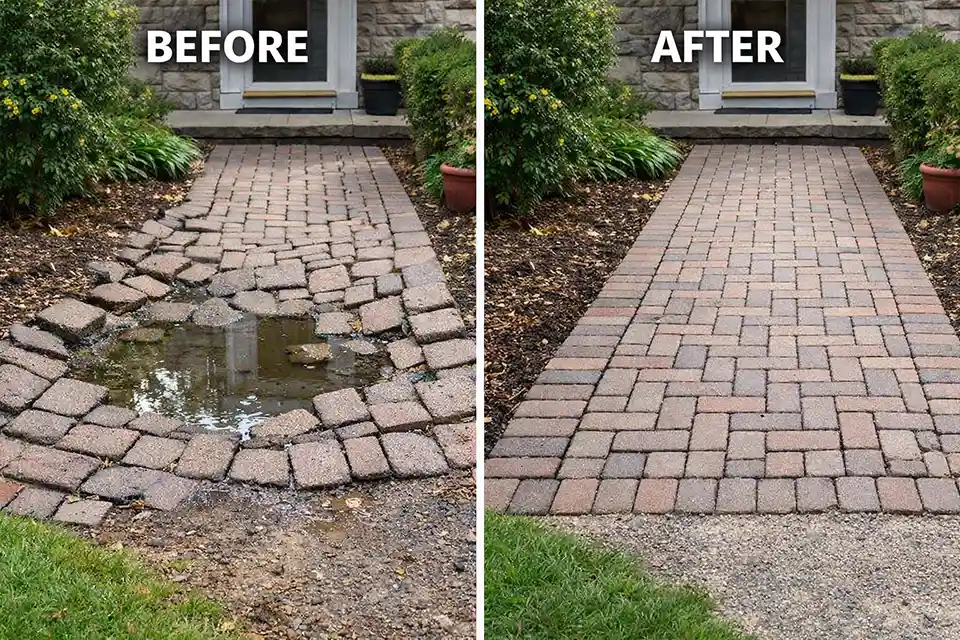
A walkway becomes more dangerous when water stops leaving it efficiently. Standing water for 12 to 24 hours is not just annoying. It often means the cross-slope is wrong, the base is softening, runoff is concentrating at one edge, or fines are being carried away.
That is why poor drainage on outdoor walkways and surface wear should not be treated as separate conversations. Water changes both traction and support reliability. People usually underestimate how quickly that changes the repair decision.
Traction loss can be the hazard even when the structure is sound
Not every dangerous surface is failing structurally. Some walkways are stable but have become slick from sealer residue, repeated polishing, algae film, or worn-down texture. That distinction matters because the fix logic is different. A stable but slick path may need cleaning correction, texture restoration, or a traction-focused remedy. A moving or settling path needs support correction first.
The mistake is assuming every slippery walkway needs a coating right away. If the area stays wet longer than surrounding zones, the moisture mechanism will keep defeating the surface fix.
Why the obvious fix often fails
Cleaning fails when the texture is gone
If the walkway has become smooth in the main travel line, pressure washing may brighten it but will not restore lost surface profile. In some cases it can make things worse by exaggerating the difference between already-worn and less-worn areas.
A good test is whether slickness returns within 1 to 3 weeks in normal weather. If it does, you probably do not have a simple dirt problem.
Grip products fail when movement is still active
Grit additives and anti-slip coatings can help on a firm, stable surface. They are a weak answer to rocking units, active settlement, chronic ponding, or edges that keep lifting. That is symptom treatment. It may feel productive, but it does not change the reason people are losing footing in the first place.
Pro Tip: If one section is both slick and slightly uneven, fix the level and moisture problem first. Traction treatments perform much worse on a path that is still moving or staying damp too long.
Spot repair fails when the failure field is broader than the visible defect
Resetting one or two pavers can make sense. Repeating that repair every few months usually does not. Once the affected area spreads beyond roughly 4 to 6 square feet, or several nearby spots show the same lippage, low spots, or rocking, the visible defect is smaller than the real failure zone.
That is where the standard quick fix stops making sense. Many owners delay at exactly this point because the damage still looks patchable. But this is often when surface problems rarely fix themselves becomes most true.
Repair priority: monitor, schedule, or fix promptly?
Monitor
Monitoring is usually enough when the walkway is flat, stable, and draining reasonably well, but looks tired. That may mean fading, mild staining, slight surface dulling, or a hairline crack that does not widen over 6 to 12 months.
Schedule repair
Schedule repair when one of the warning signs is present but the problem does not yet appear active across a larger area. Typical examples are a single edge near 1/4 inch, a localized low spot, one rocking unit, or a traction problem concentrated in one section.
Fix promptly
Prompt correction makes sense when the walkway has multiple measurable edges, rocking sections, recurring ponding into the next day, or a combination of unevenness and slickness in the same travel line. If several nearby hazards are measurable at once, professional correction is usually more sensible than repeating spot fixes. At that point the issue is no longer cosmetic maintenance. It is an active hazard response.
Once the failure extends beyond a small isolated spot, the right fix usually corrects support and drainage together, not just the visible edge.
Practical comparison guide
| Condition | Likely category | Most likely mechanism | Priority |
|---|---|---|---|
| Fading, mild staining, no movement | Normal wear | Weathering and age | Monitor |
| Hairline crack with no widening over 6-12 months | Usually normal wear | Shrinkage or surface aging | Monitor |
| Vertical offset around 1/4 inch or more | Hazard warning | Settlement, root lift, or base loss | Schedule repair |
| Water still ponding after 12-24 hours | Hazard warning | Drainage or slope failure | Schedule repair |
| Rocking paver or hollow-sounding section | Hazardous damage | Void below or base deterioration | Fix promptly |
| Slick main traffic lane, sides less slick when wet | Performance hazard | Texture loss or residue concentration | Schedule repair |
| Multiple lippage points near or above 3/8 inch | Active hazard | Broader support failure | Fix promptly |
Old-looking is not the same as unsafe
Cosmetic age is often overrated
A weathered walkway can still be dependable. People often see fading, surface dullness, and minor staining and assume replacement must be near. That is usually the wrong conclusion. If the path stays level, drains within several hours, and remains stable under load, it may need maintenance, not urgent correction.
Small performance changes are often underrated
What gets dismissed most often is the subtle shift from normal behavior to unreliable behavior. That can be a slight trip edge, a section that stays damp too long, or a unit that barely moves now but clearly did not move last season. Those are the changes that deserve attention first.
What to do today
Start with the three signals that actually decide the issue
Do not begin with appearance. Begin with offset, drainage, and stability. Those three signals tell you more in five minutes than a long inspection of stains and fading.
Treat active water as a priority problem
If the walkway holds water into the next day, that is not a detail to leave for later. It affects both slip risk and long-term support. Delay usually gets more expensive once water starts driving the problem.
Stop calling it normal wear once performance changes
Once the path starts catching feet, staying slick longer than the surrounding surface, or moving under load, the conversation is no longer about whether it still looks acceptable. Around 1/4 inch of measurable edge, next-day ponding, or rocking units should be treated as repair signals, not as cosmetic flaws to watch indefinitely.
For homeowners and property managers, a measurable walking-path edge is no longer just a wear issue once it affects stride, stability, or drainage.
For official guidance on safe, stable walking surfaces and changes in level, see the U.S. Access Board.