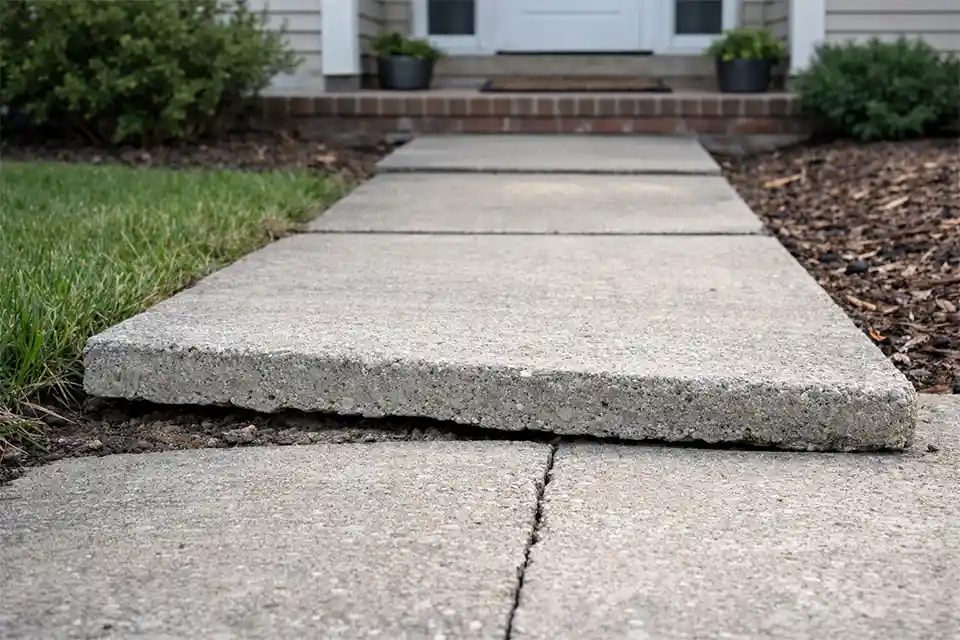
If the same slab edge lifts in wet periods, relaxes in dry weather, and keeps reappearing in the same spot, seasonal soil movement is usually a better diagnosis than surface failure.
On walkways, patios, pool decks, and driveway edges, this pattern often comes from moisture-reactive soil below or beside the surface, not from the finish material itself.
The first checks should be simple and measurable: record the vertical difference, look for irrigation or downspouts within about 3 to 10 feet, and note whether the movement changes after several weeks of rain or 2 to 8 dry weeks.
That last distinction matters. Settlement usually keeps moving in one direction. Seasonal expansion and contraction tends to cycle. If the height difference stays under about 1/4 inch and does not worsen year to year, monitoring may be enough.
Once it reaches about 1/2 inch on a walking route, it has crossed from minor nuisance into practical repair territory.
What is most likely happening under the surface
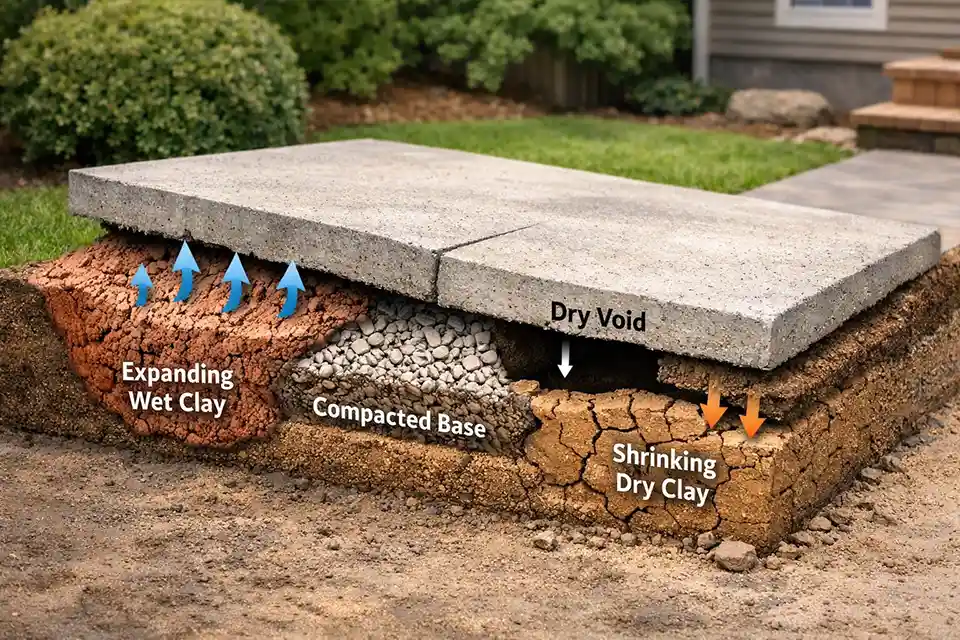
The most likely mechanism is shrink-swell behavior in clay-rich or otherwise moisture-sensitive soil. When that soil gets wetter, it expands and can push up part of the surface.
When it dries, it contracts and may leave a small void or unsupported edge behind. What you see above grade may be a lifted slab corner, a rocking paver, or a new toe-catching lip. What is actually changing is soil volume and support consistency.
Why this is usually a soil problem first
People often assume the visible surface is the failed component because that is where the symptom appears. But if the slab is still mostly intact, the pavers are not badly worn, and the distortion follows wet-dry cycles, the higher-probability cause is the ground below. Surface material failure does happen, but it usually does not keep returning in the same seasonal pattern.
That larger mechanism is part of Why Outdoor Surfaces Shift Over Time. In most cases, the surface is only showing what grading, moisture imbalance, and subgrade movement are already doing underneath.
Where this shows up first
The earliest trouble spots are usually predictable:
- walkway sections near downspouts
- patio edges beside planters or lawn irrigation
- driveway borders with mixed sun and shade
- pool deck transitions where one side stays wetter longer
- surfaces installed over disturbed fill near additions or trench work
One detail people often miss: the highest point is not always the source. A slab may rise at the visible edge while the real moisture imbalance starts several feet away.
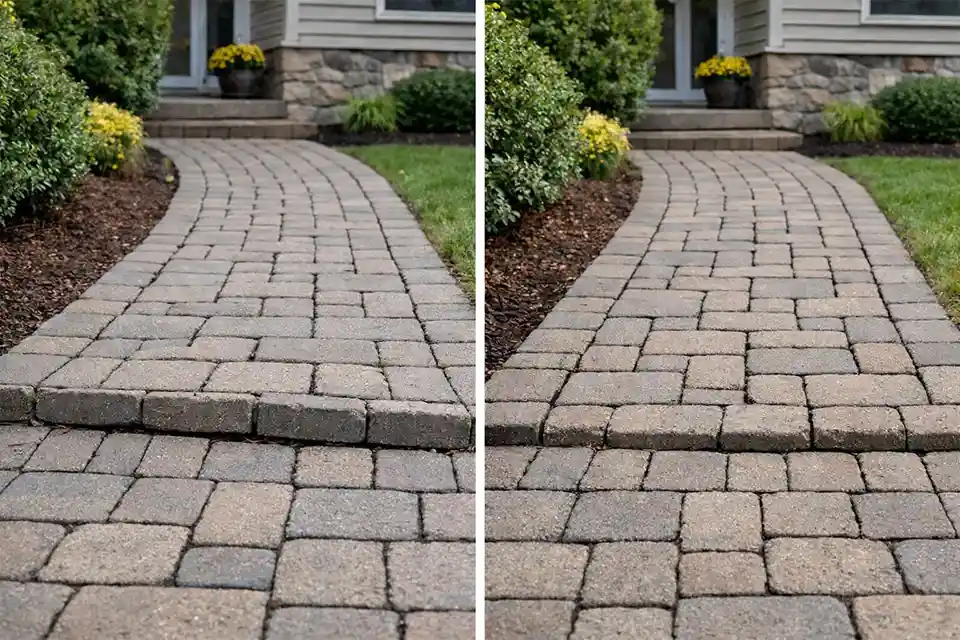
What it looks like when it is seasonal — and when it is not
The real search intent here is not just understanding that soil moves. It is figuring out whether this specific pattern fits seasonal expansion and contraction or whether something else deserves more attention.
Seasonal shrink-swell movement
Seasonal movement usually develops over weeks or months, not overnight. It tends to repeat in the same zone and often gets worse after a wet spring, a late-summer dry spell, or a change in irrigation pattern.
In clay-heavy parts of Texas and in some Colorado Front Range areas, this should be considered early, not treated as an obscure possibility.
Permanent settlement
Settlement usually behaves more like a one-way loss of support. A section drops, stays low, and keeps trending in that direction. If the surface does not recover at all between seasons, poor compaction, base failure, or erosion may be more likely than seasonal shrink-swell behavior.
That distinction matters because Poor Compaction Under Outdoor Surfaces Causes Signs and Long-Term Fixes points toward a different repair path below the surface.
Frost heave
In northern states, seasonal movement gets misnamed all the time. Frost heave is also seasonal, but the mechanism is freezing and trapped moisture rather than simple wet-dry soil cycling. If the distortion appears mainly in winter or during thaw periods, frost belongs high on the list. If it becomes obvious in July, August, or early fall, frost is probably not the lead explanation.
Root lift or leak-driven movement
Tree roots usually create more directional, localized lift and often follow a readable path. A plumbing or irrigation leak tends to keep one area active even when nearby ground is dry.
Readers often overestimate roots and underestimate watering inconsistency. In many warmer U.S. landscapes, especially in Arizona, Nevada, and inland California, uneven irrigation patterns are often a more useful lead than “heat” by itself.
Quick diagnostic checklist
- The same area tightens or rises after wetter periods and opens after 2 to 8 dry weeks
- A visible soil gap appears along a slab or edging line in hot, dry weather
- The worst movement sits near irrigation, downspouts, planter beds, or shade changes
- The problem partly relaxes when weather patterns shift
- The vertical difference is measurable even if cracking is still minor
- Grinding, patching, or resetting helped only temporarily
What changes across U.S. climates and soil regions
This topic is not evenly distributed across the U.S., and content that treats it as generic usually ends up being less useful.
Clay-heavy regions
In parts of Texas, Oklahoma, Colorado, and other shrink-swell-prone areas, reactive clay is often the main story. In those markets, it makes sense to suspect seasonal expansion and contraction early, especially where rainfall swings are sharp or irrigation is inconsistent.
Freeze-prone northern states
In the Upper Midwest, Northeast, and other cold-winter climates, the most important job is distinction. Do not force every seasonal shift into the expansive-soil category. Winter lift may be frost heave, and spring weakness may come from thaw-related support loss rather than classic shrink-swell cycling.
Hot, irrigated landscapes
In Arizona, Nevada, and inland parts of California, the wrong diagnosis is often “the heat damaged it.” Heat alone is rarely the mechanism. The better explanation is moisture inconsistency: one strip gets repeated watering, one border dries quickly, and the surface starts reacting to that imbalance.
Humid and drainage-sensitive regions
In Florida and along the Gulf Coast, expansive clay may not always be the best lead explanation. Long wet periods, softening, washout, and drainage-related instability can matter more. If a surface stays wet for extended periods rather than cycling hard between wet and dry, be careful about calling it textbook seasonal shrink-swell.
Pro Tip: The diagnosis usually gets more accurate when you can point to a specific local moisture behavior, not just say “the ground moves seasonally.”
Why the obvious fix often fails
The tempting move is to flatten the visible edge and move on. That can reduce immediate trip risk, but it is often the wrong sequence.
Surface-only fixes
Grinding a concrete lip can help today. Resetting one paver can improve appearance this month. Filling a seasonal gap can make the problem look smaller. None of those changes corrects the recurring moisture imbalance underneath. If the same zone keeps cycling, the symptom usually returns within one season or the next.
Where routine maintenance stops making sense
Once the vertical difference reaches about 1/2 inch on a walkway, or once more than one adjacent unit starts moving together, cosmetic-only repair starts losing value. If the differential reaches 3/4 inch or more, the problem has moved into clear trip-hazard territory and should not be treated as routine touch-up work.
A lot of money gets wasted when the surface is re-leveled before the water pattern is addressed. Uneven Surfaces Near Downspouts shows that sequence problem clearly: the visible failure is at the surface, but the repair logic starts where water is being delivered.
What to do before spending money on repair
A better decision usually comes from one disciplined wet-dry cycle of observation than from one rushed patch. Do not reset or re-level first if you have not documented how the area behaves through at least one meaningful weather swing.
Track four things
Measure and document:
| What to track | Useful threshold or timing | What it tells you |
|---|---|---|
| Vertical height difference | Under 1/4 inch, around 1/2 inch, 3/4 inch+ | Monitoring threshold, practical repair threshold, and clear trip-hazard range |
| Timing | Every 30 days for 6 to 12 months | Whether the movement is cyclical or one-directional |
| Moisture changes | Rain events, irrigation changes, downspout overflow | Whether water behavior matches movement |
| Area spread | One edge vs multiple adjacent sections | Local symptom vs broader support problem |
First actions that usually make sense
Start with drainage and moisture consistency before surface correction. Extend downspouts at least 4 to 6 feet away from affected edges. Fix overspray that repeatedly wets one side. Check whether planters, mulch beds, or grade transitions are holding moisture against one border.
If the affected area is small, the base is still sound, and the moisture source is obvious, a targeted reset or localized correction can make sense.
If the pattern has repeated across multiple seasons or has spread beyond one edge into a wider field, it usually makes more sense to think in terms of rebuild, drainage redesign, or broader stabilization logic. Yard Drainage Problems and Uneven Outdoor Surfaces becomes the more relevant next step once the issue is no longer isolated.
The practical repair boundary
Not every seasonal change needs major work. Some surfaces can be monitored. Some should be repaired soon. Some have clearly moved past “maintenance.”
Usually monitor
- less than 1/4 inch movement
- no clear increase year to year
- no meaningful trip risk on a walking path
- no spread into adjacent sections
Usually repair soon
- about 1/2 inch vertical change on a walkway or patio route
- repeat movement in the same zone across seasons
- surface-only fixes already failed once
- moisture source is visible and reasonably correctable
Usually stop calling it maintenance
- 3/4 inch or more differential
- multiple slabs or pavers moving together
- widening spread, rocking, hollow or void-like response, or drainage-driven support loss
- active path to an entry, stair run, pool deck, or other frequent foot-traffic area
Pro Tip: If a recurring movement problem is being quoted for repair without any mention of drainage, irrigation, grade, or subgrade support, the proposal is probably aimed at the symptom first.
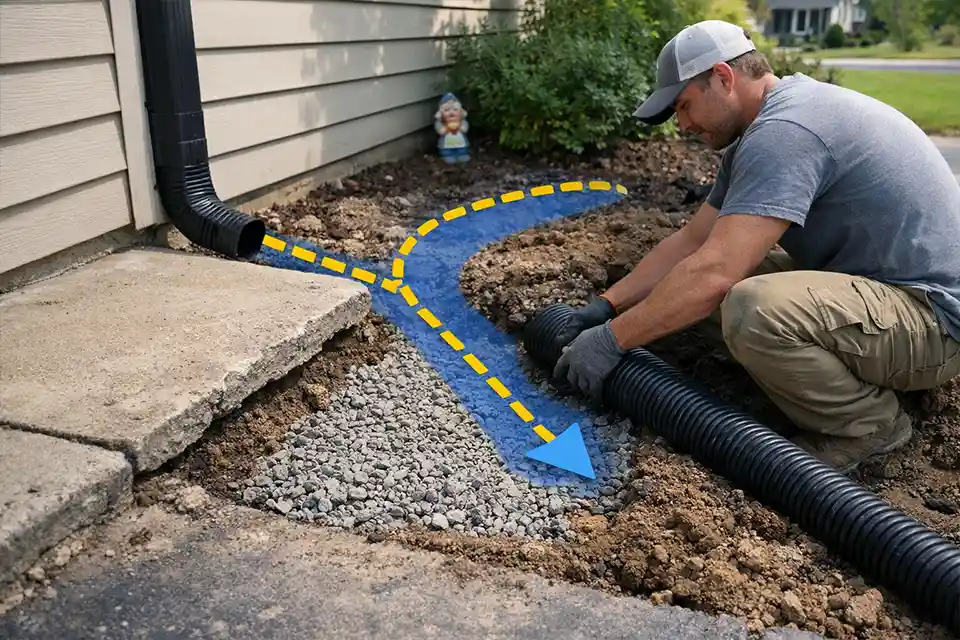
Seasonal soil expansion and contraction becomes expensive mainly when it is misread for too long. The key question is not whether the surface looks uneven today.
It is whether the movement is cyclical, moisture-driven, and still small enough to manage intelligently. On outdoor surfaces, the better results usually come from correcting water behavior and support conditions before trying to perfect the visible finish.
When that order gets reversed, the same edge usually comes back.
For broader practical guidance, see Purdue Extension’s overview of shrinking and swelling soils.