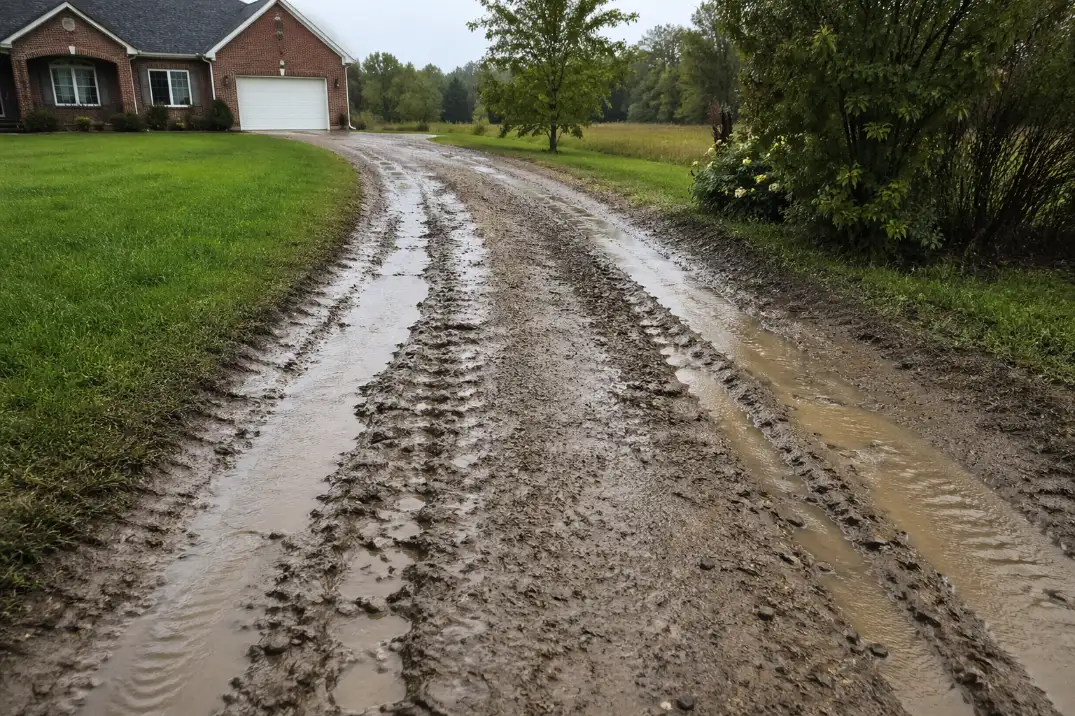
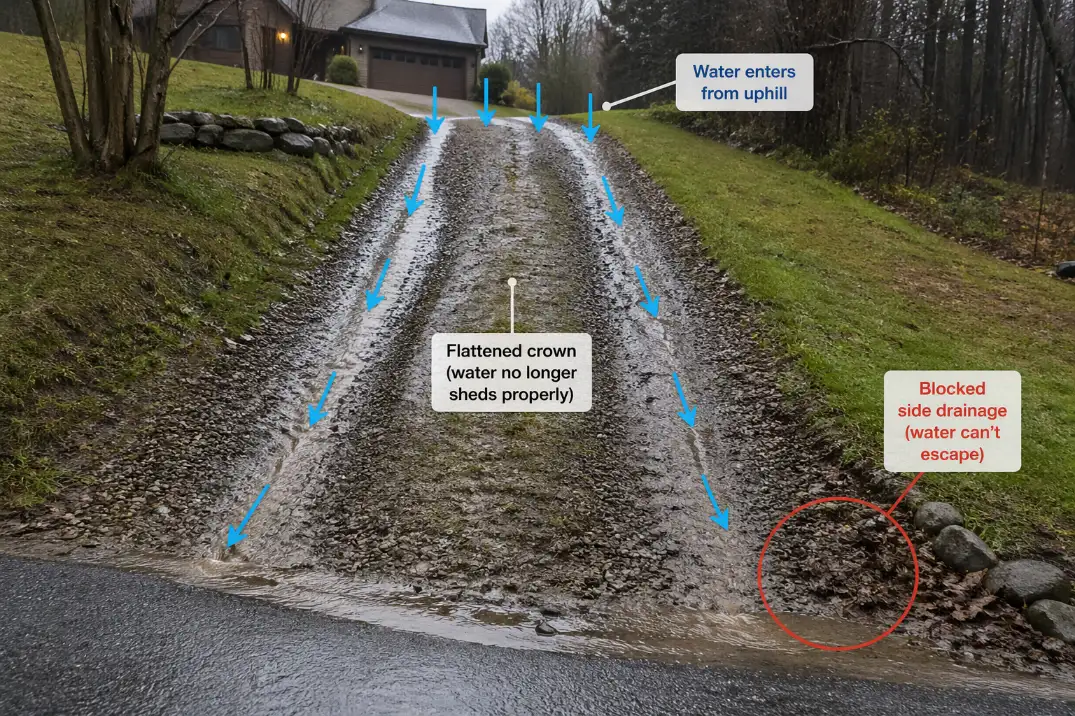
Deep ruts after heavy rain usually mean the driveway stopped shedding water before it started losing stone. In most cases, the real problem is one of three things: the crown has flattened so water stays in the wheel paths, runoff is entering from an uphill source and traveling down the drive, or the base has softened enough that traffic keeps pressing the same channels deeper.
The first checks should be practical, not cosmetic: does water remain in the tracks longer than about 24 hours, are the ruts approaching or exceeding 3 inches, and is the center of the driveway still high enough to move water toward the edges?
That distinction matters because shallow rutting and structural rutting are not the same repair. A driveway with light surface displacement may recover with reshaping and drainage correction.
One that stays soft for 24 to 48 hours after rain, or reopens within the next one to three storms, is usually telling you that fresh gravel alone is no longer the right fix.
Quick Diagnostic Checklist
- Water stays in the wheel tracks longer than 12 to 24 hours
- Ruts are deeper than about 3 inches
- The center crown looks flat or weak instead of clearly higher than the wheel paths
- Runoff from a roof, slope, ditch, or garage apron crosses the driveway
- Fresh gravel sinks into soft mud instead of staying near the surface
- The same section fails first after every storm
Which kind of rutting do you actually have?
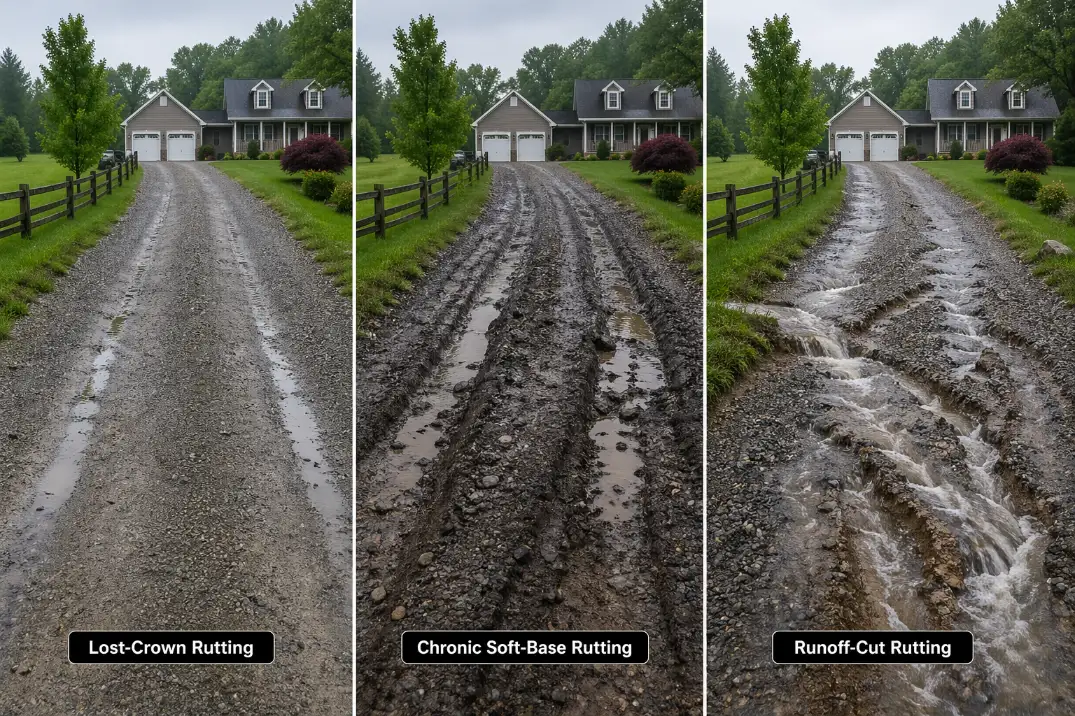
Surface rutting from lost crown
This is the most common version. The center of the driveway gradually flattens, water stops moving off the surface, and the tires begin using the wettest line as the easiest path. On a healthy gravel driveway, the middle should still sit visibly higher than the wheel tracks. If that shape is gone, the rut is mostly a drainage-shape problem first.
This is also the version people often underestimate. The driveway can still feel drivable while the wheel paths quietly stay wetter than they should.
Soft-base rutting after saturation
This is the more serious condition. Here, the rut is not just a low spot in the gravel. It is a sign that the support below has lost strength. If one section stays soft after 24 to 48 hours of drying weather while nearby areas have firmed up, the problem is usually deeper than light grading.
The visible groove is the symptom. The loss of support underneath is the mechanism.
Runoff-cut rutting from water entering the driveway
This is the failure pattern many owners miss. The driveway may not be creating the problem at all. An uphill slope, a downspout outlet, a driveway edge with no drainage exit, or a shallow ditch that spills across the surface can turn the driveway into a stormwater path.
Once water begins traveling along the drive instead of off it, loose aggregate starts moving quickly and the wheel paths deepen even faster.
What people usually misread first
The rut is the symptom, not the cause
A deep track tells you where the load is concentrating, but not why. The underlying issue may be trapped surface water, chronic saturation below, or concentrated runoff entering from the side. Treating all three the same is where repair money gets wasted.
Heavy rain gets too much blame
The storm is often just the event that exposes an older weakness. A properly shaped gravel surface can handle a lot more rainfall than a flat one. What people often overestimate is the weather. What they underestimate is shape loss, edge blockage, and thin gravel cover.
“Just add gravel” is the most common waste fix
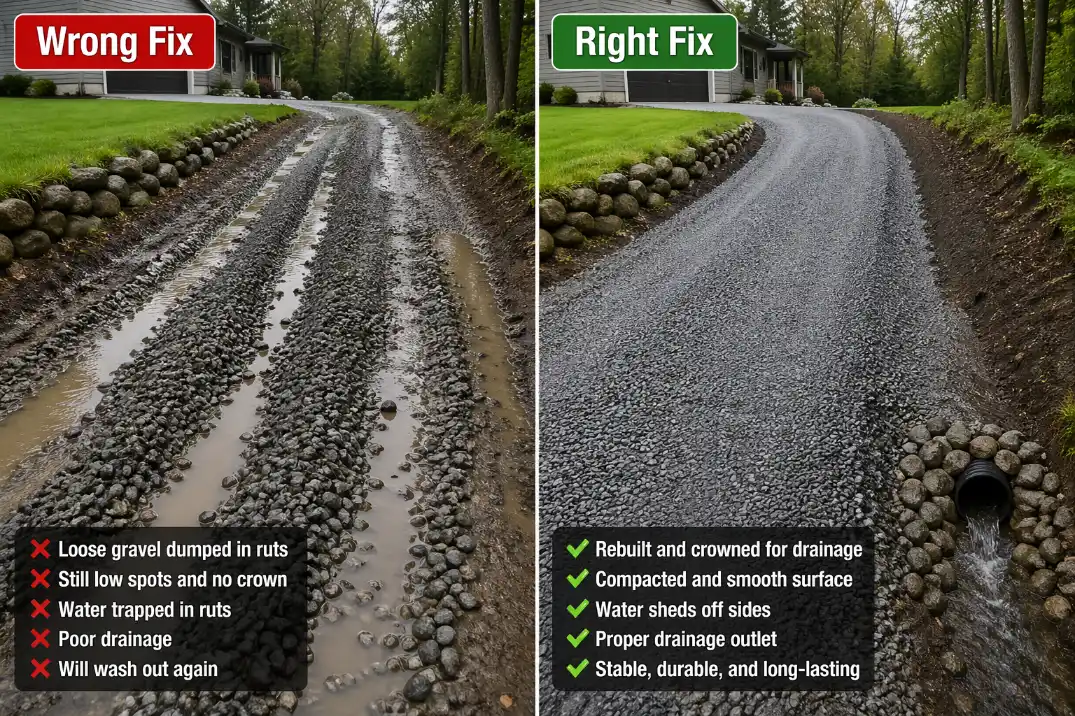
This is the mistake that keeps repeating because it looks logical. But adding gravel into wet wheel tracks without restoring crown or correcting runoff usually hides the problem for a short time rather than fixing it.
If the new stone disappears or sinks within the next few rains, that is a repair-path clue, not bad luck.
The same broader pattern shows up in Why Loose Stone and Aggregate Surfaces Start Failing and Why Gravel Surfaces Break Down Over Time.
A few on-site tests that tell you more than the surface does
Crown check
Stretch a string or lay a straight board across the driveway width. The middle should still sit visibly higher than the wheel tracks. If the cross slope is barely noticeable, water is probably staying where the tires run.
Dry-out check
Return after about 24 hours of decent drying weather. If one section still looks dark, glossy, or soft while the rest of the driveway has stiffened up, you are probably past a simple surface-shape problem.
Probe check
Push a steel rod, shovel, or stake into the damaged section and compare it with a healthier area nearby. If the weak zone gives way much sooner, the support layer is telling you more than the surface gravel is.
Water-path check
During or just after rain, look for where the water enters and where it has no clean exit. That single observation often saves more time than another round of surface-only grading.
Similar runoff-driven patterns show up in Drainage Patterns Patio and Walkway Damage and Why Ground Becomes Unstable After Major Rainfall.
Repair path: match the fix to the failure
When reshaping and topping up still make sense
This is the right lane when rutting is still relatively shallow, usually under about 2 to 3 inches, and the base firms up after drying. The sequence matters:
- Restore the crown first
- Reopen the drainage path at the edges
- Add fresh aggregate only after the shape is correct
- Compact rebuilt areas instead of leaving loose fill in the wheel tracks
Pro Tip: The best grading window is often after the damaged section has drained but before it turns rock-hard. Too wet and you churn it. Too dry and the surface resists reshaping.
When the base needs rebuilding
Once the rutting returns after the next storm cycle, stays soft, or pumps mud upward through new gravel, the problem has moved below ordinary maintenance depth. This is where undercutting soft material, rebuilding in lifts, using larger base stone, and sometimes adding a separation layer start to make sense.
This is also the point where many owners waste time by treating a support failure like a topping-off problem.
When drainage work matters more than stone
If the worst rutting happens where runoff crosses the driveway, or if water visibly runs down the travel lane during storms, gravel is not the lead fix. Diversions, side drainage, culvert correction, outlet cleaning, or slope interception are usually more important than another load of stone.
That same runoff-first logic connects naturally with Erosion Washout Under Outdoor Surfaces and Why Surface Materials Fail Early.
Comparison guide: what repair matches what condition?
| Condition | Most likely mechanism | Best repair type | What usually wastes money |
|---|---|---|---|
| Shallow ruts, surface dries within 24 hours | Lost crown, light surface displacement | Regrade, restore crown, add surface gravel after shaping | Dumping gravel into wet tracks |
| Ruts return after one to three storms | Water path still active | Regrade plus drainage correction | Repeating the same grading pattern |
| Mud pumps through new stone | Weak saturated base | Excavate the soft section and rebuild in lifts | Adding more top gravel only |
| One section always fails first | Localized seepage or runoff entry | Spot reconstruction plus diversion or outlet fix | Re-surfacing the whole drive without fixing the weak spot |
| Repeated deep rutting on slope | Water running along the driveway | Crown correction, drainage breaks, and base reinforcement | Treating it as ordinary wear |
When loose gravel stops being the right answer
There is a point where the real question is no longer “how do I touch this up?” but “is loose aggregate still the right surface here?” That point comes earlier on:
- steeper approaches
- long rural driveways that gather runoff
- properties with repeated pickup, trailer, or delivery traffic
- sections that need rut repair every wet season
If the same areas keep reopening despite reshaping and drainage work, a standard loose-gravel surface may no longer be the smartest long-term fit.
That does not automatically mean paving, but it may mean a more structural rebuild, a stronger base design, separation fabric, or a stabilized surface system instead of another cosmetic repair.
This is where many owners wait too long. They keep comparing the next fix to the last one instead of asking whether the surface type still matches the site. That same support-layer logic sits behind Surface Problems Rarely Fix Themselves.
What changes under different U.S. conditions
Clay-heavy Southeast and Midwest sites
These are the places where drying time can matter almost as much as storm intensity. A section may look acceptable on the surface but stay weak underneath for several days. Repeated rutting here often points to chronic moisture retention more than simple gravel shortage.
Freeze-thaw regions
In northern states, spring rutting can mimic a material problem when the real issue is seasonal loss of support below. If repairs are done too early, the same section may deform again before summer.
Flash-runoff climates
In drier western regions, one hard storm can cut channels fast because the problem is not long saturation but concentrated runoff. In those cases, water diversion and edge control matter more than simply adding stone.
Long drives versus short suburban drives
Longer drives usually fail because drainage continuity breaks somewhere along the route. Shorter suburban drives fail more often where roof runoff, garage aprons, or side-slope water keep feeding one weak section.
Questions people usually ask
Will bigger stone solve deep rutting by itself?
Usually not. Bigger aggregate helps only when the water path and weak layer below are also addressed.
Can I just keep filling the wheel tracks each year?
You can, but once the same sections reopen every wet season, you are maintaining the symptom instead of the mechanism.
Is this mainly a traffic problem?
Most of the time, no. Traffic finishes the damage, but water layout usually starts it.
For broader technical guidance on shaping and draining gravel surfaces, see the Federal Highway Administration Gravel Roads guide.