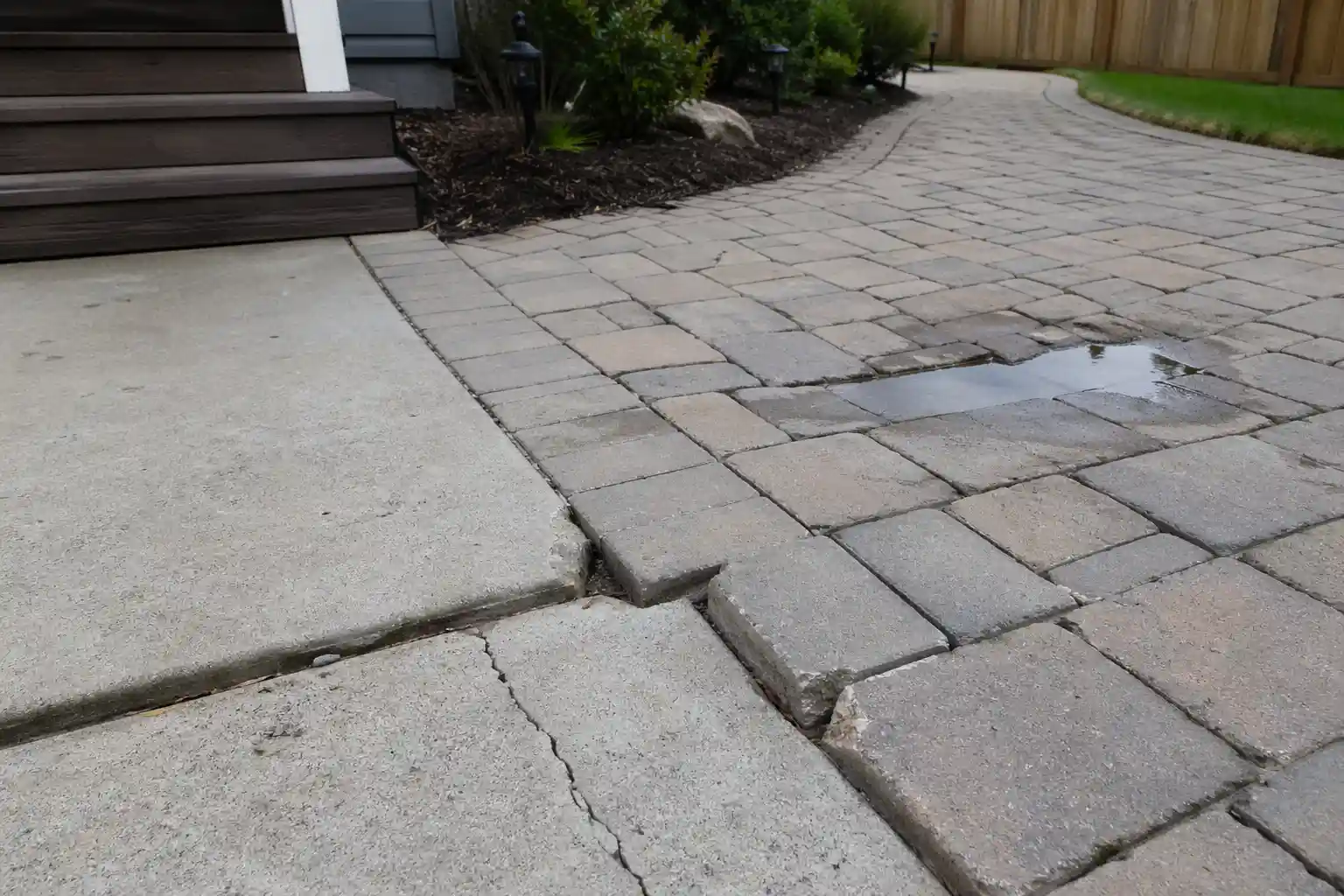
Most surface materials do not fail early because the top layer was inherently weak. They usually fail early because the support below them moves, water stays longer than it should, or installation details were wrong from the start.
That is the distinction that matters first. Pavers usually fail early by shifting, loosening, or opening joints. Concrete tends to crack, scale, or settle.
Natural stone often starts with edge chipping or isolated breakage that keeps returning. Outdoor tile is more likely to debond, crack, or trap moisture underneath.
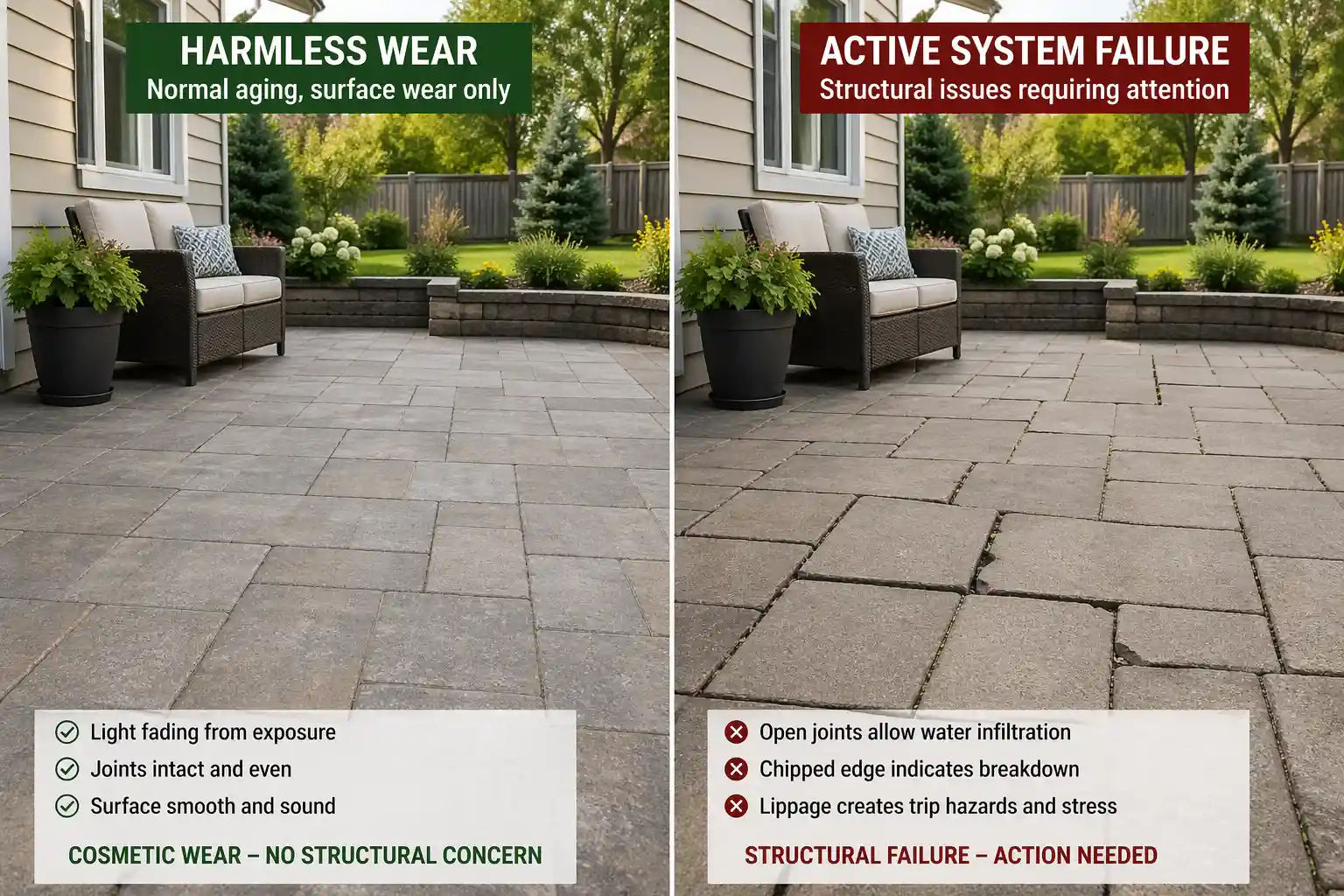
The first checks should be practical, not theoretical. Look for height changes greater than about 1/4 inch between adjacent pieces, water still sitting on the surface 30 to 60 minutes after rain, and repaired joints reopening within one season.
On many patios and walkways, the surface should also pitch away at roughly 1/4 inch per foot. If it does not, water tends to linger where it should be moving. These are not normal aging signals.
They usually mean the visible damage is only the surface expression of a support, drainage, or movement problem. That is what separates early failure from ordinary wear.
A faded finish after years of exposure is one thing. A surface that changes how it feels underfoot in the first 3 to 5 years is something else.
What people misread first
The most common mistake is blaming the material before checking the system it sits on.
The symptom is visible, but the mechanism usually is not
People see a chipped edge, one crack, or a slick section and assume the surface itself failed. Sometimes that is true. More often, the material is only the first part of the system to show stress.
Weak base layers, trapped water, poor pitch, and soil movement show up on the surface long before they become obvious below it.
That is why Cosmetic vs. Structural Surface Problems matters more than a generic repair checklist.
Early failure is often misdiagnosed because cosmetic-looking signals are actually the first structural warning.
What people overestimate and underestimate
People overestimate sealers, patch compounds, and one-piece replacement. Sealers can help with appearance and stain management, but they do not correct active movement, drainage failure, or a weakening base.
People underestimate subsurface moisture. A surface can look mostly dry on top while the bedding layer or base below stays wet for hours longer. That hidden wetness is what turns a small problem into recurring damage.
The causes are not equal
There are many possible contributors, but they do not deserve equal weight. Three causes drive most early failures.
Weak base or poor compaction is usually first
This is the most common cause, and it is the one homeowners tend to underestimate. When the base is too thin, inconsistently compacted, or laid over disturbed soil, the surface above it starts carrying movement instead of just carrying traffic.
That is when rocking units, repeated chips, and reopened joints appear.
A surface can look solid at installation and still fail within 1 to 3 years if the support underneath was never stable enough.
That is why Walkway Stones Breaking From a Weak Base is a more useful related pattern than simply asking whether the surface material was durable.
Water that exits too slowly comes next
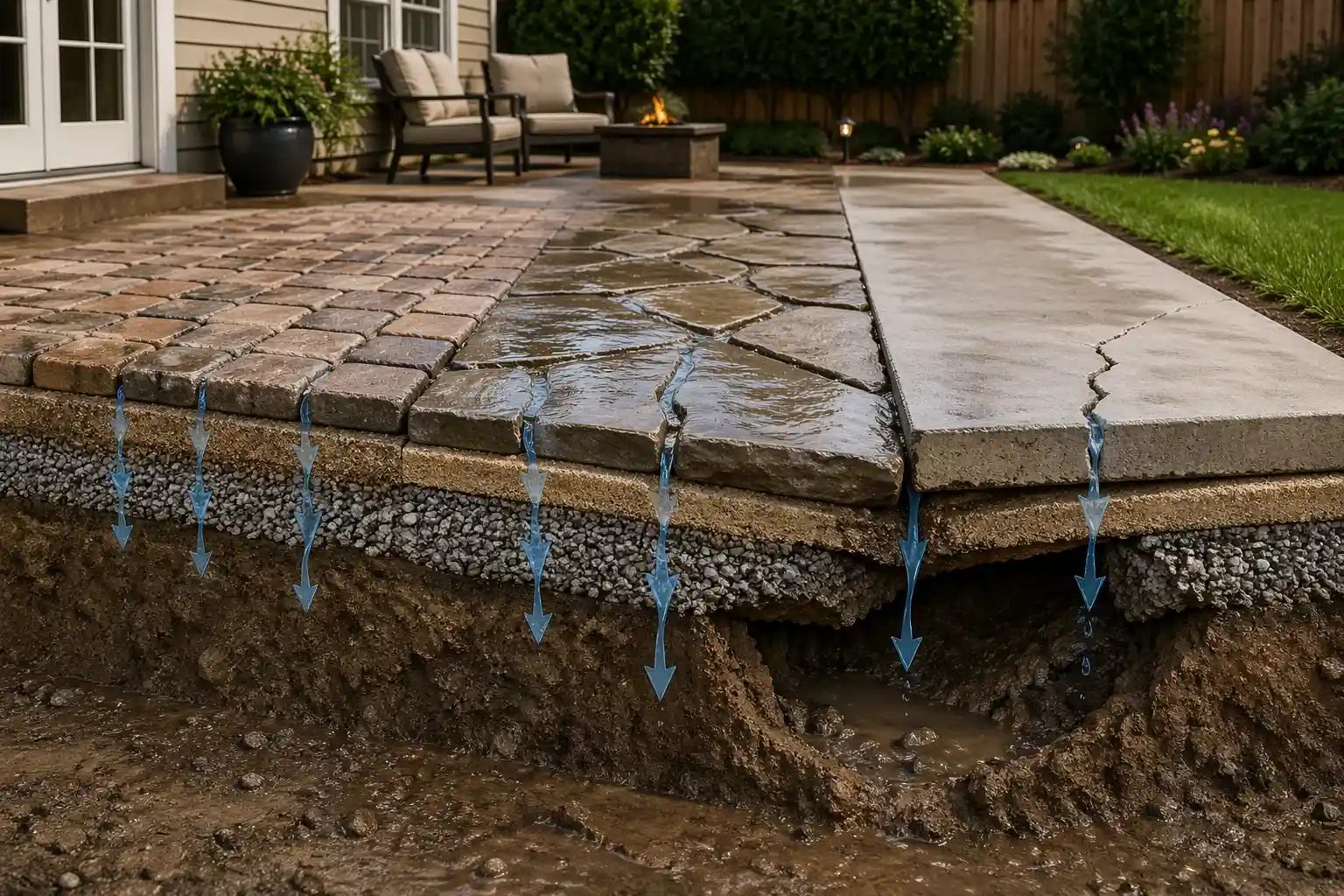
If water is still pooled after 30 to 60 minutes, or one section stays visibly darker 2 to 4 hours longer than nearby areas, drainage is not just a side issue.
It is an active stress multiplier. Water softens support layers, washes fines out of joints and base material, reduces traction, and makes freeze-thaw damage more likely.
This is also where people misread the problem. They think the surface failed because it became slippery or stained. In reality, the water pattern was usually weakening the system first.
Drainage Patterns That Damage Patio and Walkway Surfaces is relevant because drainage failure is often the mechanism behind what looks like unrelated surface damage.
Ground movement is less visible but often more expensive
Settlement, slope wash, expansive soils, and repeated wet-dry cycling below the installation are commonly underestimated until spot repairs stop holding.
If a repaired section fails again after a wet season, irrigation change, or nearby grading work, ground movement deserves much more attention than the finish layer.
How early failure looks different by material
This broad topic only works if the failure patterns stay specific. Different materials fail early in different ways.
Pavers and segmental surfaces
Pavers usually fail early through motion before breakage. The first signs are rocking underfoot, joint loss, edge spread, or one low line where runoff keeps collecting.
The mistake is thinking re-sanding alone solved it. If joints reopen within a few months, the system is still moving. In many failed installs, the issue is not the paver itself but weak edge restraint, thin support layers, or bedding material that holds too much moisture and fines.
Poured concrete
Concrete usually tells a different story. Early failure tends to show up as cracking, edge settlement, flaking, surface scaling, or one slab corner dropping relative to another.
Hairline cracks in older concrete may be cosmetic. Fresh cracking in newer slabs, especially with unevenness or recurring wetness, points to support or moisture problems rather than simple aging.
Natural stone
Stone often fails early at stress points. Corners chip, edges spall, or one piece breaks where support underneath is incomplete. People sometimes read this as stone weakness.
More often, the stone is exposing a hollow or unstable spot below it. If multiple edges in the same traffic lane keep breaking, the problem is not random.
Outdoor tile and porcelain systems
Tile failures are often more binary. Either the installation stays stable, or debonding, cracking, or trapped moisture starts to show up in a clear pattern.
Hollow sounds, cracked grout lines that return quickly, and localized tile movement usually mean the problem is below the tile layer, not just in the tile itself.
The installation mistakes that shorten surface life
Material choice gets blamed faster than installation logic, but installation errors usually do more damage.
Wrong pitch is not a small flaw
A surface does not need dramatic ponding to fail early from poor pitch. Even subtle low spots can keep moisture where it should not remain. If runoff repeatedly crosses the same seam, edge, or transition, that section ages differently from the rest of the surface.
Weak restraint and thin edges fail quietly
A surface can be mostly well built and still fail early at its edges. This is common near planting beds, drain lines, coping transitions, or where one surface meets another. Once restraint weakens, movement spreads outward.
Why Some Outdoor Areas Sink Faster fits naturally here because localized sinking often starts at these vulnerable boundaries, not in the middle of the field.
The wrong repair gets repeated too long
If the same fix fails twice within 12 months, that is usually the point where surface-only repair stops making sense. At that stage, you are no longer maintaining a finish. You are covering an active mechanism.
Pro Tip: Replacing damaged pieces before opening one small test area underneath them often wastes both material and labor.
Quick diagnostic checklist
- Height differences over 1/4 inch usually point to movement, not simple wear.
- Water still present after 30 to 60 minutes suggests drainage or settlement problems.
- One section drying 2 to 4 hours slower than nearby areas often signals hidden moisture below.
- Repaired joints reopening within one season usually means the base is still moving.
- Repeated chips, cracks, or looseness in the same line usually indicate a stress path, not bad luck.
- New damage appearing within 3 to 5 years is early enough to question support conditions and installation quality.
What to do next based on the pattern
This is where many articles stay too general. The next step should follow the pattern, not the material label.
If the problem is isolated, open and reset locally
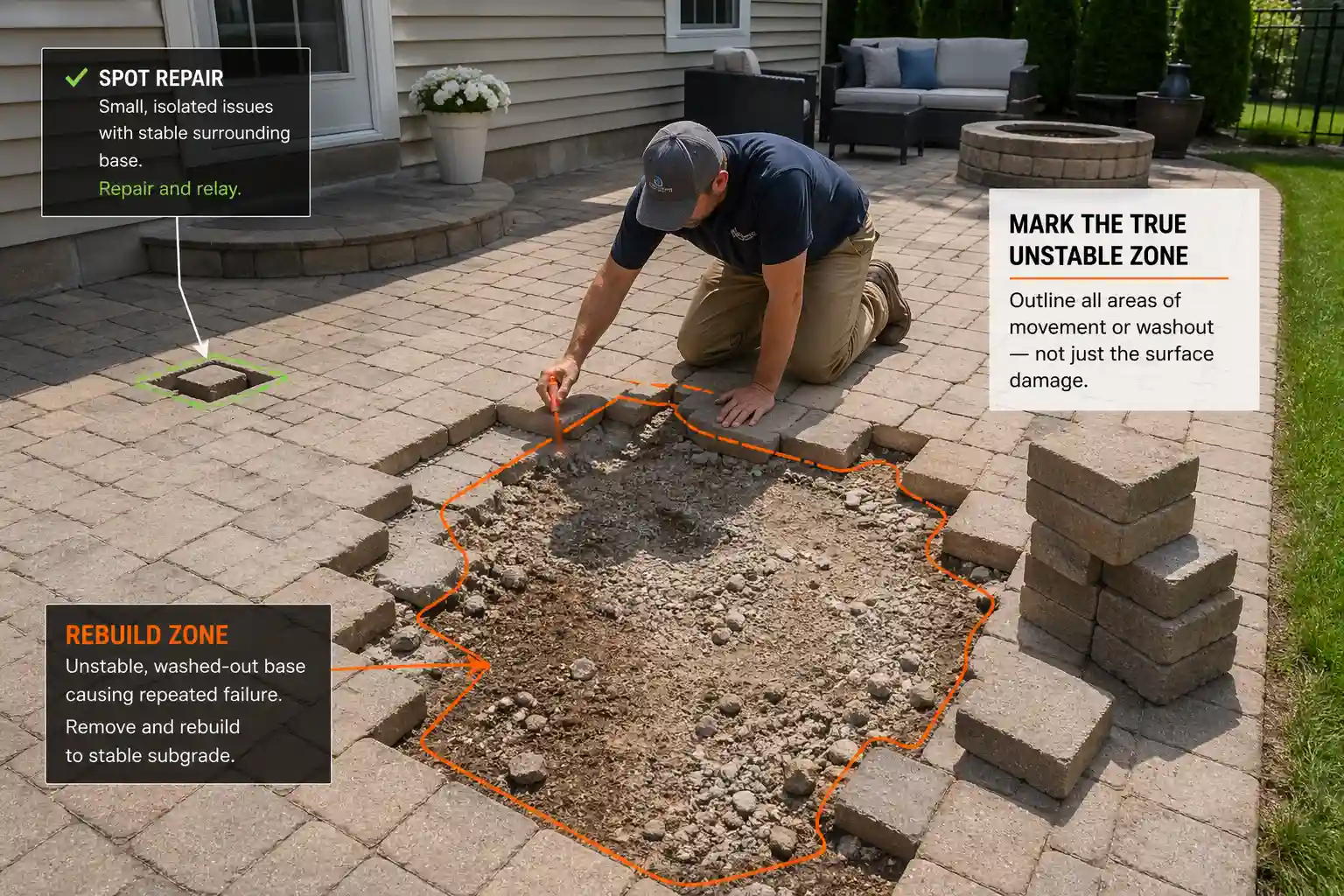
If the damage is confined to less than about 10% to 15% of the area, the surrounding surface is stable, and the failure traces back to one obvious point, localized repair can still be efficient.
One failed stone, one hollow patch, or one edge affected by a specific load can usually be lifted, inspected, rebuilt locally, and reset.
If the same moisture line keeps returning, correct drainage first
When the same band stays dark, slippery, or unstable after each rain, surface replacement is usually not the first fix.
Water handling is. Regrading the pitch, redirecting runoff, correcting an outlet problem, or rebuilding the affected drainage path often matters more than replacing the visible material.
If multiple zones move, widen the repair scope
Once several sections show the same type of movement, wetness, or breakage, repair logic needs to change. At that point, replacing pieces without correcting support, drainage, or edge conditions usually just resets the timeline for the next failure.
If different materials fail together, look below them
When stone, pavers, concrete edges, or tile sections in the same area all start deteriorating together, that usually points to a shared support or moisture problem.
Long-Term Ground Instability Under Patios and Walkways becomes the better frame once damage spreads beyond one clearly isolated section.
| Material or condition | Early failure usually looks like | Most likely underlying cause | First thing to check |
|---|---|---|---|
| Pavers | Rocking, joint loss, edge spread | Weak base, poor restraint, washout | Joint lines and edge support |
| Concrete | Cracking, scaling, slab drop | Settlement, trapped moisture, freeze-thaw stress | Low corners, cracks, drainage path |
| Natural stone | Chipped edges, isolated breakage, repeated corner failure | Hollow support, movement, concentrated loads | Support under damaged piece |
| Outdoor tile | Debonding, hollow spots, recurring cracked grout | Moisture below, movement, installation detail failure | Bond layer and moisture pattern |
| Mixed wet zone | Staining, slipperiness, recurring deterioration | Slow drainage, subsurface saturation | Drying time and runoff direction |
What changes under different climate conditions
Freeze-thaw climates punish trapped moisture faster
In northern states, small defects get worse quickly when water enters joints or cracks and repeatedly freezes. A surface that survives one wet season in a mild climate can deteriorate much faster under freeze-thaw cycling.
Hot, high-sun regions expose rigid details
Arizona, inland California, and similar climates tend to reveal thermal expansion stress, brittle sealant failure, and faster drying differences between well-supported and weakly supported areas. Heat alone is rarely the full cause, but it exposes weak detailing sooner.
Humid and irrigation-heavy settings keep the system wet longer
Florida and other humid regions often turn modest drainage flaws into chronic moisture problems. That matters not just for traction, but for support conditions below the surface.
A surface that never fully dries between wet cycles tends to fail earlier even if the material itself is technically durable.
Early surface failure is usually misread because the visible damage shows up on top while the real cause stays below.
The better question is not which material failed first. It is which condition kept forcing that material to tolerate movement, moisture, or weak support earlier than it should have.
For broader official guidance on walking-surface safety and hazards, see the U.S. Access Board.