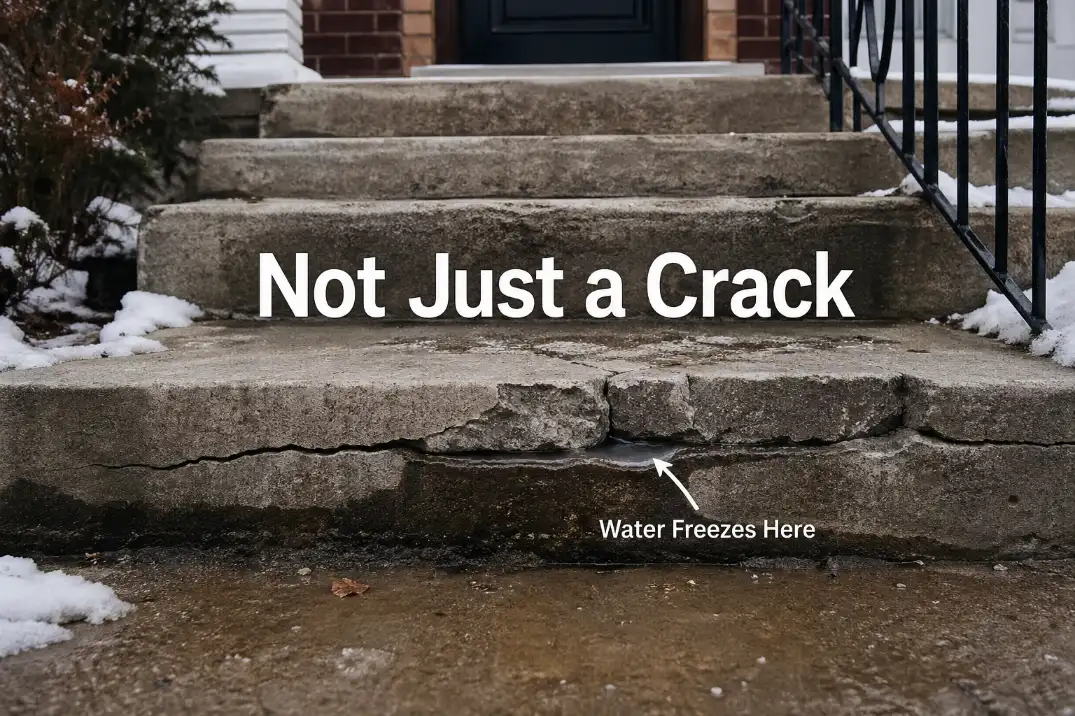
Outdoor steps rarely crack just because it’s cold. They crack because water sits, soaks in, and freezes in the same spot over and over.
If a tread stays wet longer than 24 hours after nearby surfaces dry—or if meltwater keeps freezing in the same crack overnight—you’re dealing with an active freeze-thaw cycle. Even a shallow dip of about 1/8 inch can trap enough water to start the process.
The key distinction: a dry hairline crack may be cosmetic. A wet crack, a chipped nosing, or any vertical offset over 1/4 inch is not. On steps, that shift moves from “surface issue” to “decision point” quickly because footing is concentrated and repeat stress is unavoidable.
Quick fix summary: fix the water behavior first, then repair the damage. If you skip that order, most patches fail within 1–2 winters.
Why Water Freezing on Steps Causes Cracks
It’s not cold—it’s trapped moisture
Concrete and stone tolerate freezing better than saturated conditions. The damage begins when water enters pores, micro-cracks, or weak edges, then expands during freezing. Over dozens of cycles, that pressure widens cracks and breaks the surface bond.
The important shift: the crack is the visible result. The mechanism is repeated saturation.
This is the same pattern behind broader Weather Exposure Damage on Outdoor Surfaces, but steps fail faster because they combine water, impact, and edge stress in a tight space.
Why the front edge fails first
The nosing (front lip) of the step takes direct impact, snow shovel contact, and runoff from above. If water pools near that edge, freeze pressure concentrates there. What starts as a dark line becomes flaking, chipping, or hollow spots.
A stable crack under 1/8 inch is often manageable. A crack over 1/4 inch, a loose edge, or a height difference signals a different repair category.
Crack, Scaling, or Spalling?
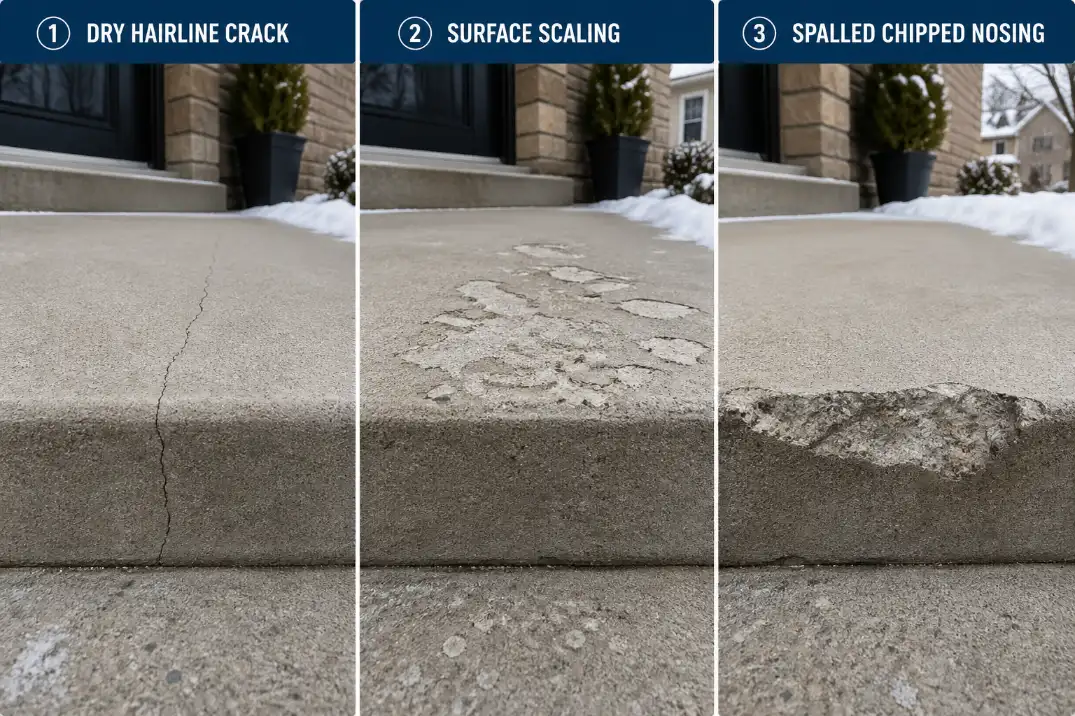
Not all “cracks” mean the same thing. Misreading this is where most repairs go wrong.
| What you see | What it usually means | Best next move |
|---|---|---|
| Thin dry crack | Surface-level aging or shrinkage | Monitor or seal |
| Flaking surface | Scaling from moisture or weak finish | Improve drainage, then resurface if needed |
| Broken edge | Spalling from freeze-thaw + impact | Rebuild edge with repair mortar |
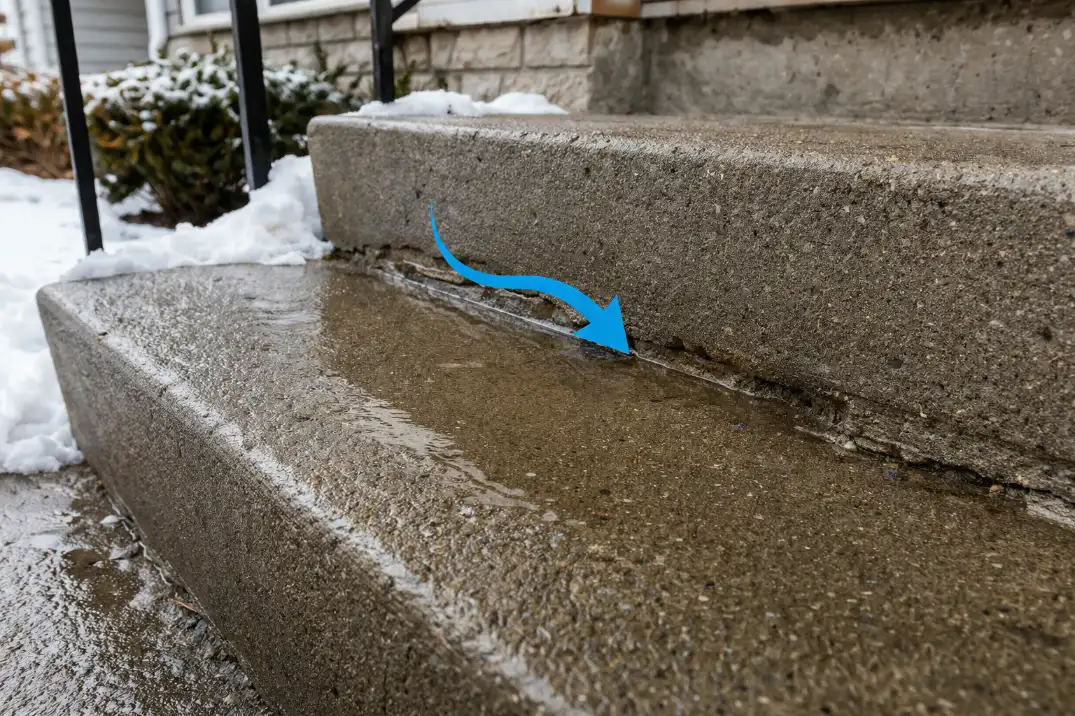
| Wet dark crack | Active water entry point | Dry, correct drainage, then seal |
| Offset over 1/4 inch | Movement or support issue | Stop patching—evaluate structure |
| Patch failed quickly | Water or bonding issue remains | Remove and correct root cause |
The critical difference is this: surface damage can be repaired; movement or saturation patterns must be corrected first.
What People Usually Misread First
“It’s just bad concrete”
Rarely the full story. If only one step is cracking and it’s also the one holding water, drainage is the primary suspect—not the material.
Most people overestimate material strength and underestimate water behavior.
Thin ice is not harmless
A thin ice layer means repeated thaw-freeze cycling. In northern states, this daily cycle does more damage than long frozen periods because water keeps re-entering and expanding inside the crack.
This freeze pattern is also explained in Freeze-Thaw Damage Beyond Patio Surfaces, but steps reach failure faster due to concentrated use.
A stair crack is not like a patio crack
Steps demand stricter judgment. A chipped nosing, small offset, or unstable edge is a safety issue even if the rest of the structure looks fine. The same defect on a patio would be less urgent.
Why the Obvious Fix Often Fails
Sealant cannot fix a puddle
Sealants work when they block water from entering a stable crack. They fail when they sit inside standing water. If the crack lies in a low spot, the repair becomes part of the freeze cycle.
That’s why clean-looking repairs fail by spring—they never addressed the water path.
Pro Tip: After repair, pour water on the tread. If it still flows into the crack instead of off the step, the job is incomplete.
Deicers can accelerate weak areas
Deicers keep surfaces wet longer and can increase stress on already damaged concrete. The worst scenario is salty slush sitting on a cracked tread for hours.
Use them carefully, clear slush early, and avoid letting meltwater sit.
The Drainage Detail That Matters Most
A slight slope changes everything
Outdoor steps should shed water outward. A fall of about 1/8 to 1/4 inch per tread is usually enough. Less than that allows pooling. More can affect footing.
This small detail often separates a one-time crack from a repeating failure.
Water may not originate on the step itself. If runoff comes from a landing or downspout, the step becomes the damage point—not the cause. That pattern aligns with Drainage Patterns That Damage Patios and Walkways.
Choosing the Right Repair Material
Flexible sealant for stable cracks
Use a polyurethane or masonry sealant when the crack is narrow, stable, and dry. It allows slight movement and blocks water entry. It does not reinforce the structure.
Repair mortar for edges and shallow damage
Polymer-modified repair mortar works best for chipped nosings and shallow spalling. Remove weak material first—patching over loose concrete leads to early failure.
Hydraulic cement is often overused here. It sets fast, but it is not always the best long-term solution for exposed freeze-thaw surfaces.
Rigid repairs can backfire
Epoxy is strong but not flexible. On exterior steps exposed to temperature swings, rigid repairs may crack or detach if movement continues.
Why Damage Looks Worse in Spring
Winter creates the damage. Spring exposes it.
Freeze-thaw cycles expand cracks internally. When ice melts and debris clears, chips and separation become visible. Spring rain also reveals whether the step has developed a new low point.
If the step also shifts, rocks, or separates from adjacent surfaces, the issue may involve support. Saturated soil or frost movement can change load distribution.
This connects to deeper patterns seen in Long-Term Ground Instability Around Patios and Walkways. In those cases, surface repair alone won’t hold.
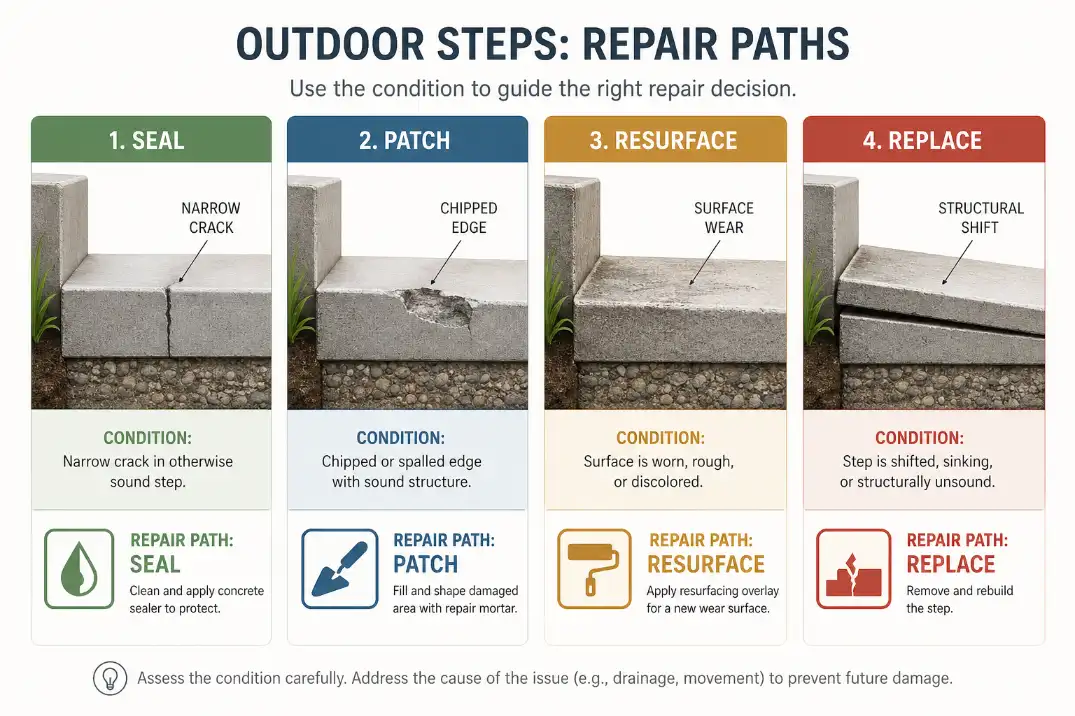
When to Seal, Patch, Resurface, or Replace
| Condition | What makes sense | When to stop |
|---|---|---|
| Dry crack under 1/8 inch | Monitor or seal | If water sits over it |
| Wet crack under 1/4 inch | Fix drainage, then seal | If offset appears |
| Chipped nosing | Rebuild edge | If damage runs deep |
| Surface scaling | Resurface | If base is hollow |
| Backward slope | Reshape or rebuild | If settlement continues |
| Movement or offset | Evaluate or replace | Surface fixes won’t hold |
Where most repairs go wrong
If more than 25–30% of the tread is loose, hollow, or flaking, resurfacing becomes unreliable. At that point, the surface is no longer a stable base.
Replacement is not overkill—it’s often the more durable choice.
The Practical Fix Sequence
1. Stop water first
Redirect runoff, clear snow early, and prevent water from pooling on the tread.
2. Dry and clean thoroughly
Wait at least 24–48 hours of dry conditions if possible. Remove debris, salt, and loose material.
3. Repair only solid areas
Do not patch over hollow or crumbling sections. Remove weak material before rebuilding.
4. Restore drainage and traction
A successful repair sheds water and maintains grip. A smooth but slippery step creates a new hazard.
Pro Tip: Always test drainage with water before the next freeze. Function matters more than appearance.
Questions People Usually Ask
Can I repair steps in cold weather?
Only if the material supports it and the surface is dry. Many products require 40–50°F during curing. Cold repairs are often temporary.
Is every crack dangerous?
No—but cracks that trap water, create ice, or cause uneven footing are. On steps, even small changes matter.
Should I seal the entire step?
Sometimes, but avoid slick finishes. Breathable sealers are safer, but traction should always be considered.
Outdoor steps crack where water collects because the tread becomes a repeat freeze point. Lasting repair depends less on stronger materials and more on better drainage, proper preparation, and knowing when repair stops making sense.
For broader official guidance on freeze-thaw durability, see the National Ready Mixed Concrete Association.