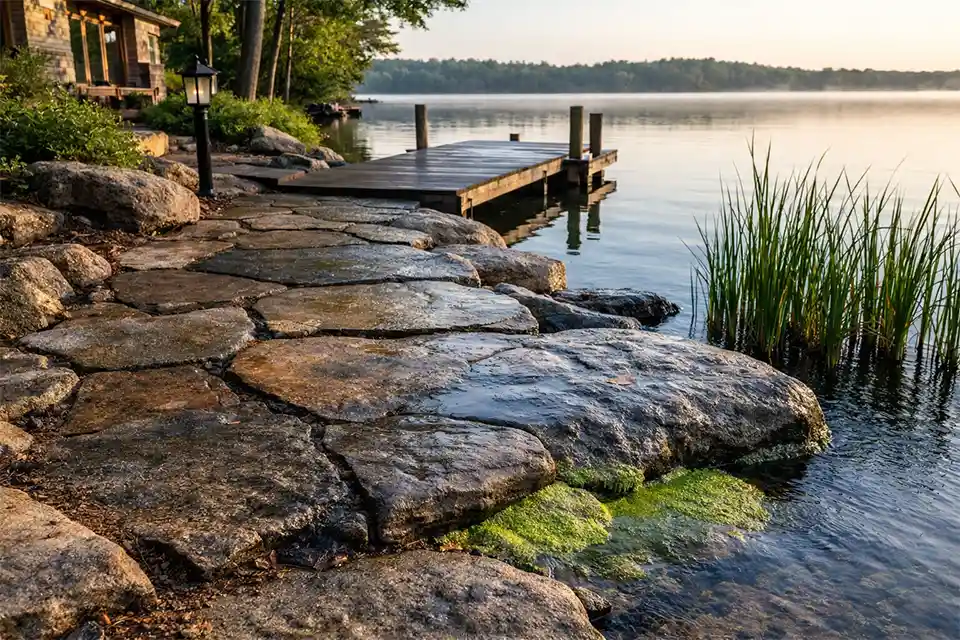
A dockside stone path usually becomes dangerous before it looks especially dirty. That is what makes the problem easy to underestimate. Near lakes, the first real loss is often traction, not appearance. A thin biofilm can settle onto stone that still looks serviceable by late afternoon, then feel slick again the next morning after humidity, splash, and shade have reset the surface.
The algae matters, but it is rarely acting alone. What usually turns the path unsafe is a combination of slow drying, nutrient-rich runoff, trapped organic residue, and a surface texture that is no longer doing as much work as people assume. Once those conditions line up, even stone that seemed reliably grippy when it was installed can start behaving very differently under wet shoes, sandals, or bare feet.
I would not treat that as a cosmetic issue once the dock-end stones start feeling less predictable underfoot. The risk is higher there because people are already stepping across a transition, often carrying gear, coolers, towels, or fishing equipment. The broader mechanism is not hard to understand: excess nutrients help fuel algae growth in lakes and nearby wet surfaces, and U.S. Environmental Protection Agency guidance on nutrient pollution in lakes and rivers helps explain why shoreline runoff can make algae regrowth more persistent than many homeowners expect.
Quick Diagnostic Checklist
-
The stone stays dark for 6 to 10 hours after rain or morning condensation
-
One shoreline edge turns green faster than the rest of the path
-
The walkway feels slick before it looks badly stained
-
Joints collect black residue, fine silt, or wet leaf fragments
-
Water from lawn, beds, or roof discharge crosses the path on its way downhill
-
Stones nearest the dock remain damp longer than the upper approach
-
Low spots hold shallow puddling around 1/8 to 1/4 inch
If three or more of those signs are present at the same time, the problem is usually not just algae growth. It is a drying failure combined with repeated re-wetting.
What People Usually Misread First
Most homeowners blame the stone type too early. Stone does matter, but it is often not the first reason the path becomes hazardous. The misread usually happens when people focus on whether the surface is bluestone, limestone, flagstone, or concrete pavers while ignoring the fact that one strip of the path is quietly staying wetter than the rest.
That difference is where the trouble often starts. The center of the walkway may still feel usable while the edges, joints, or low transitions begin to lose grip. Once algae establishes in those damp zones, the rest of the surface tends to follow. The visible staining comes later, which is one reason this issue gets underestimated for too long.
The same logic shows up on other hardscapes where the surface symptom only becomes obvious after water has already been moving the wrong way for a while, as explained in Patio Drainage Problems Most Homeowners Notice Too Late. That is not the same setting, but the moisture pattern is closely related.
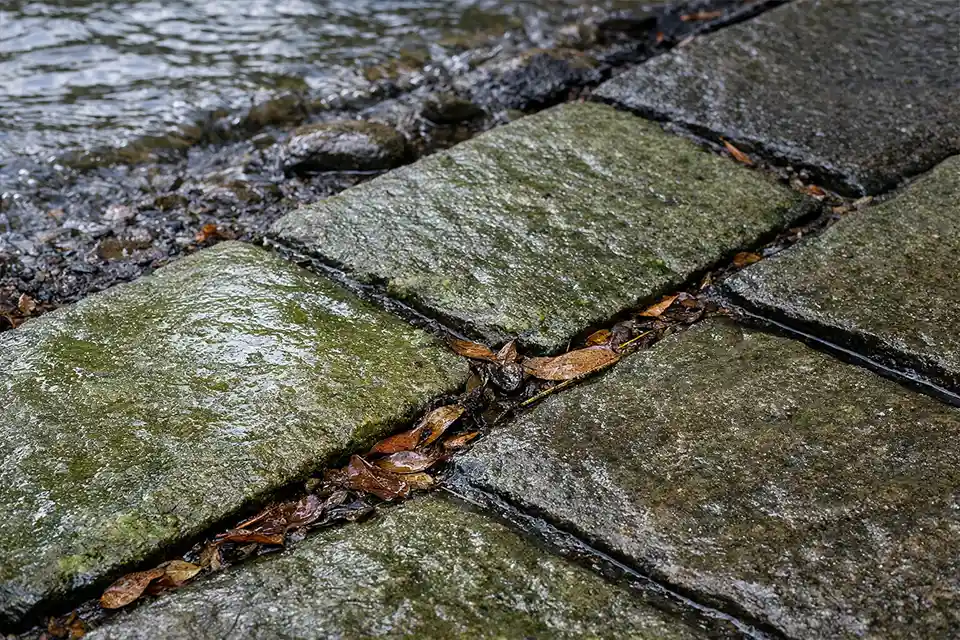
Why the Obvious Fix Often Fails
Pressure washing is the fix people reach for first because it gives an immediate visual result. The stone brightens, the green film disappears, and the path seems solved. The problem is that a cleaner-looking path can still be stuck in the same moisture cycle. If runoff continues to cross the walkway, if shade still delays drying, and if the joints still hold damp organic residue, the hazard often comes back well before the surface looks obviously dirty again.
In other words, the path did not become slick simply because it was dirty. It became dirty because it was staying wet in the wrong way.
That distinction matters. Heavy cleaning removes the symptom, but it does not change the conditions that brought it back. Similar runoff concentration is easier to spot in settings like front-yard drainage problems from downspouts near walkways, where a hard surface keeps acting like a receiver for water coming from somewhere else. On lakefront paths, the receiving surface just happens to be closer to splash, humidity, and organic debris as well.
Pro Tip: If algae returns first in the same strip or corner after every cleaning, trace the direction of water before changing cleaners. Repeat growth in a line usually points to flow, not product failure.
Conditions That Make the Risk Worse
Shade is the most obvious multiplier, but it is not always the decisive one. In humid Florida lakefront settings, even moderate shade can keep a rough-textured path damp enough for slick film to reform quickly. In parts of the Midwest, repeated rainfall followed by warm nights can create nearly the same result even when the path gets some daytime sun.
Runoff is often the bigger factor. When water from the lawn or planting beds carries fine soil, pollen, or fertilizer residue onto the path, the surface is being fed as well as wetted. That is why the most troublesome stones are not always the ones nearest open water. Often they are the ones sitting below a grade change, bed edge, or discharge point.
The ones I would watch most closely are the stones at the dock threshold and any section where the surface holds even shallow puddling. Those are usually the first areas to feel unreliable under bare feet or smooth-soled shoes. In northern states, that same damp pattern can become more disruptive after snowmelt because freeze-thaw movement exaggerates minor settling and leaves small depressions that were easy to ignore the previous summer.
| Condition | Early Signal | Best Response |
|---|---|---|
| Dense shade | Stone stays dark into late morning | Improve light and airflow where practical |
| Runoff crossing the path | Green film returns after rain | Redirect water before repeating deep cleaning |
| Failing joints | Slime develops along edges and gaps | Refill joints and remove trapped organic residue |
| Settled low spots | Damp patches persist near transitions | Reset stone and restore proper fall |
| Worn stone texture | Clean stone still feels slick | Use traction treatment or selective replacement |
What Actually Holds Up Better
The better repair sequence usually starts upstream, not on the stone itself. Clean the film, yes, but then watch the path during the next storm or heavy irrigation cycle. Where does water arrive from? Where does it hesitate? Which edge dries last? Those answers are often more useful than the first round of cleaning.
If runoff is coming from compacted or slow-draining ground above the path, the broader site problem needs attention. The same drainage logic appears in how to fix clay soil drainage problems in front yards, where poor infiltration uphill keeps sending water toward finished surfaces below. On a lake property, that pattern simply finishes at a more safety-sensitive location.
The most durable fix often combines four things: removing the existing biofilm, redirecting water away from the walkway, reducing organic buildup in the joints and at the edges, and deciding honestly whether the stone finish belongs in a splash-prone setting. Some surfaces are simply too smooth for where they were installed. Once that becomes clear, repeated maintenance stops being a cleaning issue and starts becoming a material-fit issue.
Where the yard slopes toward the shoreline, the dock path may be acting as the low receiving edge of a larger drainage pattern. That broader relationship is similar to what shows up in sloped backyard problems involving drainage, erosion, and safety, where water movement affects stability, maintenance, and safety all at once.
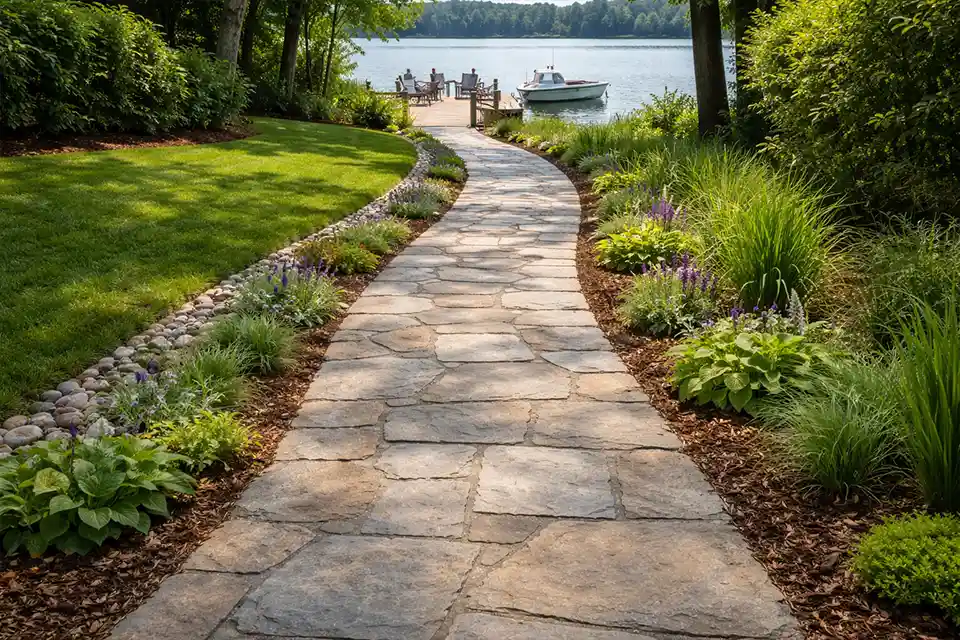
When Cleaning Stops Being the Real Answer
There is a point where frequent maintenance becomes a sign that the path is poorly matched to the site. That point usually arrives when 20% to 30% of the walkway repeatedly turns slick, the dock-end threshold stays wet from splash, or the stone has already lost too much usable texture to recover reliable grip.
In California’s coastal moisture zones, that can happen without harsh winters because persistent dampness and slower drying are enough to keep the cycle active. In Arizona, the issue is usually less climate-driven and more irrigation-driven, but a shaded path near a water feature or shoreline can still develop the same unreliable morning surface.
What matters most is not whether the stone can be cleaned again. It is whether the surface can be trusted after cleaning. If the answer keeps becoming “not really,” replacement of the worst stones or a redesign of the approach is usually more honest than another round of treatment.
A comparable pattern appears when surface instability develops because the base and pitch are no longer doing their job, which is why uneven or sloped ground can make a patio feel unstable is a useful related read. The symptom is different, but the hidden shift in performance starts long before the full failure becomes obvious.
| Factor | Impact on Slip Risk | Likelihood Near Lakes | Best Fix |
|---|---|---|---|
| Thin biofilm | Immediate traction loss | High | Clean and restore drying time |
| Nutrient-rich runoff | Fast regrowth after storms | High | Redirect runoff and protect edges |
| Compacted upslope soil | Surface keeps re-wetting | Medium to high | Improve grading and infiltration |
| Worn or polished stone | Clean path still feels unsafe | Medium | Add traction treatment or replace sections |
| Settled base | Puddles collect near transitions | Medium | Rebuild low areas and reset stone |
| Dense shade | Short drying window every day | High | Open canopy selectively for sun and airflow |
Pro Tip: On older dock paths, recurring algae in the same shallow depression often points to settlement below the stone. Surface treatment rarely outlasts a drainage depression.
Common Questions
Is every green stain on a dockside path slippery?
No. Some discoloration is mostly cosmetic, especially when it comes from tannins or mineral staining. The riskier areas are the ones that stay damp, feel slightly greasy, or become slick under wet footwear.
Should lakefront stone be sealed?
Sometimes, but sealing alone rarely solves the real issue. If runoff, shade, and repeated re-wetting remain in place, the path usually becomes hazardous again whether the color improved or not.
How often should a dockside stone path be cleaned?
During active warm-weather growth, light maintenance every 2 to 4 weeks often works better than waiting for heavy buildup. In heavily shaded areas, shorter cycles may be necessary during the most humid months.
What is the biggest mistake homeowners make?
Treating algae as the root problem when it is usually the visible result of moisture staying too long on the stone.
Pro Tip: The most durable repair is usually upstream. When less water and less organic residue reach the path, the walkway often becomes safer before it looks dramatically different.