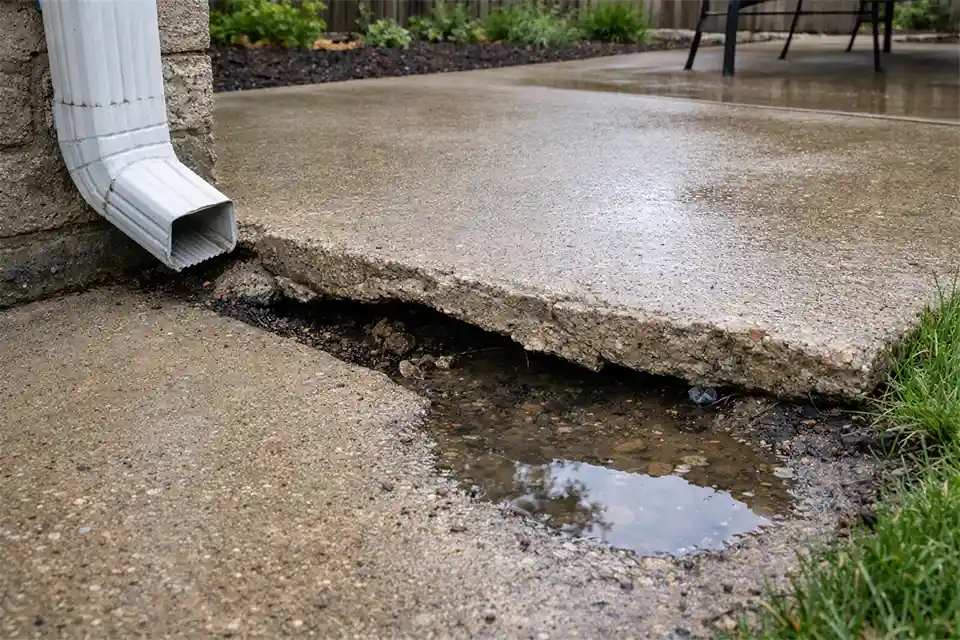
Most walkways and patios do not sink because the surface suddenly “wears out.” They sink because water keeps the support layer wet, carries fine soil away, or does both long enough that the ground loses bearing strength.
The first checks that matter are practical: does water still linger after 24 to 36 hours, is runoff or irrigation feeding the same 2- to 4-foot strip, and has the walking line shifted by more than about 1/2 inch? Those answers tell you more than a stain or a single crack.
The key distinction is surface wear versus support loss. A worn surface can still be stable. A newer surface over softened or washed-out ground is not. In most cases, this is a drainage problem first and a surface problem second.
That is also why patching, sealing, or re-leveling the top often disappoints: the visible symptom is movement, but the real failure is underneath.
The real sequence is water first, settlement second
Symptom versus mechanism
A low corner, a hollow slab edge, or pavers that rock slightly underfoot are symptoms. The underlying mechanism is usually prolonged saturation, erosion, or both.
Saturation means the base or subgrade stays wet long enough to lose stiffness. That is common in clay-heavy soils, shaded side yards, and places where evaporation is slow. Erosion is different.
Water moving across or through the support layer carries out fine particles, leaving small voids. Once that happens, the surface starts bridging spaces it was never meant to span.
That is why a patio can look only mildly uneven at first but feel noticeably less solid. Why Ground Becomes Unstable After Major Rainfall is relevant here because the bigger issue is often not the storm itself, but how long the ground stays wet after it.
What gets blamed too often
Material quality gets blamed more than it should. For most residential walkways and patios, long-term water exposure is more likely to be a drainage-and-support failure than a concrete or paver failure. A fresh surface over a compromised base can loosen again within one wet season or crack again in 6 to 24 months.
What people overestimate is age. What they underestimate is repeated low-volume water: irrigation overspray, short downspout discharge, shallow runoff from slightly bad grading, or water trapped along one edge. Those patterns are quieter than storm damage, but they are often what actually drives sinking.
What to check before assuming the surface is the problem
Water behavior tells you more than a crack
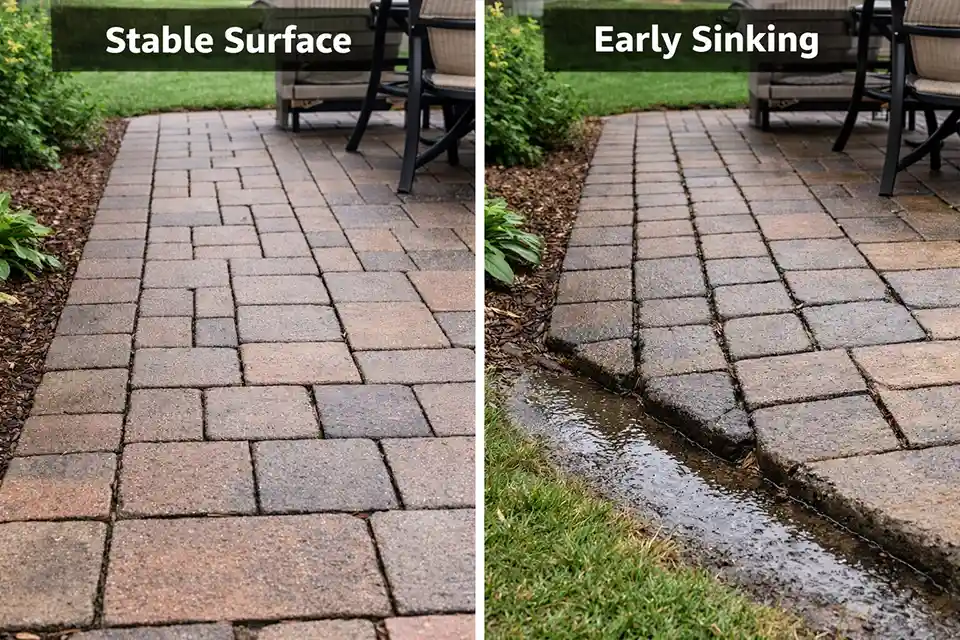
A crack by itself is weak evidence. Outdoor surfaces crack for many reasons, including shrinkage, temperature change, and normal aging. The more diagnostic clues are ponding, delayed drying, softness at the edge, and actual movement.
If water ponds deeper than about 1/4 inch in the same spot after ordinary rain, or the area is still damp a full day later when adjacent surfaces are drying normally, the support below deserves attention.
Once a walkway lip reaches 1/2 inch or more in a regular walking path, it has moved beyond cosmetic settling. On a wider patio, a depression of roughly 3/4 inch over 4 feet is usually more meaningful than minor discoloration or one isolated crack.
Persistent dampness is often worse than obvious puddling
People usually react to the dramatic puddle and miss the more useful warning sign: ground that is still damp 48 hours later. That is often the clearer indicator of trapped moisture below the surface, where drying should be happening.
This is also why Uneven Surfaces Near Downspouts keeps showing up as a real-world failure pattern. A downspout ending just 2 to 3 feet from a walkway can quietly weaken the same edge for months before the surface visibly drops.
Quick diagnostic checklist
- Water remains or the soil stays soft more than 24 to 36 hours after rain
- A downspout, sump outlet, or irrigation head discharges within about 2 to 3 feet of the affected area
- The walking line has shifted by 1/2 inch or more
- The surface rocks, deflects slightly, or sounds hollow in several spots
- Soil is visibly missing at the edge, beside the slab, or along joints
- The low spot gets worse after wet weeks instead of staying stable
Water erosion or poor compaction? Do not confuse them
Signs the problem is mostly water-driven
Water-driven settlement usually follows a path. It tends to be worse along one edge, near a downspout, beside a slope break, or where irrigation repeatedly wets the same narrow strip. It often gets worse after rain, then feels a little firmer during a dry spell without actually recovering.
If one side is dropping faster, soil is missing at the edge, or the failure lines up with runoff, water is the more likely driver. Drainage Failure Is Weakening Your Ground: Early Signs and Structural Risks supports that reading because the drainage pattern is often still active while the surface is already moving.
Signs poor compaction is more likely
Poor compaction usually shows up earlier after installation and more uniformly across an area. If settlement appears within the first 6 to 12 months, there is no obvious runoff source, and the drop looks broad rather than concentrated, base preparation becomes the stronger suspect.
Water can still make a poor-compaction problem worse, but it is not usually the original cause. That distinction matters because a drainage-only fix will not solve a base that was never properly compacted in the first place. In that case, Poor Compaction Under Outdoor Surfaces: Causes, Signs, Long-Term Fixes is the better internal comparison.
Why the obvious fix wastes time
Surface-only repairs do not restore support
Sealing, patching, and small re-leveling jobs can improve appearance, but they do not rebuild a softened or washed-out base. Sealing may reduce water entry from above. It does not stop lateral runoff, trapped edge moisture, or irrigation keeping the support layer wet.
One repair that fails more often than people expect is lifting a few pavers, adding sand, and resetting them while the drainage pattern remains unchanged. It looks logical because the surface becomes flatter. The problem is that the support underneath is still being weakened.
Pro Tip: Mark the low point after rain and measure it again 2 weeks later. If it deepens without another major storm, the failure is still active.
When routine maintenance stops making sense
Minor reset work still makes sense when the problem is localized and the support below is mostly intact. It stops making sense when the surface rocks under body weight, sounds hollow in several locations, or resettles after the next wet stretch. At that point, the top is not the repair. It is just where the repair becomes visible.
The repair sequence that actually changes the outcome
Step 1: Control the water source first
The first useful fix is often off the surface, not on it. That may mean extending a downspout 6 to 10 feet away, redirecting irrigation, correcting a shallow reverse slope, or intercepting runoff before it reaches the patio or walk.
A practical grading reference is about a 2% slope away from the structure, roughly 1/4 inch per foot, or about 6 inches over the first 10 feet where site conditions allow it. The point is not mathematical perfection.
The point is keeping water from lingering at the edge long enough to soften the base. Poor Drainage on Outdoor Walkways: Causes, Risks, and Long-Term Damage fits naturally here because drainage has to be corrected before surface work can last.
Step 2: Choose the drainage fix that matches the water pattern
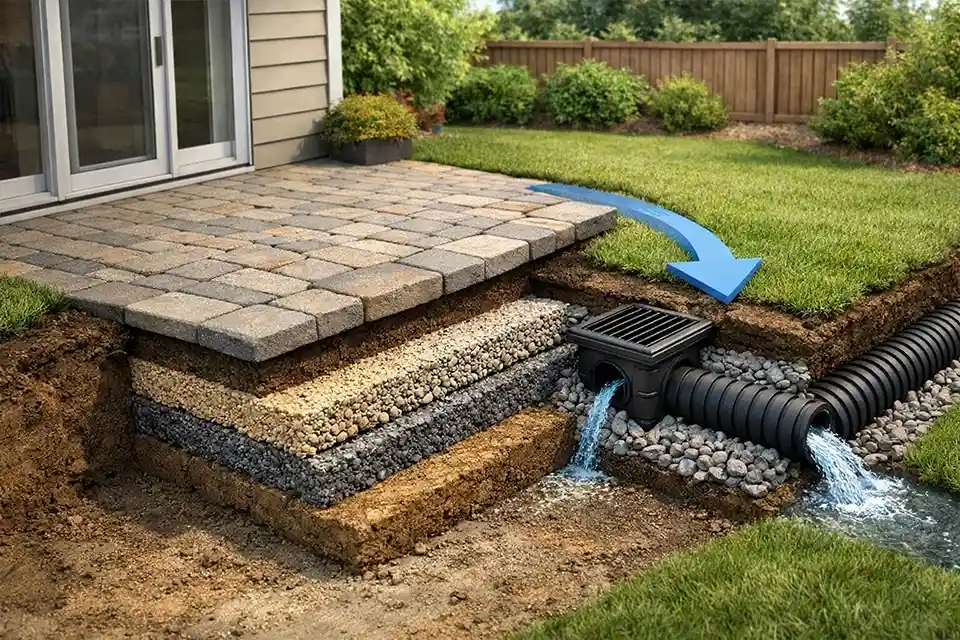
If the problem is sheet runoff crossing the surface, a channel drain or grading correction usually makes more sense than deeper subsurface drainage.
If the soil stays wet for days with no obvious surface flow, a French drain or another subsurface interception method is more likely to help.
If a downspout is feeding the area, extending or piping that discharge away is usually the first move, not rebuilding the surface immediately.
If irrigation is keeping one edge wet several times a week, the schedule or spray pattern needs to change before any reset or leveling work is worth doing.
Step 3: Match the support repair to the surface type
| Surface type | Best repair after water is controlled | When spot repair stops making sense | Common mistake |
|---|---|---|---|
| Concrete slab | Lift or stabilize a limited settled section if the slab is intact | Repeated resettling, broken slab sections, widespread voids | Raising the slab before fixing runoff |
| Pavers | Lift, rebuild localized base, compact in lifts, reset pavers | Several connected low zones or recurring movement across a broad area | Adding joint sand without rebuilding support |
| Walkway edge | Rebuild edge support and redirect flow away from the side | Edge loss returns after each wet period | Treating it like simple wear |
| Patio corner | Correct grade or drainage first, then rebuild the affected section | More than about 20% to 25% of the section is active | Resetting one corner while water still feeds it |
Step 4: Know when rebuild is the honest answer
Localized repair still works when the damage is limited to one edge, one corner, or one narrow runoff line and the water source can actually be controlled. It stops working when movement spreads across multiple connected areas, when previous repairs have already failed once, or when more than one part of the surface sounds hollow.
That is the point where people often spend money twice: first on cosmetic correction, then on the rebuild they were trying to avoid.
Pro Tip: If more than one area feels hollow, assume the visible low spot is smaller than the real problem footprint.
Which fix fits your case?
- Runoff crossing the surface: correct grading or use a channel drain
- Soil stays wet for days: use a subsurface drainage approach such as a French drain
- Small, stable concrete settlement: lift or stabilize only after drainage is fixed
- Recurring or broad movement: rebuild the affected section instead of repeating spot repairs
When fast action is justified
Move quickly when voids are visible under slab or paver edges, when water is actively carrying soil during rain, or when a primary walking line already has a lip of about 1/2 inch or more. On sloped sites, near front entries, and beside driveways, delay usually makes the repair area larger.
The most important judgment is also the simplest one: the surface is rarely the first thing failing. The support system is. Once that support has been repeatedly saturated or washed out, patching the top becomes a short-term appearance fix, not a durable repair.
For broader official guidance, see the US EPA page on urbanization and stormwater runoff.