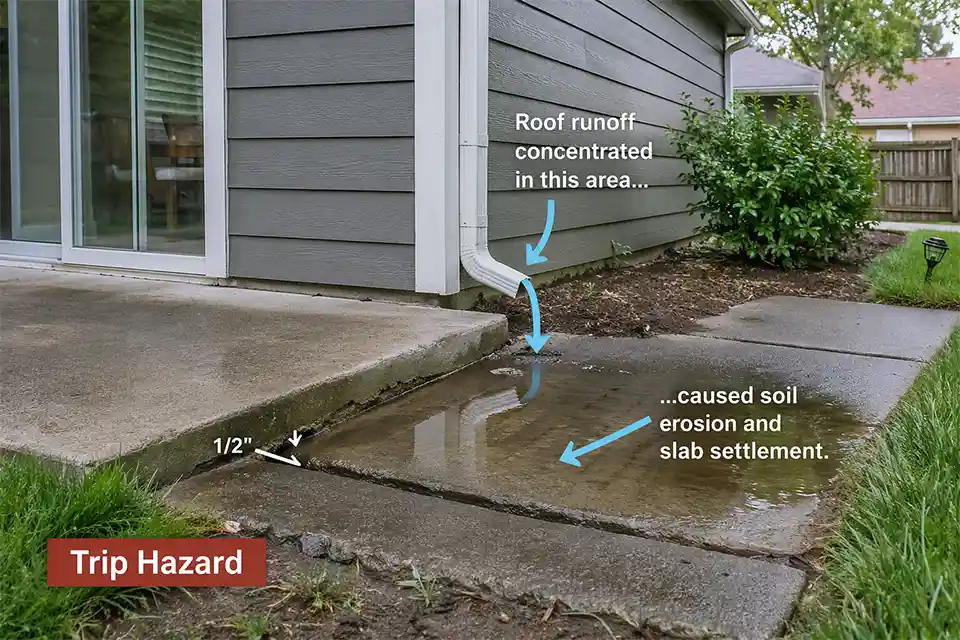
Some outdoor areas sink faster because one part of the surface system is carrying more risk than the rest. It may be taking repeated runoff from a downspout 5 to 10 feet away, sitting over weaker fill from recent grading, or losing support at an exposed edge while the middle stays stable.
That is why one patio corner drops first, one walkway panel opens up first, or one driveway side strip starts moving long before the rest.
The first checks should be practical. Does the low section stay damp for more than 24 hours after rain while nearby areas dry sooner? Was that zone filled, trenched, or rebuilt in the last 1 to 3 years?
Is the drop concentrated near an edge, transition, or narrow traffic band instead of across the whole surface? Those answers usually tell you more than the material itself.
This is also where people waste time. A dip, loose paver, or dropped slab edge is not the real problem. It is the visible symptom of support changing underneath. A section that settles 1/4 inch over several years is one thing. A section that forms a 1/2-inch trip edge within one wet season is something else entirely.
Where faster sinking usually starts
The sections that sink early are usually the sections with the least forgiveness. They are not always the oldest parts. They are the parts that get uneven moisture, weaker support history, or more exposed edge conditions.
Patio corners and perimeter edges
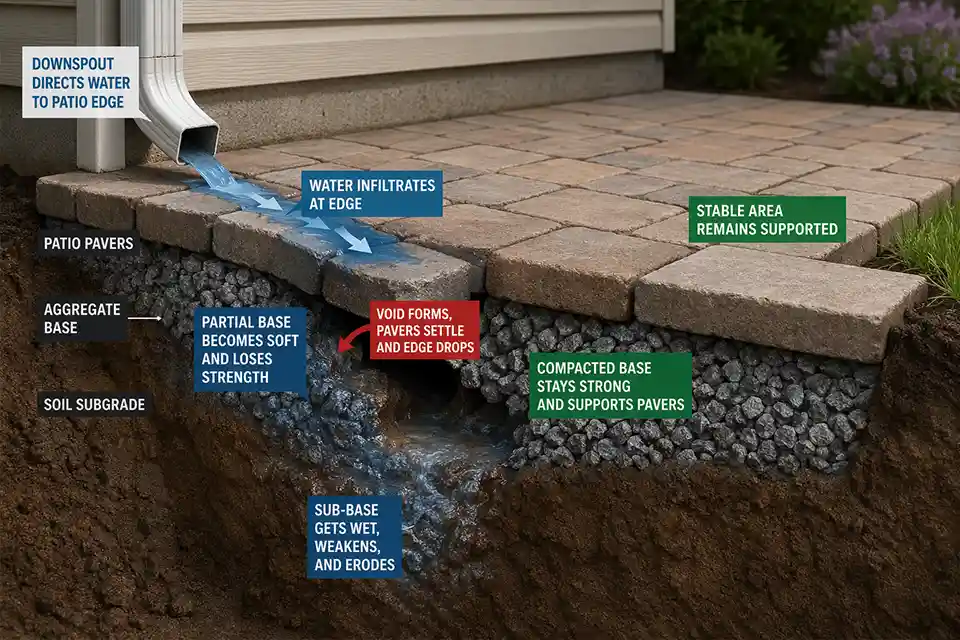
Patio corners and outer edges are early failure zones because they are easier to undermine than the center. Runoff often exits there, edge restraint is weaker there, and minor support loss shows up faster because there is less surrounding stability to hide it.
A broad patio field can still look fine while one outer corner keeps dropping after every rainy stretch.
Walkway panels near downspouts or splash zones
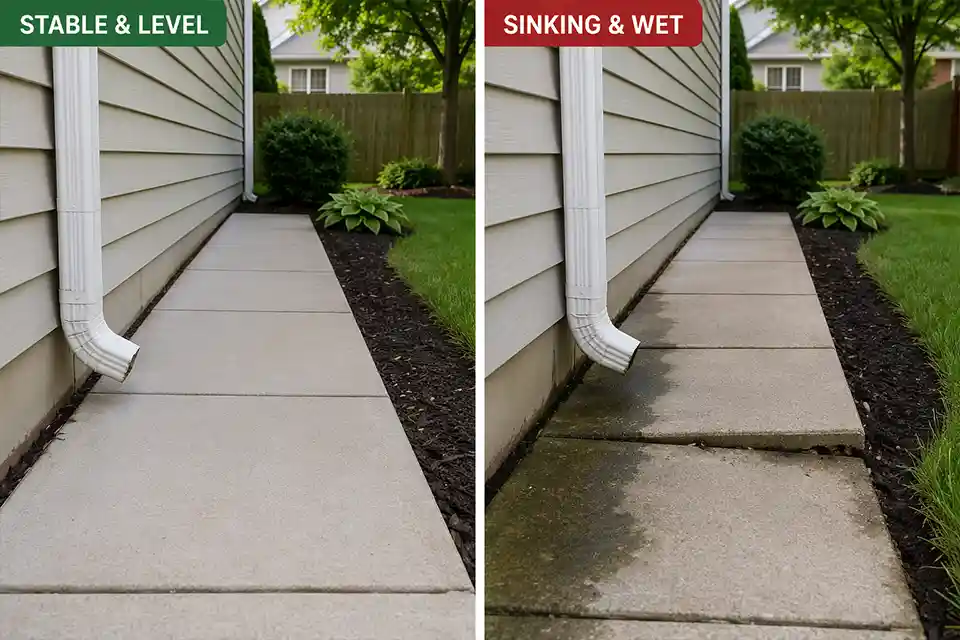
Walkways near roof discharge points often fail selectively rather than uniformly. One panel gets repeat wetting. The next one does not. That difference is enough to separate a stable section from a recurring low spot.
The same core mechanism appears in Why Walkways and Concrete Patios Sink From Long-Term Water Exposure, but here the important distinction is uneven exposure within the same run.
Driveway side strips and repeated wheel paths
Driveway edges often sink faster than center sections because the same 12- to 24-inch strip keeps taking load while also sitting at a weaker boundary. People often assume vehicle weight is the full explanation. Usually it is not. Repeated loading matters most after the support underneath has already become less reliable.
Step landings and grade transition points
Transitions are small but high-risk zones. A step landing, path connector, or driveway-to-walkway junction can combine runoff redirection, support change, and concentrated foot traffic in one narrow area. These are often the first places where the site shows that one zone is no longer behaving like the rest.
What usually causes one section to fail before the rest
Not every possible cause deserves equal weight. The most common pattern is concentrated moisture acting on a weaker-than-average support zone. Everything else usually builds on that.
Concentrated moisture usually matters more than general weather
A single bad water path can do more damage than a long stretch of ordinary rain. Downspouts, roof valleys, hose leaks, irrigation overspray, planter overflow, and runoff from higher grades all create repeat wetting in one narrow area. That section stays softer longer, drains slower, and starts losing support earlier than the rest.
Readers often overestimate “rain” and underestimate “repeat water in the same exact place.” That is the more useful distinction.
Disturbed or filled ground often explains the speed of failure
If one section was regraded, trenched, or backfilled during utility work, drainage correction, landscaping, or an addition, it often behaves differently from the original undisturbed ground beside it. This is especially common in the first 12 to 36 months, when normal wet-dry cycles begin exposing compaction gaps that were easy to miss at installation.
That pattern pairs naturally with Uneven Walkway Surfaces Caused by Recently Filled or Disturbed Soil. The important point here is not just that the soil was disturbed. It is that disturbed ground often fails earlier and more selectively than the surrounding area.
Edge support is weaker than it looks
A border, perimeter, or side strip may look finished and solid while the support underneath is less stable than the center. Once water starts escaping there, or the edge begins relaxing, settlement often accelerates faster than homeowners expect. That is why visible edge drops are often under-read at first.
Seasonal soil movement can amplify a weak zone
In clay-sensitive yards, repeated wet-dry cycling can keep stressing one vulnerable section until it starts settling faster than the rest. The soil does not always need dramatic erosion to create the problem. It can gradually loosen the support through expansion and contraction.
That is where Seasonal Soil Expansion and Contraction becomes useful context: the section with the biggest moisture swing is often the section that fails first.
What people usually misdiagnose
The wrong repair often starts with the wrong reading of the symptom.
“It is just the surface” is usually the first mistake
Loose pavers, open joints, or a small dropped slab edge make people focus on what they can see. But the surface is usually just reporting a support problem underneath. That distinction matters because surface-only repairs can look successful without changing why the section moved.
Age gets too much blame
Older surfaces do carry more risk, but age alone does not explain why one section failed first while the rest stayed serviceable. A 12-year-old patio with stable drainage can outperform a 3-year-old walkway edge sitting over weak fill. How Long Outdoor Surfaces Last helps frame that well: years matter, but conditions matter more.
Staining, algae, or moss are usually location clues
Dark patches and green growth are easy to overread because they are visible. They usually matter most as indicators of where moisture lingers. They mark the zone. They rarely explain the whole mechanism.
Seasonal movement is often dismissed too long
A section that seems to “come back” after weather changes can look harmless. But when the same zone keeps reopening joints, holding water, or dropping again within 3 to 6 months after a reset, it is no longer a mild seasonal quirk. It has become a repeating failure pattern.
Quick diagnostic checklist
- The low section is within about 5 to 10 feet of a downspout, splash zone, irrigation edge, or roof runoff path
- Water remains there longer than 24 hours after rain while surrounding sections dry sooner
- The area was filled, trenched, regraded, or rebuilt within the last 1 to 3 years
- The movement is concentrated at a corner, edge, lane, or transition instead of the entire surface
- A walking route now has around a 1/2-inch or greater height change
- The same spot settles again within one wet season or within 3 to 6 months after a repair
Why the obvious fix keeps disappointing
The most common wasted fix is correcting the visible dip while leaving the weak zone untouched.
Sweeping in more joint sand, applying a thin patch, or resetting only the lowest few units can sometimes work when the problem is shallow, dry, and isolated. It usually disappoints when runoff still reaches the area, when the base remains soft, or when the disturbed soil around the dip is still consolidating.
When a localized repair is still reasonable
A localized reset can still make sense if the dip is small, the surrounding area is dry and firm, moisture has already been redirected, and no nearby sections are showing the same pattern. A one-time edge drop under about 1 inch is not the same thing as a recurring depression that keeps returning after rain.
When the standard fix stops making sense
It stops making sense when the same section moves again after one season, when adjacent joints begin separating too, or when the surface looks level for a short time but the low spot returns after the next wet cycle. At that point, the problem is no longer just where the dip is visible. The repair boundary is too small or the water path is still active.
That is where Poor Compaction Under Outdoor Surfaces: Causes, Signs, and Long-Term Fixes becomes the more useful lens. Once support has become unreliable underneath, surface-only correction turns into a cosmetic loop.
Pro Tip: If the same area settles again after the next wet period, stop refining the surface finish and start tracing where moisture enters, where it exits, and how far the weak base condition extends.
How to tell what kind of sinking you are dealing with
Not every sunken section points to the same repair path. The useful distinction is whether you are looking at a one-time local drop, an active moisture-driven failure, a seasonal movement zone, or a broader support problem.
| What you see | Most likely cause | What it usually means | Repair direction |
|---|---|---|---|
| Small isolated dip, otherwise dry and stable | Minor local settlement or edge relaxation | Support changed once, but may not still be actively failing | Lift and reset the localized section after checking drainage |
| Dip keeps returning near runoff or discharge | Ongoing washout or moisture-softened base | The cause is still active below or beside the surface | Redirect water and rebuild the affected base zone |
| Area rises and drops with weather in clay-heavy ground | Shrink-swell soil movement | Moisture cycling is repeatedly stressing the same section | Improve drainage consistency and rebuild selectively where support is compromised |
| Long depression along an edge or traffic strip | Weak support plus repeated loading | Load is accelerating failure in a vulnerable band | Rebuild a wider section instead of only the visible low point |
| Settlement above recently filled or trenched ground | Delayed consolidation or poor compaction | The support layer never fully stabilized | Remove weak material as needed and rebuild in properly compacted lifts |
What actually changes the outcome
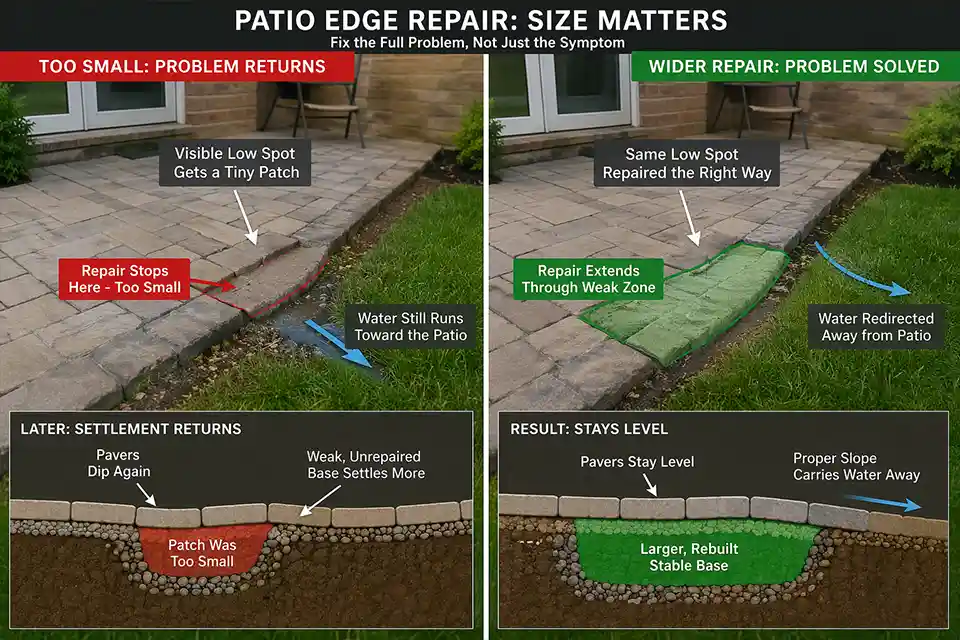
The repair that lasts is usually wider than the defect you can see.
That is the point people most often underestimate. The visible dip is often just the center of a wetter, weaker, or less stable support zone. A repair that stops at the visible low point can restore level temporarily and still fail again because the surrounding weak conditions were left in place.
Follow the water before touching the surface
Watch where water comes from and where it should leave. Do that during rain if possible, or within the first 30 to 60 minutes after a storm while the path is still obvious. That often tells you more than the finished surface ever will.
Define the weak zone, not just the low spot
Check beyond the dip. Look for widening joints, soft edges, damp base material, hollow-sounding sections, or neighboring movement. Those are the clues that tell you how far the real repair boundary extends.
Rebuild until conditions change
The right stopping point is not where the surface looks level again. It is where the support becomes firm, drainage is controlled, and adjacent material is no longer showing the same failure pattern. Small repairs fail because they restore elevation before they restore conditions.
Pro Tip: Measure the drop, then measure it again 60 to 90 days later. Repeated movement over that window is more useful than a single snapshot because it tells you whether the problem is still active.
That is also why Surface Problems Rarely Fix Themselves fits naturally in this topic cluster. Faster sinking is rarely random. It usually identifies the first place where site conditions stopped being consistent.
The bottom line
Some patios, walkways, and outdoor edges sink faster because one part of the site is being asked to absorb more water, less stable soil history, weaker edge support, or more repeated stress than the rest. The visible dip tells you where the problem showed up first. It does not tell you that the surface itself is the whole problem.
The most useful question is not “why is this spot lower?” It is “what changed under this spot before the rest of the area caught up?” Once that becomes clear, the right fix usually becomes much easier to choose.
For broader official guidance, see North Carolina Geological Survey’s expansive soils guidance.