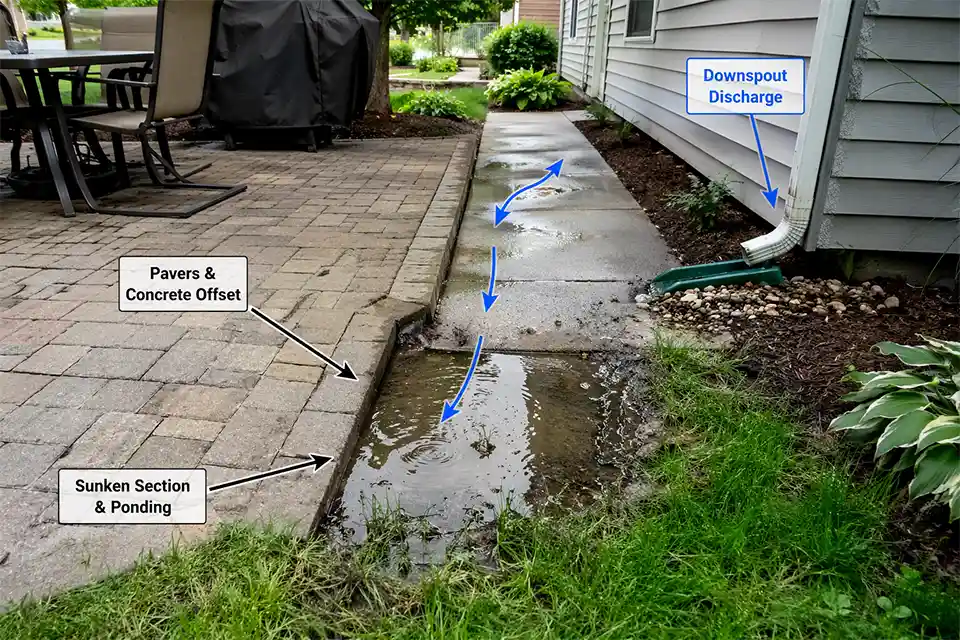
Long-term ground instability outdoors usually means the surface is no longer the real problem. If the same low spot comes back within 6 to 12 months, holds water for more than 24 hours after a normal rain, or creates roughly 1/2 inch or more of height change in a walking path, the issue is usually active support loss below the surface rather than ordinary wear on top. That is the first distinction that matters.
The next checks are more useful than most people expect. Look for a downspout discharging within about 3 to 5 feet of the affected area, irrigation that wets the same edge repeatedly, or a narrow settlement strip that lines up with old trench work, backfill, or a recent grade change.
Then check whether the footprint is spreading. A patio corner that dipped once and stayed stable is one thing. A 2- to 6-foot zone that gets wider or softer after every wet period is something else.
This is where people lose time. They reset a few pavers, add sand, patch a slab edge, or top off gravel because the visible problem looks small. But repeated sinking is rarely a finish-layer problem. It is a support problem that keeps showing through the finish.
What this usually means
Long-term instability usually points to one of four patterns: repeated water concentration, weak base compaction, settlement in disturbed soil, or gradual washout below the support layer. Those causes do not deserve equal weight in every case. Water and support loss usually matter more than the surface material itself.
The strongest signal is repetition
A worn surface can still be structurally fine. A surface that keeps dropping in the same area usually is not. If the same section has already been corrected once and starts moving again within one wet season or within a year, that is no longer routine maintenance. It is evidence that the support condition below is still changing.
The visible symptom is not the mechanism
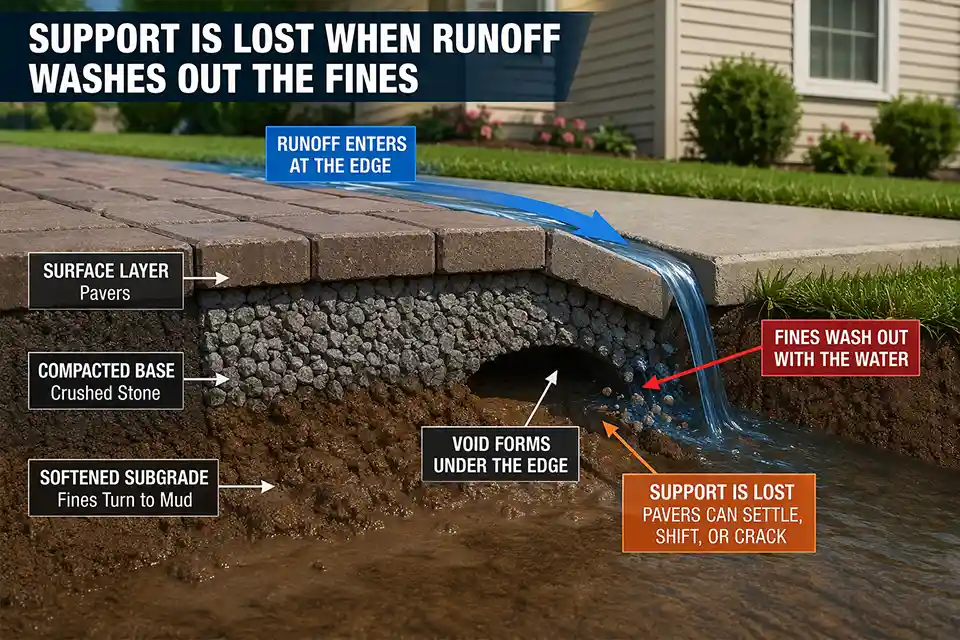
A dipped patio edge, spreading paver joints, or a walkway panel that no longer sits flush is the symptom. The mechanism is usually lower: fines washing out, base support thinning, fill settling, or moisture repeatedly softening weak soil.
That is why surface-only repairs disappoint. They improve appearance without changing why the section keeps losing bearing.
This is also why Why Some Outdoor Areas Sink Faster is the right supporting read here. Age alone usually is not the reason one section fails early. Faster support loss usually is.
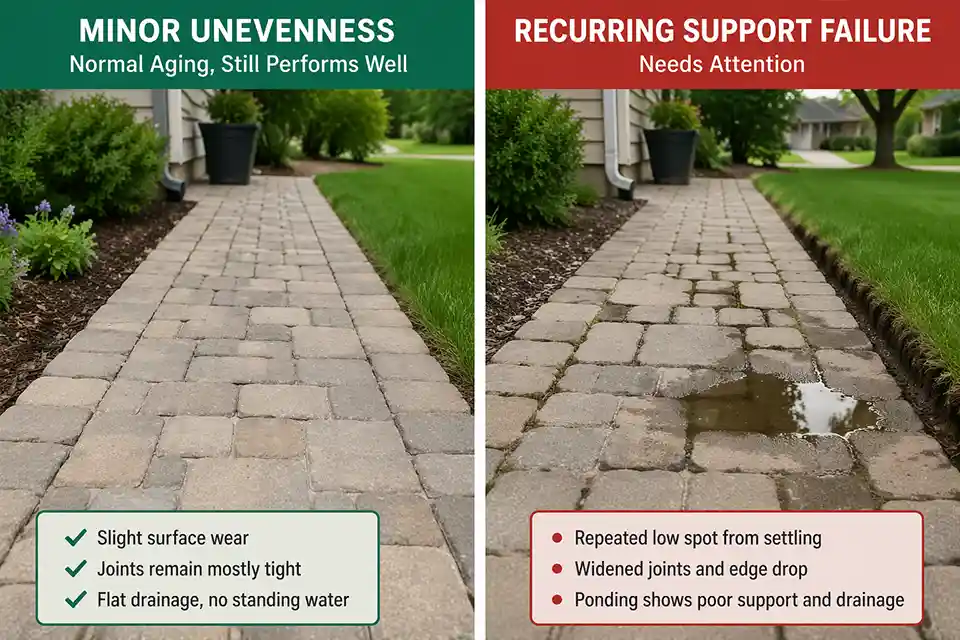
What people usually misread first
The most common overestimate is roots. The most common underestimate is water.
Roots get blamed too early
Roots certainly lift hardscape, but they are less often the main cause of recurring sinking. If the surface is dropping rather than heaving, and especially if the low point sits near runoff, irrigation, or disturbed fill, water-related support loss is usually the better first diagnosis. People reach for the root explanation because it is familiar. That does not make it the most likely one.
Small repeated water exposure matters more than one big storm
One heavy storm can reveal a weak area. Repeated wetting is what keeps it active. A downspout draining too close to a walkway, irrigation striking the same strip every morning, or runoff crossing one patio edge during every storm can slowly move fines out of the base and soften the soil below.
The damage often starts quietly. A darker damp patch that dries 24 to 48 hours later than the surrounding surface is more useful diagnostically than minor staining or a hairline crack.
Disturbed soil is easy to forget and expensive to ignore
Older utility work, fence lines, newer home backfill, recent grading, and patched landscaping zones often explain why one narrow strip keeps dropping while the rest looks fine. When settlement follows a line instead of spreading evenly, disturbed fill deserves attention early.
That broader mechanism is also where Uneven Outdoor Surfaces From Soil Movement supports the diagnosis, especially when the instability is tied to soil behavior rather than simple surface aging.
What to do next based on what you are seeing
This is where the article needs to decide, not just describe. Different sinking patterns call for different repair logic.
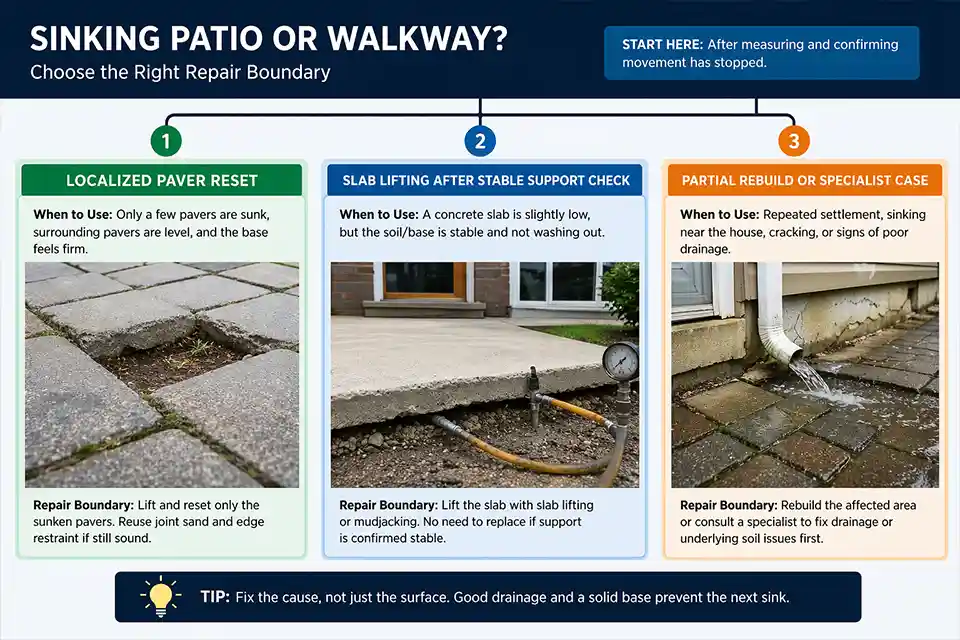
Small localized dip in pavers
If the settled area is limited, surrounding pavers are firm, and the drainage issue has already been corrected, lifting and resetting that local section can be reasonable. This works best when the dip is shallow, the footprint is contained, and the area has not already failed again after one repair.
Sunken slab edge with otherwise stable support
If one slab corner or edge has dropped but the surrounding area still feels firm and stable, targeted correction or lifting may make sense. But only if the cause of water entry or support loss is addressed first. Height correction without water-path correction is usually a temporary win.
Repeating settlement near runoff or backfill
If the same 2- to 6-foot area keeps settling, gets soft after rain, or starts ponding again within months, the repair usually needs to go below the surface. At that point, another top-side correction is mostly delay.
Movement tied to the house, porch, or steps
When a sinking patio or walkway is near steps, an entry landing, a porch, or the house edge, the threshold for concern should be lower. A widening gap, detached step, or water now moving back toward the structure changes the job from surface correction to broader site diagnosis.
Comparison guide: manageable condition vs active failure
| Condition | More manageable condition | Active failure condition | Smarter next move |
|---|---|---|---|
| Settlement pattern | One-time shallow dip | Same area returns within 6 to 12 months | Investigate support zone |
| Water behavior | Clears same day | Ponds more than 24 hours | Correct drainage path first |
| Height change | Minor cosmetic variation | About 1/2 inch or more in a walking zone | Treat as functional hazard |
| Repair history | One correction held | Repeated topping, filling, or resetting | Stop surface-only patching |
| Footprint | Small contained area | Expanding 2- to 6-foot zone or more | Partial rebuild often smarter |
Why the obvious fix often fails
The obvious fix fails when it treats the symptom after the mechanism has already gone active.
Re-leveling is not the same as solving
Re-leveling pavers, adding bedding material, or filling a depression can still be valid if the support condition has stabilized. But once the weak zone is taking on water, losing fines, or continuing to consolidate, that correction becomes cosmetic maintenance rather than actual repair.
Surface-only repair wastes the most time in two situations
The first is when runoff still enters the same area. The second is when the repair has already been repeated once. That is usually where the logic changes. The job stops being “smooth the surface” and becomes “restore support.”
This is exactly where Walkways and Concrete Patios That Sink From Water Exposure becomes highly relevant, because repeated water exposure is often the reason an area keeps failing after it was supposedly fixed.
Pro Tip: Watch the area during an actual storm, not just in dry weather. Five minutes of runoff observation can reveal more than a long visual inspection after everything looks normal again.
The causes that deserve attention first
This is not a topic where every possible cause deserves equal space. Some causes change the repair decision much faster than others.
1. Repeated water concentration
This is usually the highest-value cause to investigate first. Downspouts, poor grading, irrigation overspray, runoff crossing hardscape, splash zones, and localized leaks are all more important than many readers assume. They not only trigger settlement. They keep it active.
2. Weak or thin base support
Pedestrian hardscape often depends on a compacted base around 4 to 6 inches deep. Heavier-use areas may need 8 to 12 inches or more depending on soil, loading, and design. Where the base is thin, unevenly compacted, or built over loose fill, repeated wetting and traffic expose that weakness faster.
3. Disturbed or backfilled soil
Settlement over utility trenches, newer home perimeter fill, additions, or reworked landscaping often follows a narrow pattern. That narrow pattern is easy to miss if you focus only on the surface material.
4. Climate-driven soil movement
In clay-heavy regions, moisture swings can move support more than people expect. In northern freeze-thaw climates, trapped moisture accelerates breakdown. In dry states, the surprise is often not rainfall but irrigation concentration over old disturbed fill. In wetter climates, recurring saturation and edge washout usually matter more than one single event.
When the standard fix stops making sense
There is a point where patching costs less per visit but more overall because it never changes the outcome.
Signs you are already past that point
If the same area has been corrected twice in 12 months, if the footprint is expanding laterally, if ponding is worsening, or if multiple edges are now involved, surface-only correction is usually no longer the smart move. The area may still look mostly intact. The repair logic has still changed.
When rebuilding becomes the smarter choice
A partial rebuild usually becomes more rational when support loss extends beyond one isolated dip, when surrounding sections are starting to move too, or when opening the area reveals broader softness or washout below. That does not always mean full replacement. It does mean the real job is now below the surface line.
That is also where Normal Wear vs Hazardous Walkway Damage helps sharpen the distinction, because modest-looking settlement can still be more important than rough-looking wear if it creates unstable footing or keeps worsening.
When this stops being just an outdoor surface problem
Not every sinking patio or walkway has structural implications. Some do, and the difference matters.
Escalation signs worth taking seriously
If steps start pulling away from a porch, if a slab or landing separates from the house, if runoff now travels toward the foundation instead of away from it, or if the area near an entry begins behaving differently, concern should rise. The issue may still begin outdoors, but it is no longer only about an exterior walking surface.
This is one reason Surface Problems Rarely Fix Themselves fits naturally into the article body. Once instability starts changing drainage, and drainage starts feeding more instability, delay usually makes the repair area larger.
Quick diagnostic checklist
- The same low spot returned within 6 to 12 months
- Water sits there longer than 24 hours after rain
- Height change is about 1/2 inch or more in a walking path
- The area sits near runoff, irrigation, trench backfill, or disturbed soil
- Re-leveling, topping off, or patching has already been tried once
- The footprint is spreading beyond one small section
If three or more of those are true, treat it as active support loss rather than ordinary surface wear.
What people fix too early and what they fix too late
People often blame roots too early, replace surface materials too early, and trust a fresh-looking patch too early. Those are understandable mistakes.
What they often fix too late is the runoff path, the discharge point, the disturbed fill zone, or the base that keeps losing support. That is the real divide between a repair that lasts and one that simply resets the countdown.
The smartest order is usually this: define the water path, define the unstable footprint, correct the support condition, then reset or replace the surface. In long-term ground instability, sequence matters almost as much as the repair itself.
For broader guidance on drainage and support conditions under paver-style hardscape, see the North Carolina DEQ permeable pavement guidance.