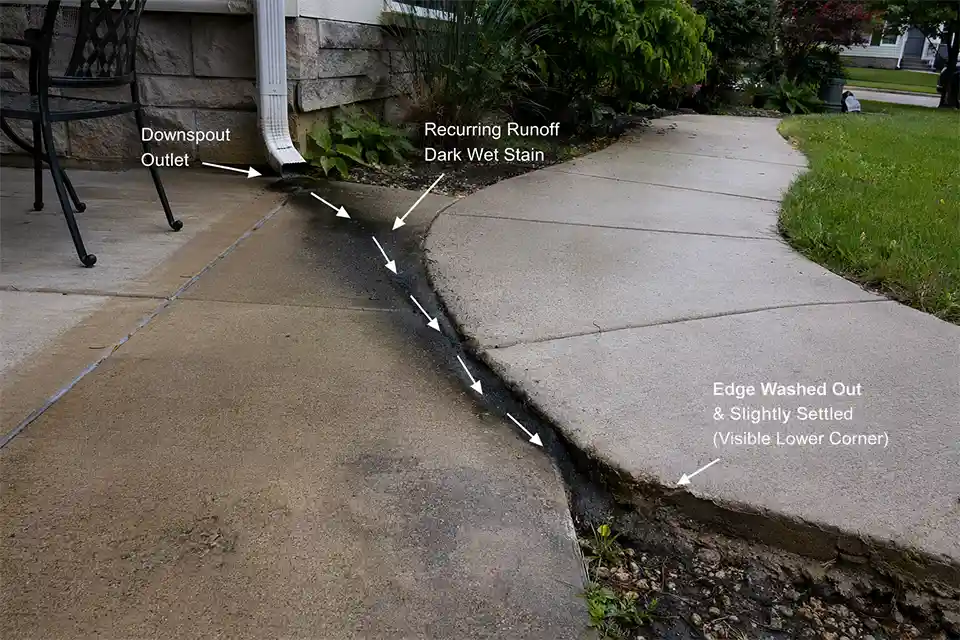
 Most drainage damage does not begin with a dramatic crack or a collapsed section. It begins with a pattern. One strip stays darker 12 to 24 hours longer than the rest. One edge keeps losing joint material.
One corner dries slowly after every storm. If water is ponding for more than about 24 hours, or the same 2- to 4-foot band keeps showing dampness, fines loss, staining, or movement, the surface is usually not failing randomly. It is reacting to a repeat water route.
That is the key difference this issue has from a general “patio drainage problem.” The useful question is not just whether the area gets wet. It is how the wetting shows up on the surface, where it repeats, and what kind of damage signature it leaves behind.
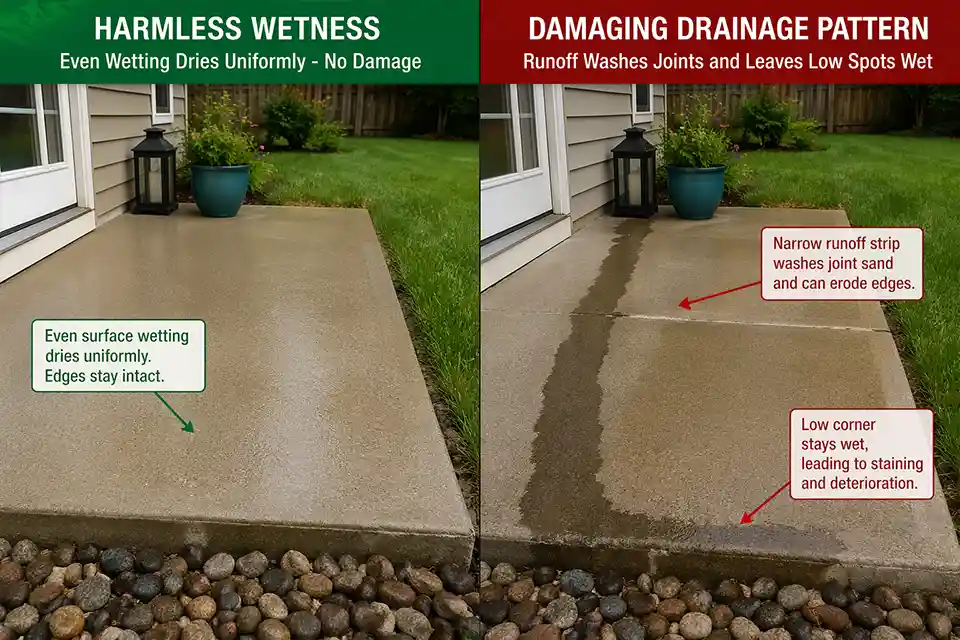
A surface-wide damp look after rain can be normal. A narrow runoff stripe, recurring edge washout, or one low pocket that keeps returning is far more diagnostic. Those are the clues that help you separate harmless wetting from early support loss below the finish.
The damage pattern usually tells you more than the water source
People often start by looking for the source: the downspout, the sprinkler head, the slope above the patio. That matters, but the surface usually tells the better story first.
A narrow wet strip usually means repeated flow, not general moisture
When the same narrow band stays darker longer than surrounding sections, it usually means water is crossing the surface in a repeatable line. That is a different condition from a broad area that simply got wet in the rain. Repeated flow lines often create the first visible signal before any major settling appears.
This is where many surfaces begin to resemble the early stage of walkways and concrete patios that sink from water exposure. The visible issue is still small, but the important clue is the repeat route, not the size of the stain.
Edge damage usually points to concentration, not age
A surface that is simply old tends to wear more diffusely. A surface that is taking concentrated runoff tends to show damage at one edge, one outlet point, or one border where water keeps entering or exiting.
That is why washed joints, soft borders, and erosion pockets at the perimeter are more useful than general discoloration when you are reading drainage damage.
One low corner matters more than broad dampness
A broad damp look can mislead people into thinking the whole installation is equally affected. Often it is not. One slightly lower corner that stays wet 24 to 48 hours longer than nearby sections is a stronger sign than widespread surface moisture right after rainfall. That low corner is where repeated saturation starts changing support conditions.
What different drainage patterns look like on the surface
This is where the article should earn its keep. Different drainage patterns tend to leave different visible signatures. That reading matters more than listing every possible water issue.
Concentrated discharge often leaves a fan or impact zone
When water exits from one point, the surface damage often spreads outward in a fan, wedge, or impact strip. You may see darker staining near the outlet, then a thinning border of lost fines or jointing material beyond it.
On pavers, this often shows up first as loosened joints and slight edge instability. On concrete, it may show up as repeated wetting at a corner or near one perimeter seam.
Cross-surface runoff usually creates a diagonal wear lane
When water cuts across a patio or walkway from higher ground, the clue is often a diagonal dark band, not a circular pond. That lane may later become the slickest strip, the dirtiest strip, or the strip with the earliest joint loss. People often treat that as a cleaning problem because it looks cosmetic before it looks structural.
It is also one reason early signs of outdoor surface failure are easy to miss. The first visible clue may be a recurring lane, not a broken surface.
Bottom-of-slope collection usually leaves a soft, slow-drying edge
Where water arrives and lingers at the lower end of a site, the surface often tells on itself through delayed drying, darkened joints, algae at the perimeter, or a muddy border. In northern climates, that same wet edge is often where freeze-thaw wear becomes more obvious because it holds moisture longer.
Chronic overspray usually weakens one perimeter instead of the whole field
Sprinkler or irrigation overspray rarely damages the entire patio evenly. It tends to keep one border, one side path, or one transition strip wetter than it should be. That is why the pattern often looks like a maintenance nuisance first. But if the same edge stays soft, green, dark, or unstable over weeks and months, that repeated wetting is no longer just cosmetic.
Pro Tip: The first 3 minutes of a manual irrigation cycle usually show the bad pattern faster than waiting for a full watering cycle to end.
What people usually misread first
Drainage damage gets misdiagnosed when readers focus on what is easiest to see instead of what is most informative.
Stain is not cause
A dark band can be helpful, but it is only a marker. The actual mechanism is repeated water movement, slow drying, fines migration, or base weakening. Cleaning the stain may improve appearance, but it does not change the route that caused it.
Slippery does not always mean structural
Some surfaces become slick long before they become unstable. A traction issue can still matter, but it is not the same as support failure. The stronger clue of structural change is not that the surface gets slick.
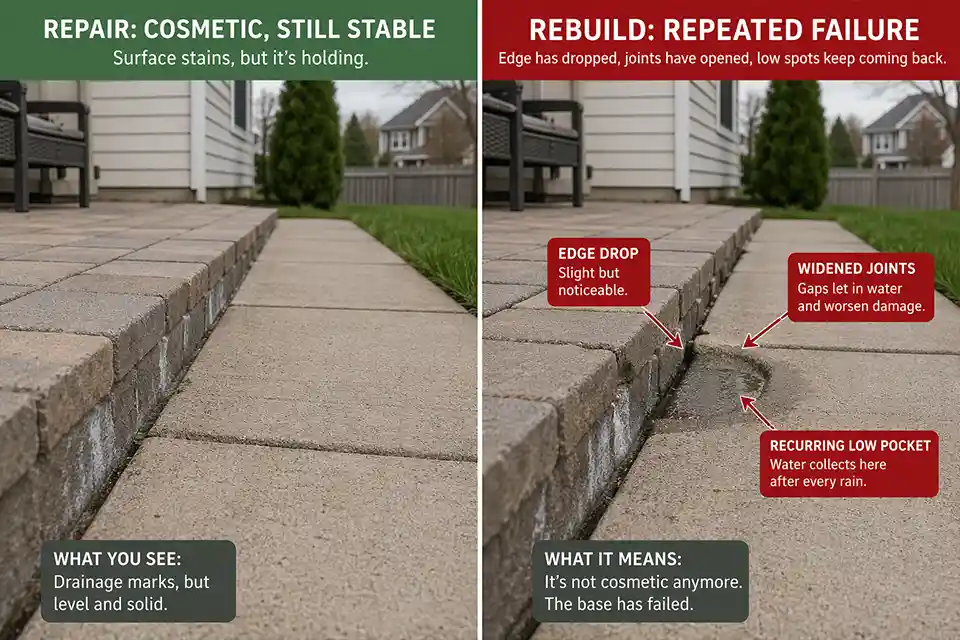
It is that one edge starts dropping, one paver starts rocking, or one lip reaches roughly 1/4 inch or more and keeps returning.
That is the line where normal wear and hazardous walkway damage becomes the better comparison. What matters is not just appearance. It is whether the pattern now affects stability underfoot.
Resealing often hides the pattern without fixing it
This is one of the most common wasted fixes. If the same dark strip returns, the same low corner stays wet, or the same border keeps washing out within 6 to 12 months, the drainage path is still active. A fresh-looking surface can still be losing support below.
Which damage patterns suggest support loss below the surface
Not every visible drainage mark means rebuild territory. But some patterns are much more serious than others.
Repeating movement in the same line
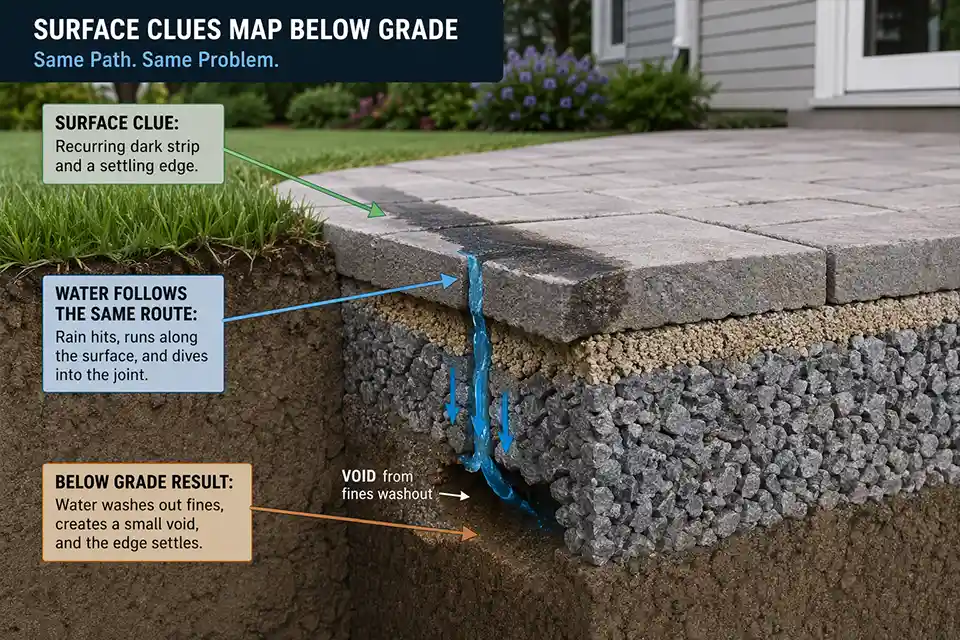
If rocking units, widening joints, or slight settlement keep reappearing in the same strip, that usually means the surface is tracing a below-surface weakness. Random cosmetic wear rarely behaves that consistently.
Recurring edge drop
An edge that is only dirty can be cleaned. An edge that keeps dropping after refill or touch-up usually points to water repeatedly weakening support near the perimeter. This is where the visible pattern shifts from surface symptom to ground condition.
That overlap matters because uneven outdoor surfaces caused by soil movement often look like minor finish issues at first. The repeat location is what gives them away.
A low spot that returns after minor correction
If a shallow low pocket comes back after patching, leveling, or joint refill, routine maintenance has probably stopped making sense. Surfaces do not keep reforming the exact same depression for no reason. There is usually an active drainage route or weakened support zone feeding it.
A practical guide to reading the pattern correctly
| Surface clue | What it usually means | Often overestimated | Often underestimated |
|---|---|---|---|
| Narrow wet strip | Repeated runoff line | “It is only staining” | Active flow path |
| Washed joint line | Fines migration or edge flow | “The sand just disappeared” | Early support loss |
| Low wet corner | Collection point or slow drainage | Total surface failure | Persistent saturation risk |
| Rocking pavers in one band | Base weakening below a route | Isolated loose units | Patterned instability |
| Dark border near irrigation | Chronic overspray | Dirt or shade alone | Repeated edge saturation |
This is also where broad “drainage problem” articles often stop too early. They name the symptom, then jump to solutions. The better move is to decide whether the pattern says clean it, redirect water, or rebuild support.
When the damage pattern stops being a maintenance issue
Routine maintenance still makes sense when the issue is mostly superficial: a damp-looking section, a dirtier strip, or mild algae where the surface remains firm and level. But the logic changes when the pattern becomes persistent, localized, and structural.
Maintenance still makes sense when the surface is stable
If the finish is intact, the surface stays firm, and the pattern is limited to appearance or traction, you may only need cleaning, irrigation correction, or better runoff control nearby.
Maintenance stops making sense when the same spot keeps failing
If the same edge needs refill more than once in 6 to 12 months, the same pavers keep rocking, or the same low area reforms after minor correction, the problem has probably moved below the finish layer. At that point, you are no longer dealing with a maintenance pattern. You are reading an instability pattern.
That is where long-term ground instability under patios and walkways becomes the better frame. The visible damage is still useful, but mainly because it reveals where support loss is being repeated.
Drainage does not leave random evidence. It leaves repeatable signatures.
The more precisely you read those signatures, the easier it becomes to tell harmless wetting from active support loss, avoid cosmetic fixes that waste time, and decide when the surface is warning you about a bigger problem below.
For broader official guidance, see Addressing Drainage Issues in the Urban Landscape.