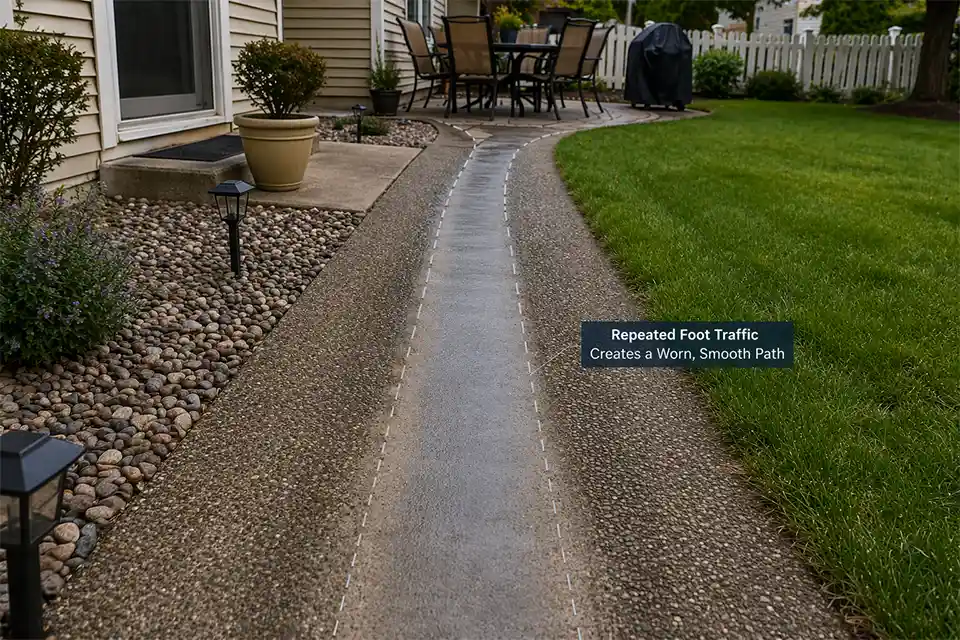
 Most outdoor traction problems are not really water problems. Water usually exposes the weakness. The real failure starts when the surface finish no longer provides enough texture under ordinary outdoor moisture.
The first checks should be practical: does the surface feel slick within 5 to 15 minutes of light wetting, is the main walking lane smoother than the surrounding area, and did the problem get worse after sealing, repeated pressure washing, or years of foot traffic? Those clues matter more than whether the patio or walkway gets wet at all.
That is the distinction people miss. A sound exterior finish should tolerate dew, irrigation overspray, and a brief rain event without suddenly feeling unsafe.
When it does not, the issue is usually finish wear, a bad sealer match, surface contamination sitting on a weak texture, or a finish that was never a strong outdoor choice in the first place.
If the area dries fairly fast but still loses grip early, you are usually looking at a finish-performance problem before anything else.
Which traction problem do you actually have?
Worn-smooth finish in the traffic lane
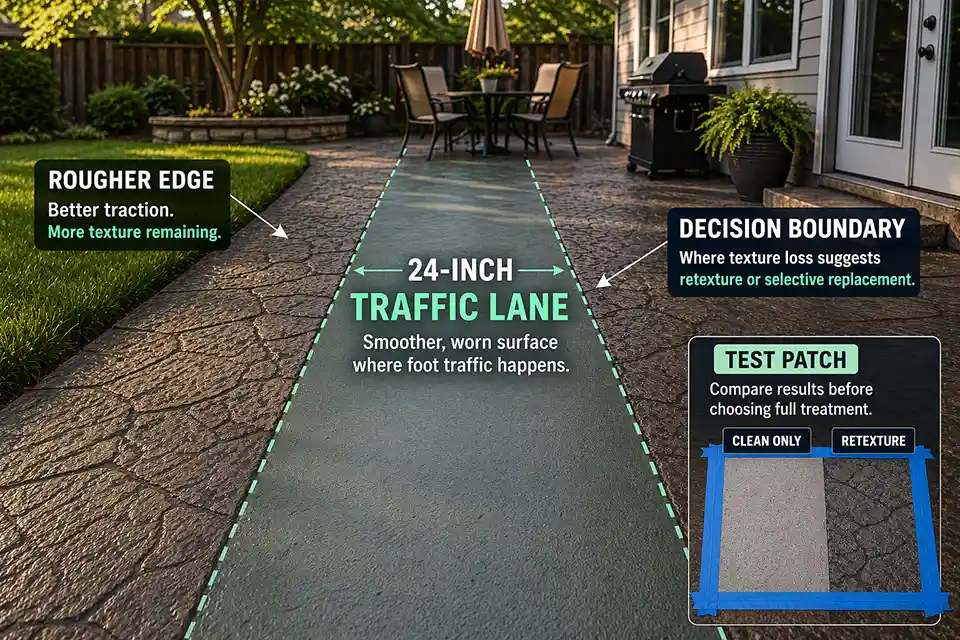
This is the most common pattern. The surface does not fail evenly. The repeated route from the back door to the grill, steps, gate, or driveway slowly polishes down first. That worn path is often only 18 to 36 inches wide, which is exactly why people underestimate it. The patio still looks acceptable overall, but the main route has already lost bite.
A protected edge or a section under furniture often tells the story faster than the worn lane itself. If that protected area feels sharper underfoot, the finish has changed enough to matter.
This is where Outdoor Courtyard Stone Worn Smooth becomes a better comparison than a general slippery-surface article. The useful clue is uneven wear inside the same installation.
Sealer-created slickness
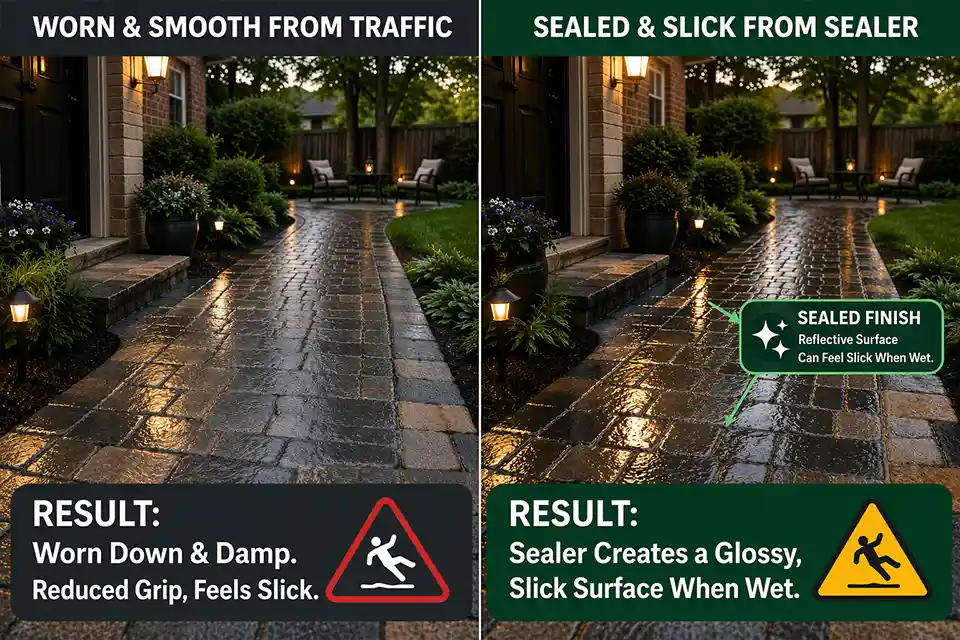
If the traction problem started within days or weeks of sealing, the sealer is not a side note. It is one of the leading suspects. Some products protect against staining or absorption but leave the surface less forgiving under light moisture, especially on already flat stone, tile, or pavers.
A slightly shinier or tighter-looking finish after sealing matters here. People often focus on the fact that the surface looks cleaner or richer in color, while missing that it now behaves worse when damp. In that situation, more cleaner is usually the wrong next move.
That is why Sealed Stone Patio Slippery After Sealing is often the more relevant path than jumping straight to replacement.
Thin residue or organic film on a vulnerable surface
Not every traction problem comes with visible algae or obvious grime. Sometimes the surface just develops a thin film from leaf tannins, shade moisture, body oils, grill grease mist, or fine organic buildup. The key point is that this film usually does its worst work on a surface that is already short on texture.
That is also why people misdiagnose it. They see a small improvement after cleaning and assume the problem was dirt alone. Then the slickness returns within 1 to 3 weeks because the real issue was weak finish plus recurring film.
Finish mismatch for outdoor use
Some surfaces are simply less forgiving outdoors once they see wet weather, shade cycles, or repeated foot traffic. A smooth-faced tile, over-refined stone, or surface chosen mainly for appearance can stay acceptable in dry conditions and then disappoint quickly in real outdoor use.
This matters because people often treat poor material or finish selection as if it were maintenance failure. It is not always fixable with better cleaning.
Drainage-assisted traction loss
This is where scope needs discipline. A drainage issue can feed a traction problem, but it is not always the primary mechanism. If the same zone stays damp longer, catches overspray, or sits under runoff, water delivery is helping the failure repeat. But if the surface would still be low-grip under ordinary dampness, the finish problem still comes first.
That is where Slippery Outdoor Walkways Poor Drainage belongs as a boundary topic rather than the center of this one.
What people usually misread first
Water gets blamed too early
Outdoor surfaces are supposed to get wet. That by itself is not the useful diagnosis. The real question is how much texture remains once a thin moisture film arrives. If one section stays manageable and another becomes slick after the same brief dampness, the difference is surface condition, not weather.
Cleaning gets too much credit
Cleaning matters, but it is often overestimated. If traction returns only briefly after scrubbing, the result is telling you something important: the finish is no longer carrying its part of the load. A maintenance win that lasts only a few days is usually not a true fix.
Full replacement gets suggested too early
People also overestimate how often replacement is necessary. If the base is stable, the units are sound, and the problem is concentrated in the finish plane, partial correction may still make sense. The expensive answer is not always the smart answer.
Traffic-lane wear gets underestimated
This is the one readers miss most often. They expect a traction problem to announce itself across the whole patio. In reality, the main walking route often fails first and keeps failing first.
Which finishes lose grip fastest?
| Surface or finish type | Usually fails by | What homeowners misread | Best correction path |
|---|---|---|---|
| Polished or worn-smooth stone | Texture loss under light moisture | “It only feels slick because it rained” | Retexture or selectively replace worn sections |
| Honed stone with problematic sealer | Tightened surface film | “The sealer protected it, so it cannot be the issue” | Strip or correct sealer, then retest |
| Smooth-faced outdoor tile | Low forgiveness when damp | “It is fine when dry, so the material is fine” | Surface-specific traction treatment or replacement |
| Broom-finish concrete worn down by age or washing | Reduced surface tooth | “It just needs stronger cleaning” | Deep clean, then assess texture restoration |
| Textured pavers with residue and bad top treatment | Film buildup on weakened grip | “The texture means it cannot be a finish problem” | Clean, review finish history, correct treatment system |
| Mixed patched sections | Inconsistent grip between zones | “Only the worst spot needs attention” | Standardize finish or rebuild mismatch areas |
That difference matters more than many general slippery-surface articles admit. A smooth-faced tile, a sealed flat stone, and an aging broom-finish concrete walkway may all feel slick, but they do not usually fail for the same reason and they do not deserve the same fix. That is one reason Why Outdoor Tiles Become Slippery should remain its own branch of the topic rather than being collapsed into a generic patio-cleaning conversation.
How to test the surface without overcomplicating it
Compare the actual traffic lane to a protected section
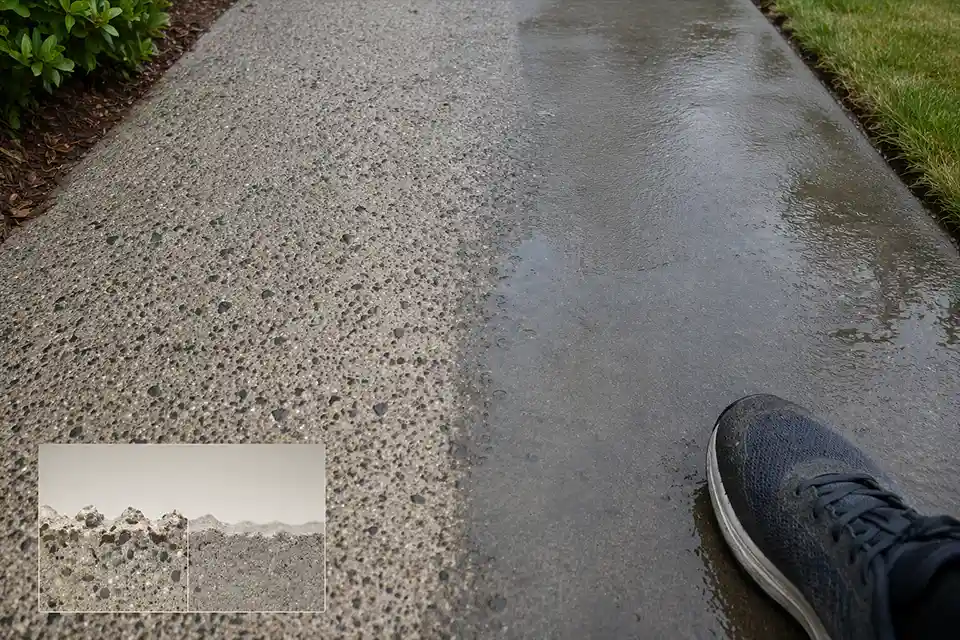
Start with the route people really use, not the cleanest-looking edge. Compare that lane to a section under a planter, bench, or perimeter area with lower wear. If the protected area feels rougher and more stable, that is a strong field clue that finish loss is real.
Use a controlled wet test
Clean one representative problem spot and let it dry fully. Then lightly re-wet both the suspect area and a nearby comparison area. If the suspect spot still feels low-grip within about 10 to 15 minutes while the better area stays more predictable, you are not dealing with dirt alone.
Use drying time carefully
A healthier surface in fair weather often regains usable grip as it dries over roughly 15 to 30 minutes. A failing one may stay risky longer or become slick again with the next dew cycle. Drying time matters, but only when you read it alongside texture, finish history, and where the problem repeats.
Pro Tip: Test with the same shoes on the same route. Traction comparisons get muddy fast when the test itself keeps changing.
Why the obvious fix often fails
Pressure washing can brighten a surface and still worsen performance
This is one of the more frustrating patterns in the field. The patio looks cleaner, so the owner assumes the surface must now be safer. But repeated aggressive washing can quietly reduce what little texture remains, especially on aging stone, decorative concrete, or already-marginal finishes.
Anti-slip products are not universal solutions
Some traction products help a lot. Some help briefly. Some only make sense after the finish or sealer problem has already been corrected. Putting a traction coating on top of a polished-down lane or a bad sealer history often creates a shallow win that fades fast.
Maintenance has a clear limit
If the same 2 or 3 zones keep returning to slick conditions after several cleanings over a few weeks, routine maintenance has stopped making sense as the main strategy. At that point you are managing a finish failure, not a housekeeping problem.
This is also where Smooth vs Textured Outdoor Surfaces: Which One Is Safer Underfoot? becomes a more useful supporting topic than a generic cleaning guide. The key issue is surface behavior, not just surface appearance.
The fix ladder that usually makes sense
1. Clean enough to see the real surface
Remove film, residue, and loose buildup first. Otherwise you are testing through contamination. But do not clean the whole site blindly. Start with one representative trouble zone.
2. Check finish history before buying products
If sealing happened recently, treat that as a lead clue. If not, look at wear concentration, repeated moisture exposure, and whether the surface choice itself was too smooth for the location.
3. Correct the finish problem before adding a traction layer
A worn lane, a bad sealer match, or a poor finish choice should be addressed before you trust a coating or additive. Otherwise the new treatment is sitting on top of the same failure pattern.
4. Retexture or selectively treat where the surface still has a future
This is the middle ground people skip. Mechanical retexturing, sealer correction, targeted traction treatment, or selective section replacement can solve the right problem without forcing a full tear-out.
5. Replace only when the finish problem is no longer isolated
Once low traction overlaps with unstable units, lipping, cracking, wide wear zones, or repeated moisture-fed failure across a broader area, the surface-only reading starts to break down. Then replacement deserves a more serious look.
Where traction loss becomes a bigger safety problem
Location matters as much as slickness. Outdoor stairs, short sloped runs above about 5 percent grade, pool transitions, and the main path between the back door and driveway deserve quicker action because a short loss of footing carries a bigger consequence there.
That does not automatically turn the issue structural. It just means performance failure matters sooner. This is where Outdoor Surfaces Unsafe, Slippery, or Uneven becomes a useful adjacent read, especially when a low-traction problem starts overlapping with broader safety concerns.
The decision point most people miss
The useful question is not whether the surface gets wet. It is whether the finish still provides enough grip under normal outdoor exposure. Once the answer becomes no during dew, brief rinse water, light shade dampness, or ordinary foot traffic, the problem has moved beyond cosmetic annoyance.
People usually wait too long because the surface still looks intact, and they also waste money when they jump too quickly to universal coatings or full replacement. The better path is sharper than that: identify which failure type you actually have, test the real traffic lane, correct the finish problem first, and only widen the repair when the evidence says the surface has outgrown finish-level fixes.
Once grip drops under ordinary moisture, this is no longer a cleaning annoyance. It is a finish-performance failure.
For broader official guidance, see the U.S. Access Board guidance on floor and ground surfaces.