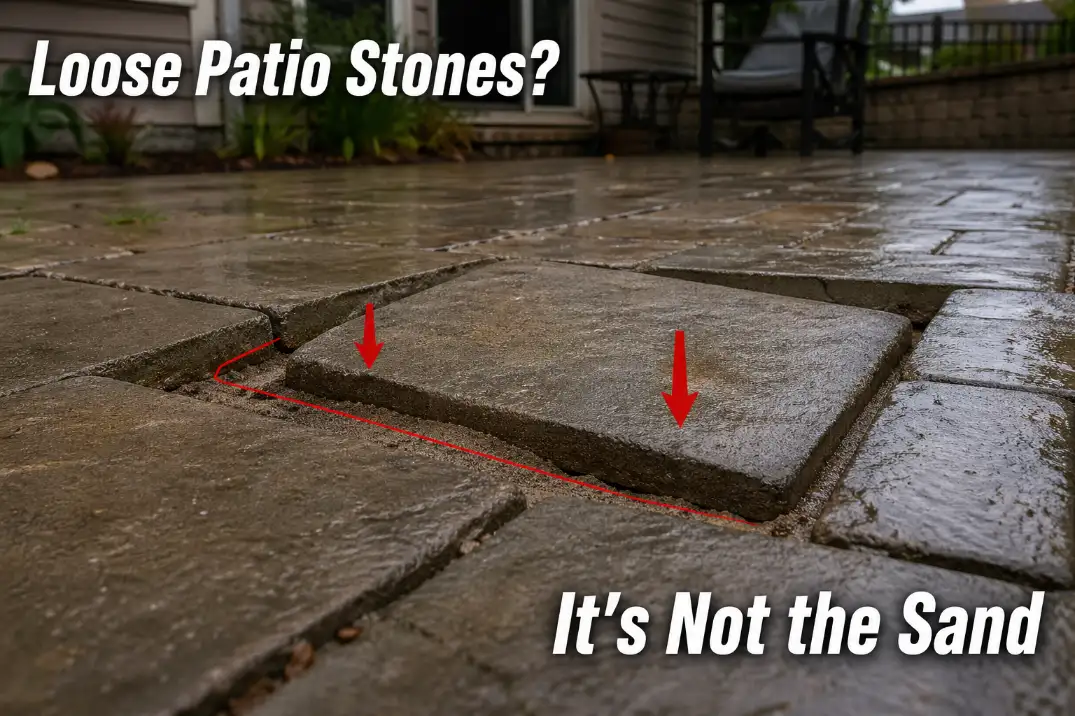
Loose patio stones that start forming wider gaps usually point to movement below the surface, not a problem with the stone itself.
The first checks are whether the gaps are opening in one direction, whether any stone has dropped more than 1/4 inch, and whether joint filler disappears again within 2–4 weeks.
A small seasonal joint change can be normal. A stone that rocks, clicks, tilts, or spreads away from neighboring stones is different.
The most likely cause is uneven settlement in the bedding layer, compacted base, or soil below the patio. That distinction matters because sweeping in more sand may improve the look for a few days, but it will not stop movement if the support system underneath is still sinking, washing out, or spreading.
First, Decide What Kind of Movement You Have
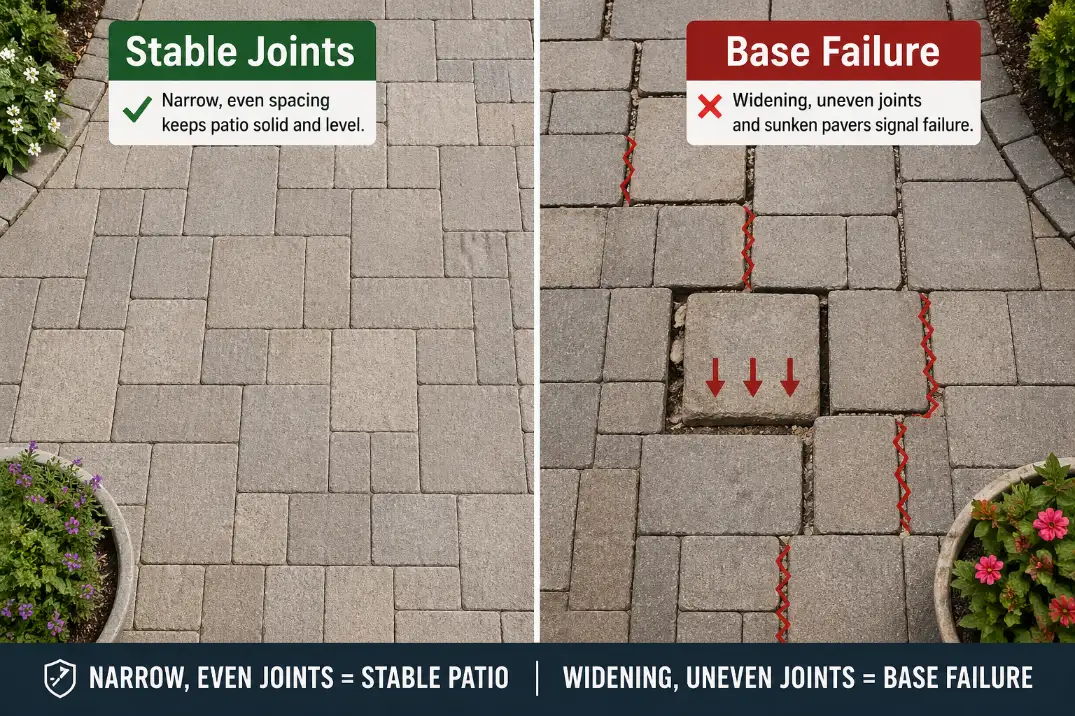
Gap-only movement is different from loose-stone movement
If the stones are still flat, tight, and firm underfoot, the issue may be limited to joint loss. If the stones move when stepped on, the gap is only the visible symptom. The real problem is loss of support.
Use a 4-foot level or straight board across the area. If neighboring stones vary by more than 1/2 inch, or if a chair leg catches in the gap, this is no longer a simple maintenance issue. It is a stability and trip-risk problem.
Border movement points to edge failure
When the widest gaps appear near the outside row, the patio edge may be creeping outward. This is common near lawns, planting beds, and slopes where soil slowly erodes away from the patio perimeter.
If the outer stones are loose but the center field still feels stable, check the edge restraint before blaming the entire base. If the gaps continue inward across several rows, the base or subsoil is more likely involved.
Match the Fix to the Type of Patio Stone
Concrete pavers
Concrete pavers are usually the most forgiving to repair. They can often be lifted, the bedding corrected, and the same pavers reset. The key is not to overbuild the bedding sand.
A thick sand layer may feel like an easy leveling shortcut, but it compresses and shifts more easily than a properly compacted aggregate base.
Large patio slabs
Large square or rectangular slabs are less forgiving. A small void under one corner can make the slab rock even when the surface looks mostly level. With slabs, the priority is full support under the piece, not just a neat joint line.
Irregular flagstone
Irregular flagstone can have wider joints by design, so the joint width alone is not always the warning sign. The warning sign is movement. If the stone rocks, the bedding below it needs attention, whether the joints are filled with stone dust, sand, gravel, or mortar.
This is where many homeowners misread the problem. Loose filler looks like the failure, but the filler often left because the stone was already moving.
Why Ground Settling Opens Patio Gaps
The base settles before the surface separates
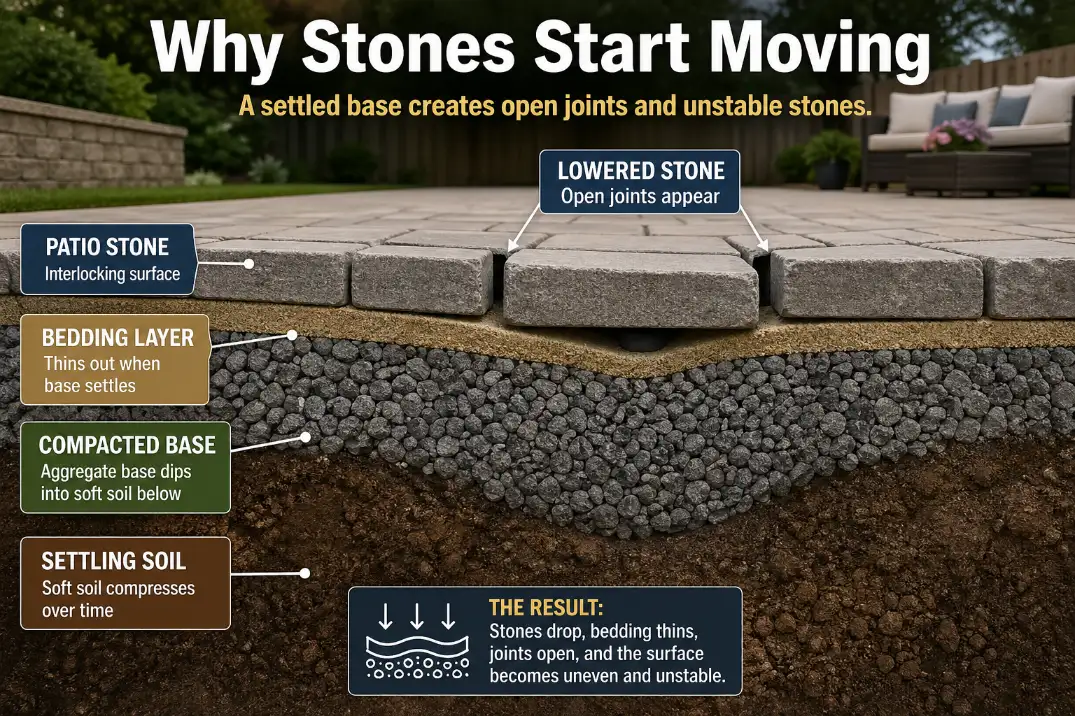
Patio stones typically sit over a compacted aggregate base with a thinner bedding layer above it. When the base settles unevenly, the stones follow the low spots.
A 1/8-inch dip may barely show. Around 1/4 inch, edges become noticeable underfoot. Around 1/2 inch, the movement is usually visible and may become a functional hazard.
In newer patios, settlement often appears within the first 6–18 months if the base was not compacted well. In older patios, sudden gap growth after storms usually points to water movement, washout, or soil compression.
If the same low area keeps returning after repairs, the pattern may be part of a broader support issue like the ones explained in Long-Term Ground Instability Outdoors.
Water makes a small weakness grow
Water does not need a dramatic flood path to damage a patio base. A downspout, a low planting bed, or a patio that slopes toward a trapped corner can slowly feed water into the joints.
A healthier patio should move water away from the house and off the paved area. A practical slope target is often about 1/8 to 1/4 inch per foot, depending on layout and local conditions.
If rainwater sits in the joints for more than 24 hours, or disappears into the patio instead of flowing away, the base is being asked to handle water it may not be built to drain.
That is why the water path matters more than the puddle itself. The same principle is central to Drainage Patterns Causing Patio and Walkway Damage.
What Usually Wastes Time
Refilling moving joints
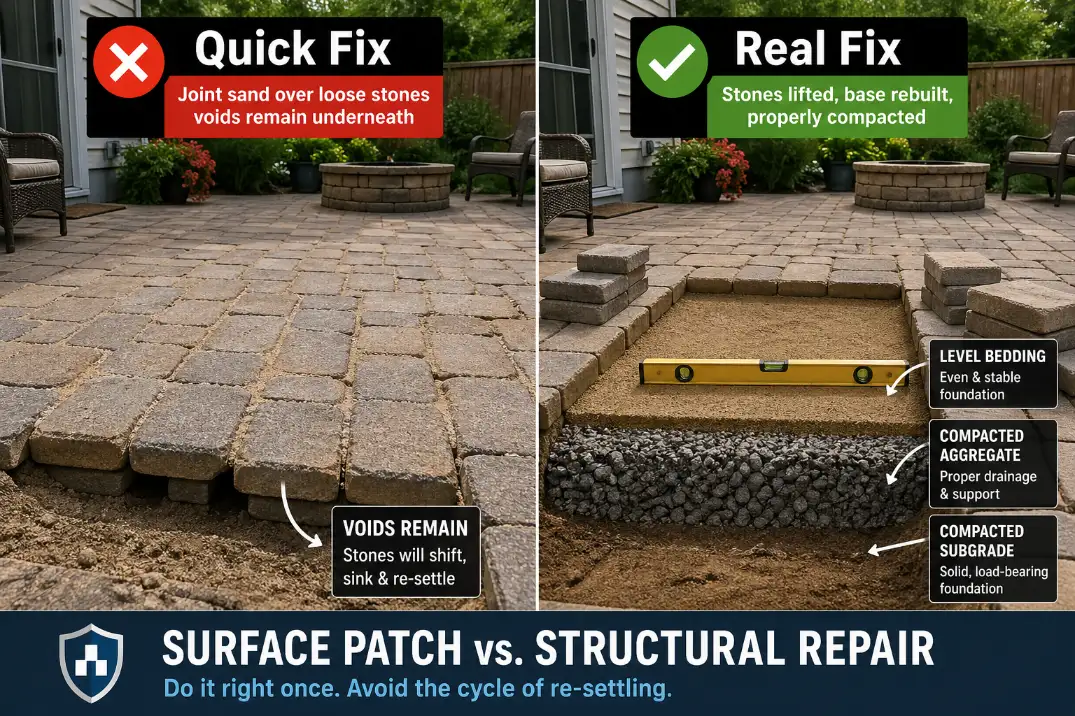
Sweeping sand into open joints is useful only after the stones are stable. If the same gaps reopen after one or two rainstorms, the joint filler is not the cause. It is the material escaping from a moving system.
Polymeric sand is often overestimated here. It can help lock stable joints, but it cannot lift a settled base, correct slope, or replace missing edge restraint. Polymeric sand should lock a stable repair, not act as the repair itself.
Pro Tip: Do not install polymeric sand over rocking stones. Stabilize the stones first, then fill the joints.
Resetting one stone inside a larger failure
A single reset works when one stone is loose and the surrounding stones are firm. It stops making sense when three or more neighboring stones have opened gaps together. In that case, the repair area should usually extend beyond the lowest stone into the stable field.
| Visible clue | Most likely hidden problem | Wrong fix to avoid | Better next step |
|---|---|---|---|
| One rocking stone | Local bedding void | Filling only the joint | Lift and re-bed the stone |
| Wider gaps near edge | Edge restraint movement | More joint sand | Rebuild or secure border |
| Several stones dropping together | Base settlement | Resetting one stone | Rebuild the weak section |
| Sand disappears after storms | Washout or drainage path | Polymeric sand first | Correct water movement |
| 1/2 inch height change | Functional unevenness | Cosmetic patching | Treat as support repair |
The Repair Path That Changes the Outcome
Step 1: Mark the full loose area
Do not mark only the lowest stone. Mark all moving stones plus at least one stable row around the affected area. This gives the repair enough room to transition back into firm patio.
Step 2: Lift and preserve the pattern
Lift the stones carefully and keep them in order. This matters most with irregular flagstone and mixed-size pavers, where the original fit may not be obvious once the stones are removed.
Step 3: Remove failed bedding
Scrape out loose, muddy, contaminated, or uneven bedding. If the bedding layer is doing all the leveling work, the base below it was probably not corrected properly.
A compacted base should feel firm after drying. If it can be scooped out easily by hand or feels spongy under pressure, the support problem goes deeper.
Step 4: Rebuild and compact the base
If the aggregate base has settled, add compatible base material in thin lifts and compact it. Do not use several inches of loose sand to make up height. Sand is for bedding, not structural correction.
This repair logic overlaps with Poor Compaction Under Outdoor Surfaces: Causes, Signs, and Long-Term Fixes, especially when the patio keeps losing level after repeated resets.
Step 5: Re-lay, test, then refill joints
Set the stones back into place and check for rocking before filling the joints. Walk the repair area from several directions. If a stone moves now, joint filler will not fix it later.
Only after the stones are stable should you refill the joints. For concrete pavers, polymeric sand may be appropriate if the joints are clean, dry, and within the product’s width range. For flagstone, the right filler depends on joint width, drainage, and whether the installation is dry-laid or mortared.
When Drainage or Soil Makes the Repair Bigger
Repeated rain failure means the water path is still active
If gaps reopen after storms, the patio is telling you the base is still receiving water or losing material. In wet regions such as Florida or the Midwest, this can happen quickly because repeated rainfall keeps the base damp. In northern states, freeze-thaw cycles can turn small voids into larger spring movement.
Dry regions are not exempt. In places like Arizona, irrigation overspray and shrinking soil near planted edges can still loosen patio stones even when the surface looks clean and dry.
For patios that sink after repeated moisture exposure, Why Walkways and Concrete Patios Sink After Water Exposure gives helpful context on why water-related settlement usually extends beyond the visible low spot.
Soil movement shows up as a pattern
If nearby walkways, steps, or patio edges are also uneven, the issue may not be limited to one paved area. Expansive soil, poorly compacted fill, erosion, or long-term settlement can shift multiple outdoor surfaces at once.
That broader pattern is worth separating from a simple loose-stone repair. Uneven Outdoor Surfaces From Soil Movement is a useful companion when the patio is only one part of a larger movement zone.
When the Standard Fix Stops Working
The patio slope is wrong
If the patio drains toward the house, into open joints, or toward a trapped corner, resetting stones will only buy time. The surface needs a better drainage path before the repair is closed.
The edge no longer holds
If perimeter stones spread outward, the patio has lost lateral support. Joint filler cannot replace a firm edge. The border may need to be reset, restrained, and backed with stable soil or base material.
People change how they walk across it
That is the practical threshold. If people step around the area, chairs catch, or a stone drops underfoot, this is not just an appearance issue. The repair goal is support, not prettier joints.
Practical Decision Rule
If the stones are stable and the joints are only slightly open, clean and refill the joints. If stones move underfoot, lift and re-bed them. If several stones move together, rebuild the section. If the same gaps return after rain, fix the drainage path before spending money on another surface repair.
Loose patio stones are visible at the surface, but the repair is usually decided underneath. The better fix is not the one that hides the gap fastest. It is the one that stops the stone from moving again.
For broader technical guidance on paver base preparation and drainage slope, see the LSU AgCenter.