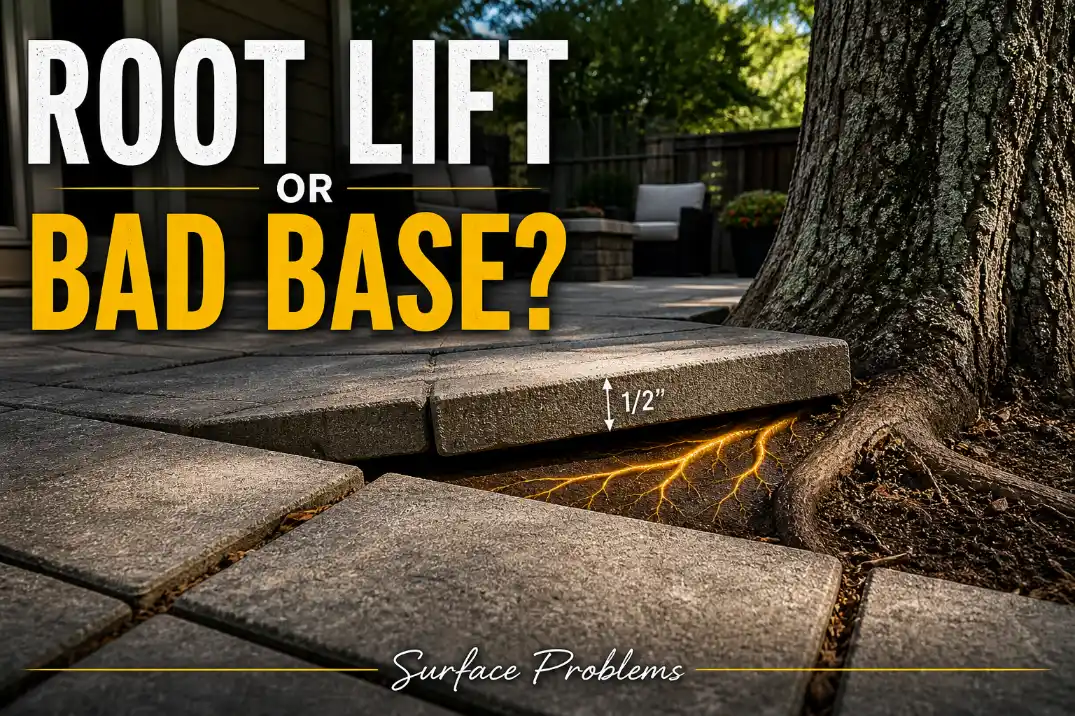
Yes, tree roots can push up patio pavers, but a raised paver near a tree is not automatically a root problem.
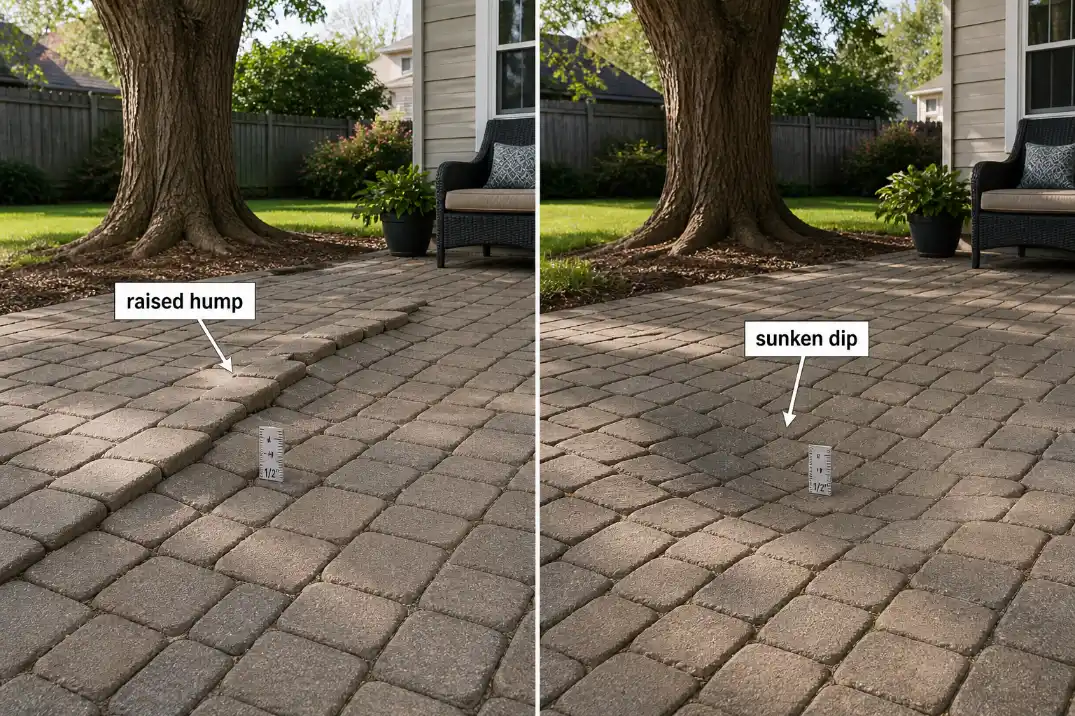
The most useful first distinction is shape: roots usually create a raised hump or ridge that points back toward the tree, while weak base material usually creates a dip, low bowl, or rocking area. If the edge has lifted 1/2 inch or more, treat it as a trip hazard, not just a cosmetic patio issue.
The timing also matters. Root lift often develops slowly over 6–24 months as a shallow root thickens beneath the bedding layer.
A paver that suddenly rocks after heavy rain may point more toward washout, soft bedding sand, or drainage movement. In other words, the lifted paver is the symptom. The real question is what moved underneath it.
Root Lift or Base Failure? Start With the Surface Clue
The fastest way to avoid the wrong repair is to read the pattern before touching the pavers. A single high spot near a tree tells a different story than a broad sunken section across the patio.
| Surface clue | More likely issue | What it usually means |
|---|---|---|
| Raised ridge leading toward a tree | Root pressure | The patio is being pushed up, not sinking |
| Saucer-shaped low spot | Base settlement | Support is being lost underneath |
| Pavers loose mainly after rain | Bedding washout | Water is moving the support layer |
| Same spot rises again within 6–12 months | Active root conflict | A surface-only reset did not solve the cause |
| Edge lifted 1/2 inch or more | Safety hazard | The transition needs correction before it becomes a trip point |
A hump usually means pressure
Root-related paver movement usually rises above the surrounding surface. The affected pavers may tilt, open their joints, or form a narrow raised strip. That raised line often points toward the trunk or a visible surface root.
A dip usually means support loss
A sunken paver area is less likely to be root lift. That pattern usually means soil moved downward, base material washed out, or the patio was installed over poorly compacted ground. If the patio is opening gaps and sinking rather than rising, the failure pattern is closer to loose patio stones forming gaps after ground settlement than to root pressure.
Why Roots Can Lift Pavers
Roots do not push pavers up because they are trying to break the patio. They grow where the soil gives them air, moisture, and space. A paver patio can accidentally create those conditions, especially near shaded edges, irrigation overspray, downspout splash zones, or lightly compacted bedding material.
The bedding layer is the weak point
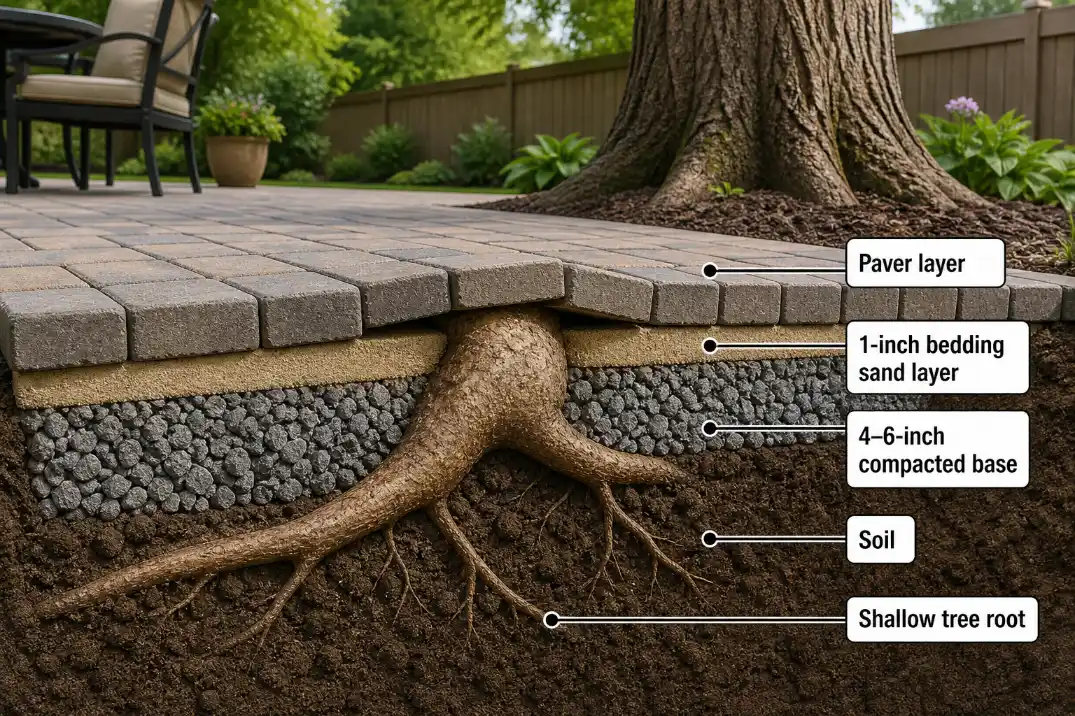
Most pedestrian patios have pavers over about 1 inch of bedding sand and roughly 4–6 inches of compacted aggregate base. That system is flexible by design. It can handle small movement better than poured concrete, but it can also be distorted by a root growing into the support layers.
A shallow root in the upper 6–18 inches of soil may pass under or beside the base. As it thickens, it can displace bedding sand, push aggregate upward, or create pressure under individual pavers. The paver itself is not usually the first thing to fail. The support layer changes shape first.
Moisture makes the root path more inviting
Homeowners often overestimate how much a thicker base can stop roots. A stronger base helps resist movement, but it does not make a patio root-proof. Roots can still exploit damp edges, open joints, and softer soil pockets.
They also underestimate how much water influences the problem. A shaded patio edge that stays damp for 24–48 hours after irrigation is more attractive to roots than a dry, open soil zone. In humid climates such as Florida, the area under pavers may remain moist for long periods. In dry regions such as Arizona, roots may chase water where sprinklers or drip irrigation concentrate it near the patio edge.
When water is part of the pattern, root lift and drainage failure can overlap. A patio can be high near the tree and low near a runoff path. That is why water movement should be checked before blaming every uneven paver on roots. If the worst movement follows downspouts, patio slope, or recurring puddles, drainage patterns that damage patios and walkways is the more useful diagnostic path.
What People Usually Get Wrong
The biggest mistake is treating the raised paver as the whole problem. Resetting the surface may make the patio look better, but it does not answer why the surface moved.
The raised paver is a symptom
A lifted paver only shows where pressure or distortion reached the surface. It does not prove the root should be cut, the whole patio should be rebuilt, or the tree should be removed.
The mechanism is underneath: root growth, displaced bedding material, weak base support, water-softened soil, or a combination of those conditions.
Tree species matters less than site pressure
Some trees are more likely to create shallow root conflicts, but species alone does not decide whether pavers lift. A mature tree 3 feet from a patio is a much bigger concern than the same tree 15 feet away with open soil and mulch available on the other side.
Distance, moisture, root size, and available growing space matter more than the tree name. A patio built tight around a trunk flare or over visible surface roots is starting with a disadvantage.
Pro Tip: Before removing any pavers, measure the highest edge with a ruler and photograph it from the side. A 1/4-inch lift and a 3/4-inch lift call for very different urgency.
Fixes That Usually Waste Time
If the paver is high, the problem is below it. Anything done only to the top surface is usually cosmetic. That does not mean every repair has to become a major rebuild, but it does mean the fix should address the bedding layer, root conflict, or water movement that caused the lift.
Sweeping more sand into the joints
Joint sand can tighten a surface, but it cannot flatten a paver that is being pushed from below. If the paver is high, the support layer has already changed shape. More sand in the joints may improve the look for a short time, but it will not remove the pressure.
Grinding only the high edge
Grinding down a raised paver edge can reduce a trip lip, but it is rarely a real repair. It leaves the hidden cause in place and can make the patio look patched. This may be acceptable as a temporary safety measure for a minor edge, but it should not be treated as a durable fix.
Cutting first
Cutting the root before understanding its size and location is the most expensive mistake. Small feeder roots may be manageable. Large roots near the trunk are different. A root larger than about 2 inches in diameter, especially within a few feet of the trunk, may contribute to tree stability and should not be casually removed.
Root pruning is not a paver-leveling shortcut. If the tree is mature, valuable, close to the house, or leaning, an arborist should evaluate large roots before they are cut.
What Repair Makes Sense?
The right repair depends on whether the root conflict is minor, active, or too close to the tree to solve by forcing the patio flat.
Minor lift: reset a small area
If only a few pavers have lifted and the height difference is under about 3/4 inch, a localized reset may be enough. The affected pavers are removed, the bedding layer is corrected, and the pavers are reinstalled with a smoother transition.
This works best when the root is small or not pressing directly into the bedding layer. If the root remains active beneath the same spot, the lift may return within one growing season.
Tree-preserving case: soften the transition
Sometimes the smartest repair is not making the patio perfectly flat. If the root should not be cut, the surface may need a gentle transition over or around the root zone. A gradual change of about 1/8 inch per foot can feel much safer underfoot than an abrupt raised lip.
This is especially useful near seating areas, grills, and narrow walkways where chair legs or shoes catch on uneven paver edges.
Large root near the trunk: change the patio edge
If several pavers are lifting close to a mature tree, repeatedly resetting them is usually a losing strategy. Pulling the patio back 12–24 inches and replacing that strip with mulch, planting bed, or flexible edging may protect both the tree and the hardscape.
That kind of adjustment also reduces future conflict. Pavers can be reset many times, but tree roots will continue to respond to moisture, oxygen, and confined growing space.
For a deeper look at how paver lift develops near tree roots, that related guide covers the broader repair logic without treating every uneven patio as the same problem.
Can You Stop Roots From Lifting Pavers Again?
Prevention depends on whether the patio already exists or is still being planned. Those are two different decisions.
For an existing patio
For an existing patio beside a mature tree, a root barrier is usually a planning tool, not a simple repair tool. Installing one may require trenching near roots, disturbing the tree, and removing part of the hardscape.
If large roots are close to the trunk, the barrier installation itself can be riskier than the lifted pavers.
Better existing-patio choices often include pulling the patio edge back, improving drainage, using a mulch ring around the tree, or creating a smoother transition where minor root lift cannot be safely eliminated.
If the surface is shifting in several directions, look beyond the tree and compare the site to why outdoor surfaces shift over time.
For a new patio
A new patio gives you more control. Avoid building tight against the trunk flare, leave open soil around mature trees, and keep irrigation water from concentrating under the paver edge. A compacted base helps, but it should not be sold as root-proof.
The better goal is not to defeat the tree. The goal is to design the patio so the tree has somewhere else to grow. In many yards, moving the patio edge even 2 feet away from the trunk or major surface roots can reduce the future conflict.
If the whole patio system is weak because base depth, water movement, and material choice were poorly matched, the issue becomes broader than roots. That is where why surface materials fail early becomes relevant.
Questions People Usually Ask
Can I cut the root under my patio pavers?
Sometimes, but not automatically. Small non-structural roots may be candidates for pruning. Large roots near the trunk should be reviewed by an arborist before cutting, especially if they are over about 2 inches in diameter.
Do root barriers stop patio pavers from lifting?
They can help during new construction, but they are less useful as a simple retrofit beside mature trees. The bigger decision is usually layout, drainage, and whether large roots can be disturbed safely.
Will removing the tree fix the lifted pavers?
Tree removal stops future root growth, but it does not instantly fix the patio. Existing roots can decay slowly, and the soil may settle as organic material breaks down. Low spots can appear for 1–3 years after a large tree is removed.
Are pavers better than concrete near tree roots?
Usually, yes, because individual pavers can be lifted, adjusted, and reset. But pavers are not immune to root pressure. They are easier to repair, not impossible to disturb.
Bottom Line
Tree roots can push up patio pavers, especially when shallow roots grow into a moist bedding zone and thicken over time. But the best clue is the pattern.
A raised ridge near a tree points toward root pressure. A low dip, rocking after rain, or broad unevenness points more toward base or drainage failure.
If the lift is under 1/4 inch and stable, monitoring may be enough. If it reaches 1/2 inch, creates a trip edge, or returns within 6–12 months after resetting, the problem needs more than joint sand and a quick tamp.
The strongest repair is the one that respects both systems: the hardscape above and the living root structure below.
Tree roots and paved surfaces are a design tradeoff, so tree-preserving repairs should account for root health as well as trip hazards; Iowa State University Extension explains that balance in its guide to managing trees near sidewalks.