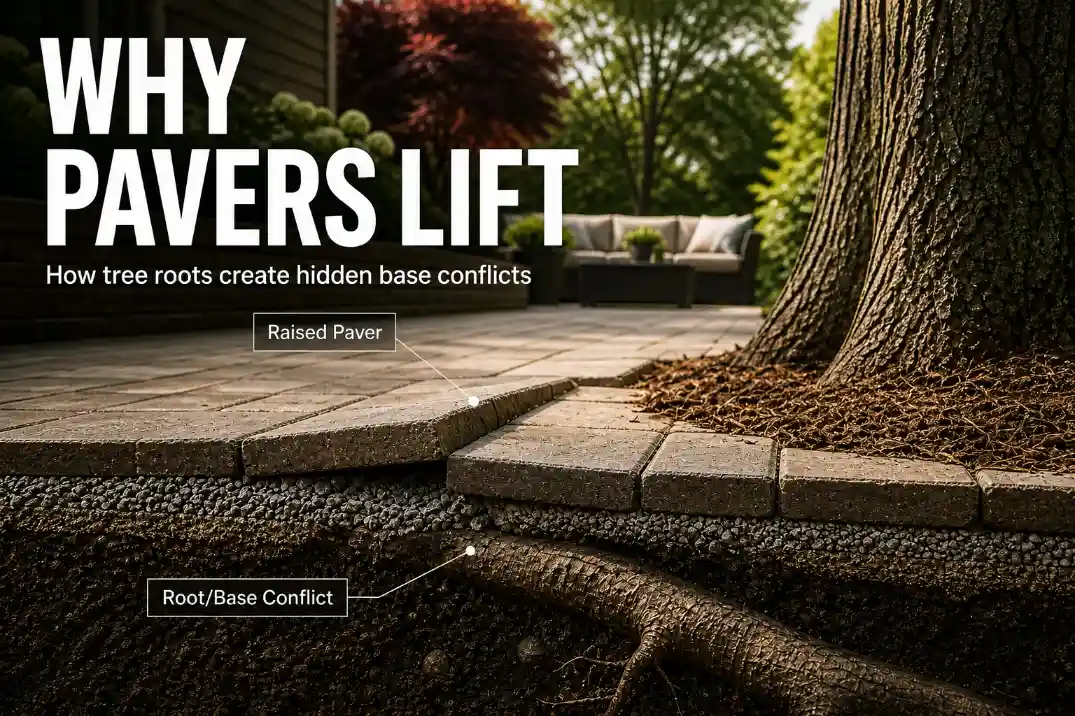
Pavers lift near tree roots because the paver base and the tree’s shallow root zone are competing for the same space. Most active absorbing roots live in the upper 12–18 inches of soil, and many patios or walkways are built right inside that zone.
The good news is that pavers usually fail in a repairable way: they tilt, rise, or open at the joints before they crack like a concrete slab.
Start with three checks: measure the raised edge, look at how close the lift is to the trunk, and decide whether the surface is rising or sinking. A 1/2-inch vertical lip is already a practical trip hazard.
If the same pavers lift again within 6–12 months after a reset, the problem is not just loose sand. Root pressure, moisture, and weak base support are still working together underneath.
Why Tree Roots Lift Pavers in the First Place
Tree roots are often blamed as if they randomly attack patios. They do not. Roots follow the easiest path with oxygen, moisture, and workable soil. A paver system can accidentally create that path.
The base becomes a root corridor
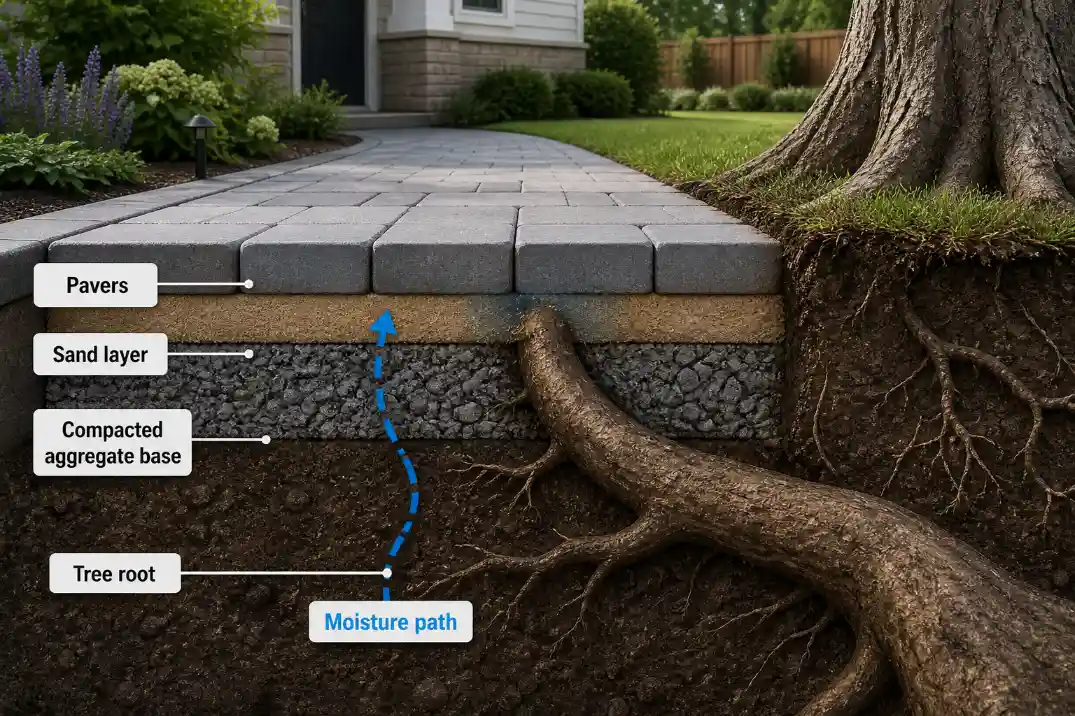
A paver walkway has joints, bedding sand, aggregate, and edges where water and air can collect. If the surrounding lawn soil is compacted clay but the paver edge stays damp and slightly open, roots may favor the hardscape edge over the yard.
This is why the lift often appears in one strip instead of evenly around the whole tree. The problem is not only “tree roots.” It is a root-friendly corridor under a surface that was supposed to stay flat.
A visible root is not always the only force. In clay soil, shrink-swell movement can loosen the base first, then roots exploit the easier path. That is why broad dips around a raised ridge deserve drainage and base inspection, not just root trimming.
Open joints wider than about 1/4 inch, loose edge restraints, and thin bedding layers all make the conflict worse. In humid climates such as Florida, the base may stay damp for days after rain. In drier states like Arizona or inland California, irrigation overspray can create the same narrow wet band under the pavers.
If nearby areas are also shifting away from the tree, the root issue may overlap with broader ground movement, especially where soil expands, shrinks, or washes out. That wider pattern is explained in Uneven Outdoor Surfaces From Soil Movement.
Pavers lift instead of crack
Concrete slabs tend to crack because they act as one rigid piece. Pavers move as smaller units. That makes them easier to repair, but it can also hide the seriousness of the root conflict for longer.
A single raised paver may look minor. But when several pavers form a ridge pointing toward the tree, the surface is showing a pattern, not a random loose stone.
Quick Diagnostic Checklist
Use these checks before pulling up pavers or cutting roots.
- Raised edge is 1/2 inch or more: correct the trip hazard, even if the long-term repair comes later.
- Lift forms a ridge toward the tree: root pressure is more likely than ordinary settlement.
- Pavers are sinking around the raised area: bedding sand or base material may have shifted.
- Lift follows sprinkler overspray or downspout flow: moisture may be feeding the root corridor.
- Joints are open wider than 1/4 inch: movement has likely been active for more than one season.
- Same area lifted again within 6–12 months: a simple reset is no longer enough.
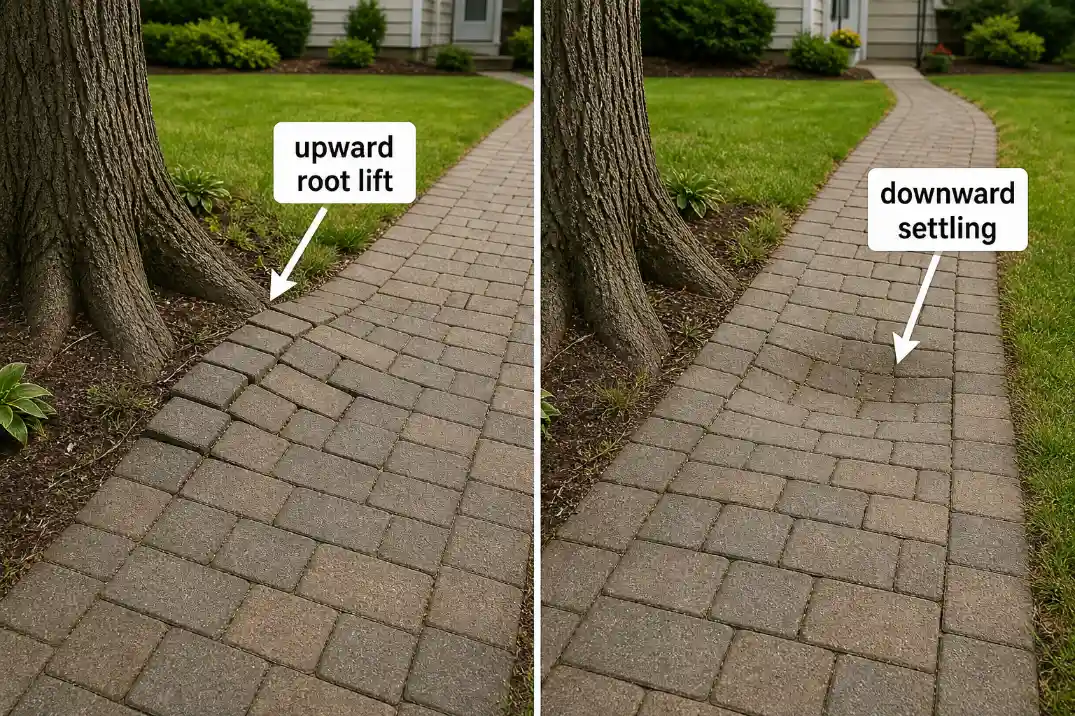
The most useful distinction is upward versus downward movement. Root pressure usually creates a raised lip, hump, or ridge. Settlement usually creates low spots, spreading dips, or uneven gaps. If your patio stones are separating because the ground below is dropping, that repair logic is closer to Loose Patio Stones Forming Gaps After Ground Settlement.
What People Usually Misread First
“It happened suddenly”
Most root lift is slow. It may become obvious after a wet season, winter freeze-thaw cycle, or spring growth period, but the pressure usually built over months or years.
In colder northern states, freezing water can exaggerate an existing hump. That does not mean ice caused the whole problem. It may only have made a root-weakened section more visible.
“Cut the root and reset the pavers”
This is the fix that creates the most avoidable risk. Small feeder roots may be manageable during a reset. A root thicker than about 2 inches, especially within a few feet of the trunk, should not be treated as a simple paving obstruction.
Large roots can help anchor the tree. Cutting them may create decay points, reduce stability, or stress the tree during heat or drought. The closer the cut would be to the trunk flare, the less it should be treated as hardscape work and the more it should be treated as tree-risk work.
Pro Tip: If the root is thicker than a garden hose and close to the trunk, get tree-health guidance before making the paving repair permanent.
“More sand will level it”
Bedding sand adjusts height. It does not stop root growth, correct a weak base, or drain a wet edge. Adding sand over the same active root may make the pavers look better for one season, but it rarely changes the cause.
A proper repair has to address the conflict under the paver, not just the height of the paver face.
What the Lift Pattern Says About the Right Fix
| Surface Clue | Likely Meaning | Repair That Makes Sense | Repair to Avoid |
|---|---|---|---|
| One or two raised pavers near a small root | Localized root pressure | Lift, inspect, rebuild base, reset pavers | Adding sand only |
| Long ridge aimed toward the tree | Root is following the base line | Rebuild section and redirect moisture | Grinding or shaving pavers |
| Broad low area around the hump | Base loss or soil settlement is also involved | Correct drainage and rebuild support | Treating it as roots only |
| Lift returns within 6–12 months | Active root/base conflict remains | Barrier, redesign, or path adjustment | Repeating the same reset |
| Large root close to trunk | Structural tree risk | Arborist review or reroute | Cutting the root for clearance |
This table matters because the visible paver is only the symptom. The underlying mechanism decides whether the fix lasts.
The Three Fix Paths That Actually Make Sense
Path 1: Reset the pavers
A reset makes sense when the lift is small, localized, and caused by minor roots or displaced bedding. The affected pavers should be lifted, loose bedding removed, the root condition inspected, the aggregate base re-compacted, and the bedding layer restored evenly before the pavers go back.
The edge restraint matters. If the outer edge has opened, the pavers can keep spreading and rocking even after they look flat. Joint sand should be replaced after the surface is corrected, not used as a substitute for base repair.
Path 2: Rebuild the weak section
A rebuild is more appropriate when the paver base is thin, wet, loose, or repeatedly disturbed. This may mean removing a larger section, improving the compacted aggregate layer, correcting drainage, and adding a root barrier where it can actually influence future growth.
For pedestrian pavers, several inches of compacted aggregate beneath the bedding layer is typically more durable than a thin sand-over-soil installation. The exact depth depends on soil, climate, and use, but a 1–2 inch base over native soil is rarely forgiving near mature roots.
Water control belongs in this repair path. If water sits near the pavers for more than 24–48 hours after normal rain, the base is staying too wet. A modest 1–2% surface slope can help move water away before the paver edge becomes the easiest damp route for roots.
When drainage is shaping the damage pattern across a larger patio or walkway, the repair should also consider the site behavior described in Drainage Patterns That Damage Patios and Walkways.
Path 3: Reroute or redesign
Rerouting sounds like a bigger decision, but it is often the cleaner fix when the root is large or the walkway sits too close to the trunk. Moving a path even 12–24 inches can reduce direct conflict if the yard allows it.
For patios, removing the highest-risk pavers and expanding a planting bed around the tree may look more intentional than repeatedly patching a distorted surface. In some areas, wider joints, stepping stones, compacted fines, or a slightly raised transition can work better than forcing tight pavers across a living root zone.
This is where routine leveling stops making sense. If the same surface keeps lifting, the hardscape layout is fighting the tree, and the tree will usually win.
If the raised area is already creating a walking hazard, the safety side of the problem overlaps with Tree Roots Lifting Pavers and Creating Uneven Outdoor Surfaces, especially when the uneven edge sits on a main route through the yard.
When Root Barriers Help—and When They Do Not
Root barriers are most useful before roots occupy the paving zone or during a proper rebuild. They are less useful as a quick fix after large roots are already under the pavers.
A shallow plastic edging strip is not a root barrier. In hardscape work, barriers are often installed roughly 18–36 inches deep, depending on the site, species, and soil conditions. The top edge should remain slightly above grade or clearly defined so roots do not simply grow over it.
A barrier is a risk reducer, not a permanent root-proof wall. Roots can eventually grow under, over, or around it if moisture and space still reward that path.
The barrier also needs to be part of a wider repair. If the paver base remains thin, wet, and poorly compacted, the surface can still move. A barrier may redirect future roots, but it does not rebuild failed support.
Pro Tip: A root barrier installed after major root cutting can leave you with two problems: a stressed tree and a paver system that still lacks durable base support.
Questions People Usually Ask
Can I cut the root under lifted pavers myself?
Only if it is small and clearly non-structural. A fine feeder root is different from a major woody root near the trunk. If the root is around 2 inches thick or close to the trunk flare, cutting it without arborist input is not a good trade for a flatter walkway.
Will resetting pavers stop tree roots permanently?
Not by itself. Resetting fixes surface height and support. It does not change the root-friendly conditions that caused the lift if moisture, weak base support, and tight clearance remain.
Should I remove the tree or move the walkway?
In most residential cases, moving or redesigning the walkway is the better first option when the tree is healthy and mature. Tree removal is a larger site decision, not a paving shortcut. If the roots are creating unsafe movement across a main walkway, the practical choice is usually between redesigning the hardscape and getting professional tree guidance.
The Practical Bottom Line
If the lift is small, local, and caused by minor roots, reset the pavers properly with better base support. If the raised edge is 1/2 inch or higher, treat it as a safety issue now. If the root is large, close to the trunk, or the same pavers lift again within 6–12 months, stop repeating the same repair and redesign the conflict area.
The condition people overestimate is the power of a quick paver reset. The condition they underestimate is how attractive a damp, oxygen-rich paver base can be to roots. The fix that lasts is the one that changes that relationship, not just the one that makes the surface flat for a weekend.
For broader official guidance on managing pavement near trees, see Iowa State University Extension and Outreach.