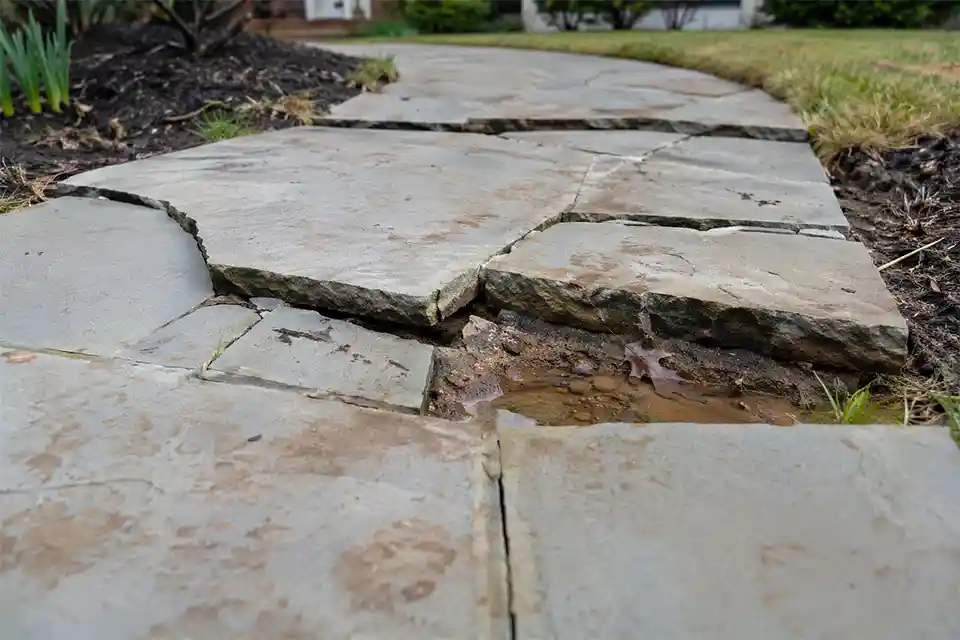
When walkway stones keep breaking in the same area, the stone is often being blamed for a support problem underneath. In most cases, the real issue is a weak base: too thin, poorly compacted, softened by water, or built over soil that kept settling after installation.
The first checks are simple and useful. Do any stones rock underfoot? Is the same 3- to 6-foot stretch cracking again? Does water sit in one shallow dip for more than 20 to 30 minutes after rain? That pattern points more strongly to support loss below than to ordinary wear or one bad stone.
This is where people lose time. Replacing a cracked piece can improve appearance for a season, but if the base is still moving, the new stone usually fails too.
Once adjacent stones are more than about 1/4 inch out of plane, or one edge visibly drops when stepped on, this is no longer just a surface repair question. The real decision is whether the problem is still local, or whether the support system in that section has already started giving way.
What this usually is — and what it usually is not
More often base failure than bad stone
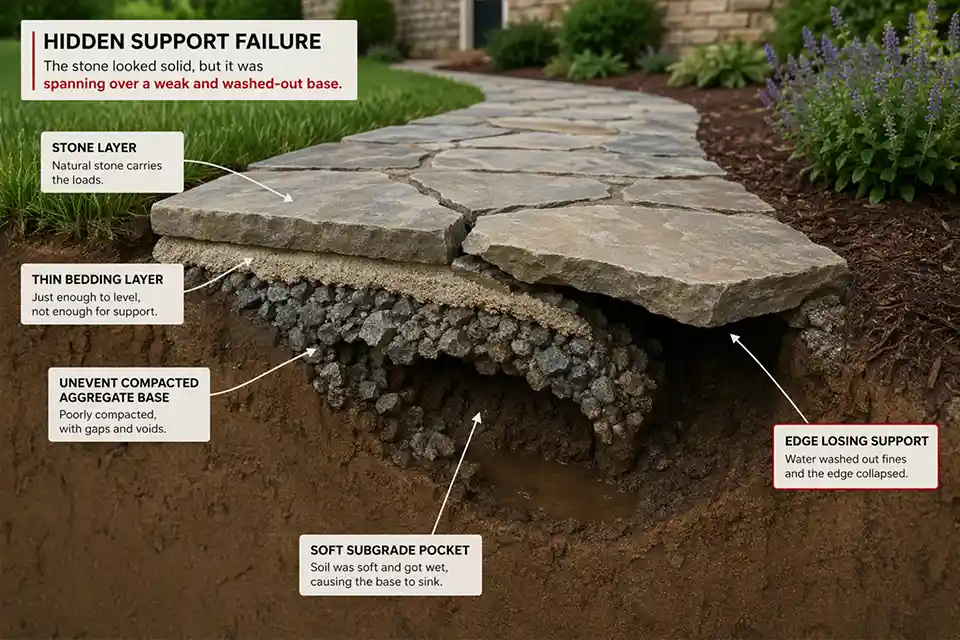
Sharp cracks make people assume the material was weak. Usually, that is the wrong conclusion. Stone often breaks because force is being concentrated over a void, a soft pocket, or an unsupported edge. Even a sound piece can fail early when the load beneath it is uneven.
More often a walkway-build problem than a whole-site problem
Not every broken walkway means the whole yard is unstable. Often the failure is limited to the walkway assembly itself: shallow base, poor compaction, edge movement, trapped water, or disturbed fill directly under the path.
Still, if nearby surfaces are also dropping or shifting, long-term ground instability under patios and walkways becomes a better fit for the broader diagnosis.
More often repeated movement than one-time damage
A one-time impact can crack stone. It just is not the leading explanation when the same traffic line keeps failing. Repetition is the bigger clue. It usually means support was lost below and never restored.
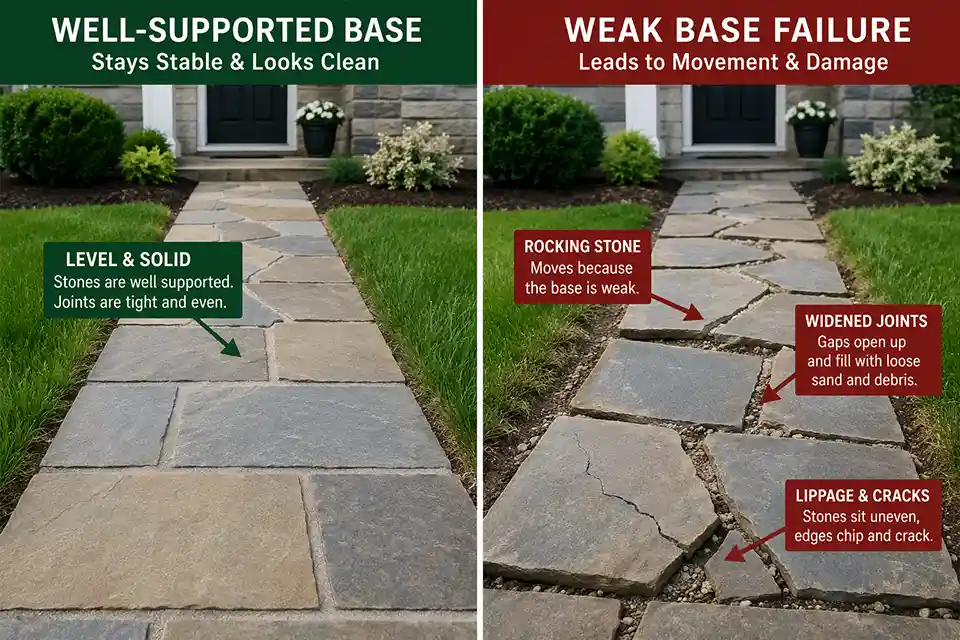
Fast field diagnosis
Signs that point below the surface
Use these as decision signals, not just observations:
- A stone rocks when you step on one edge → support is missing below
- The same crack line returns after repair → the root cause is still active
- Joint material reopens within one season → movement is continuing underneath
- Water lingers in one low spot for 20 to 30 minutes or more → settlement or washout is likely involved
- Several stones in one 3- to 6-foot run start failing together → this is usually a connected base problem, not isolated breakage
- Height difference between adjacent stones reaches 1/4 inch or more → the issue is now structural enough to affect safety and repair scope
What people usually overestimate
They overestimate stone quality as the deciding factor. Better stone helps, but it does not rescue a weak support layer.
What people usually underestimate
They underestimate how destructive small repeated movement is. A walkway does not need to sink 2 inches to start breaking stone. Repeated motion in the 1/8- to 1/4-inch range is enough to crack thinner pieces or stones bridging tiny voids.
Why the obvious fix keeps failing
The crack is the result, not the mechanism
The visible break is where the problem showed up, not where it started. The mechanism is loss of support continuity below the stone. That is why a surface-only repair can look successful at first and still fail again.
Bedding is not a substitute for base
This is one of the most common installation misunderstandings. Bedding helps with leveling and placement. It is not meant to replace a compacted structural base.
Adding more bedding under a low stone may flatten the area briefly, but if the base below is loose or washed out, the movement simply comes back.
Spot replacement turns into false economy quickly
A local lift-and-reset can still make sense when one stone failed and the surrounding field is solid. But once nearby stones are also moving, joints keep reopening, or the area has already been touched once, spot replacement starts wasting money.
Once the same zone has failed twice, or multiple stones move together, stop paying for cosmetic resets and rebuild the support.
A surprising number of walkway failures that look random are really compaction failures in disguise. That is why poor compaction under outdoor surfaces is often the more useful diagnosis than “bad stone.”
Where the base usually went wrong
Base depth was never enough
For a pedestrian stone walkway, a compacted granular base often needs to be around 4 to 6 inches, with more depth making sense in softer soils, wetter sites, or freeze-prone regions. A thin 2-inch or 3-inch base can look acceptable right after installation and still fail after 1 to 3 seasonal cycles.
Compaction was rushed or done in one thick layer
A common shortcut is placing too much base material at once and compacting only the top. The upper surface firms up, but the lower portion stays loose. That hidden weakness shows up later under rain, foot traffic, and temperature cycling.
Water kept entering the support layers
Water is often the accelerant rather than the original mistake. Once runoff starts entering open joints or reaching the edge of the walkway, it softens bedding and moves fines out of the base.
If the damaged section stays damp a day or two longer than the surrounding area, that is a meaningful clue. In many cases, drainage damage on patios and walkways is part of the same failure chain.
The soil under the base kept settling
If the walkway crosses backfilled ground, an old trench, or an area near concentrated runoff, the subgrade may still have been moving after the surface was installed.
In that case, even a decent upper base can settle unevenly because the weakness sits lower than expected. Related patterns in why some outdoor areas sink faster often overlap here.
Edge support weakened first
Some failures begin at the perimeter, not the middle. When the edge loses restraint, base material can start migrating outward. Stones along the side then tilt, joints widen, and corners begin carrying too much load.
That is useful to know, but it is usually a companion failure, not the primary one. The main problem is still inadequate support below the walking surface.
Repair scope: reset, rebuild, or replace the section?
When a local reset is still reasonable
A limited repair can work when the problem is truly confined:
- one or two stones only
- surrounding stones feel stable
- no repeat crack history in that zone
- no persistent ponding
- height variation outside the repair area stays under about 1/4 inch
In that case, lifting several adjacent stones, correcting support locally, recompacting, and resetting the field can be a sensible repair.
When section rebuild is the smarter choice
A section rebuild makes more sense when:
- multiple stones in one zone are rocking
- joints have reopened more than once
- cracking repeats in the same 3- to 6-foot area
- the low spot keeps returning after refill or reset
- the base below feels damp, loose, or hollow
This is the point where patching stops being thrifty and starts becoming repetitive labor.
When the problem is larger than the walkway section
If the failure lines up with downspout discharge, trench settlement, washout, or adjacent ground movement, the walkway may be receiving damage from a broader site condition. In those cases, rebuilding the stones alone may not hold unless the source of water or instability is corrected too.
Comparison guide: what the pattern is telling you
| Field condition | More likely meaning | Better repair direction |
|---|---|---|
| One cracked stone, surrounding field firm | Isolated support issue or impact | Local lift, base correction, reset |
| Several stones rocking in the same zone | Connected base weakness | Rebuild that section |
| Ponding plus reopened joints | Settlement or washout below | Rebuild base and correct drainage |
| Edge stones tilting outward | Edge support loss with reduced base hold | Rebuild edge support and nearby base |
| Repeated repair in the same area | Root cause never corrected | Stop patching and expand repair scope |
| Damage aligns with trench or disturbed fill | Subgrade settlement below base | Deeper repair and wider diagnosis |
When standard repair stops making sense
After the second failure in the same location
One repair attempt can be reasonable. A second failure in the same zone is usually the clearest threshold that the visible break was never the whole problem.
When the fix depends on filler more than support
If the repair is mostly more sand, more bedding, or minor shimming, be careful. That may level the surface briefly without restoring support continuity.
When the walkway is already becoming unsafe
Once the surface shows noticeable edge deflection, multiple rocking stones, or more than about 1/4 inch of vertical mismatch, the issue is no longer just visual or long-term.
Safety has already entered the decision. That is where normal wear versus hazardous walkway damage becomes a useful companion read.
Pro Tip: If one stone moves and the neighboring joint flexes with it, do not start by replacing the stone. Start by assuming the support layer below has already separated, softened, or settled.
What a correct rebuild usually includes
Open more than the visibly broken footprint
A proper repair usually means lifting beyond the exact cracked area. Once stones are removed, the loose base and damp bedding often extend farther than the visible damage suggested.
Rebuild in controlled lifts
Loose material needs to be rebuilt in layers, not dumped back in as one thick mass. That detail changes whether the repair lasts.
Fix water before resetting stone
If runoff still crosses the walkway, enters at the edge, or drains into the same dip, a new surface is simply being handed the same failure condition again.
Aim for stable support, not just a flatter look
That is the real goal. A successful repair is not the one that looks level on the day it is finished. It is the one that stays supported after rain, traffic, and seasonal movement.
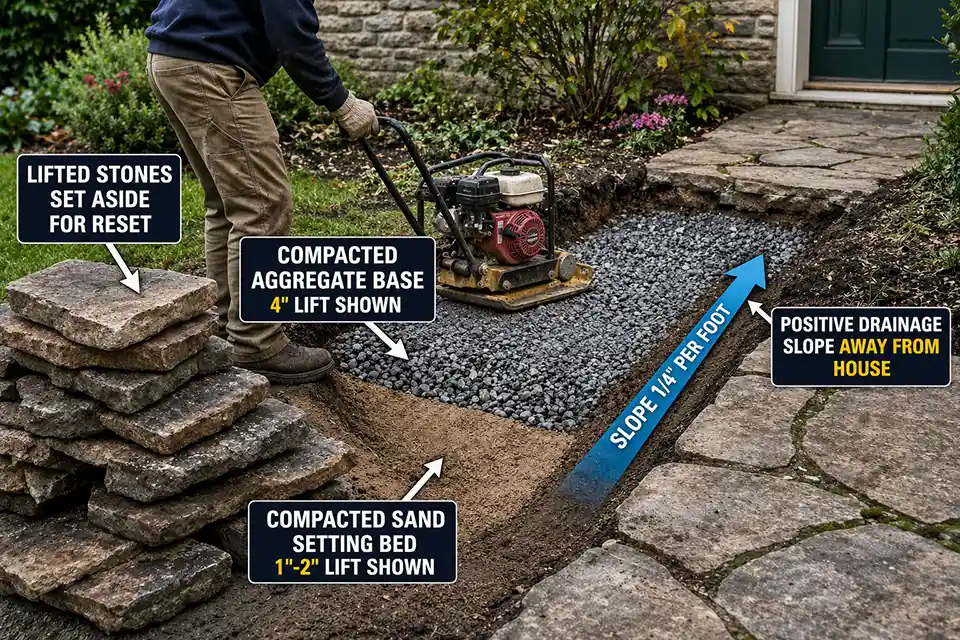
Walkway stones rarely break over a weak base for just one reason. The crack is usually the last visible step in a chain that started with shallow support, poor compaction, water entry, or settlement below the walkway.
The best repair is the one that matches the real scope of failure. If the base is weak, surface-only work is not a fix. It is delay disguised as maintenance.
For broader technical guidance on hardscape base preparation, see Penn State Extension.