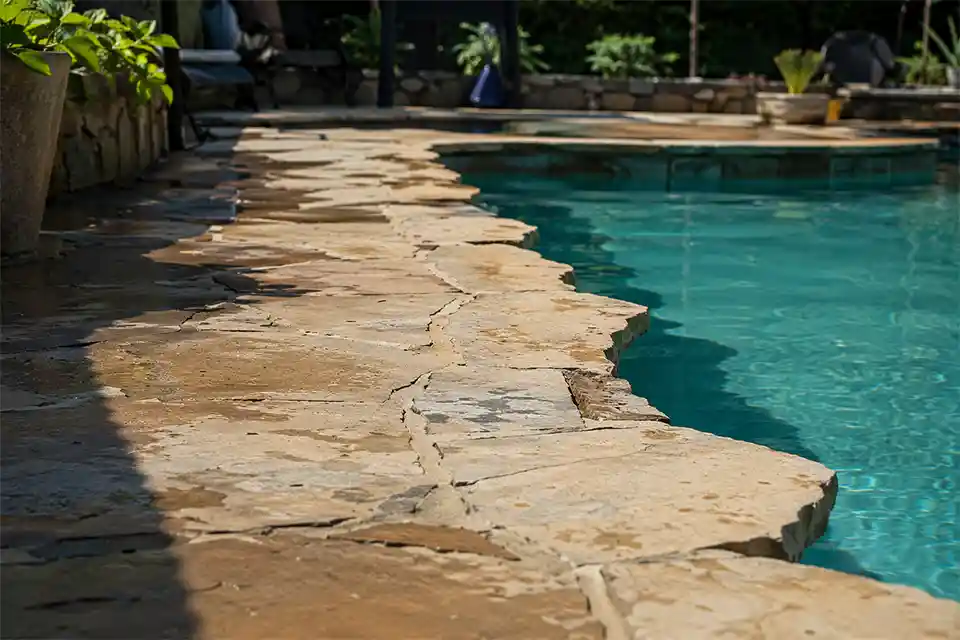
When stone pool deck edges keep chipping, the usual problem is not that the whole deck suddenly has “bad stone.” More often, the edge has lost support and heavy poolside use is exposing it.
Start with the checks that actually separate cosmetic wear from a repair decision: are chips clustering within 3 to 6 feet of the pool entry or lounger path, are nearby joints recessed more than about 1/8 inch, does the damaged line sound hollow near the edge, and does water still sit there 20 to 30 minutes after rinsing or rain?
Those clues matter because this is usually a deck-field edge failure, not a perimeter coping-nose problem and not a random dropped-object chip. If the same run keeps degrading over one season, or repaired edges start failing again within 6 to 12 months, the visible break is no longer the real issue.
The edge is telling you that joint support, bedding support, moisture, or movement is already deciding the outcome.
Quick Diagnostic Checklist
- Chips cluster in the main walking route between pool, loungers, and house
- Joint material beside damaged edges is missing, loose, or recessed more than about 1/8 inch
- Tapping reveals a hollow-sounding band near the edge but not at the tile center
- Water lingers for 20 to 30 minutes or more after a rinse or rainfall
- Damage repeats along a line of tiles instead of staying isolated to one corner
- Nearby pieces show lippage or movement around 1/8 inch or more
- Repaired edges have failed again within 6 to 12 months
First, make sure you are looking at the right problem
Pool decks create a lot of category confusion. People often mix up three different failures: chipping on the walking-surface stone, breakage at the pool coping nose, and isolated chips caused by a dropped object. They may look similar at a glance, but they do not point to the same fix.
Deck-field edge chipping is different from coping damage
This article is about the stone pieces people walk on across the deck field, not the outside nose right at the pool perimeter. If the broken line is concentrated along the pool shell edge, especially near a failed separation or mastic joint, coping or movement-joint issues move higher on the list.
If the damage sits in the main travel path, especially where people pivot or step out with force, repeated traffic acting on a weakened edge is the more likely pattern.
An isolated chip usually stays isolated
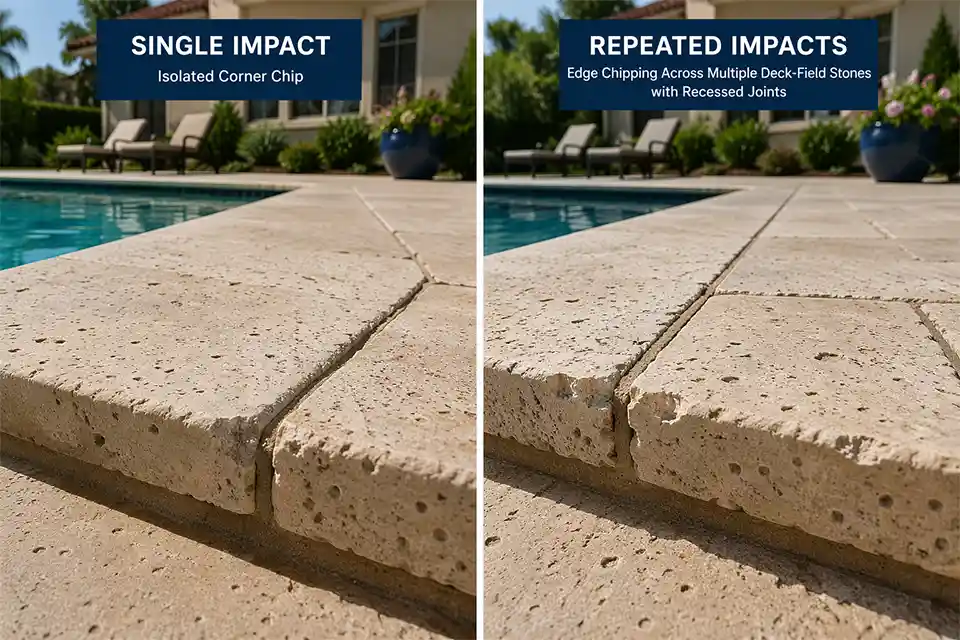
A dropped umbrella base, metal furniture leg, or hard object can chip a corner. But that kind of damage usually stays local. It does not quietly spread tile by tile. Once you start seeing repeated edge loss along the same run, the more useful question is not what struck the stone once. It is why that edge has become easy to break in the first place.
That is why cracked outdoor stone and tile isn’t just cosmetic fits this topic so well. The visible chip is the symptom. The support condition under and beside the edge is what decides whether the problem stays local.
Why this damage usually starts at the edge
Heavy use matters, but it rarely explains the full failure by itself. Healthy stone handles a lot of barefoot traffic. What it handles poorly is concentrated force on an edge that is no longer fully supported.
Missing joint support is often the real first failure
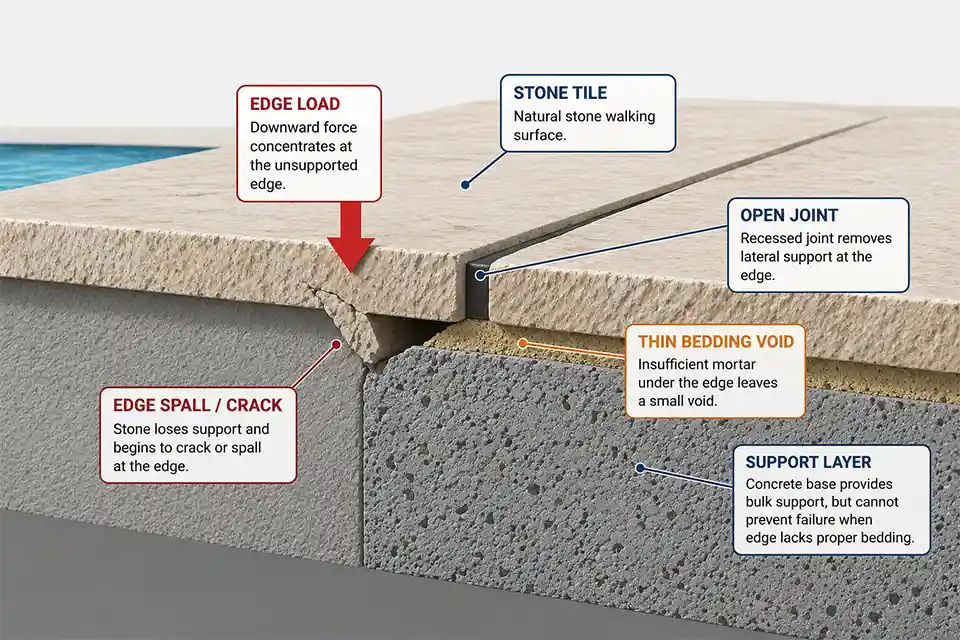
One of the most underestimated parts of this problem is the joint beside the stone. Once the joint recedes, empties out, or loses integrity, the edge starts behaving like a narrow exposed lip. That changes the load path. Instead of force dispersing cleanly across a supported assembly, more force gets concentrated right where the stone is thinnest and most vulnerable.
This is where many owners overestimate stone hardness and underestimate joint function. The edge can look mostly intact while the system beside it has already weakened enough to accelerate failure.
Small voids under the edge change the decision fast
A deck can still look flat and stable while the perimeter of the tile is no longer sitting on dependable support. If the edge sounds hollow across a 6 to 12 inch band, or one side of the tile breaks faster than the other, a small bedding void is often involved. That is the point where cosmetic patching becomes less rational, because the repaired face is still being asked to bridge the same weakness.
Poolside traffic exposes the weakness faster
Pool use adds repetition. People step out wet, pivot, stop, and cross the same routes again and again. Those loads are not extreme, but they are concentrated and predictable. Once a joint has opened or the edge has lost support, repeated traffic starts revealing the problem much faster than a lower-use patio would.
That logic lines up with best solutions for breaking and chipping outdoor surfaces: simple to structural. The visible damage invites a surface repair, but the smarter repair choice depends on whether the assembly still deserves one.
What is normal wear and what is not
This is where readers often get pulled in the wrong direction. Some assume any edge loss means failed installation. Others assume all stone near a pool is supposed to chip a little. Neither view is disciplined enough to be useful.
Slight softening can be normal on some natural stone
On softer or tumbled stone, very minor arris softening can happen over time in busy pool areas. If the change is shallow, visually even, and not spreading across neighboring pieces, it may be ordinary wear rather than active failure.
Repeated breakage is not normal wear
Once visible pieces start breaking away around 1/8 to 1/4 inch, especially across several adjoining stones, you are past the point of harmless character change. If bare feet can catch the edge, cleaning tools are snagging, or corners keep fracturing in the same route, the deck is no longer just aging. It is losing performance.
That distinction matters because “natural stone variation” is often used as cover for a problem that is already moving from cosmetic to structural relevance.
Pool-specific conditions that raise the stakes
A pool deck is not just a patio with water nearby. It has a few conditions that make edge chipping advance faster and make misdiagnosis more expensive.
Check the pool-side separation joint first
If the damage is strongest along the line nearest the pool structure, inspect the movement or mastic joint closely. If that separation line has hardened, split, detached, or opened, the edge may be taking both moisture and slight movement at the same time. That is a more pool-specific pattern than ordinary field wear, and it should move higher in the decision tree early.
Water is usually an accelerator, not the lone cause
Standing water, splash-out, slow drying, and repeated wetting do not always create the failure by themselves. But once the joint is compromised or the edge is partially unsupported, water sharply lowers the margin for error. Routes that stay damp longer often deteriorate first.
This is where drainage patterns that damage patios and walkways becomes directly relevant. Around pools, the problem is not just visible puddles. It is repeated moisture sitting on the same weak line often enough to keep helping the damage.
Narrow hard contact points do more damage than people expect
A barefoot person is usually not the worst load. Narrow chair legs, wheeled loungers, carts, and rigid furniture feet often do more harm because they concentrate force into a tiny point. On a stable edge, that may not matter. On a compromised one, it matters fast.
Pro Tip: Wider rubber or felt glides under movable pool furniture often reduce repeat edge damage more effectively than people expect, because the fix changes the load concentration instead of only treating the surface.
What usually wastes time
The common time-waster here is repeating a visible repair after the edge has already stopped behaving like a sound edge.
Sealer is not an edge-support fix
A penetrating sealer may help reduce absorption and make maintenance easier. It does not replace missing joint material, restore bedding support, or stop a weakened edge from taking concentrated impact. It is useful in the right role, but it is often asked to do a structural job it cannot do.
Patching the face without stabilizing the line
If the joint is still recessed, the edge still sounds hollow, or the damaged run keeps taking water, face repair is usually temporary. It may buy appearance. It usually does not buy much time. When a repair fails again in 3 to 6 months under ordinary use, that is usually enough evidence that the edge condition itself never changed.
Over-replacing can also be a mistake
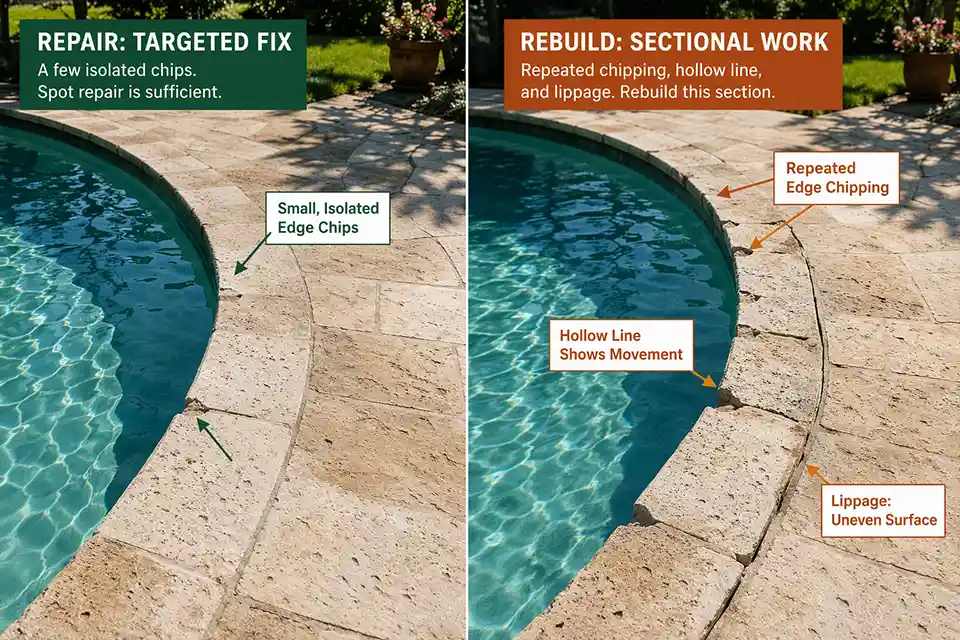
Not every chipped pool deck needs tear-out. Full replacement is often used too soon on isolated damage and too late on repeating damage. The better question is not “repair or replace everything?” It is whether the failure is still local or has already become a section problem.
What to do based on what you find
| What you see | What it usually means | What makes sense next |
|---|---|---|
| One or two isolated chips under about 1/8 inch | Local impact or early wear | Spot repair and monitor |
| Repeated edge chips with recessed joints but no rocking | Loss of edge support at the joint line | Re-joint and reset affected stones where needed |
| Hollow band 6 to 12 inches wide near the edge | Partial bedding void under the perimeter | Lift and reset that run |
| Chips plus lippage or slight rocking across several stones | Broader movement or weakening support below | Sectional rebuild |
| Damage strongest near failed pool-side separation joint | Moisture plus slight movement near the pool structure | Repair the joint and affected section together |
When local repair still makes sense and when it does not
The key decision is whether the problem is still behaving like a local wear issue or already acting like a system issue.
Local repair is still reasonable when
- the damage affects only a small number of stones
- surrounding pieces stay level within about 1/8 inch
- joints outside the damaged run still look sound
- no rocking is felt underfoot
- the area has not already failed again after prior repair
Section repair becomes the smarter move when
- chips are repeating tile after tile along one line
- more than about 10 to 15 percent of the immediate area is affected
- repaired edges fail again within 6 to 12 months
- hollow sound, open joints, and lippage appear together
- the damage is expanding sideways instead of staying isolated
That is the point where the problem starts reading less like simple surface wear and more like the kinds of support issues behind long-term ground instability in patios and walkways or why some outdoor areas sink faster. The edge chip is still the symptom, but the decision has already moved below the surface.
The fix path that usually changes the outcome
Start with the edge support clues, not the chipped face. Restore failed joints where that still makes sense. Lift and reset stones that sound hollow or show movement. Correct the water path if the damaged line stays wet too long. Address the pool-side separation joint if that line is failing. Then decide whether the damage is still local enough for targeted repair or broad enough to justify sectional rebuilding.
What people usually overestimate is sealing or patching as a standalone solution. What they usually underestimate is how quickly a poolside traffic pattern exposes a weak edge once support has started slipping. The deck does not need extreme abuse to fail this way. It just needs repeated use on an edge that has already lost too much help from the system around it.
Pro Tip: If you can map the damage with a simple chalk line and the chips mostly follow that same route tile after tile, treat it as a support pattern first, not a random wear problem.
For broader official guidance on pool environments and safety, see the CDC’s pool safety information.